Many English learners feel confused about become and became because both words come from the same verb and have almost the same meaning. However, they are not interchangeable. The difference lies in verb tense, which changes when and how you use each word. Choosing the wrong form can make a sentence sound grammatically incorrect, even if your meaning is clear.
Fortunately, the distinction is simple once you understand the basics. In this guide, you’ll learn what become and became mean, when to use each one, common mistakes to avoid, and easy memory tricks to help you use them confidently in everyday English.
Table of Contents
- Introduction
- Why “Become” and “Became” Are Confusing
- Become vs Became Explained Simply
- Understanding Homophones in English
- What Does “Become” Mean?
- What Does “Became” Mean?
- Become vs Became: Key Differences at a Glance
- How to Remember the Difference Between Become and Became
- Common Mistakes and Confusions
- Examples Section: Correct and Incorrect Usage
- Self Assessment: Test Your Knowledge
- Self Assessment Answers
- FAQs About “Become” and “Became”
- Final Conclusion: Using “Become” and “Became” Correctly
Why “Become” and “Became” Are Confusing
English learners often mix up become and became because they are different forms of the same irregular verb.
Here are the main reasons for the confusion:
- Similar pronunciation: Both words sound alike, especially in fast speech.
- Similar spelling: They differ by only a few letters.
- Context confusion: Both describe a change of state, making it difficult to know which tense to use.
- Common learner mistakes: Many learners use become instead of became in past-tense sentences or vice versa.
Remember that the choice depends on when the action happened, not on the meaning itself.
Become vs Became Explained Simply
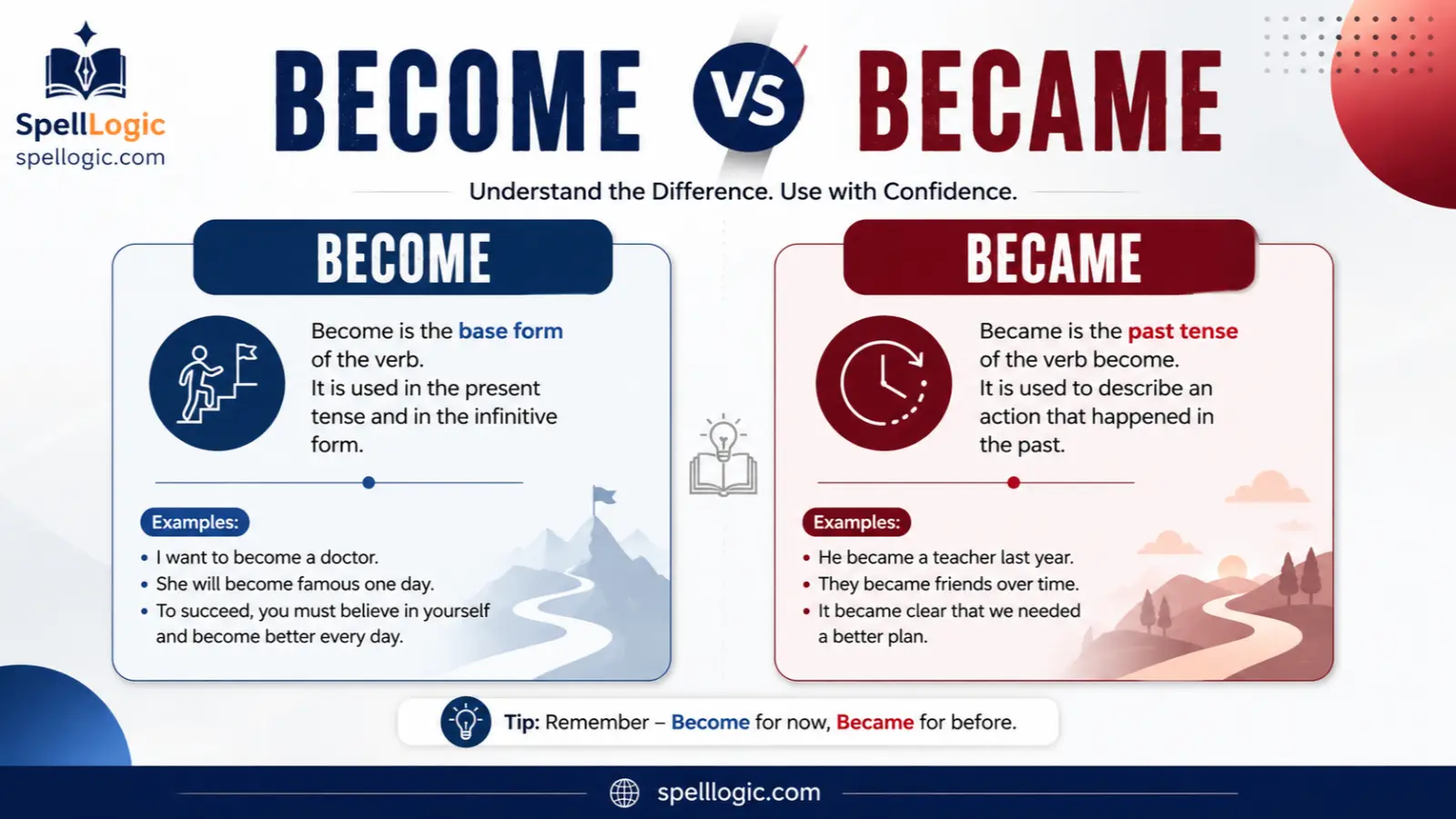
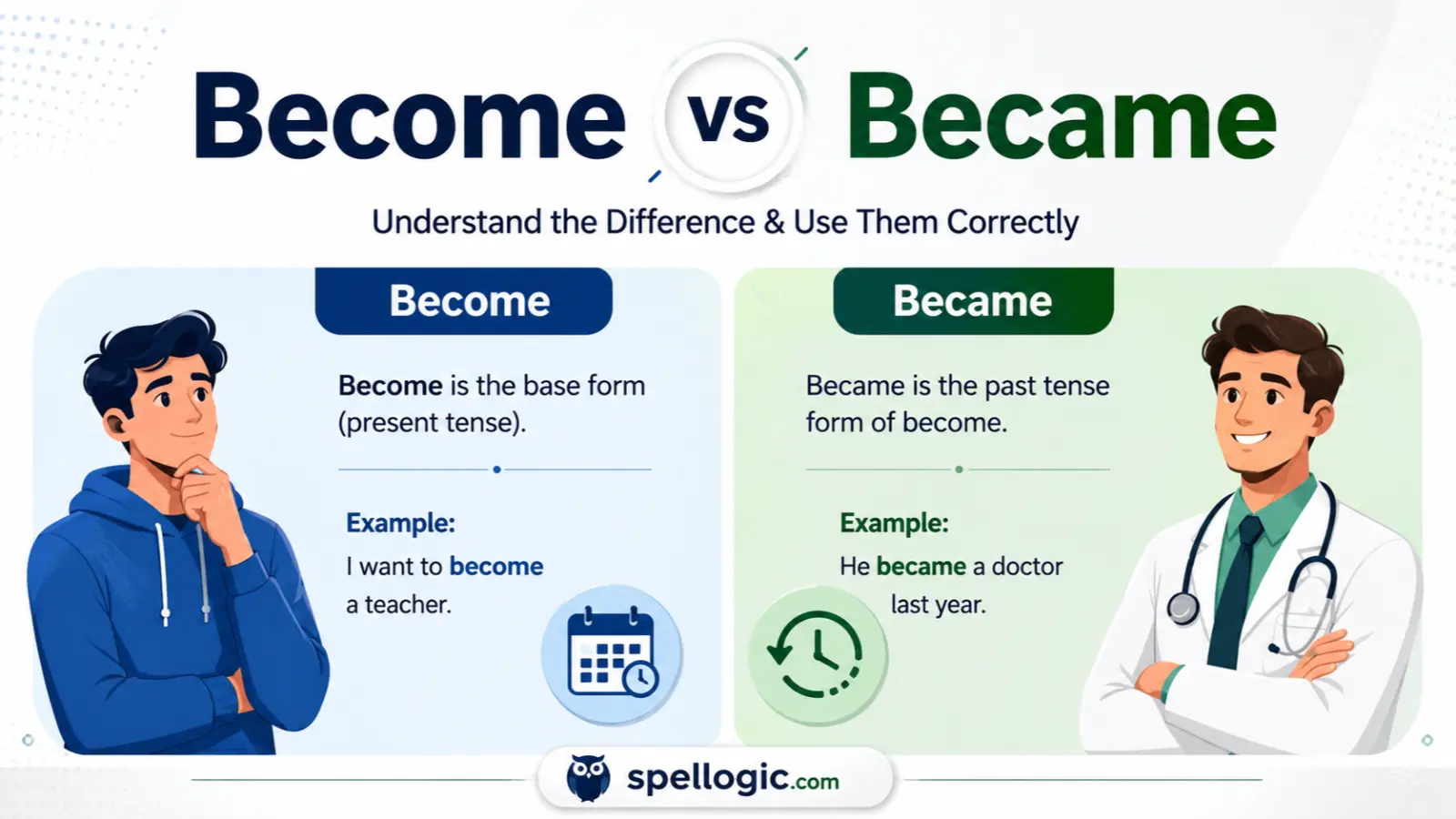
Become means to change into something or to start being something, while became is the simple past form of become and describes a change that already happened.
One-line distinction
Become is the base or past participle form, while became is the simple past tense.
Example sentences
- She wants to become a doctor.
- He has become more confident.
- She became a doctor ten years ago.
- The weather became colder after sunset.
Understanding Homophones in English
Although become and became are not homophones, learners often confuse similar-looking and similar-sounding words in English.
What Are Homophones?
Homophones are words that sound the same but have different meanings and spellings.
Example:
- Flower – a blooming plant
- Flour – powder used in baking
Why Homophones Cause Confusion
English contains many words that sound alike, so learners sometimes rely only on pronunciation instead of spelling or grammar.
For example:
- Their and there sound identical but have different meanings.
Likewise, become and became are confused because they are closely related verb forms rather than true homophones.
What Does “Become” Mean?
Definition and Core Meaning
Become means to begin to be, to grow into, or to change into a different state or condition.
It is the:
- Base form of the verb
- Present tense form (with certain subjects)
- Past participle used with helping verbs such as has, have, and had
Origin and Historical Use
The word become comes from Old English becuman, meaning “to happen,” “to come to,” or “to arrive at a state.” Over time, its meaning shifted to describe a change or transformation.
Modern Usage and Synonyms
Common synonyms include:
- Turn into
- Grow into
- Develop into
- Evolve into
- Come to be
Example sentences
- I hope to become an engineer.
- She has become much happier.
- They will become good friends.
- The city has become more crowded.
What Does “Became” Mean?
Definition and Core Meaning
Became is the simple past tense of become. It describes a change that happened and finished in the past.
Origin and Historical Context
Like become, became comes from the Old English verb becuman. It developed as the past-tense form of this irregular verb.
Modern Usage and Synonyms
Possible synonyms include:
- Turned into
- Grew into
- Changed into
- Developed into
Example sentences
- She became famous after the movie.
- The sky became dark before the storm.
- He became interested in photography.
- They became close friends at university.
Become vs Became: Key Differences at a Glance
| Word | Part of Speech | Meaning | Example Context |
|---|---|---|---|
| Become | Verb (base form/past participle) | To begin to be; to change into | She has become a teacher. |
| Became | Verb (simple past) | Changed into; was transformed in the past | She became a teacher in 2018. |
How to Remember the Difference Between Become and Became
Here are some easy memory tricks.
Easy memory tricks
- Became = Past. Notice that it ends with -came, reminding you something already happened.
- Become is used after helping verbs like has, have, had, will, can, and to.
Association techniques
Think of these sentence patterns:
- I want to become…
- She has become…
- He became… yesterday.
Memorable example
- Yesterday, Sam became a team leader.
- Today, he has become more confident.
The first sentence refers to a completed past event, while the second describes the present result.
Common Mistakes and Confusions
Many learners confuse these forms because they forget the verb tense.
Wrong
❌ She has became a great singer.
Correct
✅ She has become a great singer.
Explanation: After has, use the past participle become
Wrong
❌ He become a lawyer last year.
Correct
✅ He became a lawyer last year.
Explanation: A completed past action requires became.
Wrong
❌ They had became friends.
Correct
✅ They had become friends.
Explanation: Use become after had.
Wrong
❌ I want became a pilot.
Correct
✅ I want to become a pilot.
Explanation: After to, use the base form.
Examples Section: Correct and Incorrect Usage
Example 1
✔ Correct: She became a teacher after graduating.
✘ Incorrect: She become a teacher after graduating.
Example 2
✔ Correct: He has become very successful.
✘ Incorrect: He has became very successful.
Example 3
✔ Correct: They will become good parents.
✘ Incorrect: They will became good parents.
Example 4
✔ Correct: The weather became warmer in spring.
✘ Incorrect: The weather become warmer in spring.
Example 5
✔ Correct: I hope to become fluent in English.
✘ Incorrect: I hope to became fluent in English.
Self Assessment: Test Your Knowledge
Fill in the blanks with become or became.
- She has ______ an excellent writer.
- The sky ______ cloudy before it rained.
- I want to ______ a scientist.
- They ______ friends during college.
Self Assessment Answers
- become
- became
- become
- became
FAQs
No. The correct phrase is has become because become is the past participle.
Is “became” the past tense of “become”?
Yes. Became is the simple past tense of the irregular verb become.
Can I use “become” without a helping verb?
Yes. You can use it as the base form, such as after to, will, can, or in the present tense.
Why is “become” an irregular verb?
It is irregular because its past tense and past participle do not follow the regular -ed pattern.
Which is more common: become or became?
Both are common. The correct choice depends on the sentence structure and verb tense.
How can I avoid confusing them?
Focus on the time of the action. If it happened in the past, use became. If it follows has, have, had, or another helping verb, use become.
Final Conclusion: Using “Become” and “Became” Correctly
Understanding the difference between become and became is easier than it first appears. Although both words describe a change or transformation, they belong to different verb forms and serve different grammatical purposes. Become is the base form and the past participle, so it is used after helping verbs like has, have, had, will, and after to. On the other hand, became is the simple past tense and refers to a change that happened and finished in the past. Keeping this distinction in mind will help you write and speak more naturally.
A helpful way to remember the difference is to think about time. If the action happened yesterday or at another completed time in the past, became is usually the correct choice. If the sentence includes a helping verb or expresses a future or desired change, use become instead. Reading English books, paying attention to verb forms, and practicing with your own examples will make these patterns feel natural over time.
The more you practice, the easier it becomes to recognize the correct form without hesitation. Every new sentence you read or write strengthens your understanding of English grammar. Keep learning, review irregular verbs regularly, and don’t be afraid to make mistakes—they are an important part of becoming a confident English speaker.