Many English learners come across the words uptown and downtown when reading books, watching movies, or traveling. Because both words describe parts of a city, they are often confused. Some people even think they can always replace one with the other.
If, each word has a different meaning depending on the city’s layout and local culture. Understanding the difference between uptown and downtown will help you speak more naturally, follow directions correctly, and avoid misunderstandings. In this guide, you’ll learn their meanings, origins, examples, and simple memory tricks in clear, easy-to-understand English.
Table of Contents
- Introduction
- Why “Uptown” and “Downtown” Are Confusing
- Uptown vs Downtown Explained Simply
- Understanding Homophones in English
- What Are Homophones?
- Why Homophones Cause Confusion
- What Does “Uptown” Mean?
- What Does “Downtown” Mean?
- Uptown vs Downtown: Key Differences at a Glance
- How to Remember the Difference Between Uptown and Downtown
- Common Mistakes and Confusions
- Examples Section: Correct and Incorrect Usage
- Self Assessment: Test Your Knowledge
- Self Assessment Answers
- FAQs About “Uptown and Downtown”
- Final Conclusion: Using “Uptown” and “Downtown” Correctly
Why “Uptown” and “Downtown” Are Confusing
Many learners mix up uptown and downtown because both refer to areas within a city rather than separate cities.
Here are the main reasons for the confusion:
Similar Pronunciation
Both words have the same ending, -town, making them sound similar in everyday conversation.
Similar Spelling
The only difference is the prefixes up- and down-, which can easily be overlooked, especially by beginners.
Context Confusion
The meanings depend on the city. In one city, downtown may refer to the business center, while uptown often refers to residential or northern areas. In some cities, the exact meaning changes based on local geography.
Common Learner Mistakes
- Assuming uptown simply means “higher” than downtown.
- Thinking downtown always means “south.”
- Using the words interchangeably.
- Forgetting that local usage matters.
Uptown vs Downtown Explained Simply
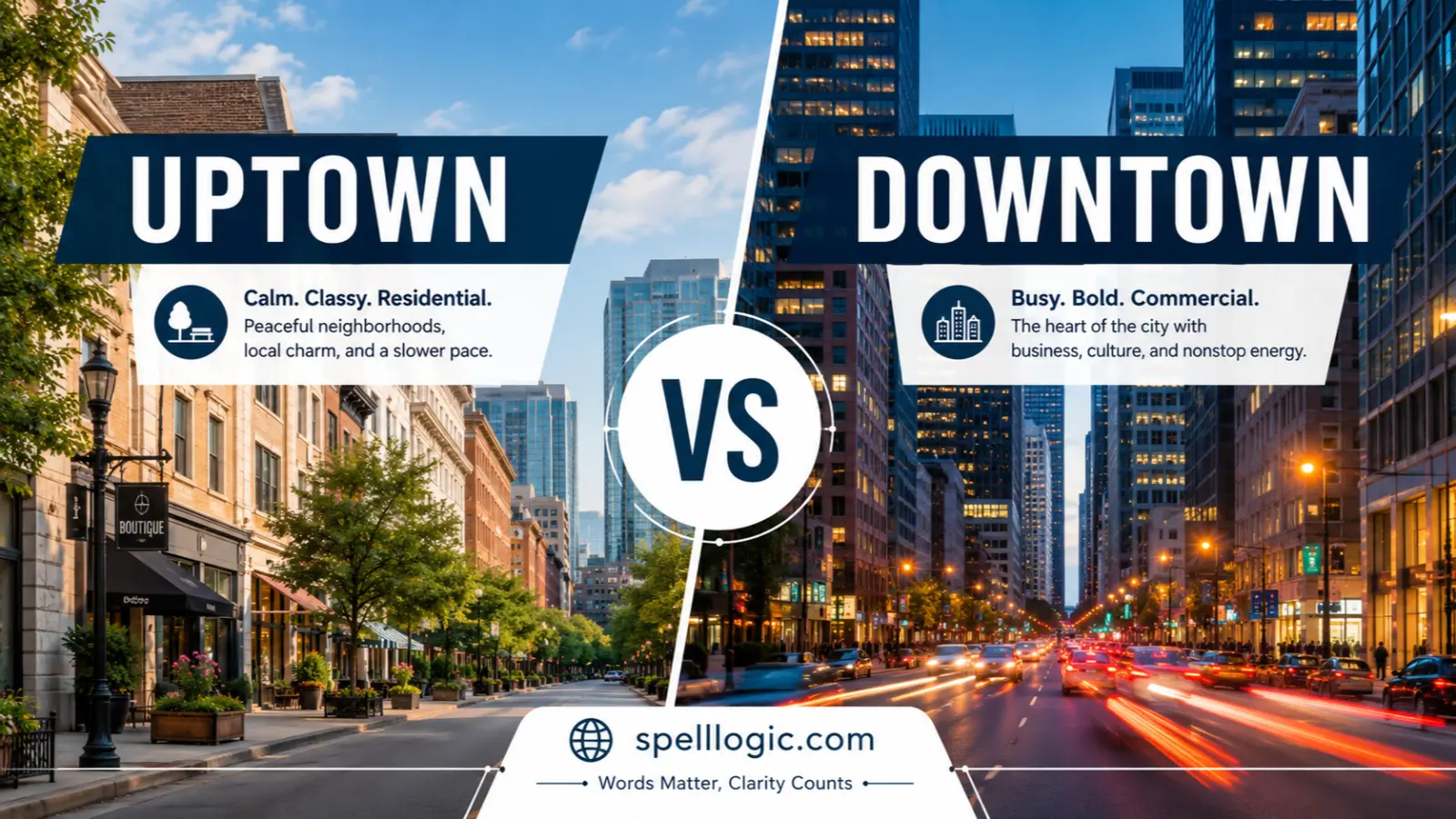
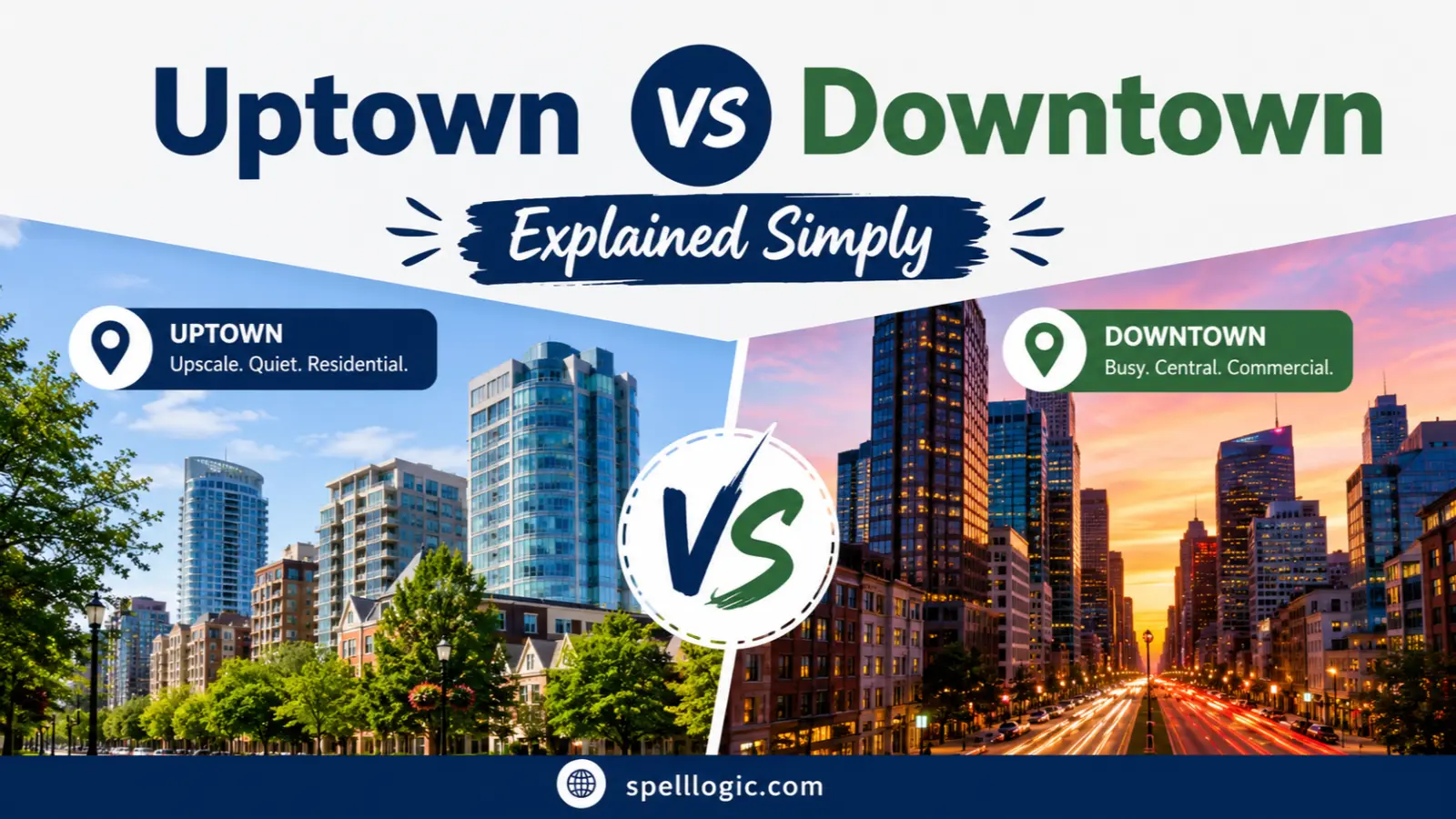
Uptown means an area away from the city’s central business district, while downtown usually means the main commercial or business center of a city.
One-Line Distinction
Uptown refers to a residential or outer part of a city, while downtown refers to the city’s central area where businesses, offices, and attractions are located.
Example Sentences
Uptown
- We moved to an apartment uptown because it is quieter.
- The restaurant is located in the uptown neighborhood.
Downtown
- I work downtown every weekday.
- Tourists usually visit downtown to see the city’s landmarks.
Understanding Homophones in English
What Are Homophones?
Homophones are words that sound the same but have different meanings and sometimes different spellings.
Example:
- Sea and see
Although uptown and downtown are not homophones, learners often confuse them because they look and sound similar.
Why Homophones Cause Confusion
Words that sound alike can make English difficult for learners.
For example:
- Their house is large.
- They are standing there.
Similarly, uptown and downtown are easy to mix up because they describe locations within the same city.
What Does “Uptown” Mean?
Definition and Core Meaning
Uptown refers to an area that is away from the central business district. In many cities, it is known for residential neighborhoods, shopping streets, parks, or quieter surroundings.
The exact location depends on the city.
Origin and Historical Use
The word uptown became common in American English during the 19th century. In cities such as New York, people traveled “up” the island to reach northern neighborhoods, leading to the term uptown.
Modern Usage and Synonyms
Modern uses include:
- Residential district
- Northern part of the city (in some places)
- Neighborhood away from downtown
- Shopping district
Synonyms
- Residential area
- Outer city
- Neighborhood
- Suburban district (in some contexts)
Example Sentences
- We spent the afternoon shopping uptown.
- She lives in an uptown apartment.
- The uptown streets are quieter than downtown.
- Many families prefer the uptown neighborhood.
What Does “Downtown” Mean?
Definition and Core Meaning
Downtown refers to the main commercial, financial, or business center of a city. It often contains offices, government buildings, hotels, restaurants, and entertainment venues.
Origin and Historical Context
The word downtown first appeared in American English in the 1800s. It described the area where businesses were concentrated, often located in the lower part of a city or near the original settlement.
Modern Usage and Synonyms
Today, downtown usually refers to:
- Business district
- City center
- Commercial hub
- Financial district
Synonyms
- City center
- Central business district
- Commercial center
- Urban core
Example Sentences
- We took the subway downtown.
- Most government offices are downtown.
- Downtown becomes very busy during rush hour.
- The conference was held in a downtown hotel.
Uptown vs Downtown: Key Differences at a Glance
| Word | Part of Speech | Meaning | Example Context |
|---|---|---|---|
| Uptown | Noun, Adjective, Adverb | Area away from the city’s main business center, often residential | We rented an apartment uptown. |
| Downtown | Noun, Adjective, Adverb | Main business or commercial center of a city | She works downtown every day. |
How to Remember the Difference Between Uptown and Downtown
Here are a few easy memory tricks.
Memory Trick 1
Think of downtown as the place where business goes down every day because people work there.
Memory Trick 2
Imagine uptown as the place where many people go home after work.
Association Technique
- Downtown = Offices, shops, tall buildings
- Uptown = Homes, quieter streets, neighborhoods
Memorable Example
“I work downtown, but I live uptown.”
This simple sentence helps remember the difference.
Common Mistakes and Confusions
Mistake 1
❌ We went uptown to visit the city’s financial district.
✔ We went downtown to visit the city’s financial district.
Explanation: Financial districts are usually downtown.
Mistake 2
❌ Most office buildings are uptown.
✔ Most office buildings are downtown.
Explanation: Business offices are commonly found downtown.
Mistake 3
❌ They bought a quiet house downtown.
✔ They bought a quiet house uptown.
Explanation: Residential neighborhoods are often uptown.
Mistake 4
❌ Tourists usually avoid downtown attractions.
✔ Tourists usually visit downtown attractions.
Explanation: Many famous landmarks are located downtown.
Examples Section: Correct and Incorrect Usage
Example 1
✔ Correct: We stayed at a hotel downtown.
✘ Incorrect: We stayed at a hotel uptown because it was in the city’s business center.
Example 2
✔ Correct: My grandparents live uptown.
✘ Incorrect: My grandparents live downtown in a quiet residential neighborhood.
Example 3
✔ Correct: She takes the train downtown for work.
✘ Incorrect: She takes the train uptown to her office in the financial district.
Example 4
✔ Correct: The uptown streets are less crowded.
✘ Incorrect: The downtown streets are always peaceful and empty during business hours.
Self Assessment: Test Your Knowledge
Fill in the blanks.
1.
Most office buildings are located __________.
2.
We bought a family home __________ because it is quieter.
3.
Tourists often visit __________ to see museums and tall buildings.
4.
The children grew up in an __________ neighborhood.
Self Assessment Answers
- downtown
- uptown
- downtown
- uptown
FAQs
1. What is the main difference between uptown and downtown?
Downtown usually refers to the city’s business center, while uptown generally refers to residential or less commercial areas.
2. Can uptown and downtown change meaning from city to city?
Yes. Their exact locations depend on the city’s layout and local traditions.
3. Is downtown always in the middle of a city?
Not always. It refers to the main commercial area, which may not be geographically central.
4. Is uptown always north of downtown?
No. In some cities, it is north, but in others, it simply means an area away from downtown.
5. Can both words be nouns and adverbs?
Yes.
Examples:
- Noun: Downtown is busy today.
- Adverb: Let’s drive downtown.
6. Are uptown and downtown opposites?
Generally, yes. They usually describe different parts of the same city with different purposes.
7. Which word is more common in American English?
Both are common, especially when talking about cities such as New York, Chicago, and many other urban areas.
Final Conclusion: Using “Uptown” and “Downtown” Correctly
Understanding the difference between uptown and downtown makes it much easier to describe locations accurately and communicate naturally in English. Although these words often appear together and both refer to parts of a city, they are not interchangeable. Downtown generally refers to the city’s main commercial, financial, or entertainment district, where you’ll often find office buildings, government services, shopping centers, restaurants, and popular tourist attractions. Uptown, on the other hand, usually describes residential neighborhoods or areas located away from the busy city center. Depending on the city, it may also refer to the northern section, but local usage always matters.
A simple way to remember the difference is this: work downtown, live uptown. This phrase captures the common pattern found in many cities and helps reinforce the meanings. Whenever you’re reading travel guides, giving directions, or talking about city life, think about whether you’re referring to the bustling business center or a quieter neighborhood. Paying attention to context will help you choose the correct word every time.
The more you practice using uptown and downtown in real conversations and writing, the more natural they will become. Keep learning, notice how native speakers use these words, and don’t be afraid to practice. Every new word you master brings you one step closer to confident and fluent English.