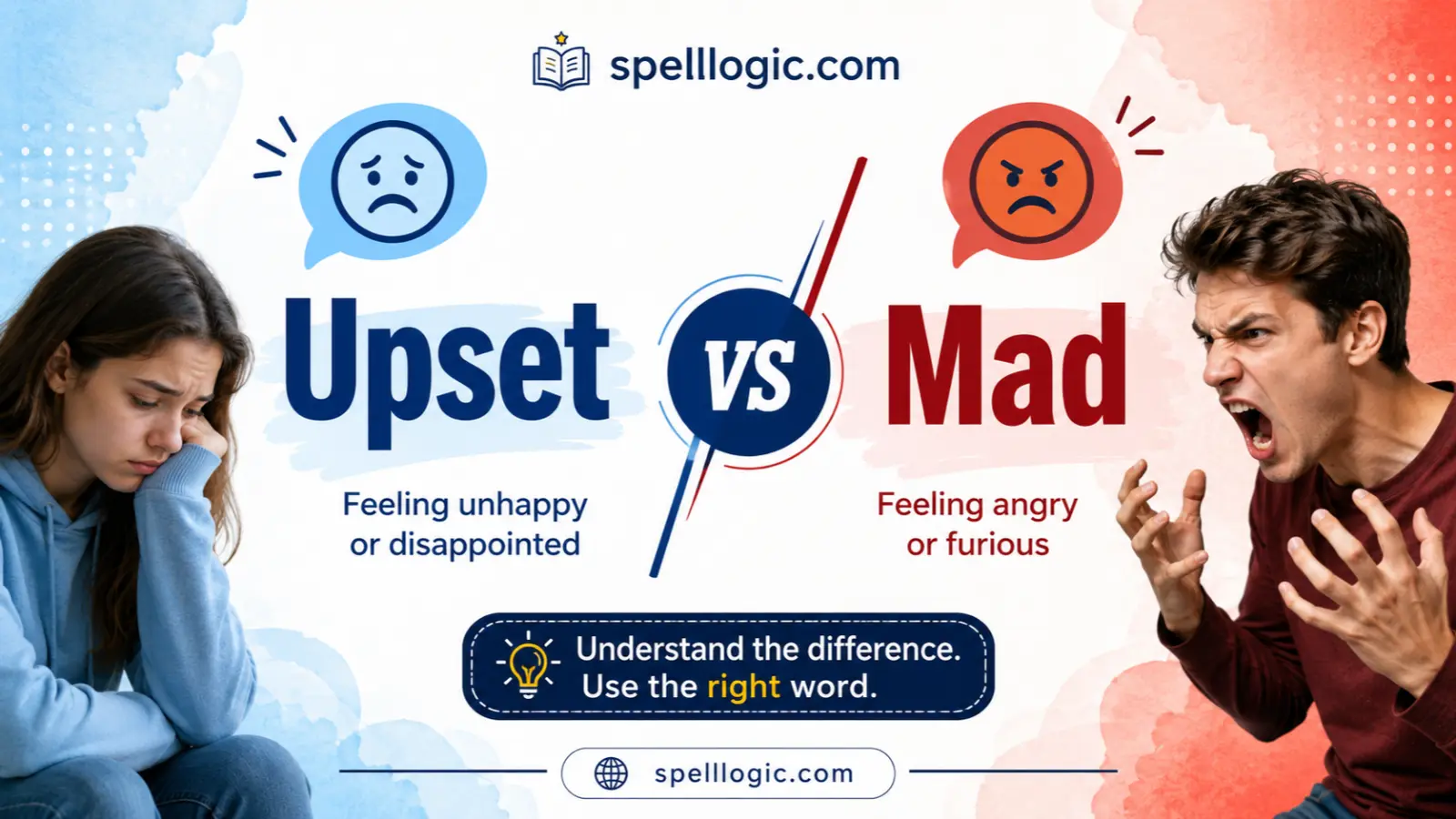
Many English learners wonder whether they should say upset or mad when talking about their feelings. These two words often appear in similar situations, so it is easy to think they mean exactly the same thing.
If, they are not always interchangeable. Upset usually describes feeling unhappy, disappointed, or emotionally disturbed, while mad often means angry, although it can have other meanings depending on the region. Understanding the difference helps you express your emotions more naturally and avoid misunderstandings in conversations, writing, and everyday English.
Table of Contents
- Introduction
- Why “Upset” and “Mad” Are Confusing
- Upset vs Mad Explained Simply
- Understanding Homophones in English
- What Are Homophones?
- Why Homophones Cause Confusion
- What Does “Upset” Mean?
- What Does “Mad” Mean?
- Upset vs Mad: Key Differences at a Glance
- How to Remember the Difference Between Upset and Mad
- Common Mistakes and Confusions
- Examples Section: Correct and Incorrect Usage
- Self Assessment: Test Your Knowledge
- Self Assessment Answers
- FAQs About “Upset” and “Mad”
- Final Conclusion: Using “Upset” and “Mad” Correctly
Why “Upset” and “Mad” Are Confusing
Many learners confuse upset and mad because they both describe negative emotions. However, they are not identical in meaning or usage.
Similar Pronunciation
Although upset and mad do not sound alike, they are commonly heard in conversations about emotions. This causes learners to assume they are synonyms in every situation.
Similar Spelling
These words are not spelled similarly, so spelling is not the main source of confusion.
Context Confusion
Both words can describe someone’s emotional state.
For example:
- She is upset about the exam.
- She is mad about the exam.
These sentences sound similar, but they express different emotions. The first suggests sadness or disappointment, while the second usually means she is angry.
Common Learner Mistakes
Learners often:
- Use mad when they actually mean sad.
- Think upset always means angry.
- Forget that mad has different meanings in British and American English.
Upset vs Mad Explained Simply
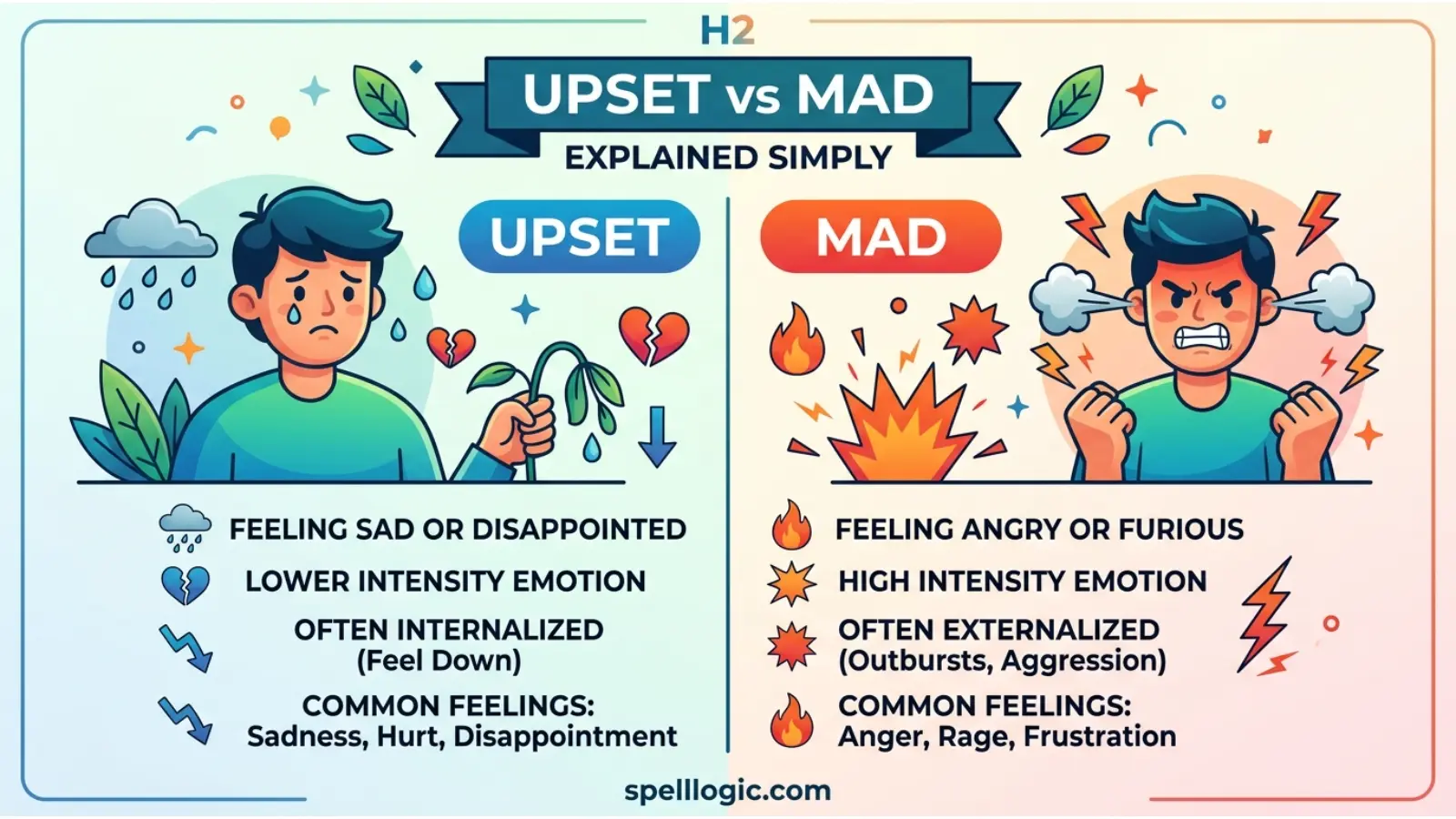
Upset means feeling unhappy, disappointed, worried, or emotionally hurt, while mad usually means feeling angry.
One-line distinction
Upset describes emotional distress, while mad mainly describes anger.
Example Sentences
Upset
- She was upset after losing her wallet.
- I’m upset because my best friend moved away.
Mad
- He was mad when someone scratched his car.
- My teacher got mad because we arrived late.
Understanding Homophones in English
Although upset and mad are not homophones, learners often confuse emotionally related words. Learning about homophones can improve your English vocabulary.
What Are Homophones?
Homophones are words that sound the same but have different meanings and spellings.
Example:
- Sea
- See
These words sound identical but have different meanings.
Why Homophones Cause Confusion
When learners hear words instead of reading them, they may misunderstand which word is being used.
Example:
“I’ll see you by the sea.”
Both words sound the same but mean different things.
What Does “Upset” Mean?
Definition and Core Meaning
Upset means feeling emotionally disturbed, unhappy, worried, disappointed, or sad because something unpleasant happened.
It can also be used as a verb meaning to disturb, overturn, or make someone unhappy.
Origin and Historical Use
The word upset appeared in English several centuries ago. Originally, it referred to something being overturned or knocked over. Over time, its meaning expanded to include emotional disturbance.
Modern Usage and Synonyms
Today, upset is commonly used in everyday conversations.
Synonyms
- Sad
- Disappointed
- Hurt
- Distressed
- Worried
- Troubled
- Emotional
Key Points
- Describes emotional pain.
- Can refer to sadness or disappointment.
- Can also be a verb.
- Common in both spoken and written English.
Example Sentences
- Sarah felt upset after failing the interview.
- Don’t be upset about small mistakes.
- The bad news upset everyone.
- I was upset when I heard the announcement.
What Does “Mad” Mean?
Definition and Core Meaning
In American English, mad usually means angry.
The word mad is an adjective that most commonly means angry in American English. It describes someone who feels strong irritation, frustration, or anger because of something unpleasant or unfair.
Origin and Historical Context
The word mad comes from Old English and originally referred to insanity or loss of reason. Later, especially in North America, it became widely used to mean angry.
Modern Usage and Synonyms
Today, mad commonly describes anger in American English.
Synonyms
- Angry
- Furious
- Annoyed
- Irritated
- Cross
- Enraged
Key Points
- Usually means angry in American English.
- Often describes strong emotions.
- Very common in informal speech.
Example Sentences
- She was mad because her flight was canceled.
- Dad got mad when I forgot my homework.
- Don’t get mad over such a small mistake.
- He was mad at his brother for breaking the phone.
Upset vs Mad: Key Differences at a Glance
| Word | Part of Speech | Meaning | Example Context |
|---|---|---|---|
| Upset | Adjective, Verb | Emotionally unhappy, worried, or disappointed | She was upset after hearing the news. |
| Mad | Adjective | Angry (American English); (traditional British English) | He was mad because someone lied to him. |
How to Remember the Difference Between Upset and Mad
Here are a few simple tricks to remember the difference.
Easy Memory Tricks
- Upset = Unhappy
- Mad = Angry
Notice that both Mad and Angry describe stronger feelings of irritation.
Association Techniques
Imagine someone crying after bad news.
They are probably upset, not mad.
Now imagine someone shouting after someone broke their laptop.
They are mad.
Memorable Example
If your heart hurts, you’re upset. If your temper rises, you’re mad.
Common Mistakes and Confusions
Mistake 1
❌ I am mad because my pet died.
✔ I am upset because my pet died.
Explanation: Losing a pet usually causes sadness rather than anger.
Mistake 2
❌ She was upset at him for breaking her phone.
✔ She was mad at him for breaking her phone.
Explanation: The situation involves anger.
Mistake 3
❌ My mother got upset when I cleaned my room.
✔ My mother got mad when I didn’t clean my room.
Explanation: Being angry fits the situation better.
Mistake 4
❌ He was mad after missing his family.
✔ He was upset after missing his family.
Explanation: Missing someone causes emotional sadness.
Examples Section: Correct and Incorrect Usage
Example 1
✔ Correct: I felt upset after reading the sad news.
✘ Incorrect: I felt mad after reading the sad news.
Example 2
✔ Correct: My coach was mad because we ignored the rules.
✘ Incorrect: My coach was upset because we ignored the rules. (Possible, but “mad” better expresses anger.)
Example 3
✔ Correct: She became upset when her friend forgot her birthday.
✘ Incorrect: She became mad when her friend moved away. (Unless she was angry rather than sad.)
Example 4
✔ Correct: Don’t get mad over a simple misunderstanding.
✘ Incorrect: Don’t get upset over a simple misunderstanding. (Possible, but “mad” fits better if the advice is about controlling anger.)
Self Assessment: Test Your Knowledge
Fill in the blanks with upset or mad.
1.
She was __________ because she lost her favorite necklace.
2.
Dad became __________ when he saw the broken window.
3.
I’m __________ that my vacation was canceled.
4.
Please don’t get __________ over such a small mistake.
Self Assessment Answers
- upset
- mad
- upset
- mad
FAQs
1. Are upset and mad synonyms?
Not exactly. Both describe negative emotions, but upset usually means emotionally hurt or disappointed, while mad usually means angry.
2. Can upset mean angry?
Yes. Sometimes upset includes mild anger, but it usually refers to emotional distress rather than strong anger.
3. Does mad always mean angry?
No. English, mad can also mean mentally unstable.
4. Which word is more polite?
Upset is generally softer and more polite than mad, especially in formal conversations.
5. Can I say “I’m upset with you”?
Yes. It means someone has disappointed or hurt you emotionally.
6. Can I say “I’m mad at you”?
Yes. It means you are angry with someone.
7. Which word should English learners use more carefully?
Learners should pay attention to mad, especially because its meaning changes between American and British English.
Final Conclusion: Using “Upset” and “Mad” Correctly
Understanding the difference between upset and mad will make your English sound more natural and precise. Although both words describe unpleasant emotions, they are used in different ways. Upset usually refers to feeling emotionally hurt, disappointed, worried, or sad because something negative has happened. It focuses on emotional distress and is often used when someone feels let down or affected by an event. Mad, on the other hand, most commonly means angry in American English. It describes irritation or strong frustration toward a person or situation. In traditional British English, however, mad can also mean upset, so the context and audience matter.
A simple way to remember the difference is this: if your feelings are hurt, you’re upset; if your temper rises, you’re mad. Keeping this memory trick in mind can help you choose the right word in conversations, emails, school assignments, and everyday writing. Reading English books, watching movies, and listening to native speakers will also help you notice how each word is naturally used in different situations.
As you continue learning English, don’t worry about making occasional mistakes. Every new word you master improves your confidence and communication skills. Practice using upset and mad in your own sentences, and soon choosing the correct word will become second nature.