Many English learners wonder whether they should write your self or yourself. At first glance, both look similar, and they sound almost the same when spoken. However, only one is considered correct in standard English in most situations. Understanding the difference helps you write more naturally and avoid common grammar mistakes.
If you’re writing an email, completing schoolwork, or chatting online, knowing when to use yourself and why your self is usually incorrect will improve your confidence. In this guide, you’ll learn the meanings, grammar rules, examples, memory tricks, and common mistakes in simple, easy-to-follow language.
Table of Contents
- Introduction
- Why “Your Self” and “Yourself” Are Confusing
- Your Self vs Yourself Explained Simply
- Understanding Homophones in English
- What Are Homophones?
- Why Homophones Cause Confusion
- What Does “Your Self” Mean?
- What Does “Yourself” Mean?
- Your Self vs Yourself: Key Differences at a Glance
- How to Remember the Difference Between Your Self and Yourself
- Common Mistakes and Confusions
- Examples Section: Correct and Incorrect Usage
- Self Assessment: Test Your Knowledge
- Self Assessment Answers
- FAQs About “Your Self and Yourself”
- Final Conclusion: Using “Your Self” and “Yourself” Correctly
Why “Your Self” and “Yourself” Are Confusing
Many learners mix up your self and yourself because the two expressions look and sound very similar. However, they are not used in the same way.
Here are the main reasons for the confusion:
- Similar pronunciation: In normal speech, both forms often sound nearly identical.
- Similar spelling: The only visible difference is the space between the words.
- Context confusion: Learners sometimes think separating the words is acceptable in every sentence.
- Common learner mistakes: Many people write your self when they actually need the reflexive pronoun yourself.
Fortunately, the rule is simple once you understand how English pronouns work.
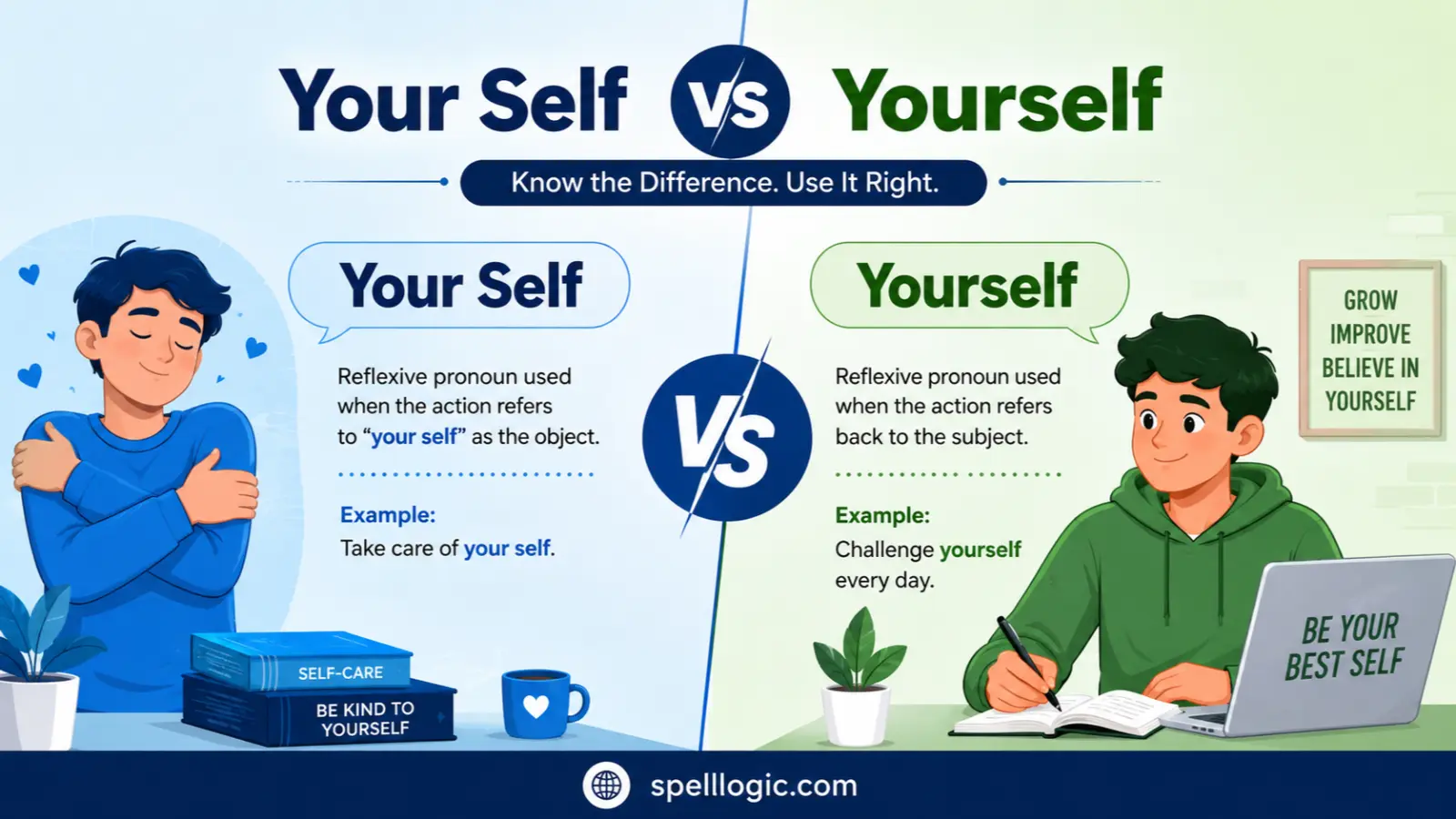
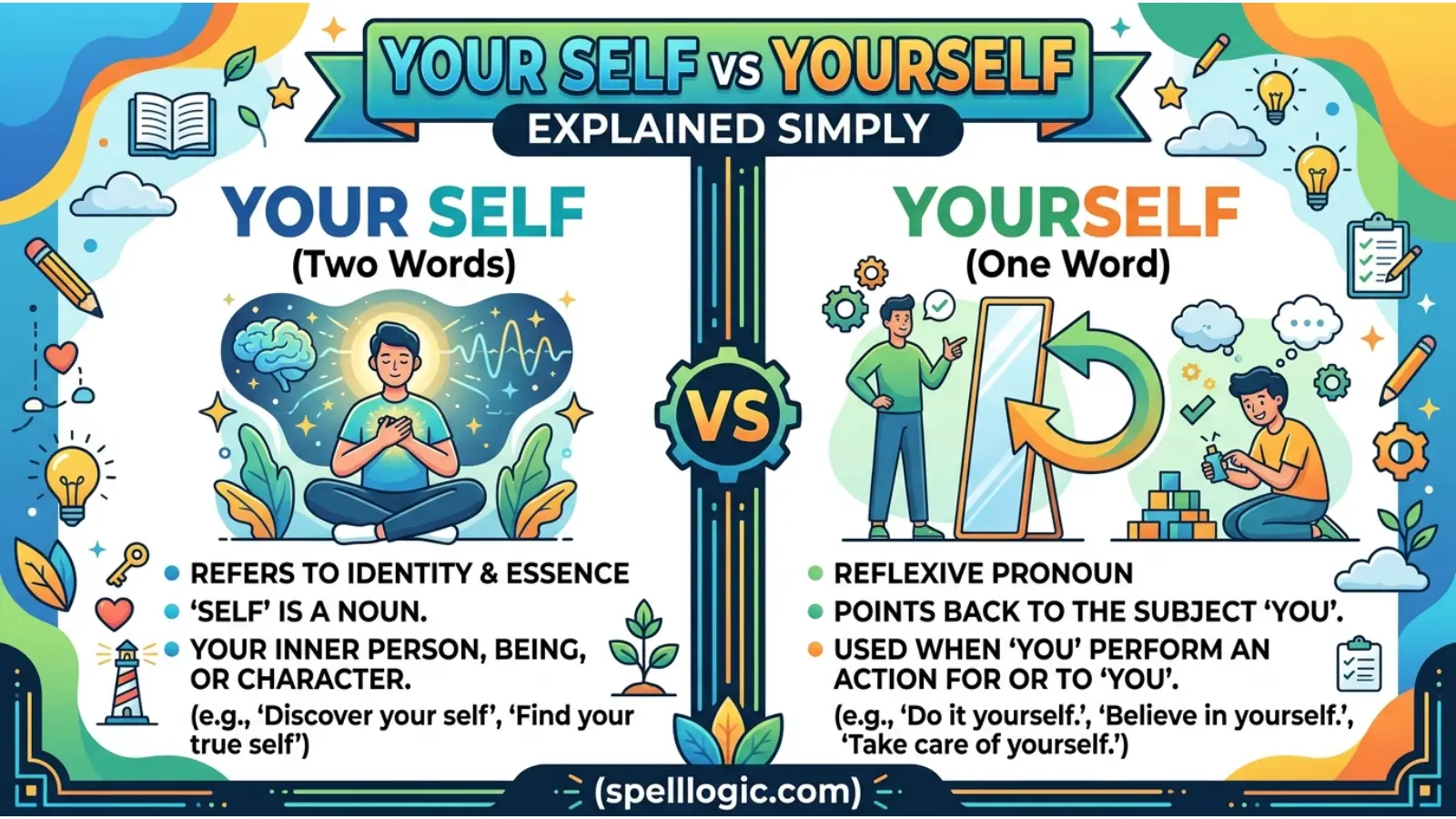
Your Self vs Yourself Explained Simply
Yourself is a reflexive pronoun that refers back to the person being spoken to.
Your self is generally not a standard form. It is only used in rare situations when self is treated as a separate noun, often in philosophical or psychological writing.
One-line distinction
Yourself is the correct reflexive pronoun, while your self refers to your own identity or inner self in very specific contexts.
Examples
- Please introduce yourself to the class.
- You should believe in yourself.
Rare usage:
- Meditation helps you understand your self more deeply.
- The book encourages readers to discover their true self, not just your self.
Understanding Homophones in English
What Are Homophones?
Homophones are words that sound the same but have different meanings or spellings.
Example:
- Sea
- See
Although they sound alike, they have completely different meanings.
Why Homophones Cause Confusion
Words that sound alike can easily confuse English learners, especially while listening or speaking.
For example:
- Their house is beautiful.
- They’re coming tomorrow.
Both sound almost identical but have different grammatical functions.
Similarly, your self and yourself sound nearly the same, making learners unsure which form is correct.
What Does “Your Self” Mean?
Definition and Core Meaning
Your self means your own identity, personality, or inner being, where self functions as a noun instead of part of a pronoun.
This usage is uncommon in everyday English.
Origin and Historical Use
The word self comes from Old English and has long been used as a noun meaning a person’s identity or true nature. Over time, English combined possessive adjectives with self to create reflexive pronouns like myself, yourself, and himself.
Today, writing your self as two separate words is mostly limited to discussions about psychology, philosophy, spirituality, or literature.
Modern Usage and Synonyms
Modern meanings include:
- Your identity
- Your inner nature
- Your true character
- Your personality
Example sentences
- Meditation helps you discover your self.
- The therapist encouraged him to reconnect with his true self, not simply his public image.
What Does “Yourself” Mean?
Definition and Core Meaning
Yourself is a reflexive pronoun used when the subject and object are the same person. It is also used for emphasis.
Origin and Historical Context
English reflexive pronouns developed by combining possessive forms with self. Over hundreds of years, these combinations became single words.
Examples include:
- myself
- yourself
- himself
- herself
- ourselves
- themselves
Today, yourself is always written as one word.
Modern Usage and Synonyms
Common uses include:
- Referring back to the subject
- Adding emphasis
- Giving instructions politely
Example sentences
- Please help yourself to some food.
- You should trust yourself.
- Did you make this cake yourself?
- Take care of yourself.
Your Self vs Yourself: Key Differences at a Glance
| Word | Part of Speech | Meaning | Example Context |
|---|---|---|---|
| Your self | Possessive adjective + noun | Your identity or inner being (rare) | You should understand your self better. |
| Yourself | Reflexive pronoun | Refers back to “you” or adds emphasis | You should believe in yourself. |
How to Remember the Difference Between Your Self and Yourself
Here are some simple memory tricks.
Think about grammar
If the word refers back to you, write yourself as one word.
Remember everyday English
Almost every sentence you write will require yourself, not your self.
Association technique
Imagine that yourself is one complete person. Since you are one person, the word stays together as one word.
Memorable example
✅ Look after yourself.
This sentence sounds natural because the reflexive pronoun refers back to you.
Common Mistakes and Confusions
Wrong
❌ You should be proud of your self.
Correct
✅ You should be proud of yourself.
Explanation: A reflexive pronoun is required.
Wrong
❌ Please introduce your self.
Correct
✅ Please introduce yourself.
Explanation: Standard English always uses yourself here.
Wrong
❌ Did you write this by your self?
Correct
✅ Did you write this by yourself?
Explanation: The phrase by yourself means alone.
Rare but acceptable
✅ The course encourages you to understand your self.
Explanation: Here, self is a noun referring to identity rather than a reflexive pronoun.
Examples Section: Correct and Incorrect Usage
Example 1
✔ Correct: You should always believe in yourself.
✘ Incorrect: You should always believe in your self.
Example 2
✔ Correct: Please enjoy yourself at the party.
✘ Incorrect: Please enjoy your self at the party.
Example 3
✔ Correct: Did you fix the bike yourself?
✘ Incorrect: Did you fix the bike your self?
Example 4
✔ Correct: The author encourages readers to discover their true self.
✘ Incorrect: The author encourages readers to discover their true yourself.
Example 5
✔ Correct: Take care of yourself every day.
✘ Incorrect: Take care of your self every day.
Self Assessment: Test Your Knowledge
Fill in the blanks with your self or yourself.
- Please introduce ________ to the new students.
- You should always believe in ________.
- The meditation course helps you understand your ________.
- Did you cook dinner by ________?
Self Assessment Answers
- yourself
- yourself
- self (forming your self in the rare noun phrase)
- yourself
FAQs
1. Is “your self” grammatically correct?
Yes, but only in rare contexts where self is used as a noun. In everyday English, yourself is almost always the correct choice.
2. Why is “yourself” written as one word?
It is a standard reflexive pronoun formed by combining your and self into a single word.
3. Can I use “your self” instead of “yourself”?
Generally, no. In most sentences, replacing yourself with your self is incorrect.
4. What does “by yourself” mean?
It means alone or without help.
5. Is “yourself” a pronoun?
Yes. It is a reflexive pronoun and can also be used for emphasis.
6. When should I use “your self” as two words?
Only when discussing someone’s identity, personality, or inner nature in specialized contexts such as philosophy, psychology, or spirituality.
7. Which form appears in formal writing?
Yourself is the standard form used in academic, business, and everyday writing.
Final Conclusion: Using “Your Self” and “Yourself” Correctly
Understanding the difference between your self and yourself is easier than it first appears. Although the two forms look and sound similar, they serve different purposes. Yourself is the standard reflexive pronoun used when the action refers back to the person being addressed or when you want to add emphasis. It appears in everyday conversations, formal writing, emails, books, and exams. In contrast, your self is a much less common expression in which self functions as a separate noun, referring to a person’s identity, inner nature, or true character. This usage is mainly found in philosophical, psychological, or spiritual discussions rather than ordinary communication.
A simple way to remember the difference is to ask yourself whether the word refers back to you. If it does, the correct spelling is almost always yourself as one word. Only in the rare case where you are discussing someone’s identity should you consider writing your self as two separate words. Reading authentic English texts and practicing with example sentences will make this distinction feel natural over time. The more you notice reflexive pronouns in everyday English, the more confident you’ll become. Keep practicing, pay attention to context, and soon choosing between your self and yourself will become second nature.