Introduction
Many English learners wonder whether they should use amid or amidst because both words seem to have the same meaning. You may have seen one in a news article and the other in a novel, making it difficult to know which is correct. The good news is that both words are correct and are often interchangeable.
If, they differ slightly in style, tone, and frequency of use. Learning when to use amid and amidst will make your writing sound more natural and confident. This guide explains the differences in simple English with clear examples, memory tips, and practice questions.
Table of Contents
- Introduction
- Why “Amid” and “Amidst” Are Confusing
- Amid vs Amidst Explained Simply
- Understanding Homophones in English
- What Are Homophones?
- Why Homophones Cause Confusion
- What Does “Amid” Mean?
- What Does “Amidst” Mean?
- Amid vs Amidst: Key Differences at a Glance
- How to Remember the Difference Between Amid and Amidst
- Common Mistakes and Confusions
- Examples Section: Correct and Incorrect Usage
- Self Assessment: Test Your Knowledge
- Self Assessment Answers
- FAQs About “Amid and Amidst”
- Final Conclusion: Using “Amid” and “Amidst” Correctly
Why “Amid” and “Amidst” Are Confusing
Many people mix up amid and amidst because they are extremely similar in meaning and appearance.
Here are the main reasons for the confusion:
Similar Pronunciation
The words sound almost identical. The only noticeable difference is the extra -st sound at the end of amidst.
Similar Spelling
The spelling differs by only two letters, making them easy to confuse while reading or writing.
Context Confusion
Both words mean “in the middle of” or “surrounded by.” They often appear in the same types of sentences.
Common Learner Mistakes
- Thinking one word is incorrect.
- Assuming amidst is the plural form of amid.
- Believing the words have different meanings.
- Using amidst in every situation because it sounds more formal.
Amid vs Amidst Explained Simply
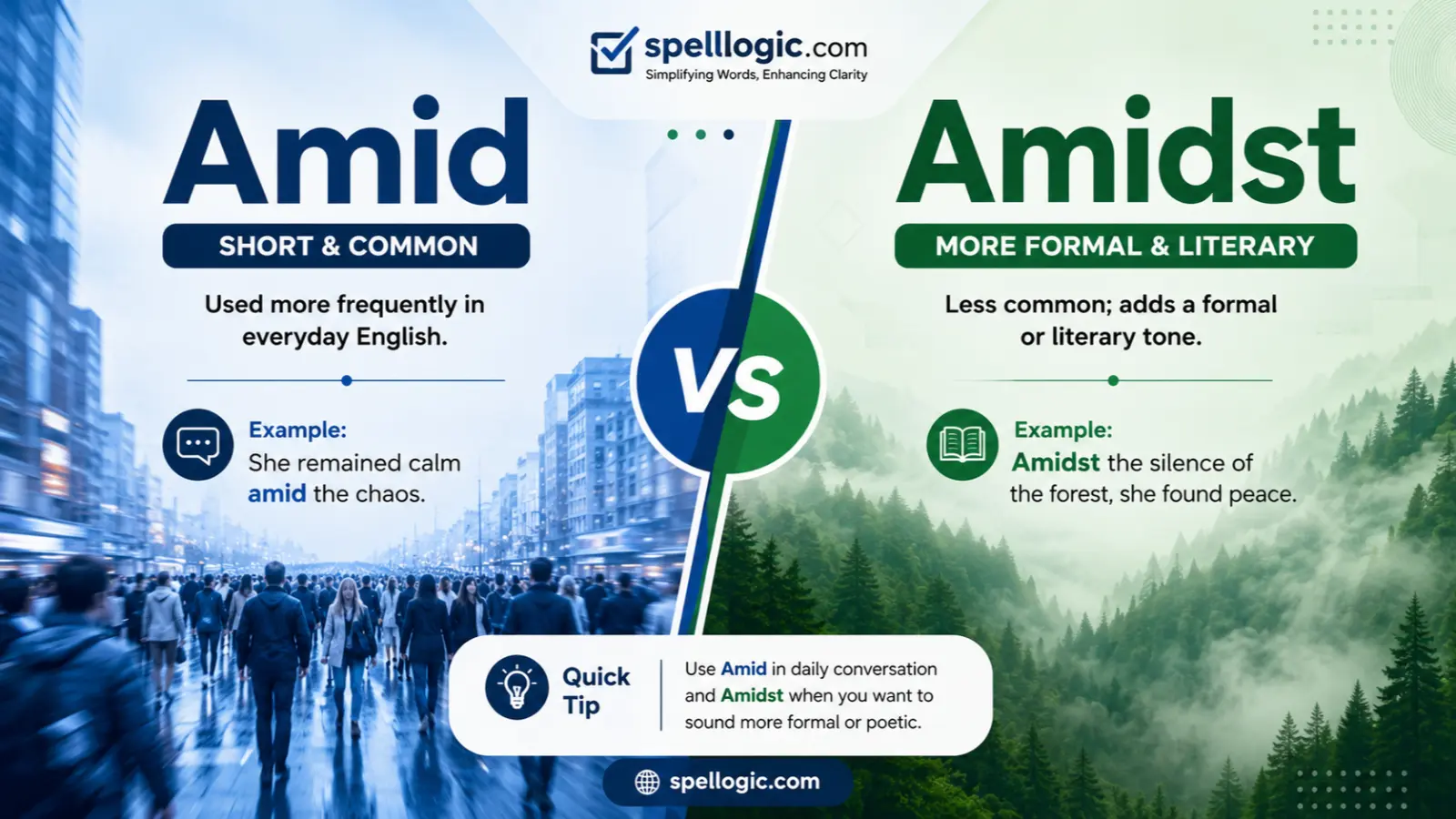
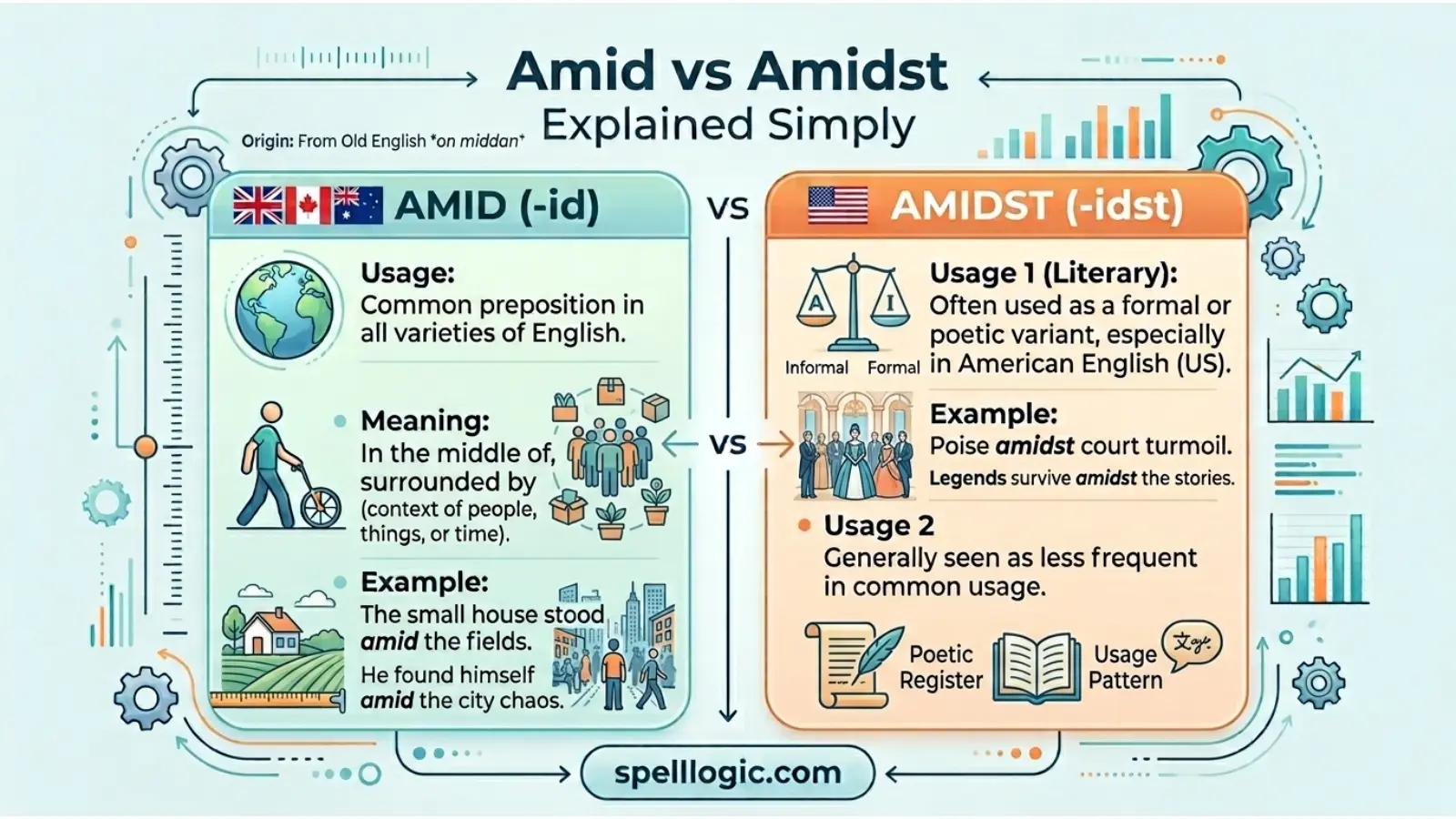
Amid means “in the middle of” or “surrounded by,” while amidst has the same meaning but sounds slightly more formal or literary.
One-Line Distinction
Amid is the modern, more common choice, while amidst is a more traditional or poetic alternative.
Examples
- The children played amid the flowers.
- The children played amidst the flowers.
Both sentences are correct and have the same meaning.
Another example:
- She remained calm amid the chaos.
- She remained calm amidst the chaos.
Understanding Homophones in English
What Are Homophones?
Homophones are words that sound the same but have different meanings or spellings.
Example:
- Sea – a large body of salt water
- See – to look at something
Although amid and amidst are not true homophones because they are pronounced slightly differently, they are often confused because they look and sound very similar.
Why Homophones Cause Confusion
English contains many words with similar pronunciation. Learners often choose the wrong word because they focus on sound rather than meaning.
For example:
- Their house is over there.
- They’re coming tomorrow.
These words sound alike but have different meanings.
What Does “Amid” Mean?
Definition and Core Meaning
Amid is a preposition that means:
- In the middle of
- Surrounded by
- During
- In the presence of
It usually describes someone’s location or a situation happening around them.
Origin and Historical Use
The word amid comes from Middle English and developed from the phrase meaning “in the middle of.” It has been used for hundreds of years and remains the more common form in modern English.
Modern Usage and Synonyms
Common synonyms include:
- Among
- Amongst
- During
- In the middle of
- Surrounded by
- Within
Example Sentences
- She smiled amid the applause.
- The village stood amid green hills.
- The company expanded amid economic uncertainty.
- He stayed calm amid the excitement.
What Does “Amidst” Mean?
Definition and Core Meaning
Amidst also means:
- In the middle of
- Surrounded by
- During
Its meaning is virtually identical to amid.
Origin and Historical Context
Amidst appeared later than amid. The extra -st ending was added in the same way words like amongst developed from among. Today, it is often associated with literary, poetic, or formal writing.
Modern Usage and Synonyms
Common synonyms include:
- Amid
- Among
- Amongst
- Surrounded by
- During
Example Sentences
- The castle stood amidst ancient trees.
- She found peace amidst the noise.
- The hikers rested amidst beautiful mountains.
- Hope remained amidst difficult times.
Amid vs Amidst: Key Differences at a Glance
| Word | Part of Speech | Meaning | Example Context |
|---|---|---|---|
| Amid | Preposition | In the middle of; surrounded by | The team celebrated amid cheering fans. |
| Amidst | Preposition | In the middle of; surrounded by | The team celebrated amidst cheering fans. |
Main Difference: The meaning is the same. Amid is more common in everyday English, while amidst often sounds more formal or literary.
How to Remember the Difference Between Amid and Amidst
Here are some simple memory tricks.
Easy Memory Tricks
- Think of amid as the shorter and simpler everyday word.
- Think of amidst as the longer, more elegant version often found in stories and formal writing.
Association Technique
Remember:
Short word = everyday writing
Long word = literary writing
Memorable Example
Imagine writing a newspaper article.
- The mayor spoke amid protests.
Now imagine writing a novel.
- The knight rode amidst the morning mist.
Both are correct, but the second sounds more poetic.
Common Mistakes and Confusions
Here are mistakes learners often make.
Wrong
She walked amidst of the crowd.
Correct
She walked amid the crowd.
Explanation: Never use of after amid or amidst.
Wrong
The baby slept amidst the room.
Correct
The baby slept in the middle of the room.
Explanation: Amid and amidst are usually used with groups, events, or surroundings rather than specific physical locations.
Wrong
Amidst is the British spelling, and amid is American.
Correct
Both British and American English use both words, although amid is generally more common.
Wrong
Amid means something different from amidst.
Correct
They have the same meaning.
Examples Section: Correct and Incorrect Usage
Example 1
✔ Correct: She remained calm amid the confusion.
✘ Incorrect: She remained calm amid of the confusion.
Example 2
✔ Correct: The hikers rested amidst the tall trees.
✘ Incorrect: The hikers rested amidst of the tall trees.
Example 3
✔ Correct: The speech continued amid loud applause.
✘ Incorrect: The speech continued in amid loud applause.
Example 4
✔ Correct: The village lies amidst beautiful mountains.
✘ Incorrect: The village lies amidstly beautiful mountains.
Self Assessment: Test Your Knowledge
Fill in the blanks.
- The family stayed hopeful ______ difficult times.
- The flowers bloomed ______ the forest.
- Both amid and ______ have the same meaning.
- In everyday English, ______ is generally more common.
Self Assessment Answers
- amid
- amidst
- amidst
- amid
FAQs
1. Is amid or amidst more correct?
Both are grammatically correct. Amid is simply more common in modern English.
2. Do amid and amidst have different meanings?
No. They share the same meaning and are usually interchangeable.
3. Which word is more formal?
Amidst often sounds slightly more formal, poetic, or literary.
4. Can I use amidst in academic writing?
Yes. However, many style guides prefer amid because it is shorter and more common.
5. Is amidst old-fashioned?
Not exactly. It is still used today, but it appears less often than amid.
6. Can amid describe time as well as place?
Yes. It can describe situations, events, emotions, or time periods.
Example:
- The company grew amid economic challenges.
7. Should beginners use amid or amidst?
Most English learners should start with amid because it is the version used more frequently in everyday writing and speech.
Final Conclusion: Using “Amid” and “Amidst” Correctly
Understanding the difference between amid and amidst is much easier once you know that they share the same meaning. Both words describe being in the middle of, surrounded by, or during something. Whether you read a sentence in a newspaper, hear a speech, or enjoy a novel, either word may appear. The biggest difference is not grammar but style. Amid is the shorter, simpler, and more common choice in modern English. It appears regularly in news reports, business writing, academic texts, and everyday conversation. Amidst, on the other hand, has a slightly more traditional or literary feel and is often chosen to create a more elegant tone in stories, descriptive writing, or formal prose.
A useful memory trick is to remember that the shorter word, amid, is usually the safest option for daily communication, while the longer word, amidst, adds a touch of style without changing the meaning. Whichever word you choose, avoid adding of after it, and make sure it introduces a surrounding situation or environment. As you continue reading English books, articles, and websites, you will naturally become more familiar with both forms. With regular practice and careful observation, choosing between amid and amidst will soon become second nature, helping you write with greater confidence, clarity, and accuracy.