Many English learners get confused by metre and meter because the two words look almost identical and have the same pronunciation. At first glance, they seem interchangeable, but their meaning actually depends on the type of English you are using.
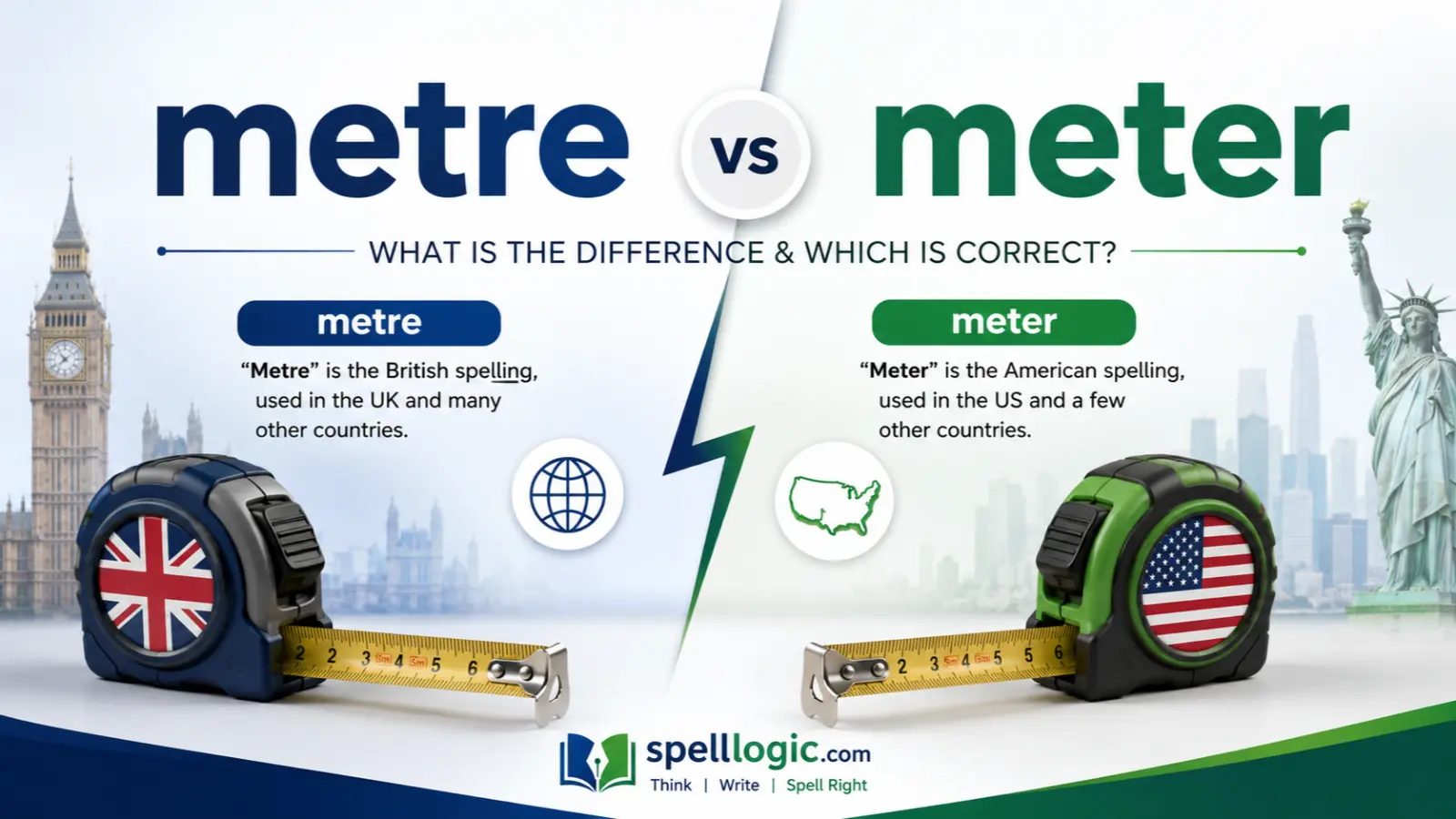
In British English, metre is the standard spelling for the unit of length, while meter usually refers to a measuring device. In American English, however, meter is used for both meanings. Understanding this difference can help you write more accurately, avoid common mistakes, and choose the correct spelling for your audience. This guide explains everything you need to know in simple, easy-to-understand language.
Table of Contents
- Introduction
- Why “Metre” and “Meter” Are Confusing
- Metre vs Meter Explained Simply
- Understanding Homophones in English
- What Are Homophones?
- Why Homophones Cause Confusion
- What Does “Metre” Mean?
- What Does “Meter” Mean?
- Metre vs Meter: Key Differences at a Glance
- How to Remember the Difference Between Metre and Meter
- Common Mistakes and Confusions
- Examples Section: Correct and Incorrect Usage
- Self Assessment: Test Your Knowledge
- Self Assessment Answers
- FAQs About “Metre” and “Meter”
- Final Conclusion: Using “Metre” and “Meter” Correctly
Why “Metre” and “Meter” Are Confusing
Many learners struggle with metre and meter because the words are nearly identical. Although they share the same pronunciation, their spelling and usage vary depending on the variety of English.
Similar Pronunciation
Both metre and meter are pronounced the same way:
/ˈmiːtər/
Since there is no difference in pronunciation, people often assume the spellings are interchangeable.
Similar Spelling
Only the last two letters differ:
- metre
- meter
This small spelling difference is easy to overlook, especially for beginners.
Context Confusion
The biggest source of confusion is that different English varieties follow different spelling rules.
- British English: metre = unit of length
- American English: meter = unit of length
In addition, meter also refers to a device that measures something, such as electricity, gas, or parking time.
Common Learner Mistakes
Many learners:
- Use meter in British English writing when metre is expected.
- Write metre in American English documents.
- Think the two spellings always mean different things.
- Forget that audience and regional spelling matter.
Metre vs Meter Explained Simply
The easiest way to understand these words is to remember that the difference depends mainly on the type of English you are writing.
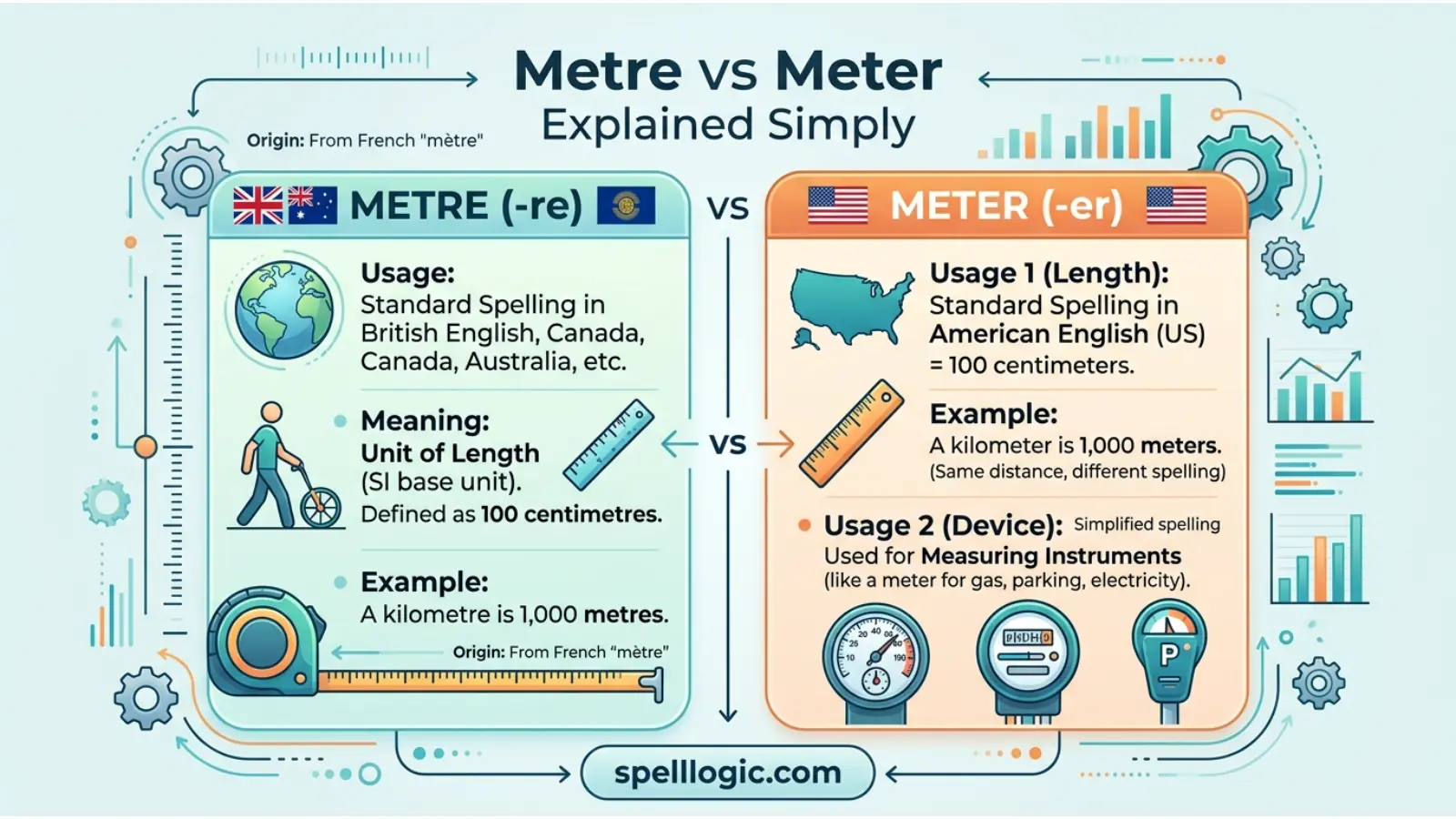
Metre means the standard unit of length in British English, while meter is the American spelling for the same unit and is also the spelling used for measuring devices.
One-Line Distinction
Metre is the British spelling of the unit of length, whereas meter is the American spelling and also refers to measuring instruments.
Example Sentences
Metre
- The swimming pool is twenty-five metres long.
- She stood exactly one metre away from the wall in British English.
Meter
- The race was a 100-meter sprint.
- The electrician checked the electric meter outside the house.
Understanding Homophones in English
What Are Homophones?
Homophones are words that have the same pronunciation but may have different spellings or meanings.
Example:
- there
- their
These words sound identical but are used differently.
Although metre and meter are not traditional homophones with different meanings in every context, they are often treated similarly because they sound exactly alike while their spelling changes according to regional English.
Why Homophones Cause Confusion
English contains many words that sound alike but differ in spelling or meaning. This often causes learners to choose the wrong word when writing.
For example:
- Their house is beautiful.
- There is a park nearby.
Because both words sound the same, writers sometimes confuse them.
Likewise, someone learning English may write:
The road is 500 meter long.
This sentence is perfectly correct in American English but should be:
The road is 500 metres long.
when writing in British English.
The key is to know which variety of English your readers expect.
What Does “Metre” Mean?
Definition and Core Meaning
A metre is the standard unit of length in the International System of Units (SI). It equals 100 centimetres or 1,000 millimetres.
In British English, metre is the correct spelling whenever you refer to distance or length.
Examples
- The bridge is 300 metres long.
- The room measures five metres across.
- He jumped nearly two metres.
Origin and Historical Use
The word metre comes from the French word mètre, which originated from the Greek word metron, meaning measure.
The metric system was introduced in France during the late eighteenth century. As it spread around the world, Britain and many Commonwealth countries adopted the spelling metre for the unit of length.
Today, this spelling remains the official standard in countries such as:
- United Kingdom
- Australia
- New Zealand
- Ireland
- India
- South Africa
Most scientific publications outside North America also prefer metre when following British spelling conventions.
Modern Usage and Synonyms
Today, metre appears in:
- Education
- Engineering
- Construction
- Science
- Sports
- Maps
- Road signs in many countries
Related Words
- length
- distance
- measurement
- unit
- metric unit
Although these are related terms, metre specifically refers to the SI unit of length.
Example Sentences
- The athlete completed the 400-metre race.
- The fence is two metres high.
- We measured the garden in metres.
- The river is approximately fifty metres wide.
Key Points About Metre
- Standard spelling in British English
- Refers only to the unit of length
- Used in science and mathematics
- Equals 100 centimetres
- Preferred throughout most Commonwealth countries
- Common in education, engineering, and everyday measurement
What Does “Meter” Mean?
Definition and Core Meaning
The word meter has two main meanings, depending on the variety of English you are using.
- In American English, meter is the standard spelling for the unit of length equal to 100 centimetres.
- In both American English and British English, meter also refers to a device that measures something, such as electricity, gas, water, speed, or parking time.
This dual meaning is one reason why English learners often become confused.
Examples
- The runner completed a 200-meter race. (American English)
- The technician replaced the electric meter yesterday.
- Please check the water meter before paying the bill.
- The taxi meter calculates the fare automatically.
Origin and Historical Context
The word meter comes from the same Greek root metron, meaning “measure.”
Although both metre and meter share the same origin, spelling conventions developed differently over time.
- British English kept metre for the unit of length and meter for measuring devices.
- American English simplified the spelling by using meter for both meanings.
Because of this difference, both spellings are correct—they simply follow different regional standards.
Modern Usage and Synonyms
Today, meter commonly appears in everyday life.
As a Unit of Length (American English)
- Used in schools
- Sports competitions
- Engineering
- Science
- Construction
As a Measuring Device
- Electric meter
- Water meter
- Gas meter
- Parking meter
- Taxi meter
- Speed meter
Related Words
- gauge
- measuring device
- indicator
- counter
- monitor
These words are related but do not always have exactly the same meaning.
Example Sentences
- The swimming pool is fifty meters long.
- We installed a new gas meter.
- The parking meter accepts credit cards.
- The survey measured the land in meters.
Key Points About Meter
- American spelling of the SI unit of length.
- Refers to measuring devices in both British and American English.
- Common in science, sports, engineering, and everyday life.
- Can describe both distance and measuring instruments depending on context.
- Preferred spelling in the United States.
Metre vs Meter: Key Differences at a Glance
| Word | Part of Speech | Meaning | Example Context |
|---|---|---|---|
| Metre | Noun | British spelling of the SI unit of length | The road is 500 metres long. |
| Meter | Noun | American spelling of the SI unit of length; also a measuring device | The race is 100 meters. / Check the electric meter. |
Quick Summary
| British English | American English |
|---|---|
| metre (unit of length) | meter (unit of length) |
| meter (measuring device) | meter (measuring device) |
How to Remember the Difference Between Metre and Meter
Remembering the correct spelling becomes much easier once you know your audience.
Easy Memory Tricks
- Metre = British English measurement
- Meter = American English measurement
- Meter = Measuring machine everywhere
Association Techniques
Think of this sentence:
Britain measures in metres, but America measures in meters.
Also remember:
Every electric meter is spelled M-E-T-E-R, no matter whether you’re writing British or American English.
One Memorable Example
Imagine visiting London and New York.
- In London, the sign says:
- “The bridge is 500 metres long.”
- In New York, the same sign says:
- “The bridge is 500 meters long.”
The distance is identical—only the spelling changes.
Common Mistakes and Confusions
Here are mistakes that English learners frequently make.
Mistake 1
✘ The road is 200 meter long. (British English)
✔ The road is 200 metres long.
Explanation: British English uses metre for distance.
Mistake 2
✘ The race is 100 metres. (American English)
✔ The race is 100 meters.
Explanation: American English prefers meter.
Mistake 3
✘ The electrician repaired the electric metre.
✔ The electrician repaired the electric meter.
Explanation: Measuring devices are always spelled meter.
Mistake 4
✘ We installed a water metre.
✔ We installed a water meter.
Explanation: Devices use meter in both British and American English.
Examples Section: Correct and Incorrect Usage
Example 1
✔ Correct: The football field is one hundred metres long. (British English)
✘ Incorrect: The football field is one hundred meters long. (British spelling expected)
Example 2
✔ Correct: The marathon includes several 500-meter sections. (American English)
✘ Incorrect: The marathon includes several 500-metre sections. (American spelling expected)
Example 3
✔ Correct: The gas meter needs to be replaced.
✘ Incorrect: The gas metre needs to be replaced.
Example 4
✔ Correct: She measured the room as four metres wide.
✘ Incorrect: She measured the room as four meters wide. (British English context)
Example 5
✔ Correct: The taxi meter showed the total fare.
✘ Incorrect: The taxi metre showed the total fare.
Example 6
✔ Correct: The swimming pool is fifty meters long. (American English)
✘ Incorrect: The swimming pool is fifty metres long. (American spelling expected)
Quick Tip
If you’re talking about an electric meter, parking meter, water meter, or gas meter, always use meter.
If you’re talking about distance, choose the spelling that matches your audience:
- Metre → British English
- Meter → American English
Self Assessment: Test Your Knowledge
Fill in the blanks with metre or meter (use the correct spelling based on the context).
1.
The Olympic swimming pool is 50 ________ long in British English.
2.
The electrician checked the electricity ________ before restoring the power.
3.
In American English, the race was a 100-________ sprint.
4.
The surveyor measured the land using a standard ________ as the unit of length in British English.
Self Assessment Answers
- metres (or metre, depending on the sentence structure)
- meter
- meter
- metre
If you answered all four correctly, you now understand the difference between metre and meter and know when each spelling should be used.
FAQs
1. What is the difference between metre and meter?
The main difference is regional spelling. Metre is the British English spelling for the unit of length, while meter is the American English spelling. Additionally, meter is the standard spelling for measuring devices in both British and American English.
2. Is metre or meter correct?
Both are correct. The right choice depends on the variety of English you are using. Choose metre for British English and meter for American English when referring to the unit of length.
3. Why does British English use “metre”?
British English follows the traditional spelling adopted from French and retained in Commonwealth countries. It distinguishes metre (the unit of length) from meter (a measuring device).
4. Why does American English use “meter”?
American English simplified the spelling and uses meter for both the unit of length and measuring instruments. This makes the spelling more consistent in American usage.
5. Is an electric metre correct?
No. The correct spelling is electric meter in both British and American English because it refers to a measuring device rather than a unit of length.
6. Which countries use “metre”?
Countries that generally follow British English use metre, including the United Kingdom, Australia, New Zealand, India, Ireland, and many other Commonwealth nations.
7. Can I use metre and meter interchangeably?
Not always. If you’re writing for a specific audience, it’s best to follow the spelling conventions of that variety of English. Mixing the two spellings in the same document can appear inconsistent.
Final Conclusion: Using “Metre” and “Meter” Correctly
Understanding the difference between metre and meter is easier than it first appears. Both words refer to the same standard unit of length, but the correct spelling depends on the type of English you are using. In British English, the correct spelling is metre, while American English uses meter. The word meter also has another important meaning—it refers to a device that measures something, such as electricity, gas, water, speed, or parking time. This spelling remains the same in both British and American English.
A simple way to remember the difference is to think about your audience. If you are writing for readers in the United Kingdom or other countries that follow British English, use metre for measurements of distance. If your audience is in the United States, use meter instead. Whenever you mention a measuring instrument, such as an electric meter or a parking meter, always use meter regardless of the regional spelling.
By keeping these rules in mind, you can write with greater confidence and accuracy. Reading books, newspapers, and websites from your target English variety will also help reinforce the correct spelling. The more you practice, the more natural the distinction will become. Remember, choosing the right spelling is not about one word being better than the other—it is simply about matching your English to your audience. With consistent practice, you’ll master metre and meter and avoid one of the most common spelling mistakes in English.