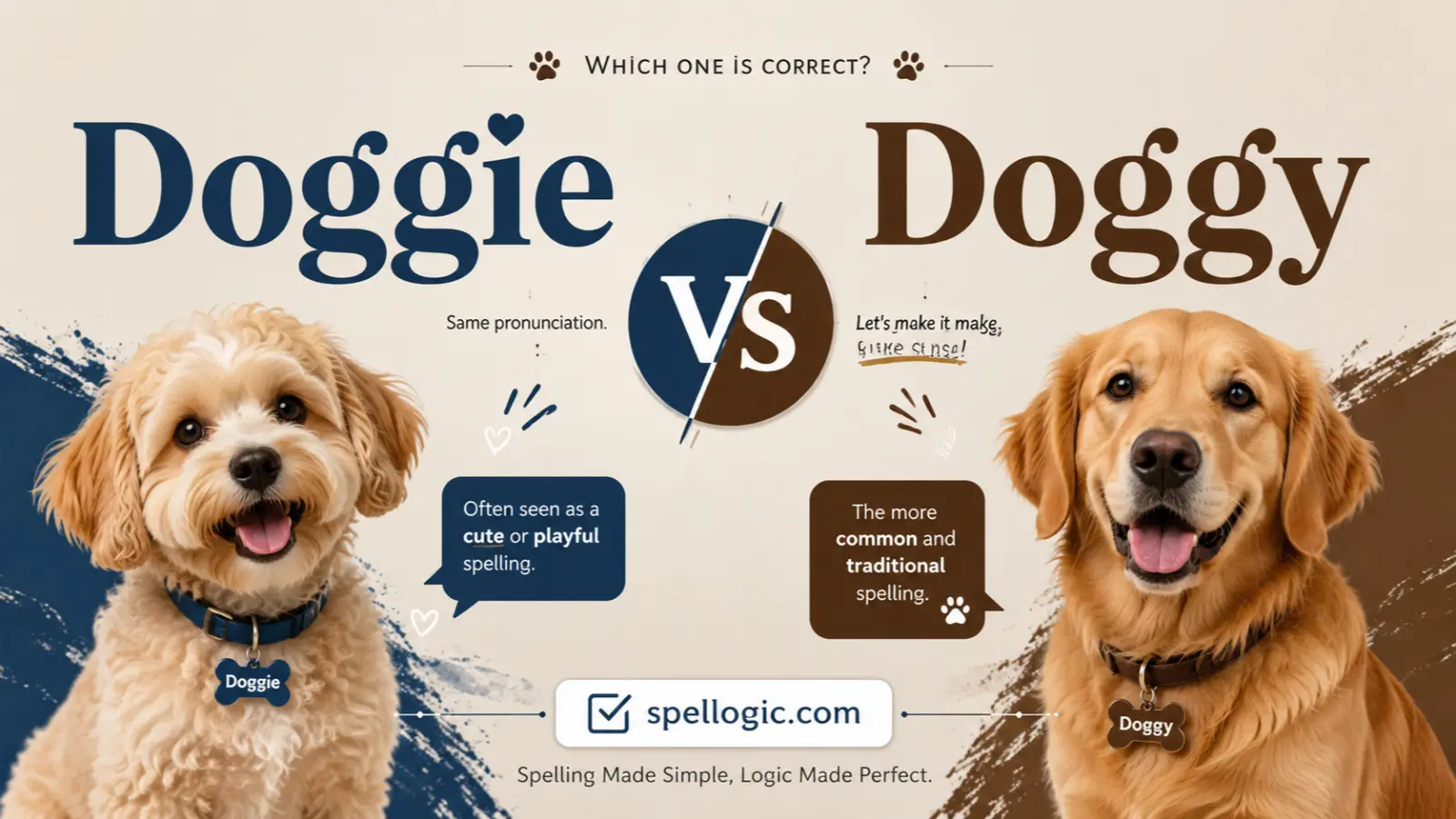
Here is a clear and engaging introduction for “Doggie vs Doggy”:
Many English learners and native speakers alike get confused by the words doggie and doggy because they sound exactly the same and refer to a dog in a cute or affectionate way. While both spellings are widely used, people often wonder whether one is more correct, formal, or common than the other.
Understanding the difference can help you choose the right spelling for writing, conversation, branding, or online content. In this article, we’ll explore the meanings, usage, popularity, and key differences between doggie and doggy so you can use them confidently.
Table of Contents
- Introduction
- Why “Doggie” and “Doggy” Are Confusing
- Doggie vs Doggy Explained Simply
- Understanding Homophones in English
- What Are Homophones?
- Why Homophones Cause Confusion
- What Does “Doggie” Mean?
- What Does “Doggy” Mean?
- Doggie vs Doggy: Key Differences at a Glance
- How to Remember the Difference Between Doggie and Doggy
- Common Mistakes and Confusions
- Examples Section: Correct and Incorrect Usage
- Self Assessment: Test Your Knowledge
- Self Assessment Answers
- FAQs About “Doggie and Doggy”
- Final Conclusion: Using “Doggie” and “Doggy” Correctly
Why “Doggie” and “Doggy” Are Confusing
Many English learners mix up doggie and doggy because the two words are extremely similar.
Similar Pronunciation
Both words are pronounced the same way:
/ˈdɔːɡi/ or /ˈdɑːɡi/
Because they sound identical, listeners cannot tell which spelling is being used when someone speaks.
Similar Spelling
The only difference is the ending:
- Doggie
- Doggy
This one-letter variation makes the words look almost identical.
Context Confusion
Both words refer to a dog, especially in a cute, affectionate, or child-friendly way. As a result, people often use them interchangeably.
Common Learner Mistakes
Learners frequently:
- Assume one spelling is wrong.
- Think the words have completely different meanings.
- Use one form without knowing regional preferences.
- Get confused when reading children’s books or pet-related content.
Doggie vs Doggy Explained Simply
Both doggie and doggy mean a dog, usually in a cute, affectionate, or informal way.
Doggie means a dog spoken of lovingly or playfully, while doggy means exactly the same thing and is simply an alternative spelling.
One-Line Distinction
Doggie and doggy have the same meaning; the difference is mainly spelling preference.
Example Sentences
- The little doggie followed the child around the park.
- My neighbor’s doggie loves playing with tennis balls.
- That cute doggy is wagging its tail.
- The doggy waited patiently by the door.
Understanding Homophones in English
What Are Homophones?
Homophones are words that sound the same but may have different spellings and meanings.
Example:
- Flower
- Flour
These words sound alike but have different meanings.
Why Homophones Cause Confusion
When people hear words instead of seeing them written, they often cannot determine the correct spelling.
For example:
- There
- Their
- They’re
All three sound the same but serve different purposes in English. Although doggie and doggy share the same meaning, their identical pronunciation can still confuse learners about which spelling to use.
What Does “Doggie” Mean?
Definition and Core Meaning
Doggie is an affectionate, informal, and often child-friendly word for a dog.
People commonly use it when speaking to children or when expressing affection toward a pet.
Origin and Historical Use
The word developed from dog with the diminutive ending -ie, which often makes a word sound smaller, cuter, or friendlier.
English speakers have used doggie for generations in nursery rhymes, children’s stories, and family conversations.
Modern Usage and Synonyms
Today, doggie is commonly used in:
- Children’s books
- Pet advertisements
- Casual conversation
- Family settings
Synonyms include:
- Puppy
- Pooch
- Canine
- Pet dog
- Pup
Example Sentences
- The little doggie ran across the yard.
- She bought a new toy for her doggie.
- Every child wanted to pet the friendly doggie.
- The lost doggie was reunited with its owner.
What Does “Doggy” Mean?
Definition and Core Meaning
Doggy is another affectionate and informal spelling of the word used to refer to a dog.
Its meaning is essentially identical to doggie.
Origin and Historical Context
The spelling doggy developed as a variant of doggie. Both forms appeared in English over time, and neither changes the meaning of the word.
In some regions and publications, doggy appears more frequently, while others prefer doggie.
Modern Usage and Synonyms
Today, doggy is commonly found in:
- Pet-related products
- Informal writing
- Advertising
- Everyday speech
Synonyms include:
- Doggie
- Puppy
- Pup
- Pooch
- Canine
Example Sentences
- Our doggy enjoys long walks.
- The doggy barked at the mail carrier.
- She adopted a rescue doggy last month.
- The happy doggy greeted everyone at the door.
Doggie vs Doggy: Key Differences at a Glance
| Word | Part of Speech | Meaning | Example Context |
|---|---|---|---|
| Doggie | Noun | An affectionate term for a dog | “The doggie is sleeping.” |
| Doggy | Noun | An affectionate term for a dog | “The doggy loves treats.” |
Quick Summary
- Same pronunciation
- Same meaning
- Same grammatical role
- Different spelling preferences only
How to Remember the Difference Between Doggie and Doggy
Fortunately, remembering the difference is easy because there is almost no difference in meaning.
Easy Memory Tricks
- Doggie ends with -ie, a common cute ending in English.
- Doggy ends with -y, another common informal ending.
Association Techniques
Think:
- Doggie = cute spelling
- Doggy = simplified spelling
Both still mean “dog.”
One Memorable Example
Imagine two children pointing at the same puppy.
One says:
“Look at that doggie!”
The other says:
“Look at that doggy!”
They are talking about the exact same animal.
Common Mistakes and Confusions
Mistake 1
❌ Doggie and doggy have different meanings.
✔ Doggie and doggy mean the same thing.
Explanation: The difference is spelling, not meaning.
Mistake 2
❌ Doggy is incorrect English.
✔ Doggy is a valid English spelling.
Explanation: Both spellings are accepted and widely used.
Mistake 3
❌ Doggie is only for children.
✔ Doggie is often used with children but can also be used by adults.
Explanation: Adults frequently use affectionate pet language.
Mistake 4
❌ One spelling is always preferred everywhere.
✔ Preferences vary by writer, publisher, and region.
Explanation: Both forms are recognized by English speakers.
Examples Section: Correct and Incorrect Usage
Example 1
✔ Correct: The doggie loves chasing butterflies.
✘ Incorrect: The doggie loves chasing butterflys.
Example 2
✔ Correct: Our doggy sleeps beside the fireplace.
✘ Incorrect: Our doggy sleep beside the fireplace.
Example 3
✔ Correct: The little doggie followed its owner.
✘ Incorrect: The little doggie follow its owner.
Example 4
✔ Correct: That doggy looks very friendly.
✘ Incorrect: That doggy look very friendly.
Example 5
✔ Correct: My doggie enjoys playing fetch.
✘ Incorrect: My doggie enjoy playing fetch.
Example 6
✔ Correct: The doggy wagged its tail happily.
✘ Incorrect: The doggy wag its tail happily.
Self Assessment: Test Your Knowledge
Fill in the blanks with doggie or doggy.
1.
The little ________ greeted visitors at the gate.
2.
My sister bought a new bed for her ________.
3.
That friendly ________ loves children.
4.
The ________ ran after the ball in the park.
Self Assessment Answers
1.
doggie or doggy
2.
doggie or doggy
3.
doggie or doggy
4.
doggie or doggy
Note: Both spellings are acceptable in all four sentences.
FAQs
1. Is doggie or doggy correct?
Both are correct spellings and have the same meaning.
2. Is there a difference between doggie and doggy?
No significant difference exists. The distinction is mainly spelling preference.
3. Which spelling is more common?
Usage varies depending on region, publication style, and personal preference.
4. Can adults say doggie?
Yes. Adults often use doggie when speaking affectionately about pets.
5. Is doggy informal English?
Yes. Doggy is considered an informal and affectionate term for a dog.
6. Are doggie and doggy interchangeable?
Yes. In most contexts, you can use either spelling.
7. Do dictionaries recognize both spellings?
Yes. Major English dictionaries generally recognize both doggie and doggy.
Final Conclusion: Using “Doggie” and “Doggy” Correctly
Understanding the difference between doggie and doggy is much easier than many English learners expect. Unlike many confusing English word pairs, these two words do not differ in meaning. Both refer to a dog in a friendly, affectionate, and informal way. Whether you write doggie or doggy, readers will understand that you are talking about a beloved pet or a dog in a playful context.
The main distinction lies in spelling preference rather than grammar or meaning. Some writers prefer doggie because the -ie ending feels more child-friendly and cute. Others choose doggy because the -y ending appears simpler and more modern. In everyday communication, both versions are widely accepted and understood by native English speakers.
A useful memory tip is to remember that both spellings point to the same furry friend. If you see doggie, think “cute dog.” If you see doggy, think “cute dog” as well. There is no need to worry about choosing the wrong meaning because the meaning stays the same.
As you continue learning English, focus on understanding how words are used in real situations rather than worrying about every spelling variation. The more you read, listen, and practice, the more confident you will become. Keep learning, stay curious, and enjoy discovering the fascinating details of the English language.