Many English learners struggle with the words fair and just because both relate to ideas of equality, rightness, and proper treatment. In everyday conversations, people often use these words in similar situations, which makes the distinction less obvious. However, understanding the difference between fair and just can improve your English vocabulary and help you communicate more accurately.
While the two words share some similarities, they are not always interchangeable. Learning when to use each one will make your writing and speaking clearer and more natural. This guide explains the meanings, differences, and correct usage of fair and just in simple English.
Table of Contents
- Introduction
- Why “Fair” and “Just” Are Confusing
- Fair vs Just Explained Simply
- Understanding Homophones in English
- What Are Homophones?
- Why Homophones Cause Confusion
- What Does “Fair” Mean?
- What Does “Just” Mean?
- Fair vs Just: Key Differences at a Glance
- How to Remember the Difference Between Fair and Just
- Common Mistakes and Confusions
- Examples Section: Correct and Incorrect Usage
- Self Assessment: Test Your Knowledge
- Self Assessment Answers
- FAQs About “Fair and Just”
- Final Conclusion: Using “Fair” and “Just” Correctly
Why “Fair” and “Just” Are Confusing
Many learners mix up fair and just because they often appear in discussions about rules, decisions, and treatment of people.
Similar Pronunciation
Although they do not sound exactly the same, both words are short and commonly used in similar contexts, which can cause confusion for non-native speakers.
Similar Spelling
The words are not spelled similarly, but they are often found together in expressions such as “fair and just treatment,” making learners think they mean exactly the same thing.
Context Confusion
Both words describe something that is right or reasonable. For example:
- The judge made a fair decision.
- The judge made a just decision.
Both sentences sound correct, but the emphasis is slightly different.
Common Learner Mistakes
Learners often:
- Use fair when discussing legal justice.
- Use just when talking about equal treatment in everyday situations.
- Assume the words are perfect synonyms.
Fair vs Just Explained Simply
Fair means treating people equally and reasonably, while just means morally right according to laws, principles, or ethics.
One-Line Distinction
Fair focuses on equal treatment; just focuses on moral or legal correctness.
Example Sentences
- The teacher gave every student a fair chance to answer.
- The court delivered a just verdict after reviewing all the evidence.
Another pair of examples:
- It is fair to share the cake equally.
- It is just to punish someone who breaks the law.
Understanding Homophones in English
What Are Homophones?
Homophones are words that sound the same or nearly the same but have different meanings and spellings.
Example:
- Sea – a large body of salt water
- See – to look at something
These words sound alike but have different meanings.
Why Homophones Cause Confusion
English learners often rely on pronunciation when learning vocabulary. As a result, words that sound similar can easily be mixed up.
For example:
- Their
- There
- They’re
Although fair and just are not true homophones, learners often confuse them because they frequently appear in similar contexts.
What Does “Fair” Mean?
Definition and Core Meaning
The word fair means treating people equally, honestly, and without favoritism. It can also describe something reasonable or acceptable.
Origin and Historical Use
The word fair comes from Old English fæger, which originally meant beautiful, pleasing, or attractive. Over time, its meaning expanded to include honesty, equality, and impartiality.
Modern Usage and Synonyms
Today, fair is commonly used when discussing:
- Equal treatment
- Rules
- Opportunities
- Competition
- Reasonable outcomes
Synonyms
- Equal
- Impartial
- Honest
- Reasonable
- Unbiased
Example Sentences
- The referee made a fair decision during the match.
- Every employee deserves fair treatment.
- The price seems fair for such a high-quality product.
- We want a fair system for everyone.
What Does “Just” Mean?
Definition and Core Meaning
The word just means morally right, lawful, or based on principles of justice. It often refers to ethical correctness rather than simple equality.
Origin and Historical Context
Just comes from the Latin word justus, meaning lawful, righteous, or upright. It entered English through Old French and has long been associated with law and morality.
Modern Usage and Synonyms
Today, just is used when discussing:
- Justice
- Morality
- Legal systems
- Ethical decisions
- Human rights
Synonyms
- Righteous
- Lawful
- Moral
- Ethical
- Upright
Example Sentences
- The judge reached a just conclusion.
- People fought for a more just society.
- It was a just punishment for the crime.
- A just leader treats citizens with dignity.
Fair vs Just: Key Differences at a Glance
| Word | Part of Speech | Meaning | Example Context |
|---|---|---|---|
| Fair | Adjective | Equal, reasonable, impartial | The teacher gave everyone a fair opportunity. |
| Just | Adjective | Morally or legally right | The court issued a just ruling. |
Quick Comparison
- Fair = equal treatment.
- Just = morally correct treatment.
- Something can be fair without being fully just.
- Something can be just even if it does not seem fair to everyone.
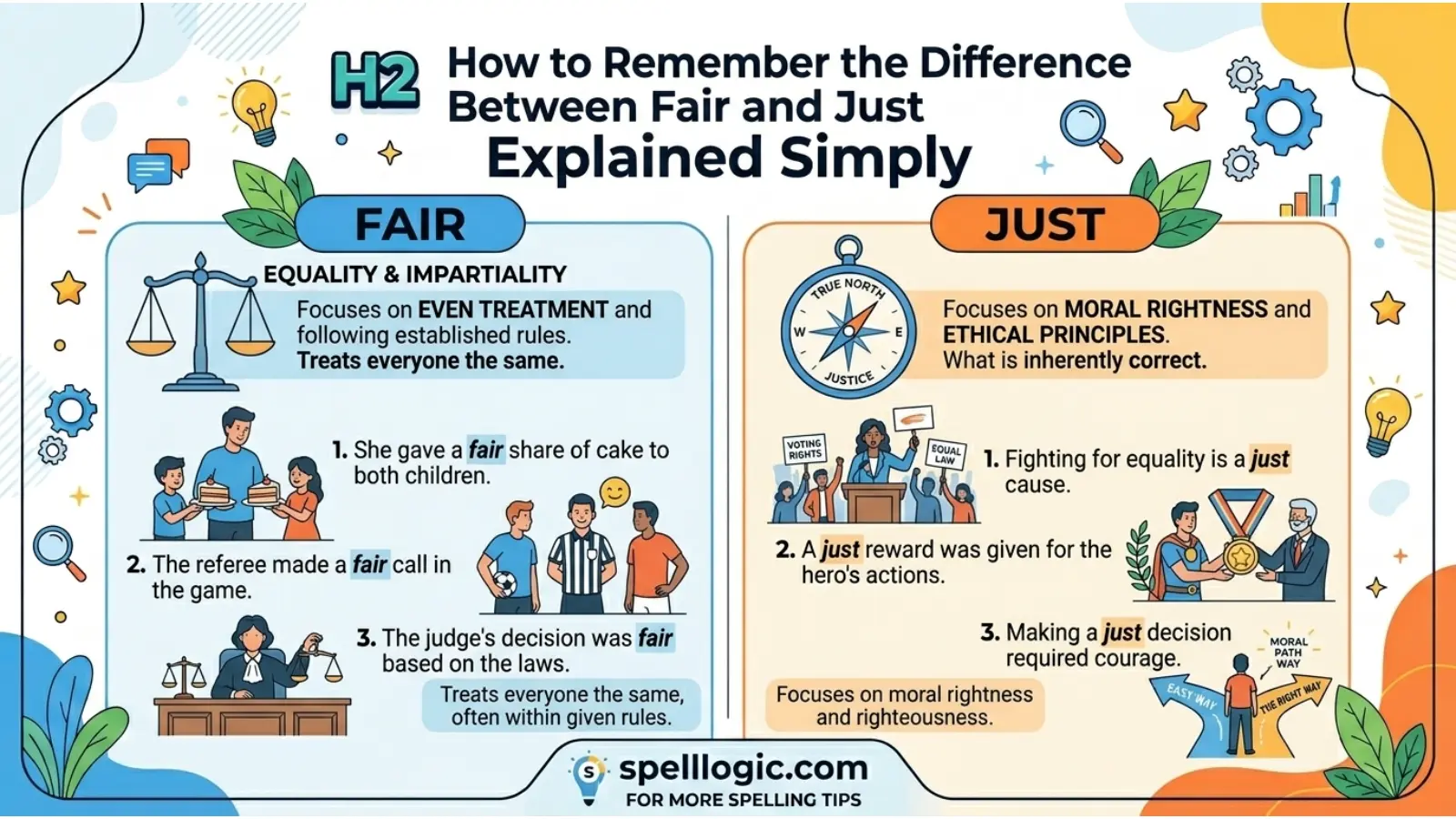
How to Remember the Difference Between Fair and Just
Easy Memory Tricks
Think of fair as related to sharing fairly.
Think of just as related to justice.
Association Techniques
- Fair = Equal
- Just = Justice
The word just even shares the same root as justice, making it easier to remember.
One Memorable Example
Imagine two children sharing candy.
- Giving each child five candies is fair.
- Giving extra candy to the child who received less yesterday might be just because it corrects a past imbalance.
This example shows that fairness and justice are related but not always identical.
Common Mistakes and Confusions
Mistake 1
❌ The criminal received a fair sentence according to the law.
✔ The criminal received a just sentence according to the law.
Explanation: Legal and moral correctness usually calls for just.
Mistake 2
❌ The teacher was just and gave every student the same amount of time.
✔ The teacher was fair and gave every student the same amount of time.
Explanation: Equal treatment is generally described as fair.
Mistake 3
❌ We need a fair legal system.
✔ We need a just legal system.
Explanation: Legal systems are usually discussed in terms of justice.
Mistake 4
❌ It wasn’t just that only one team got extra practice time.
✔ It wasn’t fair that only one team got extra practice time.
Explanation: Unequal treatment is usually described as unfair.
Examples Section: Correct and Incorrect Usage
Example 1
✔ Correct: The competition was fair because everyone followed the same rules.
✘ Incorrect: The competition was just because everyone followed the same rules.
Example 2
✔ Correct: The judge tried to make a just decision.
✘ Incorrect: The judge tried to make a fair decision according to the law.
Example 3
✔ Correct: Every worker deserves fair pay.
✘ Incorrect: Every worker deserves just pay.
Example 4
✔ Correct: Citizens expect a just government.
✘ Incorrect: Citizens expect a fair government when discussing legal justice.
Example 5
✔ Correct: The coach was fair to all players.
✘ Incorrect: The coach was just to all players.
Self Assessment: Test Your Knowledge
Fill in the blanks with fair or just.
- The court aimed to deliver a ______ verdict.
- A good teacher should be ______ to every student.
- Citizens want a ______ legal system.
- Sharing equally is usually considered ______.
Self Assessment Answers
- just
- fair
- just
- fair
FAQs About “Fair and Just”
1. Are fair and just synonyms?
They are similar but not identical. Fair emphasizes equality, while just emphasizes moral or legal correctness.
2. Can something be fair but not just?
Yes. Equal treatment may seem fair, but it may not always address deeper issues of justice.
3. Can something be just but not fair?
Sometimes. A legally correct decision may not feel fair to everyone involved.
4. Which word is used in legal contexts?
Just is more common in discussions about law, ethics, and justice.
5. Which word is used for equal treatment?
Fair is the preferred word when talking about equal opportunities or treatment.
6. Is “fair and just” a common phrase?
Yes. The phrase combines both equality and moral correctness.
7. How can I remember the difference?
Remember: Fair = Equal and Just = Justice.
Final Conclusion: Using “Fair” and “Just” Correctly
Understanding the difference between fair and just is an important step toward mastering English vocabulary. Although both words relate to doing what is right, they focus on different ideas. Fair usually describes equal, unbiased, and reasonable treatment. It is commonly used when discussing opportunities, rules, sharing, and everyday situations. Just, on the other hand, refers to moral, ethical, or legal correctness. It is often used when talking about courts, laws, punishments, human rights, and social justice.
A useful way to remember the distinction is this simple rule: Fair means equal, while just means morally right. Whenever you think about sharing, competition, or treating people the same way, fair is often the better choice. When you think about justice, ethics, or legal decisions, just is usually the correct word.
As you continue learning English, pay attention to how native speakers use these words in different situations. Reading articles, listening to conversations, and practicing your own examples will help reinforce the difference. With regular practice, choosing between fair and just will become natural, and your English communication will sound more accurate, confident, and professional.