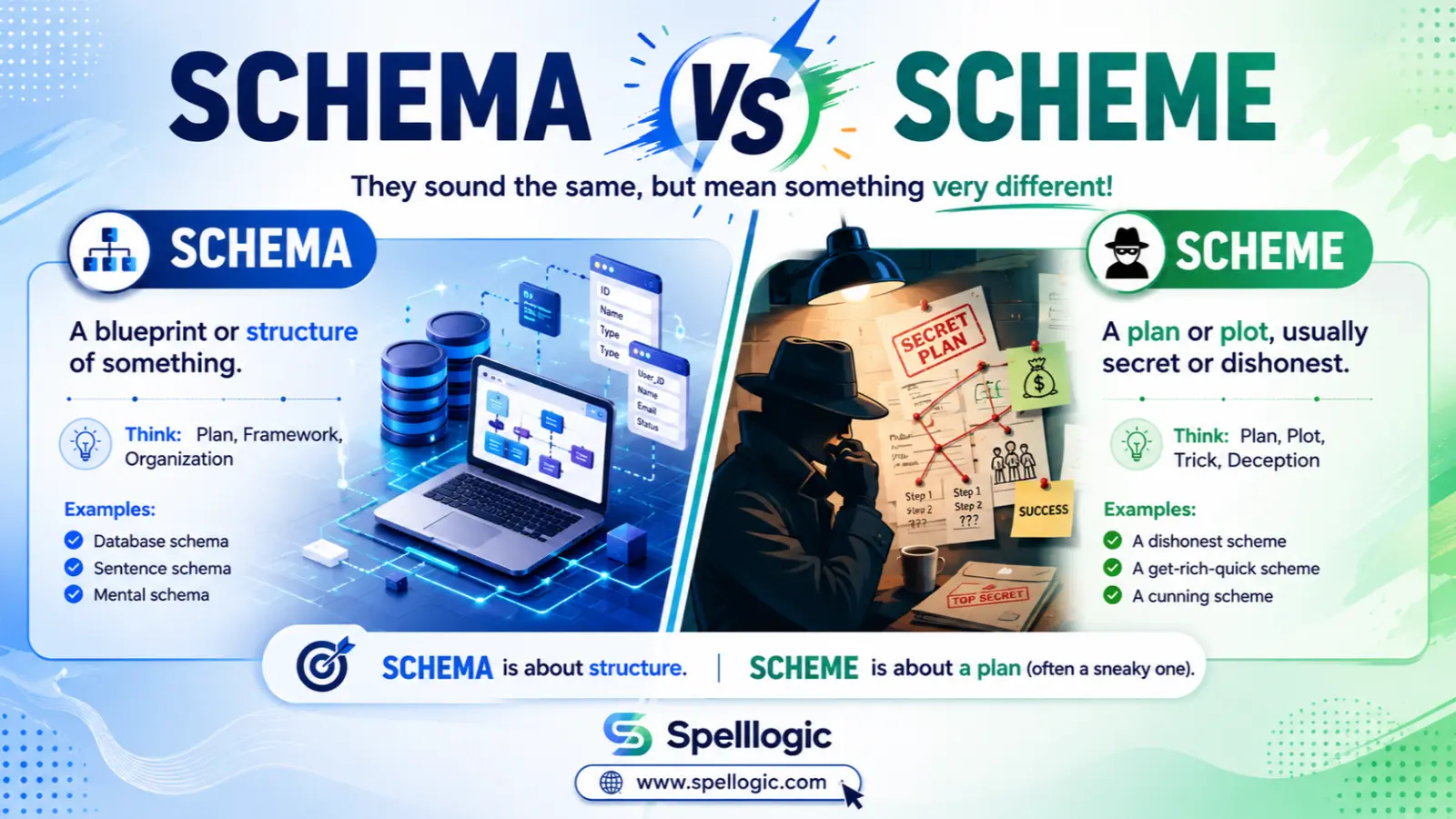
Many English learners get confused by schema and scheme because these words look and sound somewhat similar. In some situations, they even relate to planning, organization, or structure, which makes the distinction less obvious. However, despite their similarities, schema and scheme have different meanings and are used in different contexts.
Understanding the difference can help you communicate more accurately in academic writing, business discussions, psychology, education, and everyday English. In this guide, you’ll learn what each word means, how to use it correctly, and easy tricks to remember the difference between them.
Table of Contents
- Why “Schema” and “Scheme” Are Confusing
- Schema vs Scheme Explained Simply
- Understanding Homophones in English
- What Does “Schema” Mean?
- What Does “Scheme” Mean?
- Schema vs Scheme: Key Differences at a Glance
- How to Remember the Difference Between Schema and Scheme
- Common Mistakes and Confusions
- Examples Section: Correct and Incorrect Usage
- Self Assessment: Test Your Knowledge
- Self Assessment Answers
- FAQs About “Schema and Scheme”
- Final Conclusion: Using “Schema” and “Scheme” Correctly
Why “Schema” and “Scheme” Are Confusing
Many learners mix up schema and scheme for several reasons.
Similar Pronunciation
The words share similar sounds, especially at the beginning. Depending on a speaker’s accent, they may sound somewhat alike.
Similar Spelling
Both words start with sch-, making them visually similar when reading quickly.
Context Confusion
Both words can refer to some form of organization, structure, or planning. This overlap causes many learners to use one when they actually mean the other.
Common Learner Mistakes
Learners often:
- Use scheme when discussing psychology or learning.
- Use schema when talking about plans or systems.
- Assume the words are interchangeable.
- Confuse database terminology with general English usage.
Schema vs Scheme Explained Simply
Schema means a mental framework, pattern, or organized structure of knowledge, while scheme means a plan, system, program, or arrangement designed for a particular purpose.
One-Line Distinction
A schema organizes knowledge; a scheme organizes actions or plans.
Example Sentences
- The child developed a new schema for understanding animals.
- The government introduced a housing scheme for low-income families.
- Database designers created a detailed schema for storing information.
- The company launched a reward scheme to encourage customer loyalty.
Understanding Homophones in English
What Are Homophones?
Homophones are words that sound the same or nearly the same but have different meanings and spellings.
Example:
- Flower
- Flour
These words sound alike but mean completely different things.
Why Homophones Cause Confusion
When learners hear words without seeing their spelling, they may choose the wrong word.
For example:
- “Their car is parked outside.”
- “There is a car parked outside.”
The pronunciation is similar, but the meanings differ. Although schema and scheme are not true homophones, their similarity can create a comparable kind of confusion.
What Does “Schema” Mean?
Definition and Core Meaning
A schema is a framework, pattern, or organized structure that helps people understand, interpret, and store information.
It is commonly used in:
- Psychology
- Education
- Cognitive science
- Information technology
- Database design
Origin and Historical Use
The word schema comes from Greek, where it meant “form,” “shape,” or “plan.” It entered English through academic and scientific fields and became especially important in psychology during the twentieth century.
Modern Usage and Synonyms
Common synonyms include:
- Framework
- Structure
- Model
- Pattern
- Blueprint
- Template
Key Points
- Refers to organized knowledge.
- Often used in psychology and education.
- Can describe database structures.
- Helps people process information.
Example Sentences
- Children build a schema about the world through experience.
- The researcher studied how memory schemas influence learning.
- The database schema defines how information is stored.
- Reading expands a person’s knowledge schema.
What Does “Scheme” Mean?
Definition and Core Meaning
A scheme is a plan, arrangement, program, or organized system designed to achieve a particular goal.
The word can be neutral, positive, or negative depending on context.
Origin and Historical Context
Scheme comes from Greek through Latin and French. Historically, it referred to a plan or design. Over time, it developed both positive and negative meanings.
Modern Usage and Synonyms
Common synonyms include:
- Plan
- Program
- Strategy
- Project
- System
- Arrangement
Key Points
- Refers to a plan or organized system.
- Common in government, business, and everyday English.
- Can describe official programs.
- Sometimes suggests a secret or dishonest plan.
Example Sentences
- The government introduced a pension scheme.
- She created a savings scheme to manage her finances.
- The company developed a marketing scheme.
- The criminal scheme fooled hundreds of people.
Schema vs Scheme: Key Differences at a Glance
| Word | Part of Speech | Meaning | Example Context |
|---|---|---|---|
| Schema | Noun | A framework or structure of knowledge | Psychology, education, databases |
| Scheme | Noun | A plan, program, or organized arrangement | Business, government, personal planning |
Quick Comparison
| Feature | Schema | Scheme |
|---|---|---|
| Focus | Knowledge structure | Plan or system |
| Common Fields | Psychology, databases | Business, government |
| Purpose | Organizes information | Organizes actions |
| Example | Database schema | Retirement scheme |
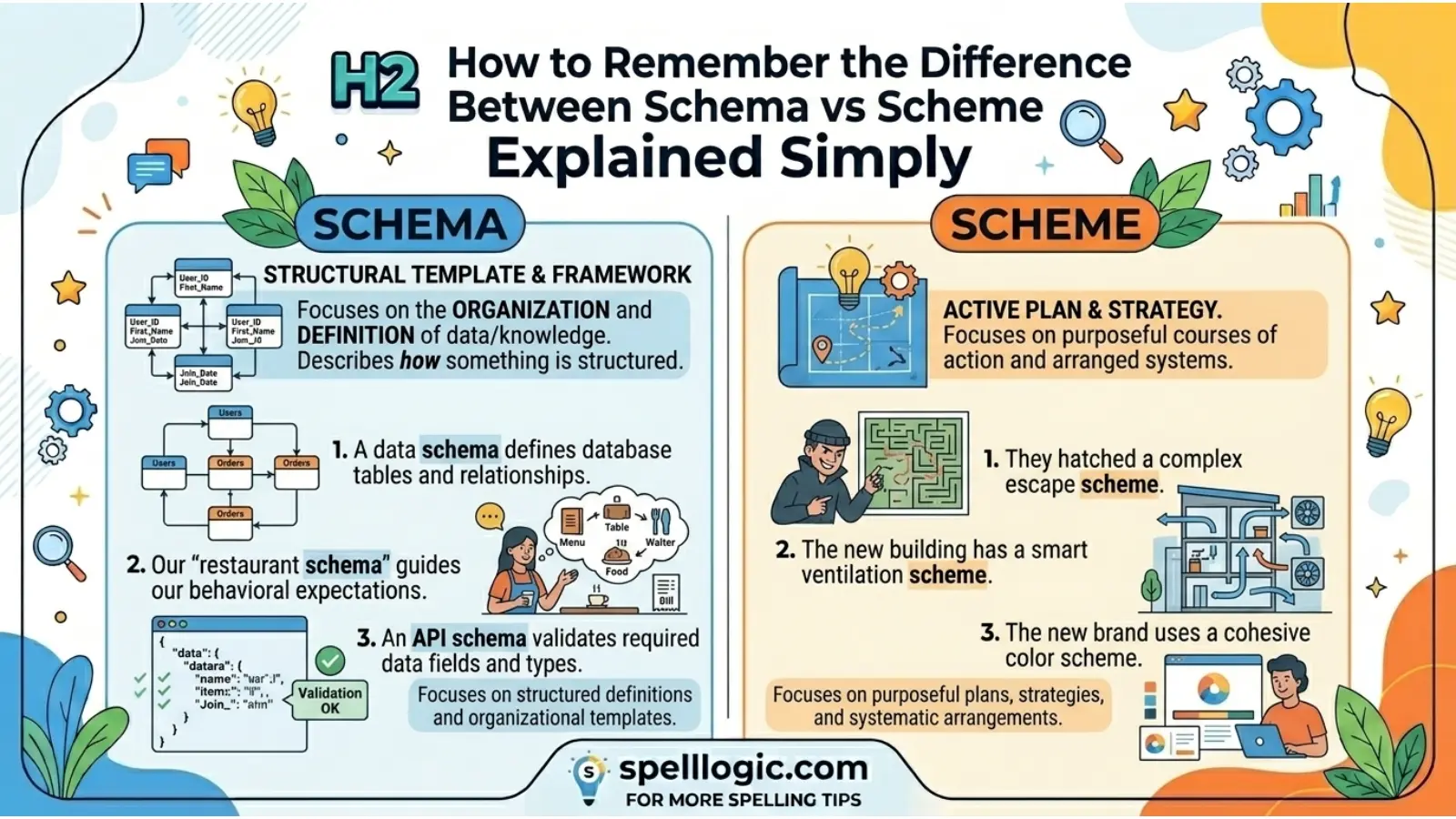
How to Remember the Difference Between Schema and Scheme
Easy Memory Tricks
Think of the letter A in schema as standing for Awareness or Accumulated knowledge.
Think of the letter E in scheme as standing for Execution because a scheme helps you carry out a plan.
Association Techniques
- Schema = Structure of knowledge
- Scheme = Strategy or plan
One Memorable Example
Imagine a student preparing for an exam.
- The student’s understanding of the subject is their schema.
- The study timetable they create is their scheme.
Knowledge equals schema. Planning equals scheme.
Common Mistakes and Confusions
Mistake 1
❌ The teacher introduced a new learning scheme about animal classifications.
✔ The teacher introduced a new learning schema about animal classifications.
Explanation: The sentence refers to a knowledge framework, not a plan.
Mistake 2
❌ The company designed a customer reward schema.
✔ The company designed a customer reward scheme.
Explanation: A reward program is a plan, so scheme is correct.
Mistake 3
❌ The database scheme contains five tables.
✔ The database schema contains five tables.
Explanation: In database terminology, schema is the standard word.
Mistake 4
❌ The government’s housing schema helped thousands of families.
✔ The government’s housing scheme helped thousands of families.
Explanation: Government programs are usually called schemes.
Examples Section: Correct and Incorrect Usage
Example 1
✔ Correct: The database schema defines the relationships between tables.
✘ Incorrect: The database scheme defines the relationships between tables.
Example 2
✔ Correct: The company introduced a pension scheme for employees.
✘ Incorrect: The company introduced a pension schema for employees.
Example 3
✔ Correct: Children develop schemas through experience and learning.
✘ Incorrect: Children develop schemes through experience and learning.
Example 4
✔ Correct: The marketing scheme increased sales by twenty percent.
✘ Incorrect: The marketing schema increased sales by twenty percent.
Example 5
✔ Correct: Psychologists study how schemas affect memory.
✘ Incorrect: Psychologists study how schemes affect memory.
Example 6
✔ Correct: She joined a government savings scheme.
✘ Incorrect: She joined a government savings schema.
Self Assessment: Test Your Knowledge
Fill in the blanks with schema or scheme.
1.
The database ______ describes how information is organized.
2.
The government launched a healthcare ______ for citizens.
3.
A child’s understanding of family relationships is a ______.
4.
The company introduced a bonus ______ to reward employees.
Self Assessment Answers
1.
Schema
2.
Scheme
3.
Schema
4.
Scheme
FAQs
1. Are schema and scheme interchangeable?
No. They have different meanings and are not usually interchangeable.
2. What does schema mean in psychology?
In psychology, a schema is a mental framework that helps people organize and understand information.
3. What does scheme mean in business?
In business, a scheme usually refers to a program, strategy, or organized plan.
4. Which word is used in databases?
Schema is the correct term in database design and information technology.
5. Is scheme always negative?
No. Although it can describe a dishonest plan, it often refers to neutral or positive programs such as pension schemes or savings schemes.
6. How can I remember the difference?
Remember: schema = knowledge structure and scheme = action plan.
7. Which word is more common in everyday English?
Scheme is generally more common in everyday conversation because people frequently discuss plans, programs, and systems.
Final Conclusion: Using “Schema” and “Scheme” Correctly
Understanding the difference between schema and scheme can greatly improve your English vocabulary and communication skills. Although these words look similar and sometimes relate to organization or structure, they serve very different purposes. A schema is a framework of knowledge, understanding, or information. It is commonly used in psychology, education, cognitive science, and database design. A scheme, on the other hand, is a plan, program, strategy, or organized system created to achieve a goal.
One helpful way to remember the difference is to connect schema with knowledge and understanding, while connecting scheme with planning and action. If you are discussing how information is organized in the mind or in a database, use schema. If you are talking about a project, program, strategy, or official plan, use scheme.
As you continue learning English, pay attention to the context in which these words appear. Reading articles, books, and professional documents will help reinforce their correct usage. The more examples you see, the easier it becomes to choose the right word naturally. Keep practicing, review the memory tricks in this guide, and don’t be afraid to test yourself regularly. Small distinctions like this can make a big difference in your confidence and accuracy as an English learner.