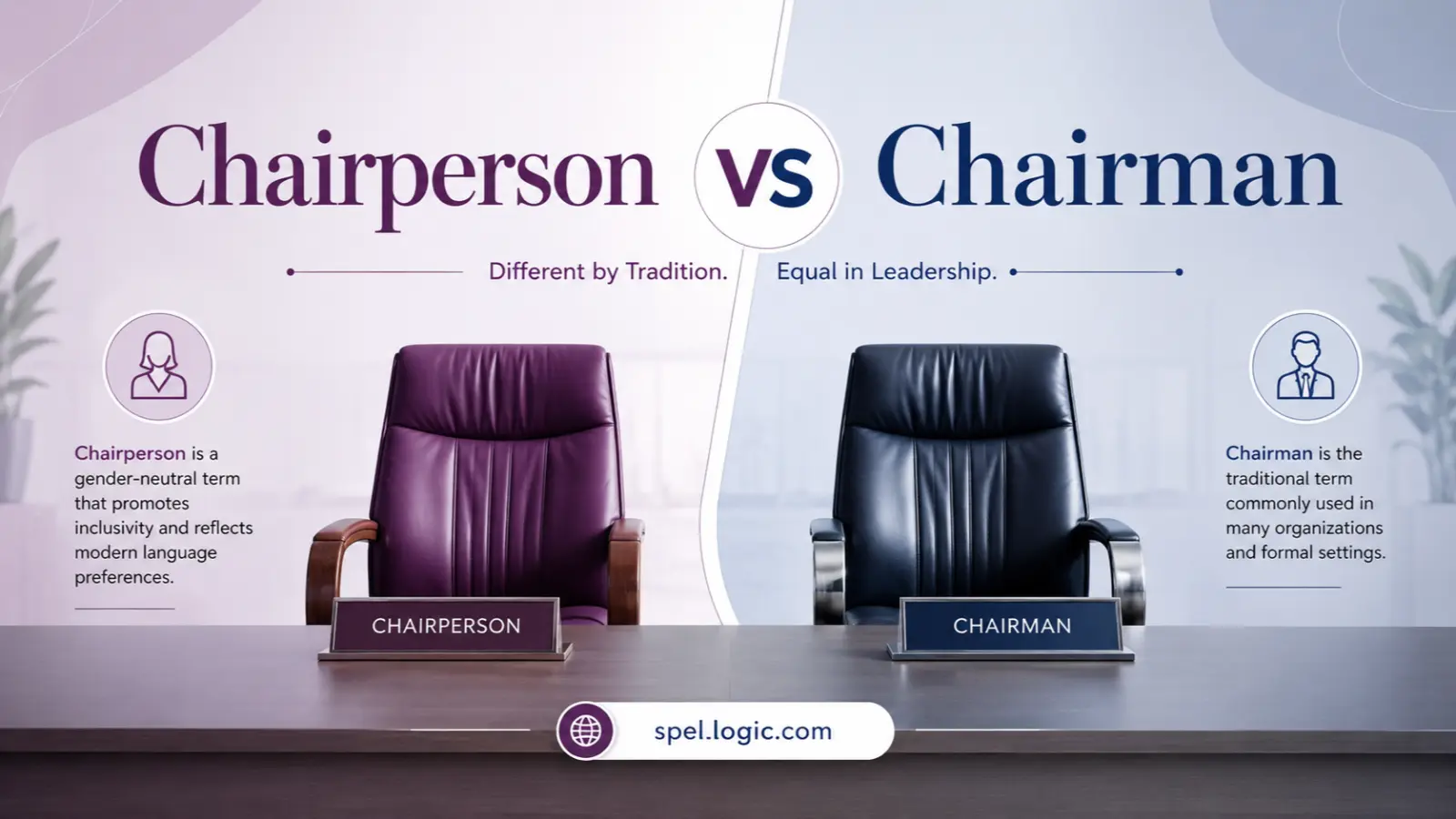
Chairperson vs Chairman Many English learners become confused by the terms chairperson and chairman because both words refer to the person who leads a meeting, committee, organization, or board. Since they are often used in similar situations, it can be difficult to know which one is more appropriate.
Understanding the difference is important because modern English increasingly favors inclusive language, and choosing the right term can help you communicate clearly and respectfully. In this guide, you’ll learn the meanings, history, usage, and key differences between chairperson and chairman, along with examples, memory tips, and practice exercises to help you use them correctly.
Table of Contents
- Introduction
- Why “Chairperson” and “Chairman” Are Confusing
- Chairperson vs Chairman Explained Simply
- Understanding Homophones in English
- What Does “Chairperson” Mean?
- What Does “Chairman” Mean?
- Chairperson vs Chairman: Key Differences at a Glance
- How to Remember the Difference Between Chairperson and Chairman
- Common Mistakes and Confusions
- Examples Section: Correct and Incorrect Usage
- Self Assessment: Test Your Knowledge
- Self Assessment Answers
- FAQs About Chairperson and Chairman
- Final Conclusion: Using Chairperson and Chairman Correctly
Why “Chairperson” and “Chairman” Are Confusing
People often mix up chairperson and chairman because both words describe the leader of a meeting, committee, or organization.
Similar Pronunciation
The two words sound very similar. The only noticeable difference is the ending: -person versus -man.
Similar Spelling
Both words begin with chair- and refer to the same leadership role, making them easy to confuse in writing.
Context Confusion
In many workplaces and organizations, either term may be used. Some companies prefer chairperson, while others continue using chairman.
Common Learner Mistakes
- Thinking the two words have completely different jobs.
- Assuming chairman can only refer to a male leader.
- Believing chairperson and chairman are never interchangeable.
- Using outdated terminology without considering the audience.
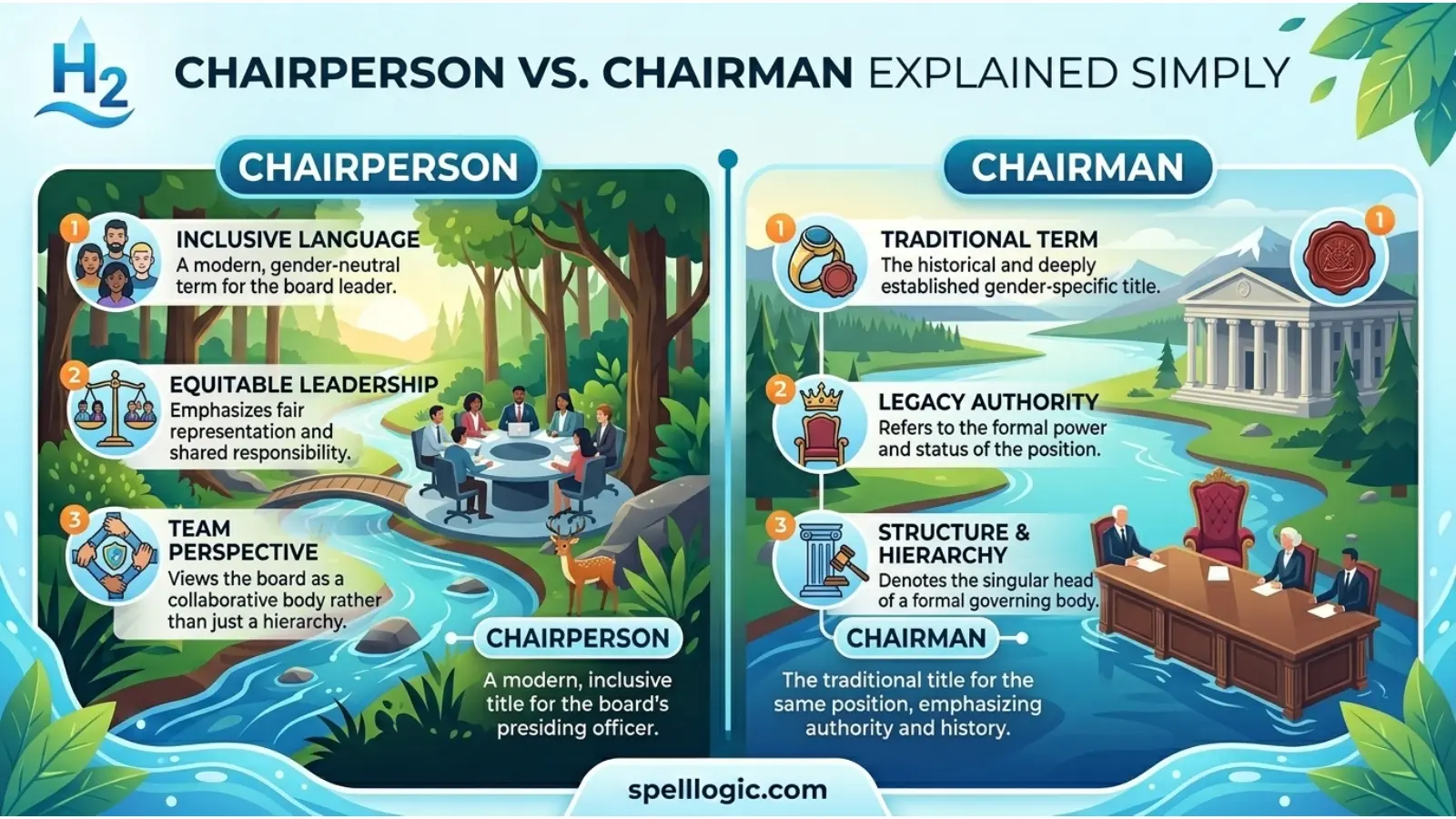
Chairperson vs Chairman Explained Simply
Chairperson means the leader of a meeting or organization without specifying gender, while chairman traditionally refers to a person holding the same position and originally implied a male leader.
One-Line Distinction
Chairperson is gender-neutral, while chairman is a traditional term that often carries a male association.
Example Sentences
- The chairperson opened the meeting and welcomed all members.
- The chairman announced the company’s annual results.
Understanding Homophones in English
What Are Homophones?
Homophones are words that sound the same but have different meanings and sometimes different spellings.
Example:
- Sea = a large body of salt water
- See = to look at something
These words sound alike but have different meanings.
Why Homophones Cause Confusion
English learners often rely on pronunciation when learning vocabulary. When two words sound similar, they can easily be confused.
For example:
- Their refers to ownership.
- There refers to a place.
Although chairperson and chairman are not true homophones, their similar pronunciation and meaning create confusion in a similar way.
What Does “Chairperson” Mean?
Definition and Core Meaning
A chairperson is the person who leads a meeting, committee, board, organization, or group.
The term is gender-neutral and can refer to any individual regardless of gender.
Origin and Historical Use
The word chairperson became popular during the twentieth century as organizations began adopting more inclusive language. It was introduced as an alternative to gender-specific titles.
Modern Usage and Synonyms
Today, many businesses, schools, governments, and nonprofit organizations prefer chairperson because it is inclusive and professional.
Common synonyms:
- Chair
- Presiding officer
- Meeting leader
- Committee head
- Board leader
Key Points
- Gender-neutral term
- Common in modern professional settings
- Suitable for any leader regardless of gender
- Widely accepted in formal writing
Example Sentences
- The chairperson called the meeting to order.
- Our chairperson will present the annual report tomorrow.
- The committee elected a new chairperson last week.
- The chairperson listened carefully to all opinions.
What Does “Chairman” Mean?
Definition and Core Meaning
A chairman is the person who leads a committee, board, company, or meeting.
Traditionally, the term referred to a man serving in that position.
Origin and Historical Context
The word chairman dates back several centuries and was the standard term used in government, business, and organizations.
Historically, leadership positions were often held by men, which is why the title became common.
Modern Usage and Synonyms
Many organizations still use chairman, especially when it is part of an official title. However, some institutions have replaced it with chairperson or simply chair.
Common synonyms:
- Chair
- Chairperson
- Presiding officer
- Board leader
- Committee head
Key Points
- Traditional leadership title
- Often associated with male office holders
- Still used in many organizations
- May appear in official job titles
Example Sentences
- The chairman approved the proposal.
- The company’s chairman addressed shareholders.
- The chairman led the discussion effectively.
- Everyone thanked the chairman for his service.
Chairperson vs Chairman: Key Differences at a Glance
| Word | Part of Speech | Meaning | Example Context |
|---|---|---|---|
| Chairperson | Noun | A gender-neutral leader of a meeting, committee, or organization | The chairperson opened the conference. |
| Chairman | Noun | A traditional title for the leader of a meeting, committee, or organization, often associated with men | The chairman presented the annual report. |
How to Remember the Difference Between Chairperson and Chairman
Easy Memory Tricks
Chairperson = Person
The word person includes everyone, regardless of gender.
Chairman = Man
The word man reminds you that the term traditionally referred to a male leader.
Association Techniques
- Think of chairperson as the modern and inclusive option.
- Think of chairman as the traditional title.
One Memorable Example
Imagine a committee choosing a leader:
- If gender does not matter, use chairperson.
- If the official title is chairman, use chairman.
This simple idea can help you choose the correct word quickly.
Common Mistakes and Confusions
Mistake 1
❌ The chairperson is a completely different role from the chairman.
✔ The chairperson and chairman usually refer to the same leadership role.
Explanation: The difference is mainly in language style and gender reference, not job duties.
Mistake 2
❌ A woman can never be called chairman.
✔ Some organizations still use chairman as an official title regardless of gender.
Explanation: Usage depends on organizational preferences.
Mistake 3
❌ Chairman is always incorrect.
✔ Chairman is still correct in many contexts.
Explanation: It remains a valid English word and official title.
Mistake 4
❌ Chairperson can only be used in informal situations.
✔ Chairperson is widely used in formal and professional communication.
Explanation: Many organizations prefer it because it is gender-neutral.
Examples Section: Correct and Incorrect Usage
Example 1
✔ Correct: The chairperson welcomed the new members.
✘ Incorrect: The chairperson welcomed the new members because only men can hold that role.
Example 2
✔ Correct: The chairman announced the board’s decision.
✘ Incorrect: The chairman means someone completely different from a chairperson.
Example 3
✔ Correct: The organization elected a new chairperson.
✘ Incorrect: The organization elected a new chairman because women are not allowed to lead.
Example 4
✔ Correct: The chairman chaired the annual meeting.
✘ Incorrect: The chairperson and chairman have unrelated meanings.
Self Assessment: Test Your Knowledge
Fill in the blanks with chairperson or chairman.
- The committee selected a new _________ to lead future meetings.
- The company’s official title is Board _________.
- The _________ thanked everyone for attending the conference.
- Many modern organizations prefer the term _________ because it is gender-neutral.
Self Assessment Answers
- chairperson
- chairman
- chairperson (or chairman depending on context)
- chairperson
FAQs
1. Is chairperson the same as chairman?
Yes. Both terms generally refer to the leader of a meeting, committee, board, or organization.
2. Which word is more modern?
Chairperson is generally considered the more modern and gender-inclusive term.
3. Is chairman still correct?
Yes. Chairman is still a correct English word and remains an official title in many organizations.
4. Can a woman be called chairman?
Yes. Some organizations use chairman as a title regardless of the person’s gender.
5. Why do some companies use chairperson?
They prefer gender-neutral language that applies equally to everyone.
6. Is chair a good alternative?
Yes. Many organizations now use chair because it is short, professional, and gender-neutral.
7. Which term should English learners use?
In most situations, chairperson or chair is a safe and modern choice unless an organization officially uses chairman.
Final Conclusion: Using “Chairperson” and “Chairman” Correctly
Understanding the difference between chairperson and chairman is easier once you know that both words usually describe the same leadership position. The main distinction lies in their style and gender association. Chairperson is a gender-neutral term that can refer to any leader of a meeting, committee, board, or organization. Because of its inclusive nature, it has become increasingly popular in modern workplaces, educational institutions, and professional settings. Chairman, on the other hand, is the traditional title and is still widely used, especially when it remains part of an organization’s official terminology.
When deciding which term to use, consider your audience and context. If you want a neutral and contemporary option, chairperson is often the best choice. If a company, committee, or board officially uses chairman, it is appropriate to follow that title. A helpful memory trick is to remember that person includes everyone, while man reminds you of the term’s historical connection to male leaders.
As you continue learning English, paying attention to small differences like these will improve both your vocabulary and communication skills. The more examples you read and practice, the more natural these distinctions will become. Keep learning, stay curious, and remember that understanding word choices is an important step toward confident and effective English usage.