Girl vs Girls Many English learners get confused by girl and girls because the two words look almost identical and refer to the same basic idea. However, the difference between them is important because one is singular and the other is plural.
Using the wrong form can make a sentence grammatically incorrect and may confuse your readers or listeners. Fortunately, the distinction is simple once you understand how English nouns change to show number.
In this guide, you’ll learn the meaning of girl and girls, see examples of correct usage, discover common mistakes, and gain easy memory tips to help you use both words confidently.
Table of Contents
- Introduction
- Why “Girl” and “Girls” Are Confusing
- Girl vs Girls Explained Simply
- Understanding Homophones in English
- What Are Homophones?
- Why Homophones Cause Confusion
- What Does “Girl” Mean?
- What Does “Girls” Mean?
- Girl vs Girls: Key Differences at a Glance
- How to Remember the Difference Between Girl and Girls
- Common Mistakes and Confusions
- Examples Section: Correct and Incorrect Usage
- Self Assessment: Test Your Knowledge
- Self Assessment Answers
- FAQs About “Girl and Girls”
- Final Conclusion: Using “Girl” and “Girls” Correctly
Why “Girl” and “Girls” Are Confusing
English learners often mix up girl and girls because they are closely related forms of the same noun.
Similar Pronunciation
The words sound very similar. The only difference is the “s” sound at the end of girls, which can be difficult for some learners to hear or pronounce.
Similar Spelling
The spelling difference is small. Girls is simply girl + s, making it easy to overlook when reading or writing quickly.
Context Confusion
Sometimes learners focus on the main idea of a sentence and forget whether the noun should be singular or plural.
For example:
- The girl is playing outside.
- The girls are playing outside.
Both sentences talk about people playing outside, but the number of people changes.
Common Learner Mistakes
Learners often:
- Use girl when talking about multiple people.
- Use girls when talking about one person.
- Forget to match verbs with singular or plural nouns.
- Misuse apostrophes and write girl’s instead of girls.
Girl vs Girls Explained Simply
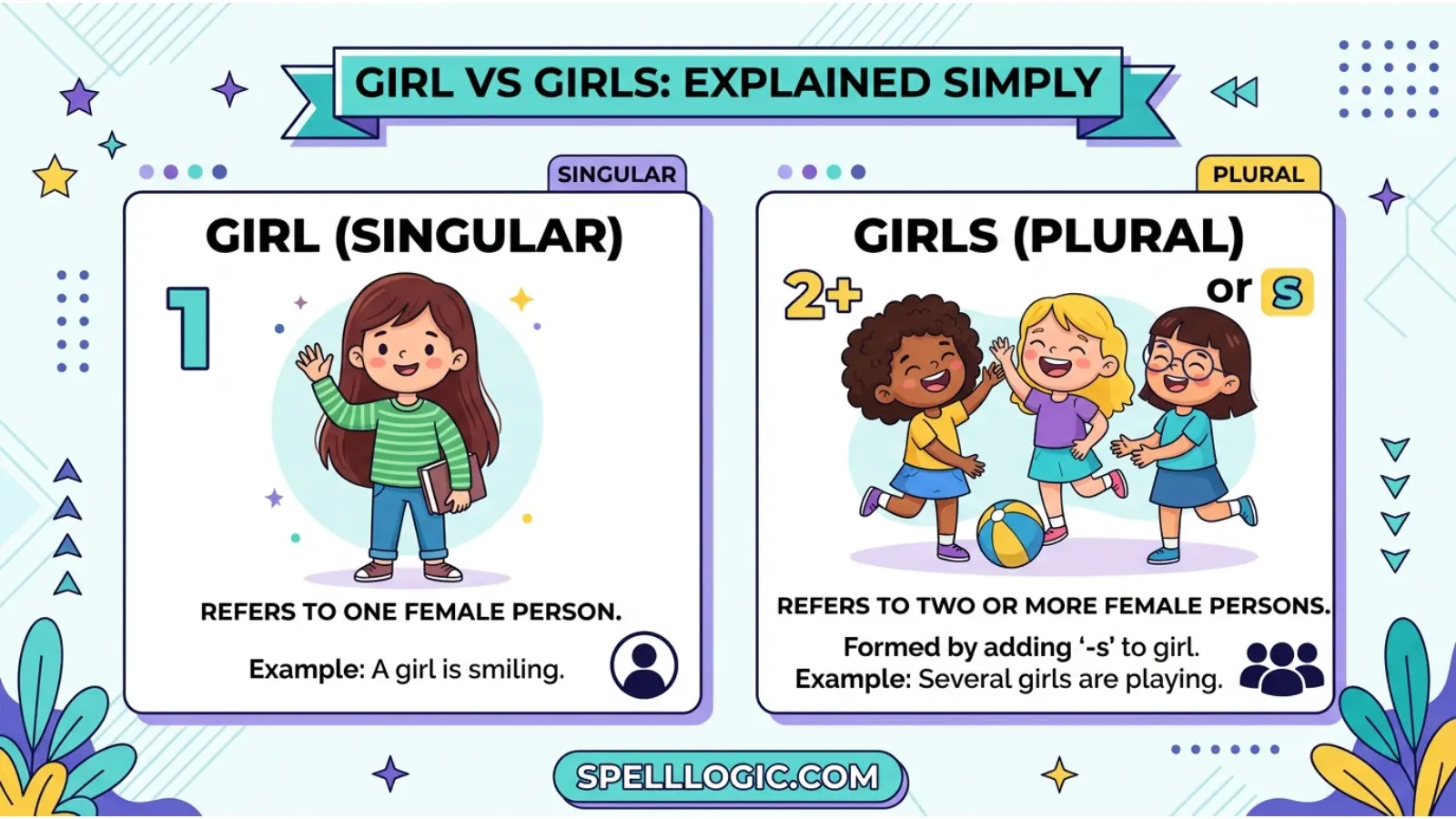
Girl means one female child or young woman, while girls means more than one female child or young woman.
One-Line Distinction
Girl = singular (one person); Girls = plural (two or more people).
Example Sentences
- The girl is reading a book.
- One girl won the competition.
- The girls are reading books.
- Several girls joined the basketball team.
Girl means one female person, while girls means two or more female peopl
Understanding Homophones in English
Although girl and girls are not true homophones, learners often confuse them because they sound similar.
What Are Homophones?
Homophones are words that sound the same but have different meanings or spellings.
Example:
- Sea – a large body of salt water
- See – to look at something
Why Homophones Cause Confusion
When words sound alike, learners may choose the wrong spelling.
For example:
- I want to see the ocean.
- The sea is calm today.
Because pronunciation is similar, many people confuse these words in writing.
What Does “Girl” Mean?
Definition and Core Meaning
A girl is a female child or a young female person. In some contexts, it may also refer informally to a young woman.
Origin and Historical Use
The word girl comes from Middle English. Historically, it was used in different ways, but over time it became the standard word for a female child.
Modern Usage and Synonyms
Today, girl is commonly used in schools, families, literature, and everyday conversations.
Synonyms may include:
- Female child
- Young lady
- Daughter (in some contexts)
- Young woman
Key Points
- Refers to one person.
- Functions as a singular noun.
- Usually describes a female child or young woman.
- Requires singular verbs.
Example Sentences
- The girl smiled at her teacher.
- A girl won first prize in the contest.
- That girl enjoys painting.
- The girl lives next door.
What Does “Girls” Mean?
Definition and Core Meaning
Girls is the plural form of girl. It refers to two or more female children or young women.
Origin and Historical Context
The word developed naturally through the English plural system, where many nouns become plural by adding -s.
Modern Usage and Synonyms
The plural form is widely used when discussing groups of female children or young women.
Synonyms may include:
- Female children
- Young women
- Ladies (depending on context)
- Daughters (in certain situations)
Key Points
- Refers to more than one person.
- Functions as a plural noun.
- Requires plural verbs.
- Commonly describes groups.
Example Sentences
- The girls are practicing soccer.
- Three girls entered the competition.
- The girls laughed together.
- Several girls volunteered for the project.
Girl vs Girls: Key Differences at a Glance
| Word | Part of Speech | Meaning | Example Context |
|---|---|---|---|
| Girl | Noun (Singular) | One female child or young woman | The girl is singing. |
| Girls | Noun (Plural) | Two or more female children or young women | The girls are singing. |
How to Remember the Difference Between Girl and Girls
Learning a simple memory trick can help you avoid mistakes.
Easy Memory Tricks
- Girl = One person
- Girls = More than one person
Notice the extra s at the end of girls.
Association Technique
Think of s as standing for several.
- No s = one girl
- s = several girls
Memorable Example
Imagine one student standing alone.
- One student = girl
Now imagine five students together.
- Five students = girls
The added s reminds you that there is more than one person.
Common Mistakes and Confusions
Here are some mistakes English learners frequently make.
Mistake 1
❌ The girls is happy.
✔ The girls are happy.
Explanation: Girls is plural, so it needs the plural verb are.
Mistake 2
❌ The girl are playing.
✔ The girl is playing.
Explanation: Girl is singular, so it needs the singular verb is.
Mistake 3
❌ Two girl came to class.
✔ Two girls came to class.
Explanation: More than one person requires the plural noun.
Mistake 4
❌ One girls won the race.
✔ One girl won the race.
Explanation: One person requires the singular form.
Examples Section: Correct and Incorrect Usage
Example 1
✔ Correct: The girl is drawing a picture.
✘ Incorrect: The girls is drawing a picture.
Example 2
✔ Correct: The girls are playing volleyball.
✘ Incorrect: The girl are playing volleyball.
Example 3
✔ Correct: One girl received an award.
✘ Incorrect: One girls received an award.
Example 4
✔ Correct: Several girls attended the meeting.
✘ Incorrect: Several girl attended the meeting.
Example 5
✔ Correct: The girl lives near the park.
✘ Incorrect: The girls lives near the park.
Example 6
✔ Correct: The girls enjoy reading books.
✘ Incorrect: The girl enjoy reading books.
Self Assessment: Test Your Knowledge
Fill in the blanks with girl or girls.
1.
The ______ is wearing a blue jacket.
2.
Three ______ won medals in the competition.
3.
The ______ enjoys learning English.
4.
The ______ are preparing for the school concert.
Self Assessment Answers
1.
girl
2.
girls
3.
girl
4.
girls
FAQs
1. What is the difference between girl and girls?
Girl refers to one female child or young woman, while girls refers to two or more.
2. Is girls singular or plural?
Girls is a plural noun.
3. Can I use girl for more than one person?
No. When referring to multiple people, use girls.
4. Why do we add “s” to girl?
In English, many nouns become plural by adding -s.
5. Which verb should I use with girl?
Use singular verbs such as is, was, and has.
6. Which verb should I use with girls?
Use plural verbs such as are, were, and have.
7. Is “girls” the same as “girl’s”?
No. Girls is plural, while girl’s shows possession.
Example:
- The girls are singing. (plural)
- The girl’s book is on the desk. (possession)
Final Conclusion: Using “Girl” and “Girls” Correctly
Understanding the difference between girl and girls is one of the simplest yet most important grammar skills for English learners. While the two words share the same root meaning, they serve different purposes. Girl refers to one female child or young woman, whereas girls refers to two or more female children or young women. This distinction affects not only the noun itself but also the verbs and sentence structure that accompany it.
In everyday communication, using the correct form helps make your writing and speaking clear and professional. For example, saying “The girl is studying” correctly describes one person, while “The girls are studying” correctly refers to a group. Paying attention to the small -s at the end of girls can prevent many common grammar mistakes.
A useful memory trick is to remember that s stands for several. If you are talking about more than one person, use girls. If you mean only one person, use girl. This simple association makes the difference easy to remember.
As you continue learning English, practice identifying singular and plural nouns in books, articles, and conversations. The more examples you see, the more natural these grammar patterns will become. Keep practicing, stay curious, and remember that every small grammar lesson brings you one step closer to mastering English with confidence.