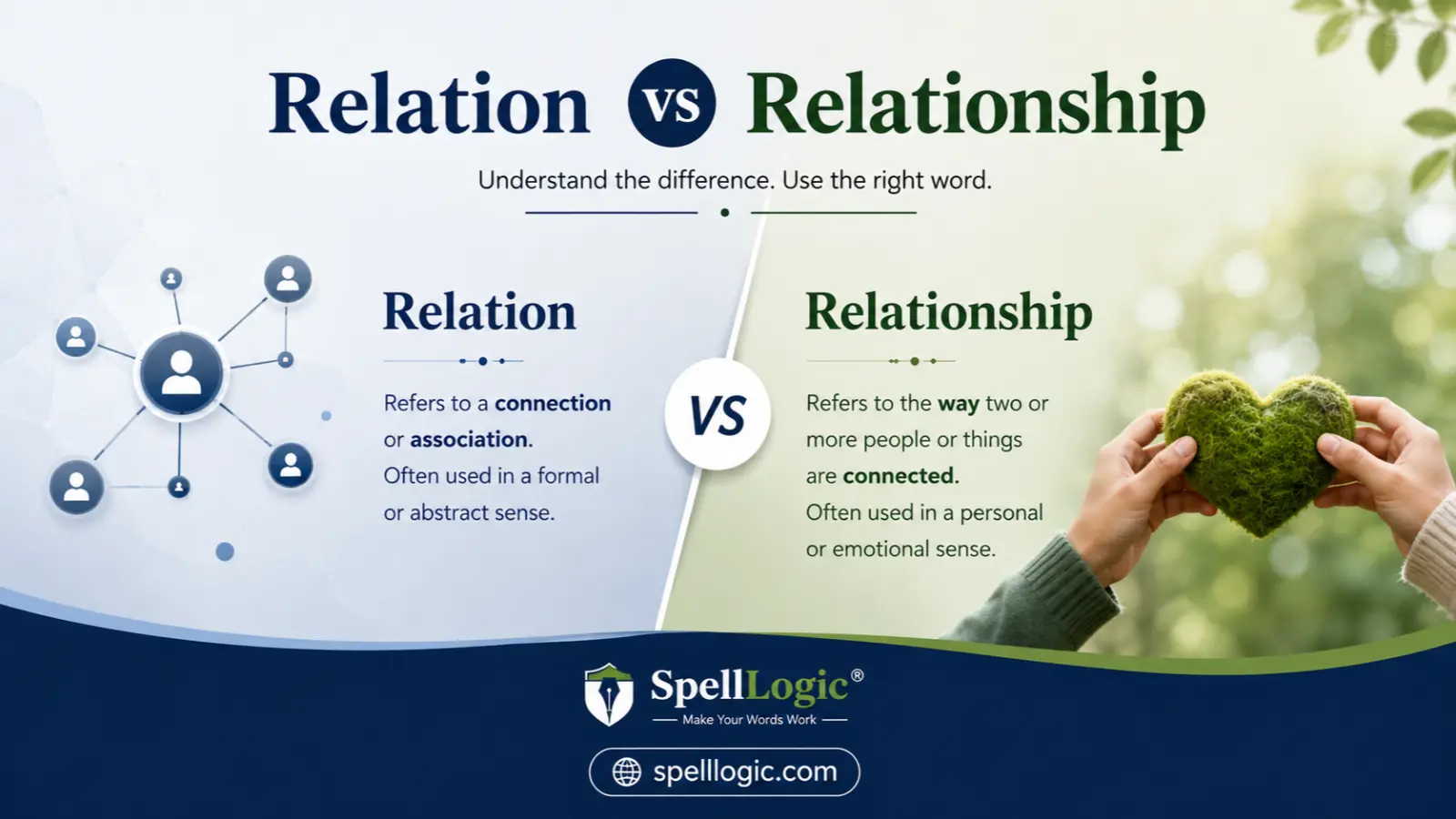
Relation vs Relationship However, there are important differences in meaning, usage, and context. Understanding these differences can help you communicate more naturally and accurately in both spoken and written English. In this guide, you’ll learn what each word means, how they differ, common mistakes to avoid, and simple memory tricks that make choosing the correct word much easier.
Many English learners find relation and relationship confusing because both words describe a connection between people, things, or ideas. In everyday conversations, these terms sometimes appear interchangeable, which makes it difficult to know which one to use.
Table of Contents
- Introduction
- Why “Relation” and “Relationship” Are Confusing
- Relation vs Relationship Explained Simply
- Understanding Homophones in English
- What Are Homophones?
- Why Homophones Cause Confusion
- What Does “Relation” Mean?
- What Does “Relationship” Mean?
- Relation vs Relationship: Key Differences at a Glance
- How to Remember the Difference Between Relation and Relationship
- Common Mistakes and Confusions
- Examples Section: Correct and Incorrect Usage
- Self Assessment: Test Your Knowledge
- Self Assessment Answers
- FAQs About “Relation and Relationship”
- Final Conclusion: Using “Relation” and “Relationship” Correctly
Why “Relation” and “Relationship” Are Confusing
English learners often mix up relation and relationship for several reasons.
Similar Pronunciation
Both words sound similar because they share the same root word, relate. The difference in pronunciation is small, especially in fast speech.
Similar Spelling
The words look nearly identical. The only major difference is the addition of -ship in relationship.
Context Confusion
In some situations, both words can refer to a connection between people or things. For example:
- Their relation to the project is unclear.
- Their relationship with the project is important.
Because both sentences discuss a connection, learners may assume the words mean exactly the same thing.
Common Learner Mistakes
Many learners:
- Use relation when talking about romantic partners.
- Use relationship when referring to family members.
- Believe both words are interchangeable in every context.
In reality, each word has preferred uses.
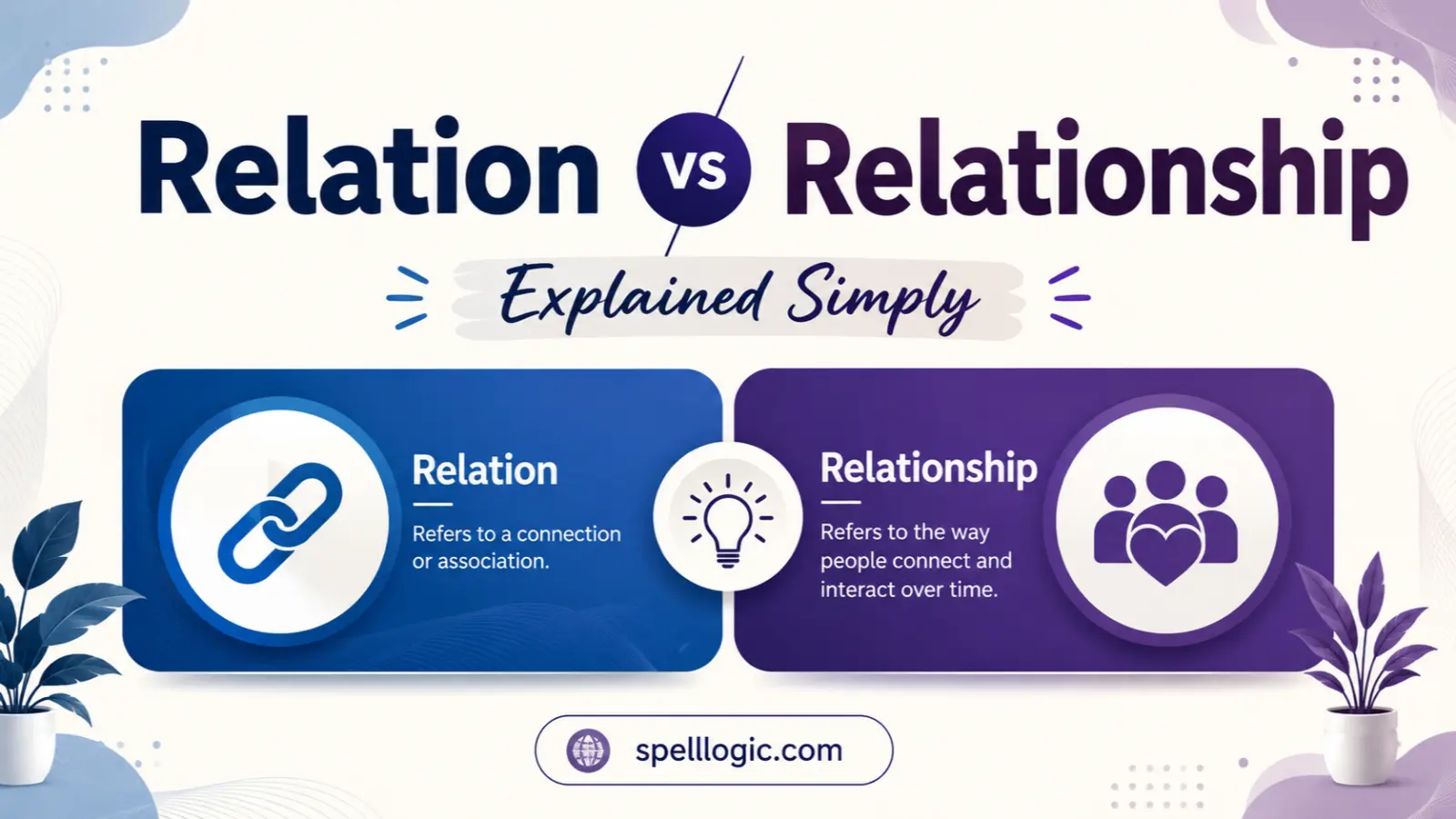
Relation vs Relationship Explained Simply
Relation usually refers to a connection, association, or family member.
Relationship usually refers to the way two or more people, groups, or things are connected and interact over time.
One-Line Distinction
Relation means a connection or family link, while relationship means an ongoing connection or interaction between people or things.
Example Sentences
- Relation: My uncle is a close relation of ours.
- Relation: There is no relation between the two events.
- Relationship: They have a strong relationship.
- Relationship: The relationship between exercise and health is well known.
Relation means a connection or relative, while relationship means the nature of an ongoing connection.
Understanding Homophones in English
What Are Homophones?
Homophones are words that sound the same or nearly the same but have different meanings and often different spellings.
Example:
- Flower
- Flour
These words sound alike but mean different things.
Why Homophones Cause Confusion
When learners hear similar-sounding words, they may choose the wrong spelling or meaning.
For example:
- Their = belonging to them
- There = a place
Similarly, because relation and relationship sound similar and share a common root, learners sometimes use them incorrectly.
What Does “Relation” Mean?
Definition and Core Meaning
The word relation refers to:
- A connection between two things.
- A family member or relative.
- A reference or association between ideas, events, or subjects.
Origin and Historical Use
Relation comes from the Latin word relatio, meaning “bringing back” or “reporting.” It entered English centuries ago and was commonly used to describe connections, reports, and family ties.
Historically, it was a broader term than it is today.
Modern Usage and Synonyms
Today, relation is often used in formal writing, academic discussions, and family contexts.
Common synonyms include:
- Connection
- Association
- Link
- Relative
- Correspondence
Key Points
- Often used in formal English.
- Can mean a family member.
- Can describe a connection between concepts.
- Less common than relationship in everyday conversation.
Example Sentences
- She is a distant relation of the king.
- There is a clear relation between sleep and productivity.
- The scientist studied the relation between temperature and pressure.
- I have no relation to that company.
What Does “Relationship” Mean?
Definition and Core Meaning
A relationship is the way in which two or more people, groups, or things are connected and interact with each other.
Unlike relation, it often emphasizes the ongoing nature of the connection.
Origin and Historical Context
The word combines relation with the suffix -ship, which indicates a state, condition, or quality.
Over time, relationship became the preferred word for describing personal, social, business, and romantic connections.
Modern Usage and Synonyms
Today, relationship is extremely common in both spoken and written English.
Common synonyms include:
- Bond
- Connection
- Partnership
- Association
- Interaction
Key Points
- Describes ongoing connections.
- Commonly used for friendships and romance.
- Often used in business and professional contexts.
- Can describe connections between ideas and concepts.
Example Sentences
- They have a healthy relationship.
- Our company has a strong relationship with its clients.
- The relationship between diet and health is important.
- She values her relationship with her family.
Relation vs Relationship: Key Differences at a Glance
| Word | Part of Speech | Meaning | Example Context |
|---|---|---|---|
| Relation | Noun | A connection, association, or family member | He is my closest relation. |
| Relation | Noun | A link between ideas or events | The relation between the variables is clear. |
| Relationship | Noun | An ongoing connection between people or things | They have a good relationship. |
| Relationship | Noun | The way people or groups interact | The company values customer relationships. |
How to Remember the Difference Between Relation and Relationship
Learning a simple memory trick can make these words easier to remember.
Easy Memory Tricks
Relation = Relative
If you see relation, think about family members or a simple connection.
Relationship = Partnership
If you see relationship, think about interactions, friendships, romance, or ongoing connections.
Association Technique
Notice the ending:
- Relation = basic link
- Relationship = active connection
The suffix -ship often describes a state or condition.
Examples:
- Friendship
- Leadership
- Membership
Likewise:
- Relationship = state of being connected
Memorable Example
A cousin is a relation, but the way you get along with your cousin is your relationship.
This sentence clearly shows the difference.
Common Mistakes and Confusions
Here are some errors English learners frequently make.
Mistake 1
Wrong: She is in a relation with Tom.
Correct: She is in a relationship with Tom.
Explanation: Romantic connections are usually called relationships.
Mistake 2
Wrong: My relationship lives in Canada.
Correct: My relation lives in Canada.
Explanation: When referring to a family member, use relation.
Mistake 3
Wrong: We need to improve our relation with customers.
Correct: We need to improve our relationship with customers.
Explanation: Business interactions are usually described as relationships.
Mistake 4
Wrong: He is my relationship.
Correct: He is my relation.
Explanation: A person can be your relation, but not your relationship.
Examples Section: Correct and Incorrect Usage
Example 1
✔ Correct: My aunt is a close relation.
✘ Incorrect: My aunt is a close relationship.
Example 2
✔ Correct: They have a happy relationship.
✘ Incorrect: They have a happy relation.
Example 3
✔ Correct: Researchers studied the relation between income and education.
✘ Incorrect: Researchers studied the relationship relative between income and education.
Example 4
✔ Correct: The relationship between teacher and student is important.
✘ Incorrect: The relation between teacher and student is important in everyday conversation.
(While not always grammatically wrong, “relationship” sounds more natural here.)
Example 5
✔ Correct: I have no relation to that family.
✘ Incorrect: I have no relationship to that family.
Example 6
✔ Correct: Their business relationship has lasted for years.
✘ Incorrect: Their business relation has lasted for years.
Self Assessment: Test Your Knowledge
Fill in the blanks with relation or relationship.
1.
My grandfather is a close ________.
2.
The company wants to improve its ________ with customers.
3.
Scientists examined the ________ between climate and agriculture.
4.
They have been in a happy ________ for five years.
Self Assessment Answers
1.
My grandfather is a close relation.
2.
The company wants to improve its relationship with customers.
3.
Scientists examined the relation between climate and agriculture.
4.
They have been in a happy relationship for five years.
FAQs
1. Are relation and relationship the same?
No. While both involve connections, relation often refers to a family member or simple association, while relationship describes an ongoing connection.
2. Which word is used for romance?
Relationship is the correct word for romantic connections.
3. Can relation mean a family member?
Yes. A relation is another word for a relative.
4. Which word is more common in everyday English?
Relationship is generally more common in modern conversation.
5. Can both words describe connections between ideas?
Yes. However, relation is often preferred in formal or academic contexts.
6. Is “business relation” correct?
It is grammatically possible, but business relationship is far more common and natural.
7. How can I remember the difference?
Think of this rule:
- Relation = Relative
- Relationship = Partnership
This simple trick works in most situations.
Final Conclusion: Using “Relation” and “Relationship” Correctly
Understanding the difference between relation and relationship can make your English sound more natural and precise. Although both words describe some type of connection, they are not always interchangeable. Relation typically refers to a family member, a relative, or a simple association between people, ideas, or events. Relationship, on the other hand, describes the nature of an ongoing connection, interaction, or bond between people, groups, or things. This is why we commonly talk about romantic relationships, business relationships, customer relationships, and family relationships.
A useful way to remember the distinction is to connect relation with relative and relationship with partnership. If you are talking about a person who belongs to your family, relation is often the correct choice. If you are describing how people interact or connect over time, relationship is usually the better option. Context plays an important role, so paying attention to real-life examples will help reinforce the difference.
The more you read, write, and listen to English, the easier these distinctions become. Don’t worry if you make mistakes at first—every learner does. Keep practicing, review the examples in this guide, and soon you’ll use relation and relationship confidently and correctly in everyday English.