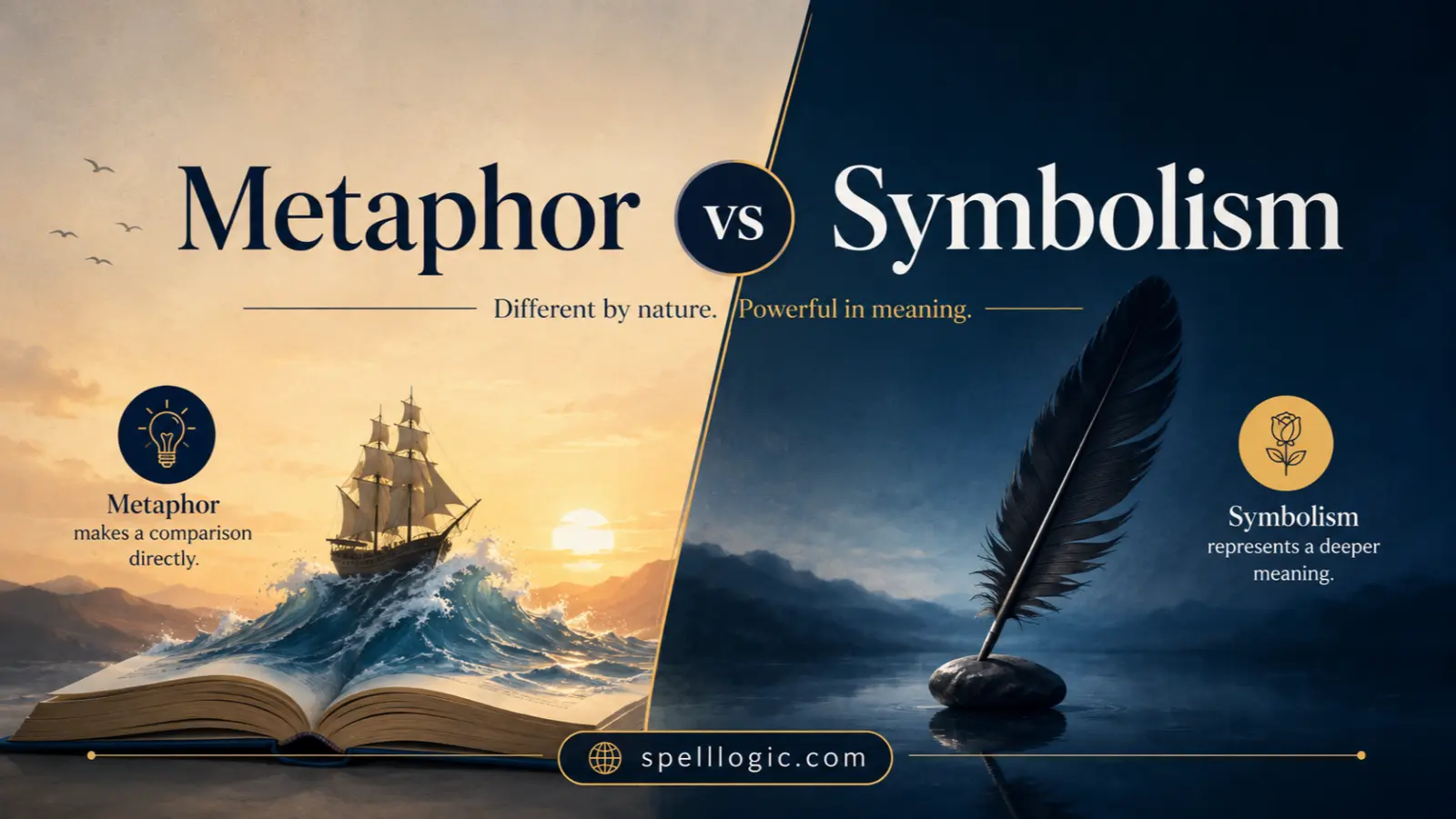
Many English learners struggle with metaphor vs symbolism because both are literary devices used to create deeper meaning in writing and speech. At first glance, they seem similar since both help writers express ideas beyond their literal meanings. However, they work in different ways and serve different purposes.
Understanding the difference between metaphor and symbolism can improve your reading comprehension, writing skills, and appreciation of literature. Whether you are studying English, analyzing a poem, or simply trying to communicate more effectively, knowing when to identify a metaphor and when to recognize symbolism is an important skill.
Table of Contents
- Why “Metaphor” and “Symbolism” Are Confusing
- Metaphor vs Symbolism Explained Simply
- Understanding Homophones in English
- What Does “Metaphor” Mean?
- What Does “Symbolism” Mean?
- Metaphor vs Symbolism: Key Differences at a Glance
- How to Remember the Difference Between Metaphor and Symbolism
- Common Mistakes and Confusions
- Examples Section: Correct and Incorrect Usage
- Self Assessment: Test Your Knowledge
- Self Assessment Answers
- FAQs About “Metaphor and Symbolism”
- Final Conclusion: Using “Metaphor” and “Symbolism” Correctly
Why “Metaphor” and “Symbolism” Are Confusing
Many learners mix up metaphor and symbolism because both involve meaning beyond the literal definition of words or objects.
Similar Pronunciation
The words do not sound exactly alike, but they are often discussed together in literature classes. This frequent pairing can make learners assume they mean the same thing.
Similar Spelling
Both words are literary terms and share a similar academic style. As a result, students sometimes confuse their definitions.
Context Confusion
Metaphors and symbols often appear in the same poem, novel, or speech. For example, a writer may use a rose as a symbol of love while also comparing love to a journey through a metaphor.
Common Learner Mistakes
- Calling every symbol a metaphor.
- Thinking metaphor and symbolism are interchangeable.
- Assuming both devices work in exactly the same way.
- Misidentifying literary techniques during reading comprehension exercises.
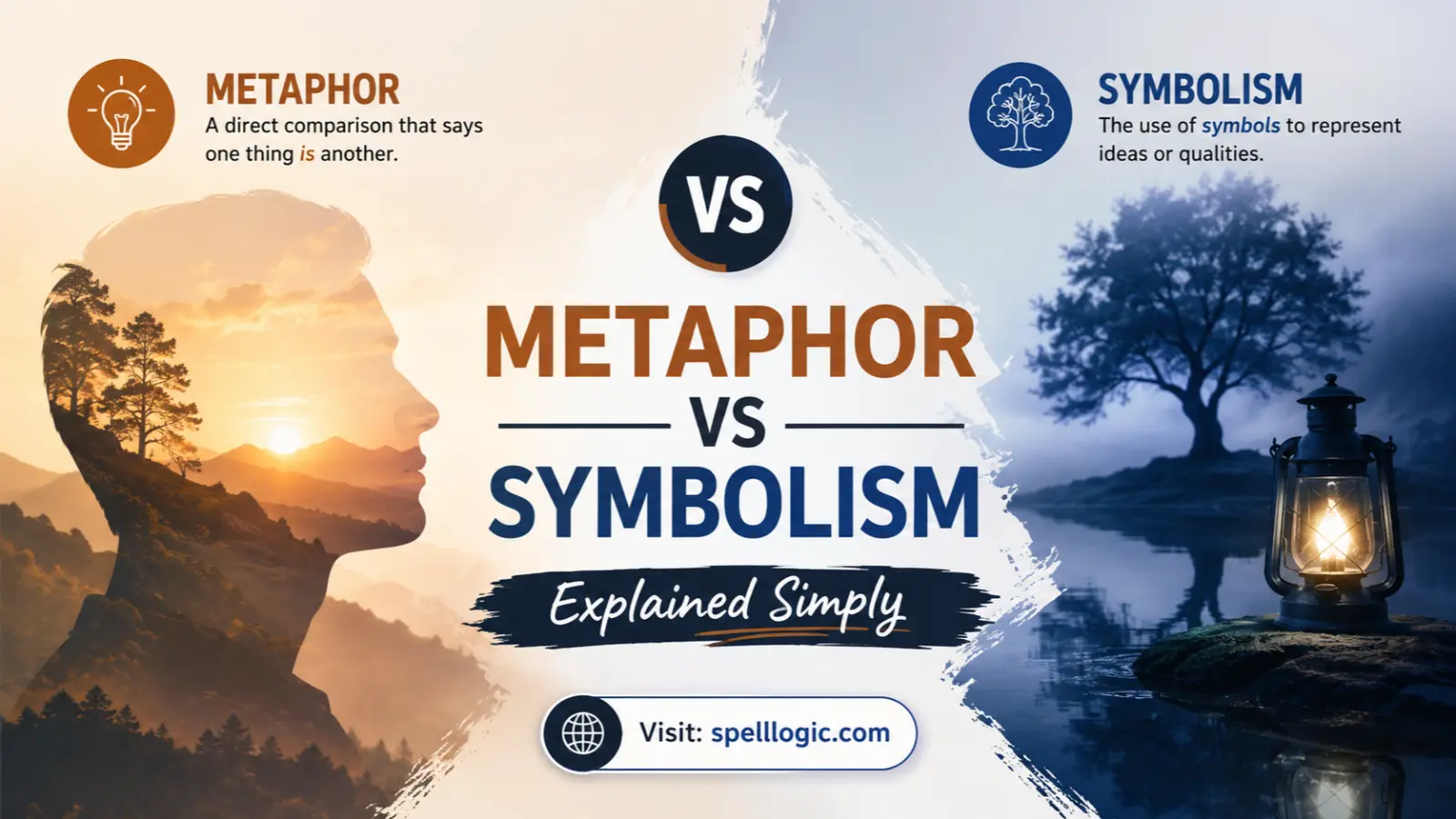
Metaphor vs Symbolism Explained Simply
A metaphor is a direct comparison between two unlike things.
Symbolism is the use of an object, image, person, or action to represent a deeper meaning or idea.
One-Line Distinction
Metaphor compares, while symbolism represents.
Simple Explanation
A metaphor says one thing is another thing to highlight a shared quality.
Symbolism uses something concrete to stand for something abstract.
Example Sentences
Metaphor means a comparison, while symbolism means representation.
- Her smile was sunshine. (Metaphor)
- The white dove symbolizes peace. (Symbolism)
Another pair:
- Time is a thief. (Metaphor)
- A broken chain symbolizes freedom. (Symbolism)
Understanding Homophones in English
Although metaphor and symbolism are not homophones, understanding homophones helps learners avoid confusion between similar-sounding words.
What Are Homophones?
Homophones are words that sound the same but have different meanings and spellings.
Example:
- Flower
- Flour
These words sound alike but mean different things.
Why Homophones Cause Confusion
Learners often rely on pronunciation when learning vocabulary. This can lead to mistakes.
For example:
- Their
- There
- They’re
These words sound identical but have different uses and meanings.
Metaphor and symbolism are not homophones, but they create confusion because they belong to the same literary field.
What Does “Metaphor” Mean?
Definition and Core Meaning
A metaphor is a figure of speech that directly compares two unlike things without using words such as like or as.
The purpose is to make descriptions more vivid and memorable.
Origin and Historical Use
The word metaphor comes from the Greek word metaphora, meaning “transfer” or “carry over.”
Ancient Greek philosophers and writers used metaphors extensively to explain complex ideas in a simple way.
Modern Usage and Synonyms
Today, metaphors appear in:
- Literature
- Speeches
- Journalism
- Everyday conversation
- Advertising
Common synonyms include:
- Figurative comparison
- Analogy (in some contexts)
- Figurative expression
Key Characteristics
- Compares two things directly.
- Creates imagery.
- Enhances understanding.
- Makes writing more engaging.
Example Sentences
- The classroom was a zoo.
- His mind is a computer.
- The city is a melting pot of cultures.
- Her voice was velvet.
In each example, one thing is described as another thing to emphasize a shared quality.
What Does “Symbolism” Mean?
Definition and Core Meaning
Symbolism is the use of symbols to represent ideas, emotions, or concepts beyond their literal meaning.
A symbol stands for something larger than itself.
Origin and Historical Context
The word comes from the Greek term symbolon, meaning a sign or mark of recognition.
Symbolism has been used for centuries in:
- Religious texts
- Mythology
- Literature
- Art
- Cultural traditions
Modern Usage and Synonyms
Today, symbolism appears in:
- Novels
- Poetry
- Films
- Political movements
- Advertising campaigns
Common synonyms include:
- Representation
- Allegory (in some contexts)
- Emblematic meaning
Key Characteristics
- Represents deeper ideas.
- Often repeated throughout a work.
- Encourages interpretation.
- Adds layers of meaning.
Example Sentences
- The flag symbolizes national pride.
- A red rose symbolizes love.
- The storm symbolizes emotional turmoil.
- Light often symbolizes hope.
In these examples, the object represents something beyond its literal meaning.
Metaphor vs Symbolism: Key Differences at a Glance
| Word | Part of Speech | Meaning | Example Context |
|---|---|---|---|
| Metaphor | Noun | A direct comparison between two unlike things | “Life is a journey.” |
| Symbolism | Noun | The use of symbols to represent deeper meanings | “The dove symbolizes peace.” |
Additional Difference
| Feature | Metaphor | Symbolism |
|---|---|---|
| Purpose | Compare | Represent |
| Meaning | Figurative comparison | Deeper significance |
| Example | “Knowledge is power.” | A key symbolizing opportunity |
| Common Use | Descriptions and imagery | Themes and messages |
How to Remember the Difference Between Metaphor and Symbolism
Easy Memory Tricks
Metaphor = Match
Think of metaphor as matching one thing to another.
Example:
- Time = thief
Symbolism = Symbol
The word symbolism contains symbol.
A symbol represents an idea.
Example:
- Dove = peace
Association Techniques
Ask yourself:
Is the writer comparing two things?
- Yes → Metaphor
Is the writer using something to represent an idea?
- Yes → Symbolism
One Memorable Example
- Life is a roller coaster. → Metaphor
- A roller coaster in a story represents life’s ups and downs. → Symbolism
The same object can sometimes be involved in both techniques, but the purpose is different.
Common Mistakes and Confusions
Mistake 1
❌ The dove is a metaphor for peace.
✔ The dove is a symbol of peace.
Explanation: The dove represents peace rather than directly comparing itself to peace.
Mistake 2
❌ The sentence “My teacher is a lion” uses symbolism.
✔ The sentence “My teacher is a lion” uses a metaphor.
Explanation: The teacher is directly compared to a lion.
Mistake 3
❌ Symbolism compares two things.
✔ Symbolism represents ideas through symbols.
Explanation: Comparison is the role of metaphor.
Mistake 4
❌ Every symbol is a metaphor.
✔ Symbols and metaphors are different literary devices.
Explanation: While both create deeper meaning, they work differently.
Examples Section: Correct and Incorrect Usage
Example 1
✔ Correct: His heart was made of stone. (Metaphor)
✘ Incorrect: His heart was made of stone symbolizes cruelty.
Example 2
✔ Correct: The white dove symbolizes peace. (Symbolism)
✘ Incorrect: The white dove is peace. (Unless intentionally used as a metaphor.)
Example 3
✔ Correct: The world is a stage. (Metaphor)
✘ Incorrect: The world is a stage is symbolism.
Example 4
✔ Correct: Dark clouds symbolize trouble ahead.
✘ Incorrect: Dark clouds compare trouble ahead.
Example 5
✔ Correct: Her ideas were seeds planted in young minds. (Metaphor)
✘ Incorrect: Her ideas were seeds is symbolism.
Self Assessment: Test Your Knowledge
Fill in the blanks with metaphor or symbolism.
1.
The sentence “The classroom was a battlefield” is an example of __________.
2.
A red rose representing love is an example of __________.
3.
“Time is money” is a __________.
4.
A national flag representing a country demonstrates __________.
Self Assessment Answers
- Metaphor
- Symbolism
- Metaphor
- Symbolism
FAQs
1. What is the main difference between metaphor and symbolism?
A metaphor directly compares two things, while symbolism uses an object or image to represent a deeper idea.
2. Can a symbol also be part of a metaphor?
Yes. In some literary works, an object may function as both a symbol and part of a metaphorical expression.
3. Is symbolism a figure of speech?
Symbolism is generally considered a literary device rather than a traditional figure of speech.
4. Why do writers use metaphors?
Writers use metaphors to create vivid imagery, emphasize ideas, and make descriptions more engaging.
5. Why is symbolism important in literature?
Symbolism adds depth and allows readers to discover hidden meanings and themes.
6. Which is easier to identify: metaphor or symbolism?
Metaphors are often easier because they involve direct comparisons. Symbols may require more interpretation.
7. Can symbolism appear outside literature?
Yes. Flags, logos, colors, and cultural objects often function as symbols in everyday life.
Final Conclusion: Using “Metaphor” and “Symbolism” Correctly
Understanding the difference between metaphor vs symbolism is an important step toward mastering English literature and improving your communication skills. Although these two literary devices often appear together, they serve different purposes. A metaphor creates a direct comparison between two unlike things to highlight a shared quality. For example, saying “Life is a journey” helps readers understand life through comparison. Symbolism, on the other hand, uses an object, image, action, or character to represent a deeper idea. A dove representing peace or a rose representing love are classic examples of symbolism.
When deciding which term applies, remember a simple rule: metaphors compare, symbols represent. This quick memory trick can help you identify each device more accurately when reading stories, poems, articles, or speeches. Additionally, paying attention to the writer’s purpose can make the distinction clearer. If the writer is making a comparison, it is likely a metaphor. If the writer is giving an object a deeper meaning, it is probably symbolism.
The more examples you read and analyze, the easier it becomes to recognize these literary techniques. Keep practicing, stay curious, and remember that every new concept you learn brings you one step closer to becoming a more confident and skilled English user.