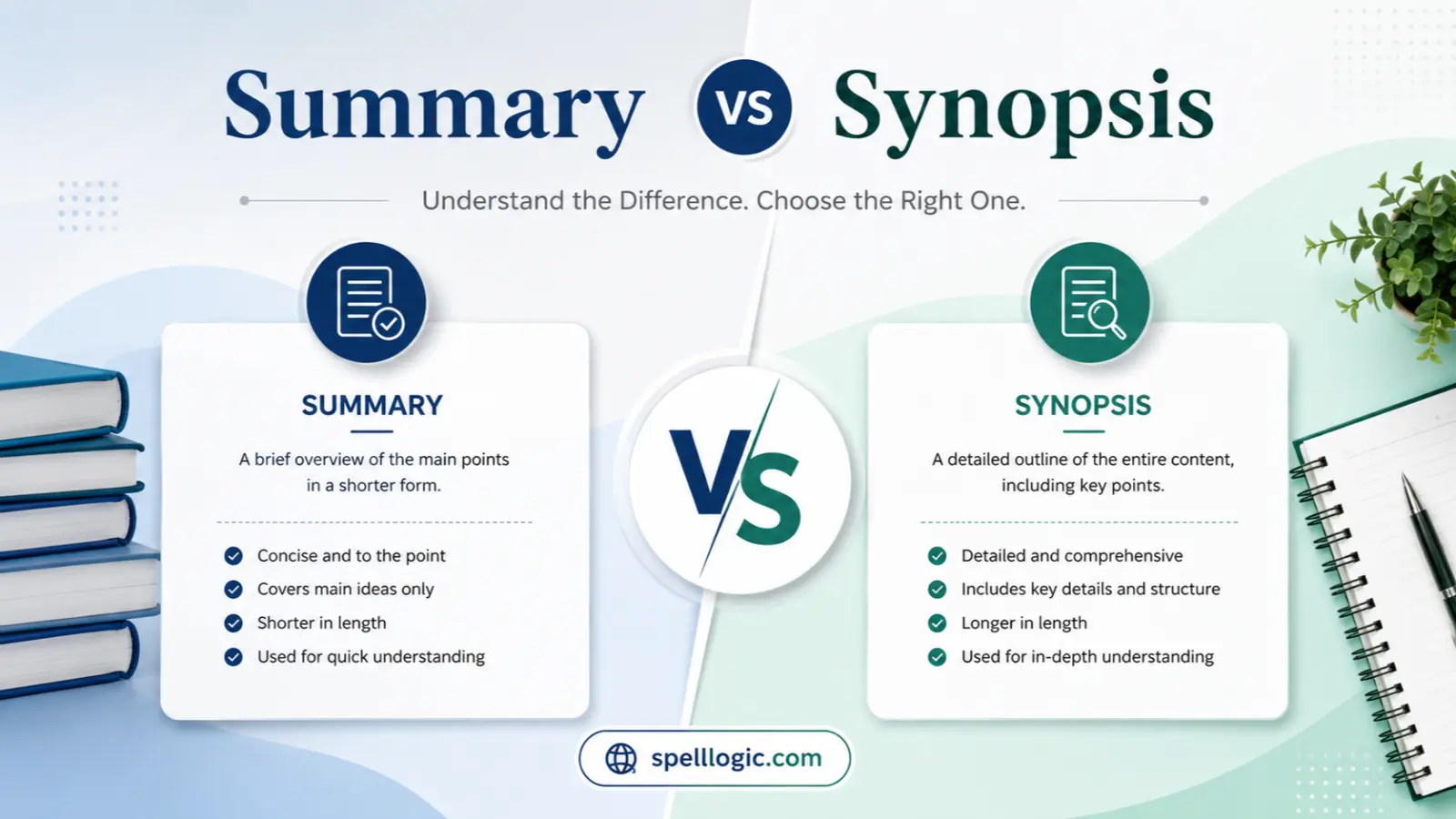
Summary vs Synopsis Many English learners get confused by summary and synopsis because both words refer to shortened versions of longer content. You may see them used when discussing books, movies, articles, reports, or presentations. Although they share a similar purpose, they are not exactly the same.
Understanding the difference can help you communicate more clearly in academic writing, professional settings, and everyday conversations. In this guide, you’ll learn what each word means, when to use it, and how to avoid common mistakes. By the end, you’ll confidently know whether to use summary or synopsis in any situation.
Table of Contents
- Introduction
- Why “Summary” and “Synopsis” Are Confusing
- Summary vs Synopsis Explained Simply
- Understanding Homophones in English
- What Are Homophones?
- Why Homophones Cause Confusion
- What Does “Summary” Mean?
- What Does “Synopsis” Mean?
- Summary vs Synopsis: Key Differences at a Glance
- How to Remember the Difference Between Summary and Synopsis
- Common Mistakes and Confusions
- Examples Section: Correct and Incorrect Usage
- Self Assessment: Test Your Knowledge
- Self Assessment Answers
- FAQs About “Summary and Synopsis”
- Final Conclusion: Using “Summary” and “Synopsis” Correctly
Why “Summary” and “Synopsis” Are Confusing
People often mix up summary and synopsis because both words describe condensed information.
Similar Pronunciation
The words do not sound exactly alike, but they share a similar rhythm and are often used in similar contexts.
Similar Spelling
Both words begin with the letter S and refer to shortened versions of larger works, which can make them seem interchangeable.
Context Confusion
A book, movie, or report can have both a summary and a synopsis. Because they serve related purposes, many learners assume they mean the same thing.
Common Learner Mistakes
Learners often:
- Use synopsis when they mean a general summary.
- Use summary when referring to a formal plot overview.
- Assume both words are perfect synonyms in every situation.
While the meanings overlap, the intended use is often different.
Summary vs Synopsis Explained Simply
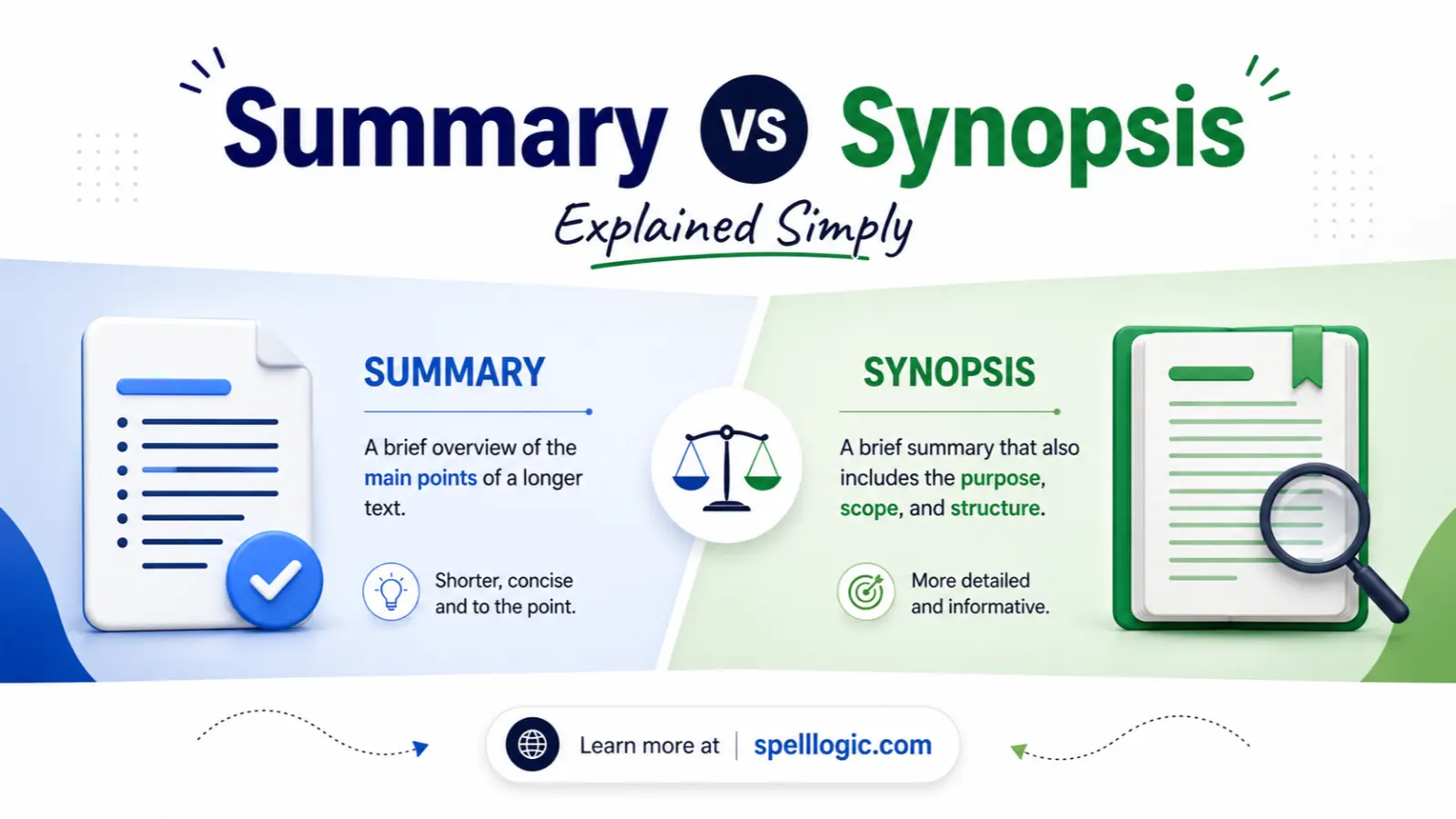
Summary means a brief statement of the main points of something, while synopsis means a condensed outline or overview of a story, book, movie, or larger work.
One-Line Distinction
A summary highlights the key points, while a synopsis outlines the overall content or plot.
Example Sentences
- The teacher asked us to write a summary of the article.
- The publisher requested a synopsis of the novel before reviewing it.
Another pair of examples:
- Her summary captured the main ideas of the report.
- The movie’s synopsis appeared on the back of the DVD case.
Understanding Homophones in English
What Are Homophones?
Homophones are words that sound the same but have different meanings and often different spellings.
Example:
- Sea and see
These words sound alike but mean different things.
Why Homophones Cause Confusion
English learners often rely on pronunciation when learning vocabulary. When two words sound similar, they can easily be confused.
For example:
- Their = belonging to them
- There = a place
Although summary and synopsis are not true homophones, they create confusion because their meanings overlap and they appear in similar situations.
What Does “Summary” Mean?
Definition and Core Meaning
A summary is a short version of a longer text, speech, event, or piece of information that includes only the most important points.
The goal is to present the essential information without unnecessary details.
Origin and Historical Use
The word summary comes from the Latin word summarium, meaning “an abstract” or “brief statement.”
For centuries, writers and scholars have used summaries to condense lengthy information into a more manageable form.
Modern Usage and Synonyms
Today, summary is widely used in schools, businesses, journalism, and everyday communication.
Common synonyms include:
- Overview
- Abstract
- Recap
- Outline
- Digest
Key Characteristics
- Focuses on main ideas
- Removes unnecessary details
- Can apply to almost any content
- Often used in education and business
Example Sentences
- Please write a summary of the chapter.
- The report includes an executive summary.
- She gave a summary of the meeting.
- The news anchor provided a quick summary of the event.
What Does “Synopsis” Mean?
Definition and Core Meaning
A synopsis is a concise outline of a book, film, play, television show, or similar work. It presents the main storyline or structure in a shortened form.
Unlike a summary, a synopsis often follows the sequence of events.
Origin and Historical Context
The word synopsis comes from Greek roots meaning “a general view” or “seeing together.”
Historically, it referred to a broad overview that allowed readers to understand the structure of a work at a glance.
Modern Usage and Synonyms
Today, synopsis is especially common in publishing, filmmaking, theater, and entertainment.
Common synonyms include:
- Plot outline
- Story overview
- Brief description
- Narrative outline
- Condensed account
Key Characteristics
- Often focuses on stories
- May include major plot points
- Used in publishing and entertainment
- Presents an overall view of a work
Example Sentences
- The author submitted a synopsis of her novel.
- Read the synopsis before watching the movie.
- The producer requested a one-page synopsis.
- The book’s synopsis revealed the main conflict.
Summary vs Synopsis: Key Differences at a Glance
| Word | Part of Speech | Meaning | Example Context |
|---|---|---|---|
| Summary | Noun | A brief statement of the main points | A summary of a report |
| Synopsis | Noun | A condensed outline of a story or work | A synopsis of a novel |
| Summary | Noun | Focuses on key ideas and conclusions | School assignments |
| Synopsis | Noun | Focuses on structure or plot | Publishing and film industries |
How to Remember the Difference Between Summary and Synopsis
Easy Memory Tricks
Summary = Main Points
Think of a summary as a quick collection of the most important information.
Synopsis = Story Overview
Think of a synopsis as a map of a story’s journey.
Association Techniques
- Summary → School reports
- Synopsis → Books and movies
One Memorable Example
Imagine reading a novel.
- A summary tells you the most important ideas.
- A synopsis tells you what happens throughout the story.
This simple image can help you choose the correct word.
Common Mistakes and Confusions
Mistake 1
Wrong: Please send me a synopsis of the meeting.
Correct: Please send me a summary of the meeting.
Explanation: Meetings are usually summarized rather than given a formal synopsis.
Mistake 2
Wrong: The publisher requested a summary of every plot detail.
Correct: The publisher requested a synopsis of the novel.
Explanation: Publishers often ask for a synopsis because it outlines the story.
Mistake 3
Wrong: The movie summary explained every major scene.
Correct: The movie synopsis explained every major scene.
Explanation: A synopsis often follows the storyline.
Mistake 4
Wrong: I wrote a synopsis of the scientific report.
Correct: I wrote a summary of the scientific report.
Explanation: Reports typically require summaries, not synopses.
Examples Section: Correct and Incorrect Usage
Example 1
✔ Correct: The student submitted a summary of the research article.
✘ Incorrect: The student submitted a synopsis of the research article.
Example 2
✔ Correct: The agent asked for a synopsis of the screenplay.
✘ Incorrect: The agent asked for a summary of the screenplay’s plot structure.
Example 3
✔ Correct: The executive summary highlighted the report’s findings.
✘ Incorrect: The executive synopsis highlighted the report’s findings.
Example 4
✔ Correct: The book synopsis introduced the main characters and conflict.
✘ Incorrect: The book summary introduced every stage of the plot.
Example 5
✔ Correct: She gave a brief summary of the lecture.
✘ Incorrect: She gave a brief synopsis of the lecture.
Self Assessment: Test Your Knowledge
Fill in the blanks with summary or synopsis.
- The publisher requested a __________ of the novel before publication.
- Please provide a short __________ of today’s meeting.
- The movie’s __________ appeared on the streaming platform.
- The teacher asked students to write a __________ of the chapter.
Self Assessment Answers
- Synopsis
- Summary
- Synopsis
- Summary
FAQs
1. Is a synopsis the same as a summary?
No. A summary focuses on key points, while a synopsis usually provides an overview of a story or structured work.
2. Which word is more common in everyday English?
Summary is more common in everyday conversation, education, and business.
3. When should I use synopsis?
Use synopsis when discussing books, movies, plays, scripts, or other narrative works.
4. Can a synopsis contain spoilers?
Yes. Depending on its purpose, a synopsis may include important plot details and even the ending.
5. Is an executive summary a synopsis?
No. An executive summary highlights the most important information in a report or document.
6. Do publishers ask for summaries or synopses?
Publishers often request a synopsis because it outlines the story and major plot developments.
7. Can a summary be one sentence?
Yes. A summary can be as short as one sentence if it clearly communicates the main idea.
Final Conclusion: Using “Summary” and “Synopsis” Correctly
Understanding the difference between summary and synopsis can make your English more accurate and professional. Although both words refer to shortened versions of longer content, they serve different purposes. A summary focuses on the most important points, ideas, or conclusions of a text, report, speech, or event. A synopsis, on the other hand, provides a condensed overview of a story, book, movie, screenplay, or other narrative work, often following the main sequence of events.
In everyday situations, you’ll probably use summary more often. Teachers ask students for summaries, businesses create executive summaries, and people summarize meetings or articles. Meanwhile, synopsis is especially useful in publishing, filmmaking, and entertainment, where understanding a story’s structure is important.
A simple memory trick can help: summary = main points, synopsis = story overview. If you’re talking about the essential ideas, choose summary. If you’re describing the plot or structure of a creative work, choose synopsis.
The more you read, write, and practice these words in context, the easier it becomes to use them correctly. Keep learning, pay attention to real-world examples, and remember that every new distinction you master makes your English stronger and more confident.