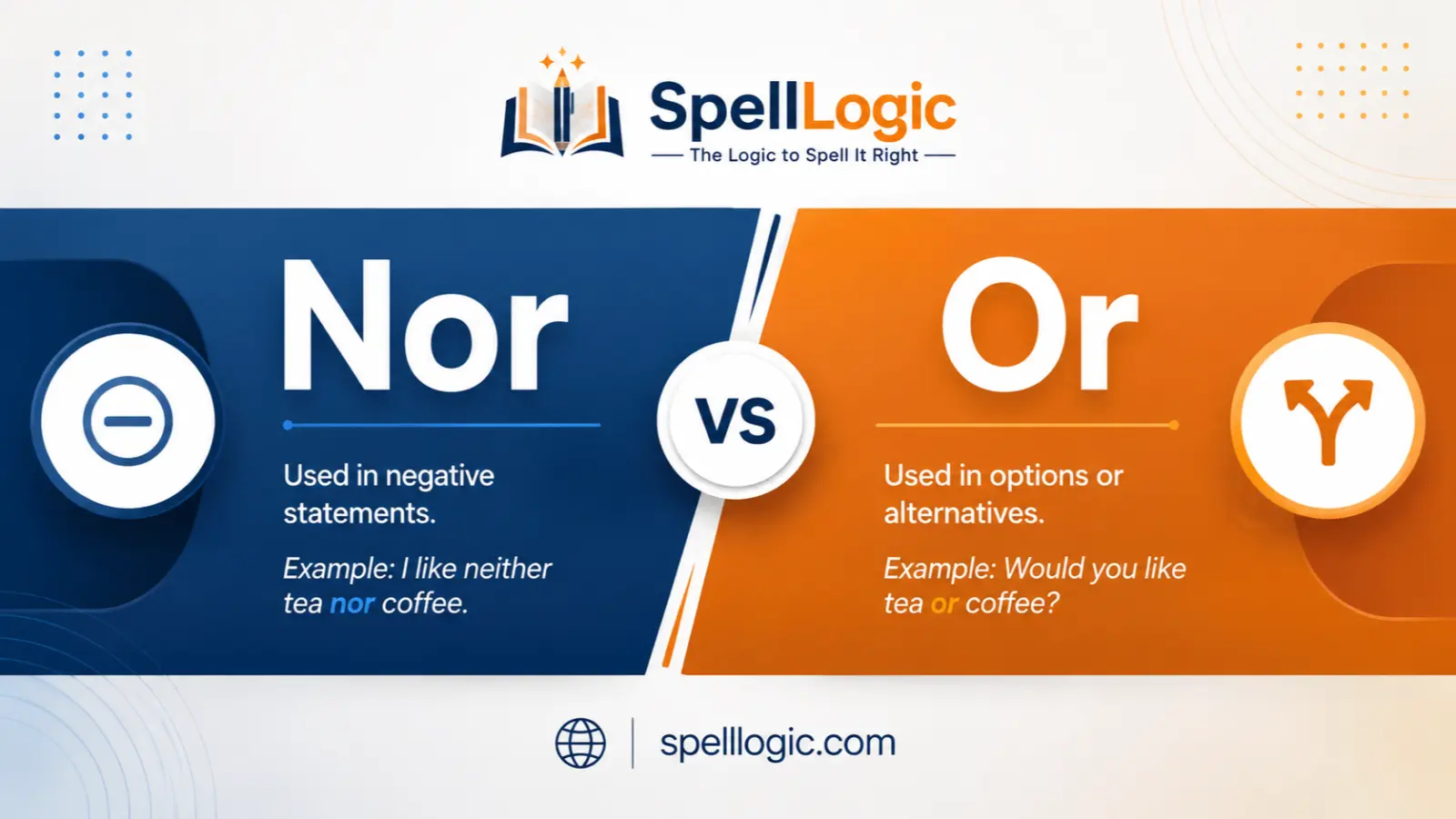
Nor vs Or Many English learners struggle with nor and or because both words connect ideas in a sentence. At first glance, they seem very similar, and in some situations, they even appear in related sentence structures.
However, these two conjunctions have different grammatical purposes. Using the wrong one can make a sentence sound awkward or grammatically incorrect. Understanding the difference between nor and or helps you communicate more clearly in both speaking and writing. In this guide, you’ll learn the meanings, uses, examples, memory tricks, and common mistakes related to these two commonly confused English words.
Table of Contents
- Introduction
- Why “Nor” and “Or” Are Confusing
- Nor vs Or Explained Simply
- Understanding Homophones in English
- What Are Homophones?
- Why Homophones Cause Confusion
- What Does “Nor” Mean?
- What Does “Or” Mean?
- Nor vs Or: Key Differences at a Glance
- How to Remember the Difference Between Nor and Or
- Common Mistakes and Confusions
- Examples Section: Correct and Incorrect Usage
- Self Assessment: Test Your Knowledge
- Self Assessment Answers
- FAQs About “Nor and Or”
- Final Conclusion: Using “Nor” and “Or” Correctly
Why “Nor” and “Or” Are Confusing
Many learners mix up nor and or for several reasons.
Similar Pronunciation
Both words are short and sound somewhat alike, especially in fast speech. This can make it difficult for learners to distinguish them.
Similar Spelling
The words differ by only one letter. Because of this, learners often confuse them when writing.
Context Confusion
Both words are conjunctions used to connect words, phrases, or clauses. However, they are used in different grammatical situations.
Common Learner Mistakes
Learners often:
- Use or after a negative statement when nor is required.
- Use nor in positive sentences.
- Forget that nor is commonly paired with neither.
- Confuse the structures “either…or” and “neither…nor.”
Nor vs Or Explained Simply
Or is used to present alternatives or choices.
Nor is used to connect a second negative idea to a first negative idea.
One-Line Distinction
Nor means “and not,” while or means “one choice or another.”
Example Sentences
- I would like tea or coffee.
- She did not call, nor did she send a message.
Nor means adding another negative idea, while or means presenting alternatives or options.
Understanding Homophones in English
What Are Homophones?
Homophones are words that sound the same or nearly the same but have different meanings and spellings.
Example:
- Flower
- Flour
These words sound alike but mean different things.
Why Homophones Cause Confusion
Homophones can confuse learners because the pronunciation is similar while the meaning changes completely.
Example:
- I bought flour for baking.
- The flower looks beautiful.
Although nor and or are not true homophones, their similar sound and spelling often lead to confusion.
What Does “Nor” Mean?
Definition and Core Meaning
Nor is a conjunction used to introduce another negative statement. It often means “and not” or “also not.”
Origin and Historical Use
The word nor comes from Old English nāhwæðer, which developed into forms expressing negative alternatives. It has been used in English for centuries to connect negative ideas.
Modern Usage and Synonyms
Today, nor is commonly used:
- After neither
- After a negative statement
- In formal and written English
Possible meanings include:
- And not
- Also not
- Neither
Key Points
- Connects negative ideas
- Often follows neither
- Common in formal grammar
- Creates balance between negative elements
Example Sentences
- Neither John nor Mary attended the meeting.
- She doesn’t like coffee, nor does she enjoy tea.
- He was not hungry, nor was he thirsty.
- The answer is neither simple nor obvious.
What Does “Or” Mean?
Definition and Core Meaning
Or is a conjunction used to show alternatives, choices, possibilities, or options.
Origin and Historical Context
The word or comes from Old English oþþe, meaning “either” or “otherwise.” It has long been used to connect alternatives.
Modern Usage and Synonyms
Today, or is one of the most common conjunctions in English.
It can mean:
- Either
- Alternatively
- Otherwise
Key Points
- Shows choices or options
- Connects alternatives
- Used in questions
- Common in everyday speech and writing
Example Sentences
- Would you like tea or coffee?
- We can travel by train or bus.
- Call me today or tomorrow.
- Is that your book or mine?
Nor vs Or: Key Differences at a Glance
| Word | Part of Speech | Meaning | Example Context |
|---|---|---|---|
| Nor | Conjunction | Introduces another negative idea; means “and not” | Neither Sarah nor Tom was present. |
| Or | Conjunction | Presents alternatives, options, or choices | Would you like cake or ice cream? |
How to Remember the Difference Between Nor and Or
Easy Memory Tricks
Nor = Negative
Both words start with N:
- Nor
- Negative
If the sentence is negative, nor may be the correct choice.
Association Technique
Remember these pairs:
- Either → Or
- Neither → Nor
These combinations almost always go together.
Memorable Example
Think:
- Either pizza or pasta. (choice)
- Neither pizza nor pasta. (negative choice)
This simple pattern helps many learners remember the difference instantly.
Common Mistakes and Confusions
Mistake 1
❌ Neither Jack or Jill came.
✔ Neither Jack nor Jill came.
Explanation: After neither, use nor, not or.
Mistake 2
❌ She doesn’t like coffee or does she like tea.
✔ She doesn’t like coffee, nor does she like tea.
Explanation: The second clause is also negative, so nor is needed.
Mistake 3
❌ Would you like tea nor coffee?
✔ Would you like tea or coffee?
Explanation: The sentence offers a choice, so use or.
Mistake 4
❌ Either Sam nor Ben will help.
✔ Either Sam or Ben will help.
Explanation: Either pairs with or, not nor.
Examples Section: Correct and Incorrect Usage
Example 1
✔ Correct: Neither the manager nor the assistant was available.
✘ Incorrect: Neither the manager or the assistant was available.
Example 2
✔ Correct: Would you like water or juice?
✘ Incorrect: Would you like water nor juice?
Example 3
✔ Correct: She didn’t apologize, nor did she explain her actions.
✘ Incorrect: She didn’t apologize, or did she explain her actions.
Example 4
✔ Correct: Either you can stay here or you can leave now.
✘ Incorrect: Either you can stay here nor you can leave now.
Example 5
✔ Correct: He was neither tired nor upset.
✘ Incorrect: He was neither tired or upset.
Example 6
✔ Correct: We can meet today or tomorrow.
✘ Incorrect: We can meet today nor tomorrow.
Self Assessment: Test Your Knowledge
Fill in the blanks with nor or or.
1.
Neither the teacher _____ the students knew the answer.
2.
Would you prefer coffee _____ tea?
3.
He did not call, _____ did he send an email.
4.
Either you start now _____ you will be late.
Self Assessment Answers
1.
Neither the teacher nor the students knew the answer.
2.
Would you prefer coffee or tea?
3.
He did not call, nor did he send an email.
4.
Either you start now or you will be late.
FAQs
1. What is the main difference between nor and or?
Nor connects negative ideas, while or presents alternatives or choices.
2. Do I always use nor after neither?
Yes. The standard grammatical structure is neither…nor.
3. Can nor start a sentence?
Yes. In formal English, nor can begin a clause after a negative statement.
Example: He didn’t attend the meeting, nor did he send an apology.
4. Is or used only for choices?
Mostly, yes. It commonly introduces alternatives, options, possibilities, or consequences.
5. Which is more common in everyday English?
Or is much more common because people frequently discuss choices and alternatives.
6. Is nor considered formal?
Yes. Nor often sounds more formal than or, especially in written English.
7. Can I replace nor with or?
Usually not. Replacing nor with or often creates a grammatical error because they serve different functions.
Final Conclusion: Using “Nor” and “Or” Correctly
Understanding the difference between nor and or is an important step toward mastering English grammar. Although these two conjunctions look similar and sometimes appear in related sentence structures, they perform different jobs. Or is used when presenting choices, alternatives, or possibilities. Whenever you offer options—such as “tea or coffee” or “today or tomorrow”—or is the correct word. Nor, on the other hand, is used to connect negative ideas. It often appears with neither or after a negative statement to mean “and not” or “also not.”
A simple memory trick can help you remember the difference. Think of nor as the negative connector because both words start with the letter N. Also remember the common pairs: either…or and neither…nor. These patterns appear frequently in both spoken and written English.
In real-world communication, choosing the correct conjunction makes your sentences clearer and more natural. Whether you are writing emails, completing school assignments, preparing for English exams, or having conversations, using nor and or correctly will improve your grammar and confidence. Keep practicing with examples, pay attention to sentence structure, and review the memory tricks in this guide. With regular practice, distinguishing between nor and or will soon become second nature.