Many English learners struggle with ones and one’s because they look almost identical but have completely different meanings. A single apostrophe changes how the word works in a sentence, making it easy to choose the wrong form. Fortunately, the difference is simple once you understand the basic grammar rule.
Learning when to use ones and one’s will improve your writing, help you avoid common mistakes, and make your English sound more natural. In this guide, you’ll discover clear explanations, practical examples, memory tricks, and exercises to confidently use both words in everyday English.
Table of Contents
- Introduction
- Why “Ones” and “One’s” Are Confusing
- Ones vs One’s Explained Simply
- Understanding Homophones in English
- What Does “Ones” Mean?
- What Does “One’s” Mean?
- Ones vs One’s: Key Differences at a Glance
- How to Remember the Difference Between Ones and One’s
- Common Mistakes and Confusions
- Examples Section: Correct and Incorrect Usage
- Self Assessment: Test Your Knowledge
- Self Assessment Answers
- FAQs About “Ones” and “One’s”
- Final Conclusion: Using “Ones” and “One’s” Correctly
Why “Ones” and “One’s” Are Confusing
Many learners mix up ones and one’s because they look and sound very similar. However, they perform different jobs in English grammar.
Here are the main reasons for the confusion:
Similar Pronunciation
In everyday speech, ones and one’s are pronounced almost exactly the same. Since they sound alike, people often rely on spelling, which can lead to mistakes.
Similar Spelling
The only visible difference is the apostrophe. Because the words differ by just one punctuation mark, writers sometimes forget whether an apostrophe is needed.
Context Confusion
Both words can appear in similar types of sentences. For example:
- I like the blue ones.
- One’s opinion matters.
Without understanding the grammar, it’s easy to confuse them.
Common Learner Mistakes
Learners often:
- Add an apostrophe when it isn’t needed.
- Forget that one’s shows possession.
- Use ones when referring to ownership.
- Think every word ending in s should have an apostrophe.
Ones vs One’s Explained Simply
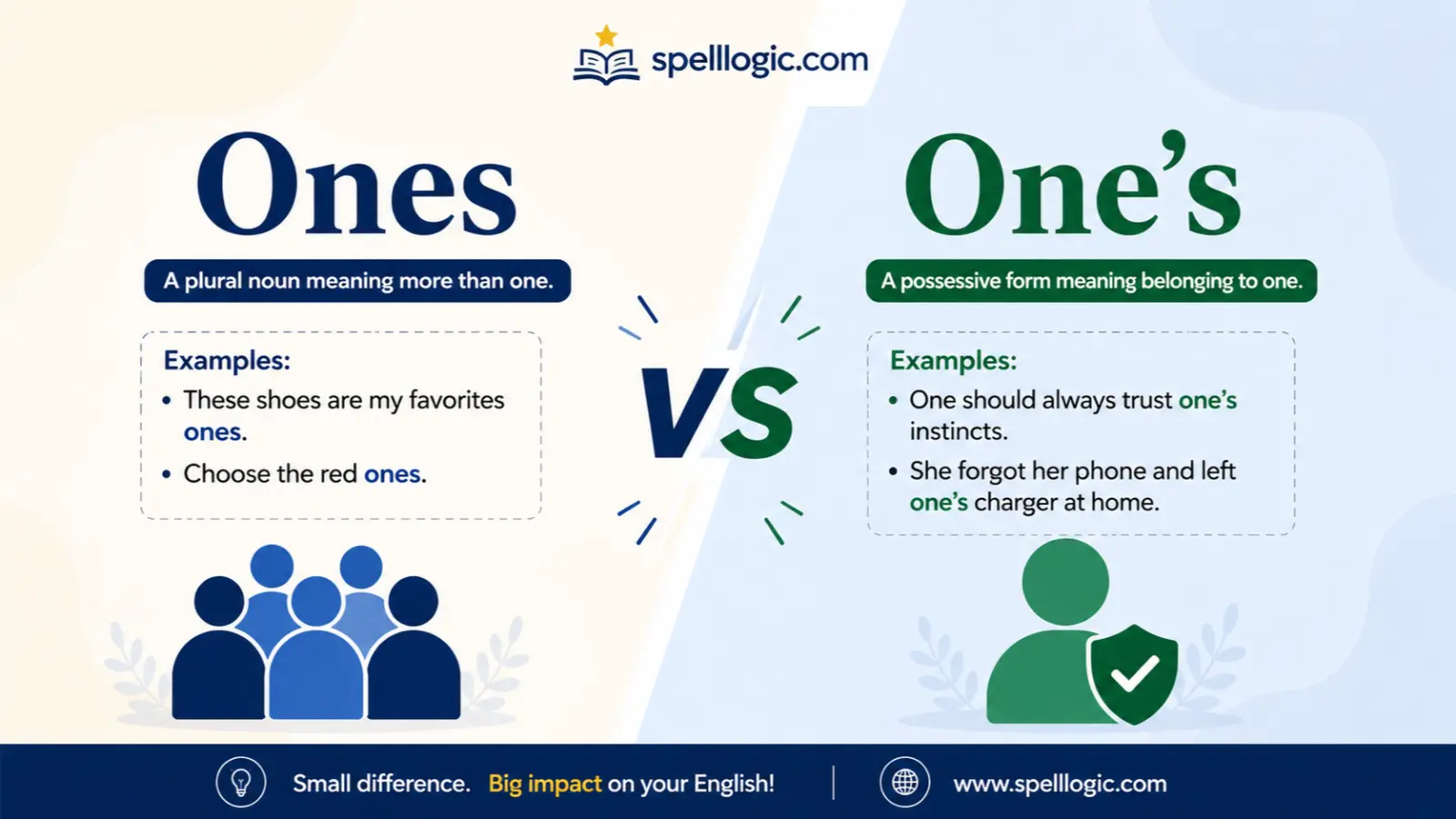
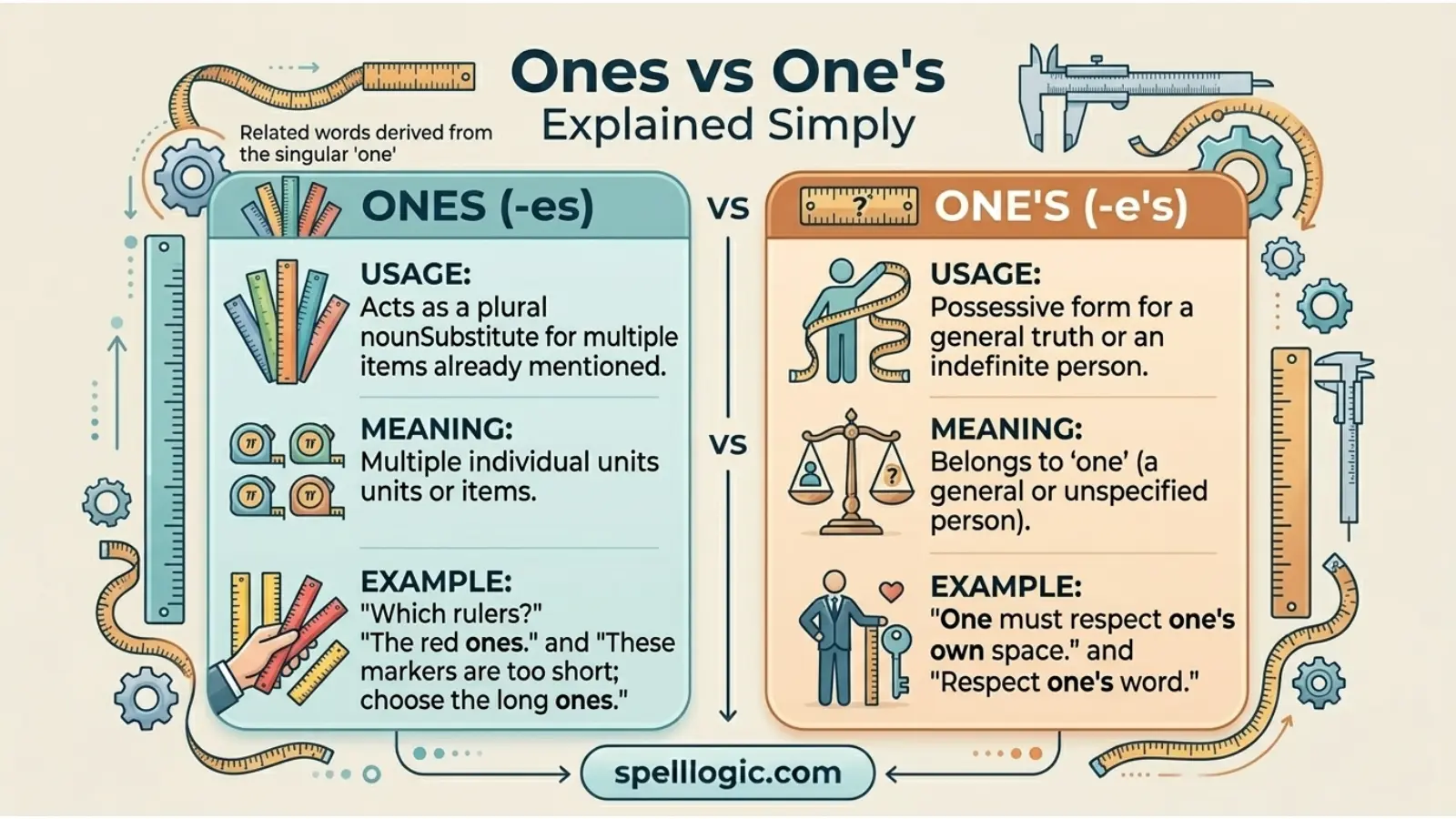
Ones means more than one “one” or is commonly used as a pronoun to replace plural nouns.
One’s is the possessive form of “one,” meaning something belongs to one person or an unspecified individual.
One-line distinction
Ones refers to plural things, while one’s shows possession.
Examples
Ones
- I prefer the red ones.
- These are the ones we ordered.
One’s
- One’s success depends on hard work.
- One should always keep one’s promises.
Understanding Homophones in English
What Are Homophones?
Homophones are words that sound the same but have different meanings and spellings.
Example:
- pair
- pear
Although they are pronounced alike, they mean different things.
Why Homophones Cause Confusion
When speaking, listeners hear the same pronunciation, but writers must choose the correct spelling based on grammar and meaning.
Example:
- Their house
- They’re coming.
Both sound similar but have different uses.
Interestingly, ones and one’s are often treated like homophones in everyday English because they sound nearly identical.
What Does “Ones” Mean?
Definition and Core Meaning
Ones is the plural form of one and often functions as a pronoun replacing previously mentioned plural nouns.
Instead of repeating the same noun, English speakers often use ones.
Example:
- I don’t like the old shoes. I want new ones.
Origin and Historical Use
The word comes from the Old English numeral one. Over time, English developed ones as both the plural of the number and a pronoun used to avoid repetition.
Modern Usage and Synonyms
Common uses include:
- Referring to multiple items
- Replacing plural nouns
- Making sentences less repetitive
Possible synonyms (depending on context):
- those
- items
- examples
- people
Example Sentences
- Which cookies do you want? The chocolate ones.
- These aren’t the right ones.
- The smaller ones fit better.
- We bought the expensive ones.
What Does “One’s” Mean?
Definition and Core Meaning
One’s is the possessive form of one. It shows that something belongs to an unspecified person.
It is commonly used in formal writing and general statements.
Example:
- One should respect one’s elders.
Origin and Historical Context
English has long used one as an indefinite pronoun meaning “any person.” The possessive form one’s developed naturally to express ownership.
Modern Usage and Synonyms
Common situations include:
- Formal advice
- Academic writing
- General truths
- Instructions
Possible alternatives:
- his or her
- your (less formal)
- someone’s (depending on context)
Example Sentences
- One should always do one’s best.
- It is important to protect one’s privacy.
- One’s attitude affects success.
- One should learn from one’s mistakes.
Ones vs One’s: Key Differences at a Glance
| Word | Part of Speech | Meaning | Example Context |
|---|---|---|---|
| Ones | Pronoun / Plural noun | Refers to multiple people or things already mentioned | I bought the blue ones. |
| One’s | Possessive pronoun form | Shows something belongs to one person | One should keep one’s word. |
How to Remember the Difference Between Ones and One’s
Here are a few simple memory tricks.
1. Look for the Apostrophe
An apostrophe usually shows possession.
Think:
One’s = belongs to one.
2. Replace the Word
If you can replace it with:
- those
- them
- the items
then ones is correct.
3. Ask a Question
Does something belong to someone?
- Yes → one’s
- No → ones
Memorable Example
- I like the green ones.
- One should respect one’s parents.
Remember:
Apostrophe = ownership. No apostrophe = plural replacement.
Common Mistakes and Confusions
Wrong
❌ I like the blue one’s.
✔ I like the blue ones.
Explanation: Nothing belongs to the blue items. You’re simply referring to multiple items.
Wrong
❌ Ones responsibility is important.
✔ One’s responsibility is important.
Explanation: Responsibility belongs to “one,” so possession is required.
Wrong
❌ Which one’s do you want?
✔ Which ones do you want?
Explanation: Here, ones means multiple items.
Wrong
❌ Everyone should respect ones privacy.
✔ Everyone should respect one’s privacy.
Explanation: Privacy belongs to the person.
Examples Section: Correct and Incorrect Usage
Example 1
✔ Correct: I bought the red ones yesterday.
✘ Incorrect: I bought the red one’s yesterday.
Example 2
✔ Correct: One should always keep one’s promises.
✘ Incorrect: One should always keep ones promises.
Example 3
✔ Correct: These are the ones we selected.
✘ Incorrect: These are the one’s we selected.
Example 4
✔ Correct: One’s attitude often determines success.
✘ Incorrect: Ones attitude often determines success.
Example 5
✔ Correct: The larger ones are more comfortable.
✘ Incorrect: The larger one’s are more comfortable.
Example 6
✔ Correct: One should believe in one’s abilities.
✘ Incorrect: One should believe in ones abilities.
Self Assessment: Test Your Knowledge
Fill in the blanks with ones or one’s.
1.
I like the black ______.
2.
Everyone should take care of ______ health.
3.
The smaller ______ fit perfectly.
4.
______ character is more important than wealth.
Self Assessment Answers
- ones
- one’s
- ones
- One’s
FAQs
Is “ones” a real English word?
Yes. It is the plural form of one and is often used as a pronoun replacing plural nouns.
What does “one’s” mean?
It is the possessive form of one, meaning something belongs to an unspecified person.
Is “ones” plural?
Yes. It refers to multiple people or things.
Does “one’s” always need an apostrophe?
Yes. The apostrophe shows possession.
Can I use “one’s” instead of “your”?
Only in formal or general statements. In everyday conversation, your is usually more natural.
How can I remember the difference?
Remember:
- ones = plural things
- one’s = belongs to one
The apostrophe is your clue.
Which word is more common?
Both are common but used in different situations. Ones appears frequently in everyday conversation, while one’s is more common in formal writing, instructions, and general statements.
Final Conclusion: Using “Ones” and “One’s” Correctly
Understanding the difference between ones and one’s is much easier than it first appears. Although these words sound almost the same and differ by only an apostrophe, they serve completely different grammatical purposes. Ones is the plural form of one and is often used to replace previously mentioned plural nouns, making sentences shorter and less repetitive. One’s, on the other hand, is the possessive form of one, showing that something belongs to an unspecified person.
Remember this simple rule whenever you’re unsure: if you’re talking about several things, use “ones”; if you’re showing ownership, use “one’s.” Looking for the apostrophe is often the quickest way to make the correct choice. Reading English books, paying attention to examples, and practicing with your own sentences will help reinforce the difference.
Over time, choosing between these two forms will become automatic. Even advanced English learners occasionally pause to check apostrophes, so don’t be discouraged by mistakes. Every correction strengthens your grammar skills and builds confidence in your writing. Keep practicing, review the examples in this guide, and test yourself regularly. With consistent practice, you’ll soon use ones and one’s naturally and accurately in both formal and everyday English.