
Many English learners struggle with “yours sincerely” and “yours faithfully” because both are common ways to end formal letters and emails. At first glance, they seem interchangeable since they appear in similar situations and express politeness. However, each closing has a specific purpose based on how you begin your letter.
Using the wrong one may not completely change your message, but it can make your writing seem less professional or less natural. Understanding the difference between yours sincerely and yours faithfully will help you write formal correspondence with confidence, whether you’re applying for a job, writing to a company, or communicating in a business setting.
Table of Contents
- Introduction
- Why “Yours Sincerely” and “Yours Faithfully” Are Confusing
- Yours Sincerely vs Yours Faithfully Explained Simply
- Understanding Homophones in English
- What Does “Yours Sincerely” Mean?
- What Does “Yours Faithfully” Mean?
- Yours Sincerely vs Yours Faithfully: Key Differences at a Glance
- How to Remember the Difference Between Yours Sincerely and Yours Faithfully
- Common Mistakes and Confusions
- Examples Section: Correct and Incorrect Usage
- Self Assessment: Test Your Knowledge
- Self Assessment Answers
- FAQs About “Yours Sincerely” and “Yours Faithfully”
- Final Conclusion: Using “Yours Sincerely” and “Yours Faithfully” Correctly
Why “Yours Sincerely” and “Yours Faithfully” Are Confusing
Many learners use these expressions incorrectly because they both appear at the end of formal letters.
Here are the main reasons for the confusion:
Similar Pronunciation
If they do not sound exactly the same, both expressions have a similar rhythm and are spoken in formal contexts.
Similar Spelling
Both phrases begin with “Yours” and end with an adverb, making them look very similar.
Context Confusion
People often see both closings in business letters, school applications, and official emails. Without knowing the rules, they may assume either phrase is acceptable.
Common Learner Mistakes
Some learners always write “Yours sincerely” regardless of the greeting. Others always choose “Yours faithfully” because it sounds more formal. In reality, the correct choice depends on how the letter begins.
Yours Sincerely vs Yours Faithfully Explained Simply
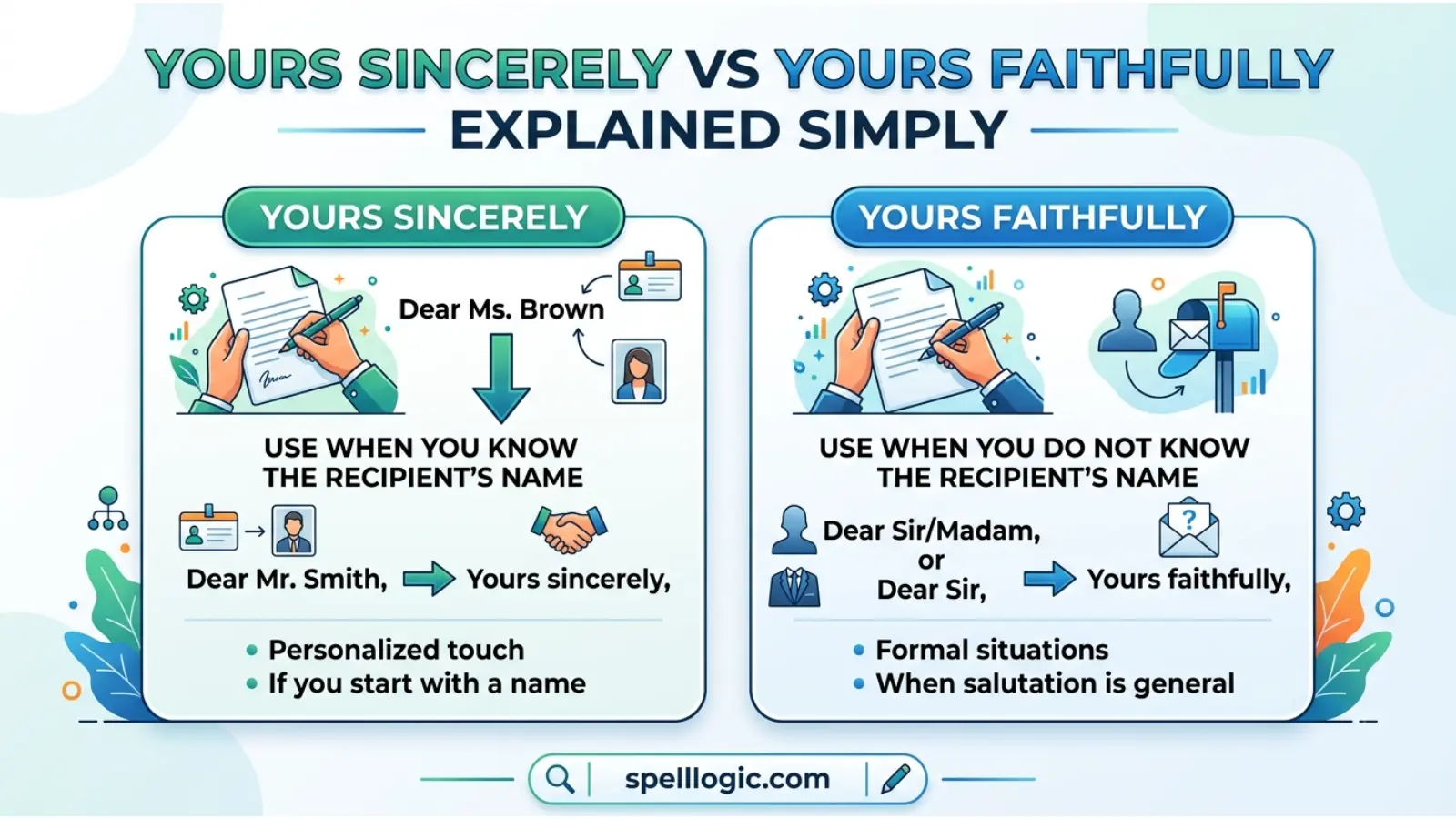
Yours sincerely means you know the name of the person you are writing to, while Yours faithfully means you do not know the person’s name
One-line distinction
“Yours sincerely” follows a named greeting, while “yours faithfully” follows a general greeting.
Example Sentences
- Dear Mr. Wilson, … Yours sincerely,
- Dear Sir or Madam, … Yours faithfully,
In other words:
“Yours sincerely” means you know who you’re writing to, while “yours faithfully” means you don’t know the person’s name.
Understanding Homophones in English
What Are Homophones?
Homophones are words that sound the same but have different meanings and spellings.
Example:
- right
- write
These words sound identical but have different meanings.
Why Homophones Cause Confusion
English learners often confuse words that sound alike or appear in similar situations. Although “yours sincerely” and “yours faithfully” are not true homophones, they are frequently mixed up because they are both formal letter endings.
For example, someone might write:
Dear Hiring Manager… Yours sincerely.
This is incorrect because the recipient’s name is unknown.
What Does “Yours Sincerely” Mean?
Definition and Core Meaning
Yours sincerely is a polite closing used at the end of a formal letter when you know the recipient’s name.
It shows respect while maintaining a professional tone.
Origin and Historical Use
The phrase has been used in formal English correspondence for centuries. It became standard in British English business writing and remains widely accepted today.
Modern Usage and Synonyms
Today, yours sincerely is common in:
- Job application letters
- Business correspondence
- Academic letters
- Professional emails
Similar expressions include:
- Sincerely
- Sincerely yours
- Kind regards (less formal)
- Best regards (semi-formal)
Example Sentences
- Dear Ms. Brown, I appreciate your time. Yours sincerely,
- Dear Dr. Ahmed, Thank you for your support. Yours sincerely,
What Does “Yours Faithfully” Mean?
Definition and Core Meaning
Yours faithfully is a formal closing used when the recipient’s name is unknown.
It expresses respect while addressing someone whose identity is not known.
Origin and Historical Context
This phrase originated in traditional business correspondence. It emphasized honesty, respect, and professionalism toward an unidentified reader.
Modern Usage and Synonyms
It commonly appears in:
- Complaint letters
- Customer service emails
- Government correspondence
- General inquiries
Similar expressions include:
- Faithfully yours
- Respectfully
- Yours truly (more common in North American English)
Example Sentences
- Dear Sir or Madam, Thank you for your assistance. Yours faithfully,
- Dear Hiring Manager, I look forward to your reply. Yours faithfully,
Yours Sincerely vs Yours Faithfully: Key Differences at a Glance
| Word | Part of Speech | Meaning | Example Context |
|---|---|---|---|
| Yours sincerely | Complimentary closing | Used when the recipient’s name is known | Dear Mr. Khan… Yours sincerely |
| Yours faithfully | Complimentary closing | Used when the recipient’s name is unknown | Dear Sir or Madam… Yours faithfully |
How to Remember the Difference Between Yours Sincerely and Yours Faithfully
Here are a few simple tricks to remember which one to use.
Easy Memory Tricks
- Name known = Yours sincerely
- Name unknown = Yours faithfully
Association Techniques
Think of sincerely as being more personal because you already know the person’s name.
Think of faithfully as remaining respectful even though you don’t know exactly who will read your letter.
Memorable Example
Dear Sarah Wilson → Yours sincerely
Dear Sir or Madam → Yours faithfully
Just remember:
Known name = Sincerely. Unknown name = Faithfully.
Common Mistakes and Confusions
Wrong Example
Dear Mr. Smith,
…
Yours faithfully
Correct Version
Dear Mr. Smith,
…
Yours sincerely
Explanation
Because you know the recipient’s name.
Wrong Example
Dear Sir or Madam,
…
Yours sincerely
Correct Version
Dear Sir or Madam,
…
Yours faithfully
Explanation
The recipient’s name is unknown.
Wrong Example
Dear Hiring Manager,
…
Yours sincerely
Correct Version
Dear Hiring Manager,
…
Yours faithfully
Explanation
“Hiring Manager” is a job title, not a person’s name.
Examples Section: Correct and Incorrect Usage
Example 1
✔ Correct:
Dear Mrs. Taylor,
Thank you for your help.
Yours sincerely,
✘ Incorrect:
Dear Mrs. Taylor,
Thank you for your help.
Yours faithfully,
Example 2
✔ Correct:
Dear Sir or Madam,
I am writing to request information.
Yours faithfully,
✘ Incorrect:
Dear Sir or Madam,
I am writing to request information.
Yours sincerely,
Example 3
✔ Correct:
Dear Mr. Johnson,
I appreciate your quick response.
Yours sincerely,
✘ Incorrect:
Dear Mr. Johnson,
I appreciate your quick response.
Yours faithfully,
Example 4
✔ Correct:
Dear Customer Service Manager,
Please investigate this issue.
Yours faithfully,
✘ Incorrect:
Dear Customer Service Manager,
Please investigate this issue.
Yours sincerely,
Self Assessment: Test Your Knowledge
Fill in the blanks.
- Dear Ms. Carter… __________
- Dear Sir or Madam… __________
- Dear Mr. Williams… __________
- Dear Hiring Manager… __________
Self Assessment Answers
- Yours sincerely
- Yours faithfully
- Yours sincerely
- Yours faithfully
FAQs
1. What is the difference between yours sincerely and yours faithfully?
Use yours sincerely when you know the recipient’s name. Use yours faithfully when you do not.
2. Is “yours sincerely” more formal?
Both expressions are equally formal. The choice depends on the greeting, not the level of formality.
3. Can I use “yours sincerely” after “Dear Sir or Madam”?
No. The correct closing is yours faithfully.
4. Which expression is more common in business letters?
Both are common. Their use depends on whether the recipient’s name is known.
5. What do Americans usually use?
Many American writers prefer Sincerely, Sincerely yours, or Best regards, although Yours faithfully is less common in American English.
6. Is it wrong to use the incorrect closing?
Most readers will still understand your message, but using the correct closing demonstrates strong writing skills and professionalism.
7. Can I use these expressions in emails?
Yes. They are appropriate in formal emails as well as traditional letters.
Final Conclusion: Using “Yours Sincerely” and “Yours Faithfully” Correctly
Understanding the difference between yours sincerely and yours faithfully is an important step toward writing clear and professional English. Although both phrases are polite ways to end formal letters and emails, they follow a simple rule that is easy to remember. If you know the recipient’s name—for example, when your letter begins with “Dear Mr. Brown” or “Dear Ms. Ali”—you should end it with “Yours sincerely.”
On the other hand, if you do not know the person’s name and your letter begins with “Dear Sir or Madam,” “Dear Hiring Manager,” or another general greeting, the correct ending is “Yours faithfully.” This distinction is especially common in British English and is widely expected in formal business and academic writing.
A useful memory trick is “Known name = sincerely; unknown name = faithfully.” By practicing this rule and reviewing examples, you’ll soon choose the correct closing without hesitation. Whether you’re writing a job application, a business inquiry, a complaint letter, or a formal email, using the appropriate sign-off leaves a positive impression and shows that you understand standard English writing conventions. Keep practicing, pay attention to the greeting at the beginning of your letter, and you’ll confidently use yours sincerely and yours faithfully correctly every time.