Many English learners confuse inverse and reverse because both words describe something that changes direction, order, or relationship. Although they are related in meaning, they are not interchangeable. Choosing the wrong word can make your sentence sound confusing, especially in mathematics, science, technology, or everyday English.
Fortunately, the difference is easier to understand than it first appears. In this guide, you’ll learn what each word means, when to use it, and how to remember the difference with simple explanations, practical examples, comparison tables, and memory tips.
Table of Contents
- Introduction
- Why “Inverse” and “Reverse” Are Confusing
- Inverse vs Reverse Explained Simply
- Understanding Homophones in English
- What Are Homophones?
- Why Homophones Cause Confusion
- What Does “Inverse” Mean?
- What Does “Reverse” Mean?
- Inverse vs Reverse: Key Differences at a Glance
- How to Remember the Difference Between Inverse and Reverse
- Common Mistakes and Confusions
- Examples Section: Correct and Incorrect Usage
- Self Assessment: Test Your Knowledge
- Self Assessment Answers
- FAQs About “Inverse and Reverse”
- Final Conclusion: Using “Inverse” and “Reverse” Correctly
Why “Inverse” and “Reverse” Are Confusing
Many learners accidentally mix up inverse and reverse because they both involve the idea of change. However, they describe different kinds of change.
Here are the main reasons they cause confusion:
- Similar pronunciation: Both words begin with the same sound and end similarly.
- Similar spelling: They share several letters and have a comparable structure.
- Context confusion: Both can describe opposites or changes, especially in mathematics, science, and everyday speech.
- Common learner mistakes: People often use reverse when they actually mean inverse, or vice versa.
Remember that although they are related, they are used in different situations and have different meanings.
Inverse vs Reverse Explained Simply
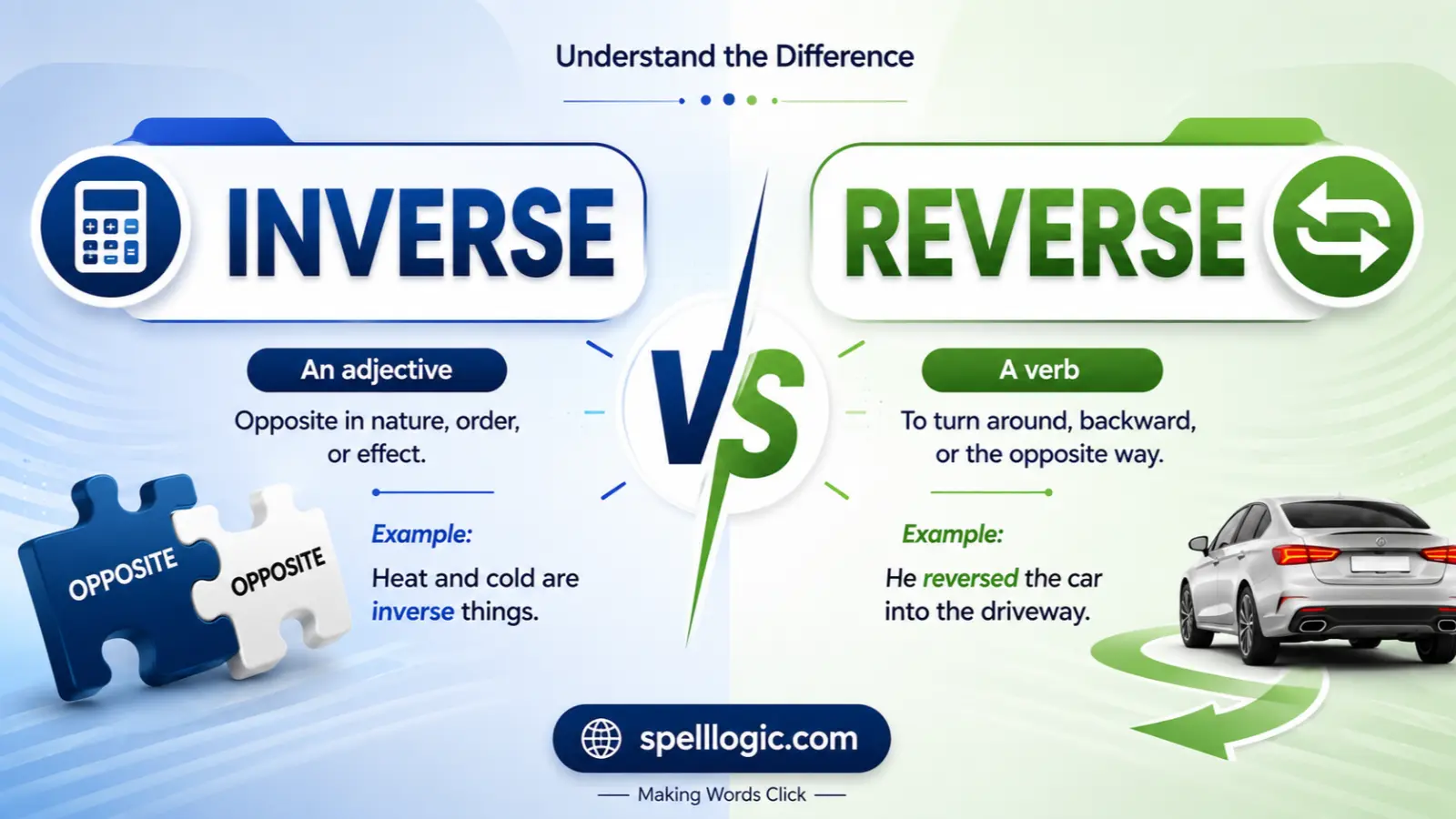
Inverse means the opposite in relationship or effect, while reverse means to move backward or change direction.
One-line distinction
Inverse describes an opposite relationship, while reverse describes going back or turning around.
Example sentences
Inverse
- The temperature and pressure have an inverse relationship.
- Multiplication and division are inverse operations.
Reverse
- Please reverse the car slowly.
- She read the list in reverse order.
Understanding Homophones in English
What Are Homophones?
Homophones are words that sound the same but have different meanings and spellings.
Example:
- Flower – a blooming plant
- Flour – powder used for baking
Although inverse and reverse are not homophones, learners sometimes confuse them because their pronunciation and meanings are somewhat similar.
Why Homophones Cause Confusion
English contains many words that sound alike or have related meanings. Learners may rely on sound instead of meaning when speaking or writing.
For example:
- Their and there sound the same but have different meanings.
Similarly, although inverse and reverse do not sound exactly alike, they both describe change, making them easy to mix up.
What Does “Inverse” Mean?
Definition and Core Meaning
Inverse refers to something that is opposite in effect, position, relationship, or mathematical operation.
It often describes situations where one thing increases while another decreases, or where one action undoes another.
Origin and Historical Use
The word inverse comes from the Latin inversus, meaning turned upside down or turned opposite.
It entered English several centuries ago and became especially common in mathematics, science, and logic.
Modern Usage and Synonyms
Today, inverse appears frequently in:
- Mathematics
- Physics
- Economics
- Statistics
- Computer science
Synonyms
- Opposite
- Reciprocal
- Contrasting
- Contrary
- Complementary (in some contexts)
Example sentences
- Division is the inverse of multiplication.
- There is an inverse relationship between supply and price.
- The graph shows an inverse correlation.
- Adding negative numbers is the inverse of subtraction in certain contexts.
What Does “Reverse” Mean?
Definition and Core Meaning
Reverse means to move backward, turn around, or change the direction or order of something.
It can be used as both a verb and a noun, and sometimes as an adjective.
Origin and Historical Context
The word comes from the Latin revertere, meaning to turn back.
Over time, it became common in everyday English as well as in driving, sports, music, law, and technology.
Modern Usage and Synonyms
Today, reverse is widely used in daily conversation.
Synonyms
- Turn back
- Go backward
- Undo
- Flip
- Opposite direction
- Backward
Example sentences
- He put the car into reverse.
- Please reverse the decision.
- Read the numbers in reverse order.
- The team managed to reverse the score.
Inverse vs Reverse: Key Differences at a Glance
| Word | Part of Speech | Meaning | Example Context |
|---|---|---|---|
| Inverse | Adjective, Noun | Opposite relationship or effect | In mathematics, multiplication and division are inverse operations. |
| Reverse | Verb, Noun, Adjective | Move backward or change direction/order | Reverse the car before turning. |
How to Remember the Difference Between Inverse and Reverse
Learning a simple memory trick can help you avoid mistakes.
Easy memory tricks
- Inverse = Opposite relationship
- Reverse = Go backward
Association techniques
Think of inverse whenever you hear words like:
- opposite
- mathematical operation
- relationship
- correlation
Think of reverse whenever you imagine:
- a car backing up
- reading from the end
- changing direction
- undoing movement
Memorable example
Reverse the car.
Inverse relationship between speed and travel time.
The car moves backward, but the relationship describes opposite effects.
Common Mistakes and Confusions
Here are mistakes many learners make.
Wrong
The driver inverse the car.
Correct
The driver reversed the car.
Explanation: Cars move in reverse, not inverse.
Wrong
These two variables have a reverse relationship.
Correct
These two variables have an inverse relationship.
Explanation: Scientific relationships are described as inverse.
Wrong
Reverse multiplication is division.
Correct
Division is the inverse of multiplication.
Explanation: Mathematical operations are inverse operations.
Wrong
Please inverse the order of the pages.
Correct
Please reverse the order of the pages.
Explanation: Changing order is reversing.
Examples Section: Correct and Incorrect Usage
Example 1
✔ Correct: The two values have an inverse relationship.
✘ Incorrect: The two values have a reverse relationshipExample 2
✔ Correct: Reverse the truck carefully.
✘ Incorrect: Inverse the truck carefully.
Example 3
✔ Correct: Addition and subtraction are inverse operations.
✘ Incorrect: Addition and subtraction are reverse operations.
Example 4
✔ Correct: She read the book in reverse order.
✘ Incorrect: She read the book in inverse order.
Example 5
✔ Correct: There is an inverse correlation between these variables.
✘ Incorrect: There is a reverse correlation between these variables.
Self Assessment: Test Your Knowledge
Fill in the blanks with inverse or reverse.
- Multiplication and division are ________ operations.
- Please ________ the car into the parking space.
- Scientists found an ________ relationship between pressure and volume.
- Read the instructions in ________ order.
Self Assessment Answers
- inverse
- reverse
- inverse
- reverse
FAQs
1. Are inverse and reverse the same?
No. Inverse refers to an opposite relationship or effect, while reverse means moving backward or changing direction.
2. Which word is used in mathematics?
Inverse is commonly used in mathematics for operations, functions, and relationships.
3. Can reverse be used as a verb?
Yes. For example:
“Please reverse the car slowly.”
4. What is an inverse relationship?
An inverse relationship means that when one thing increases, the other decreases.
5. Is reverse used in everyday English?
Yes. It is commonly used for driving, changing direction, undoing actions, and changing order.
6. Can inverse be used outside mathematics?
Yes. It is also common in science, economics, medicine, statistics, and everyday discussions about opposite relationships.
7. How can I remember the difference?
Remember this simple rule:
- Inverse = opposite relationship
- Reverse = backward movement or order
Final Conclusion: Using “Inverse” and “Reverse” Correctly
Although inverse and reverse are related because they both involve change, they describe different kinds of change. Inverse refers to an opposite relationship, effect, or operation. It is especially common in mathematics, science, economics, and other technical subjects. For example, multiplication and division are inverse operations, and two variables may have an inverse relationship when one rises as the other falls. Reverse, on the other hand, is used when something moves backward, changes direction, or is arranged from end to beginning. You reverse a car, reverse a decision, or read something in reverse order.
A simple way to remember the difference is to connect inverse with the idea of opposites and reverse with the idea of going backward. Whenever you are describing a relationship between ideas, numbers, or variables, ask yourself whether you mean “opposite.” If so, inverse is probably the correct choice. If you are talking about movement, direction, or order, reverse is almost always the right word.
The more you read, write, and practice these words in context, the easier it becomes to use them naturally. Small differences like these can greatly improve your English accuracy and confidence. Keep learning one word pair at a time, and you’ll steadily build stronger vocabulary and clearer communication skills.