Began and Begun Many English learners struggle with began and begun because both words come from the verb begin and both refer to something that started in the past. At first glance, they seem interchangeable, but they actually have different grammatical roles. Using the wrong one can make a sentence sound incorrect or unnatural.
Fortunately, the difference is simple once you understand how English verb tenses work. In this guide, you’ll learn the meaning of began and begun, when to use each word, common mistakes to avoid, and easy memory tricks that will help you use them confidently in everyday English.
Table of Contents
- Introduction
- Why “Began” and “Begun” Are Confusing
- Began vs Begun Explained Simply
- Understanding Homophones in English
- What Are Homophones?
- Why Homophones Cause Confusion
- What Does “Began” Mean?
- What Does “Begun” Mean?
- Began vs Begun: Key Differences at a Glance
- How to Remember the Difference Between Began and Begun
- Common Mistakes and Confusions
- Examples Section: Correct and Incorrect Usage
- Self Assessment: Test Your Knowledge
- Self Assessment Answers
- FAQs About “Began and Begun”
- Final Conclusion: Using “Began” and “Begun” Correctly
Why “Began” and “Begun” Are Confusing
Many learners mix up began and begun because they are different forms of the same verb: begin.
Several factors contribute to this confusion:
Similar Pronunciation
Both words sound very similar. The only major difference is the vowel sound in the second syllable.
- Began = /bɪˈɡæn/
- Begun = /bɪˈɡʌn/
Because they sound alike, learners often use one in place of the other.
Similar Spelling
The words differ by only one letter:
- began
- begun
This small spelling difference makes them easy to confuse when writing.
Context Confusion
Both words refer to actions that started in the past. However, they belong to different verb forms and must be used in different sentence structures.
Common Learner Mistakes
Many learners write sentences like:
- “I have began my homework.”
- “The meeting has began.”
These are incorrect because begun, not began, is needed after helping verbs such as has, have, or had.
Began vs Begun Explained Simply
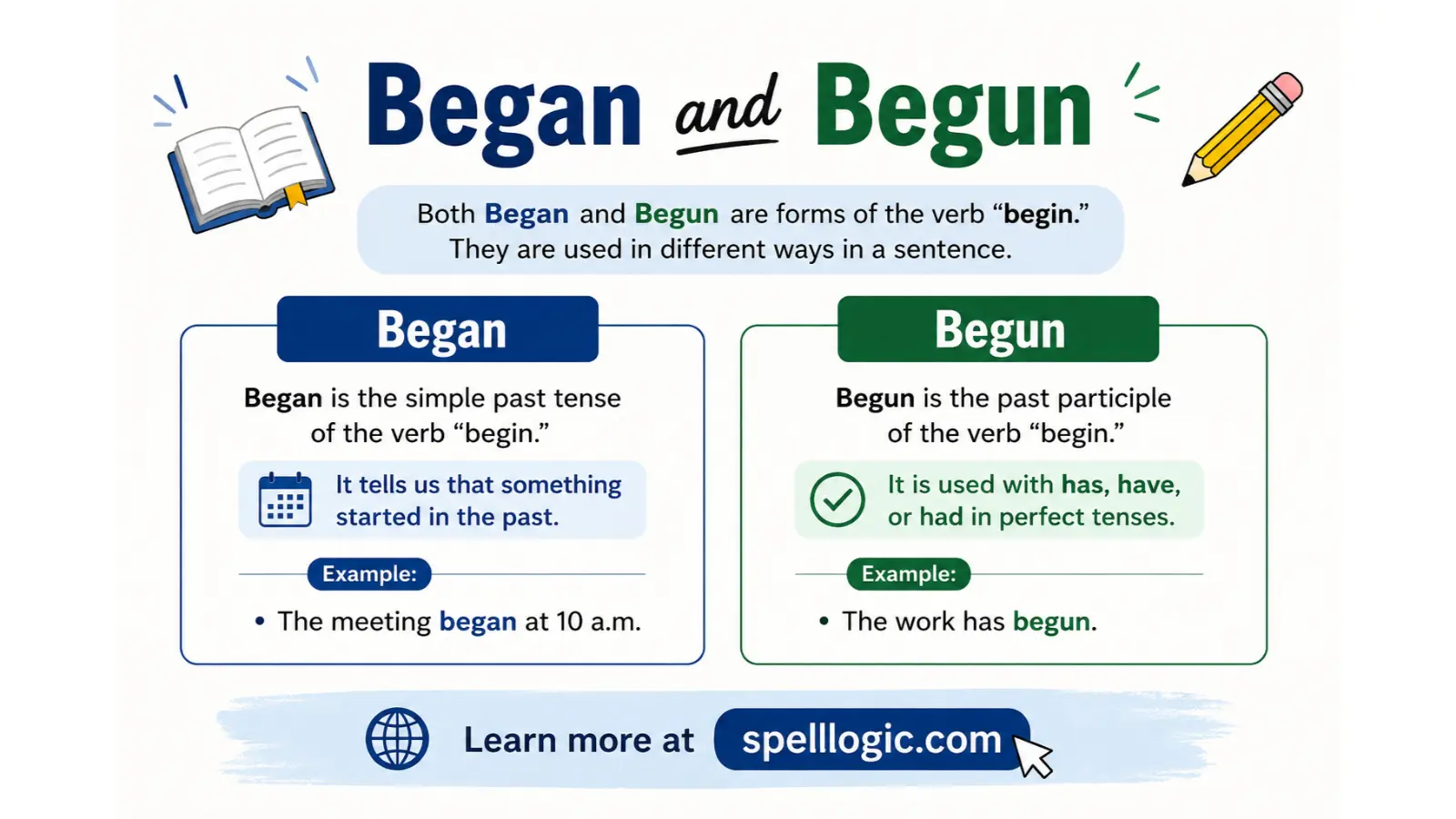
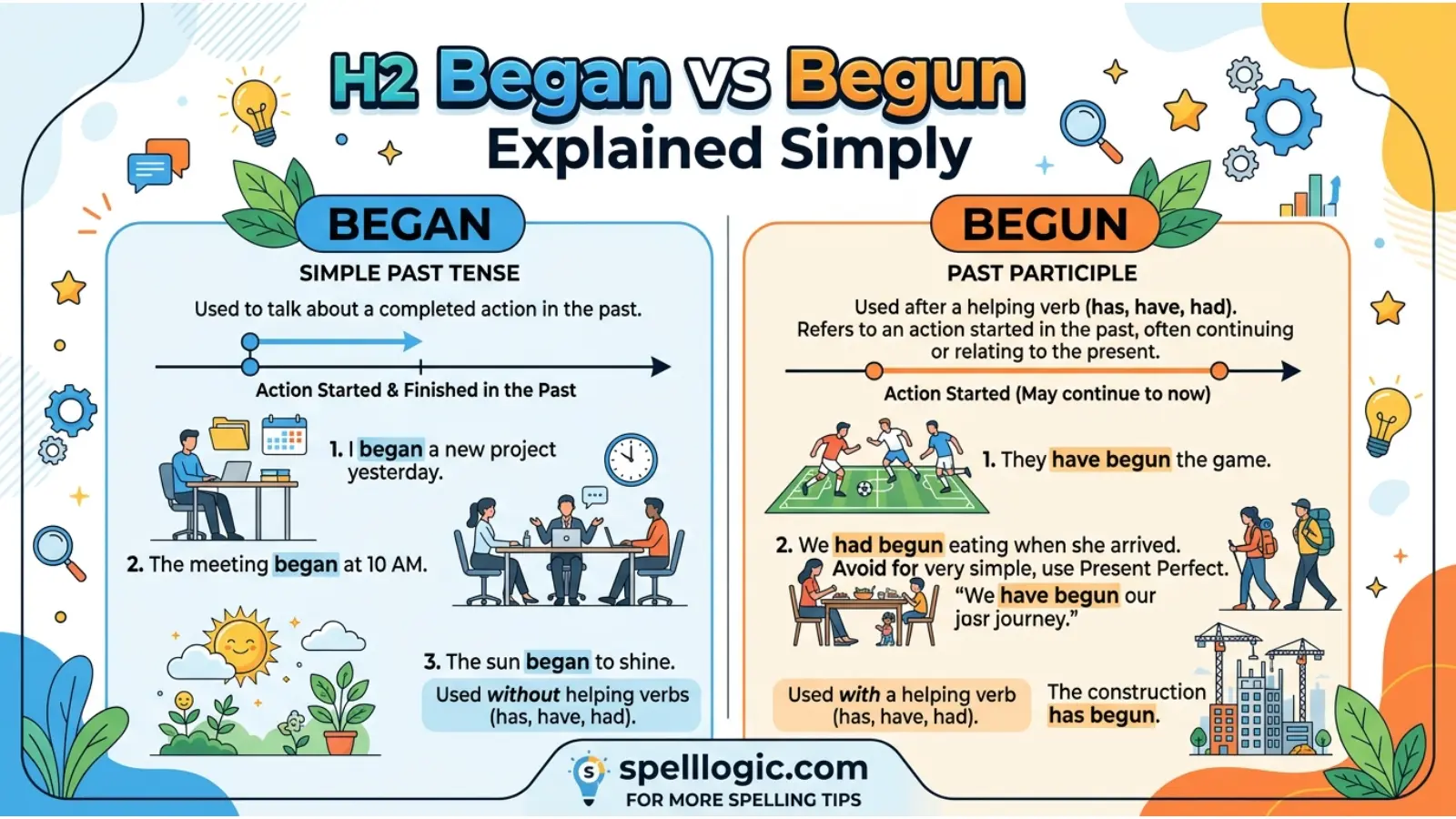
Began is the simple past tense of begin, while begun is the past participle form.
One-Line Distinction
Began is used alone in the past tense, while begun is used with helping verbs such as has, have, or had.
Simple Explanation
“Began means started in the past.”
“Begun means started and is usually used with a helping verb.”
Examples
Began
- She began studying at 7 p.m.
- The concert began late.
Begun
- She has begun studying for the exam.
- The concert had begun before we arrived.
Understanding Homophones in English
Although began and begun are not true homophones, they are often confused because of their similar sounds and meanings.
What Are Homophones?
Homophones are words that sound the same but have different meanings or spellings.
Example:
- Flower
- Flour
These words sound alike but mean different things.
Why Homophones Cause Confusion
When people hear similar-sounding words, they may not immediately recognize which spelling or meaning is correct.
For example:
- Their
- There
- They’re
Because these words sound alike, many learners accidentally use the wrong one in writing.
Similarly, began and begun are often confused because of their related meanings and similar pronunciation.
What Does “Began” Mean?
Definition and Core Meaning
Began is the simple past tense of the verb begin.
It describes an action that started and occurred at a specific time in the past.
Core Meaning
- Started
- Commenced
- Initiated
Examples
- The movie began at 8 o’clock.
- She began her new job last Monday.
- Rain began falling in the afternoon.
Origin and Historical Use
The word comes from Old English beginnan, meaning “to start” or “to undertake.”
Over centuries, English evolved, and began became the standard simple past form of begin.
Modern Usage and Synonyms
Today, began is commonly used in everyday speech and writing.
Synonyms
- Started
- Commenced
- Opened
- Initiated
- Launched
Key Points
- Used for simple past tense.
- Does not require a helping verb.
- Refers to a completed action in the past.
More Example Sentences
- The teacher began the lesson early.
- Construction began in June.
- The celebration began after sunset.
What Does “Begun” Mean?
Definition and Core Meaning
Begun is the past participle form of begin.
It is generally used with helping verbs such as:
- Has
- Have
- Had
- Is
- Was
- Were
Core Meaning
- Started
- Set in motion
- Commenced
Examples
- The project has begun.
- We had begun eating before they arrived.
- A new chapter has begun in her life.
Origin and Historical Context
Like began, begun originates from Old English forms of begin.
Over time, English grammar developed separate forms for the simple past and the past participle.
That distinction remains important today.
Modern Usage and Synonyms
Begun is widely used in perfect tenses.
Synonyms
- Started
- Commenced
- Initiated
- Launched
Key Points
- Past participle form of begin.
- Usually follows helping verbs.
- Common in perfect tenses.
More Example Sentences
- The meeting has begun.
- They had begun planning months earlier.
- Recovery has begun slowly.
Began vs Begun: Key Differences at a Glance
| Word | Part of Speech | Meaning | Example Context |
|---|---|---|---|
| Began | Simple past tense verb | Started in the past | She began reading yesterday. |
| Begun | Past participle verb | Started, used with helping verbs | She has begun reading the book. |
Quick Rule
- Use began by itself.
- Use begun with has, have, had, or another helping verb.
How to Remember the Difference Between Began and Begun
Learning a simple memory trick can make the distinction much easier.
Easy Memory Tricks
Trick 1: Look for a Helping Verb
If you see:
- has
- have
- had
Use begun.
Example:
- Correct: I have begun.
- Incorrect: I have began.
Trick 2: Think of Past Tense Patterns
Just as:
- Sing → Sang → Sung
Similarly:
- Begin → Began → Begun
Association Technique
Think:
- A in began = alone
- U in begun = used with helping verbs
Memorable Example
- Yesterday I began my essay.
- Today I have begun the second chapter.
Common Mistakes and Confusions
Many learners accidentally swap these two forms.
Wrong Example
❌ I have began my homework.
Correct Version
✔ I have begun my homework.
Explanation
After have, use the past participle begun.
Wrong Example
❌ The show begun at 8 p.m.
Correct Version
✔ The show began at 8 p.m.
Explanation
This sentence uses simple past tense, so began is required.
Wrong Example
❌ She had began studying.
Correct Version
✔ She had begun studying.
Explanation
After had, use begun.
Wrong Example
❌ The ceremony has began.
Correct Version
✔ The ceremony has begun.
Explanation
Perfect tenses require the past participle form.
Examples Section: Correct and Incorrect Usage
Example 1
✔ Correct: The game began at noon.
✘ Incorrect: The game begun at noon.
Example 2
✔ Correct: The game has begun.
✘ Incorrect: The game has began.
Example 3
✔ Correct: She began learning French last year.
✘ Incorrect: She begun learning French last year.
Example 4
✔ Correct: We had begun preparing before sunrise.
✘ Incorrect: We had began preparing before sunrise.
Example 5
✔ Correct: The discussion began after lunch.
✘ Incorrect: The discussion begun after lunch.
Example 6
✔ Correct: A new era has begun.
✘ Incorrect: A new era has began.
Self Assessment: Test Your Knowledge
Fill in the blanks with began or begun.
1.
The meeting ______ at 10 a.m.
2.
The meeting has ______ already.
3.
She ______ working here last month.
4.
They had ______ building the house before winter arrived.
Self Assessment Answers
1.
The meeting began at 10 a.m.
2.
The meeting has begun already.
3.
She began working here last month.
4.
They had begun building the house before winter arrived.
FAQs
1. Is it correct to say “have began”?
No. The correct phrase is have begun because begun is the past participle.
2. What is the difference between began and begun?
Began is the simple past tense, while begun is the past participle.
3. Can begun be used without a helping verb?
Generally, no. Begun is usually used with helping verbs such as has, have, or had.
4. Which comes first: began or begun?
The verb forms are:
- Begin
- Began
- Begun
5. Is “the event begun yesterday” correct?
No. The correct sentence is:
- The event began yesterday.
6. Why do people confuse began and begun?
Because they have similar spellings, similar meanings, and come from the same verb.
7. How can I remember which one to use?
Remember: if there is a helping verb like has, have, or had, use begun.
Final Conclusion: Using “Began” and “Begun” Correctly
Understanding the difference between began and begun is an important step toward mastering English grammar. Although these two words come from the same base verb, begin, they serve different purposes in a sentence. Began is the simple past tense form and is used when talking about something that started at a specific time in the past. For example, “The class began at nine o’clock.” In contrast, begun is the past participle form and is usually paired with helping verbs such as has, have, or had, as in “The class has begun.”
A simple way to remember the difference is to check whether a helping verb appears in the sentence. If it does, begun is usually the correct choice. If the sentence simply describes a past action without a helping verb, began is generally the right answer. Practicing this pattern regularly will help you recognize the correct form naturally.
In real-world communication, using these forms correctly makes your English sound more accurate and professional. Whether you are writing emails, completing school assignments, or speaking in everyday conversations, understanding this distinction can improve your confidence. Keep practicing with examples, review the memory tricks in this guide, and don’t be discouraged by mistakes. Every grammar challenge you overcome brings you one step closer to fluent and natural English.