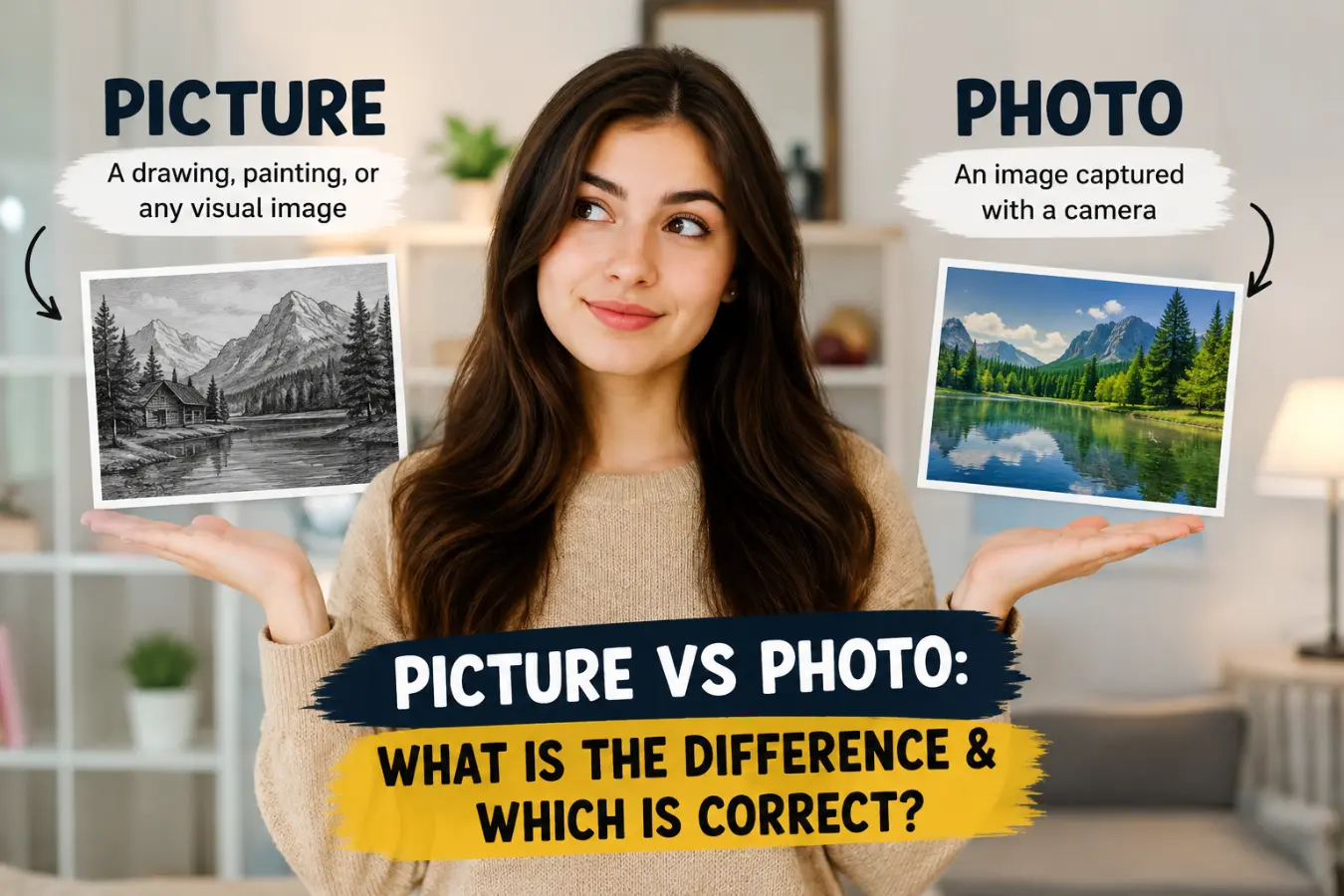
Many English learners use the words “picture” and “photo” as if they mean exactly the same thing. In everyday conversation, people often switch between them without thinking. However, while these words are closely related, they are not always identical in meaning or usage. A “photo” usually refers to an image captured with a camera, while a “picture” can describe many types of visual images, including drawings, paintings, and photographs.
Understanding the difference between “picture” and “photo” helps improve your vocabulary, speaking accuracy, and writing clarity. Once you learn their meanings and contexts, choosing the correct word becomes simple.
Table of Contents
- Why “Picture” and “Photo” Are Confusing
- Picture vs Photo Explained Simply
- Understanding Homophones in English
- What Does “Picture” Mean?
- What Does “Photo” Mean?
- Picture vs Photo: Key Differences at a Glance
- How to Remember the Difference
- Common Mistakes and Confusions
- Examples Section
- Self Assessment
- Self Assessment Answers
- FAQs
- Final Conclusion
Why “Picture” and “Photo” Are Confusing
English learners often confuse “picture” and “photo” because both relate to images and visual content.
Several reasons create confusion:
- Both refer to something people look at
- They are frequently used interchangeably
- Their meanings overlap in daily conversation
- Modern technology uses both words frequently
Unlike many confusing English word pairs, these are not true homophones because they do not sound exactly alike. However, they create confusion because of similar contexts.
Common learner mistakes include:
Incorrect: I drew a beautiful photo.
Correct: I drew a beautiful picture.
Incorrect: Send me your picture from the camera.
Better: Send me your photo from the camera.
Context helps determine which word fits naturally.
Picture vs Photo Explained Simply
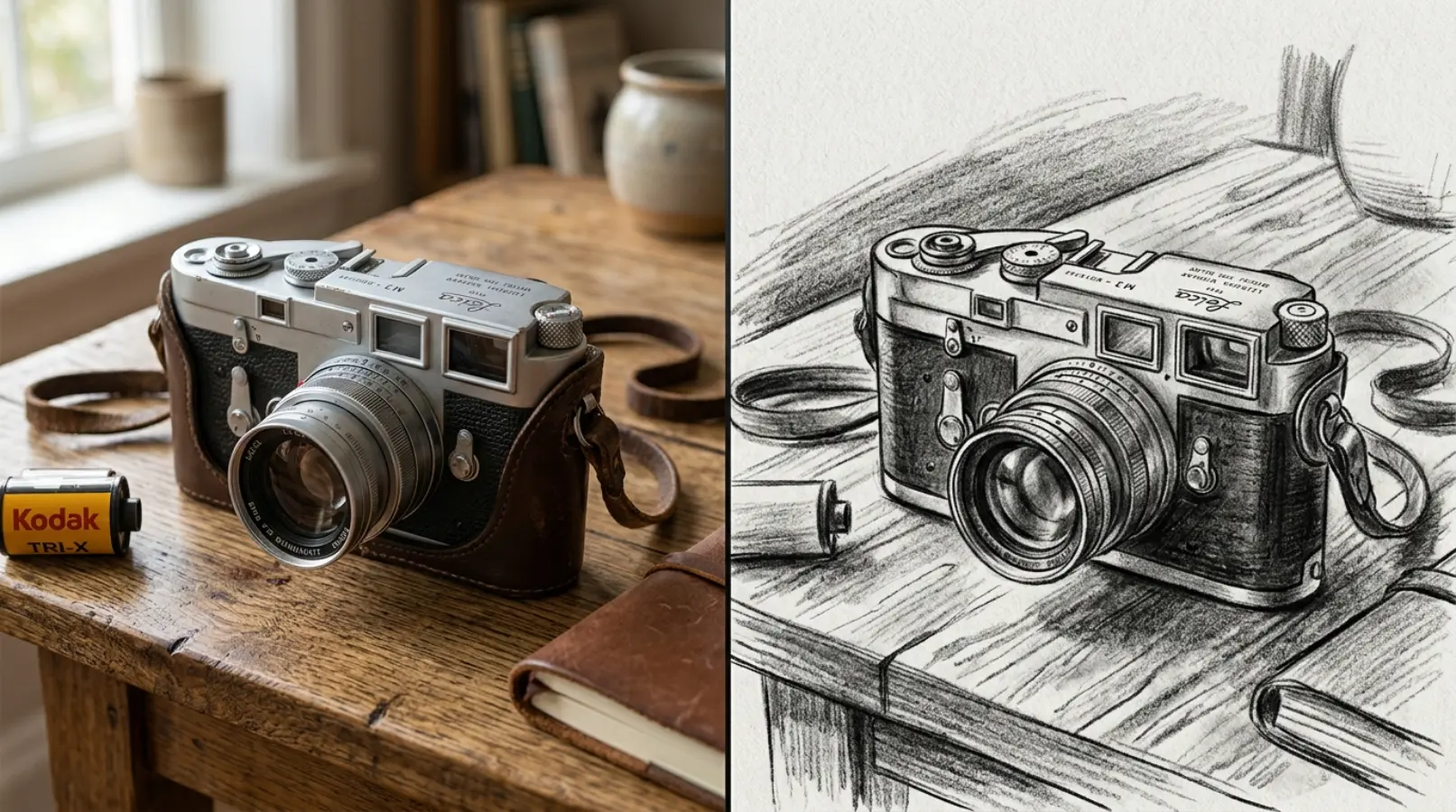
“Picture” means any visual representation, while “photo” means an image created using a camera.
One-line distinction:
Every photo is a picture, but not every picture is a photo.
Examples:
- She framed a beautiful picture for her room.
- He uploaded a photo from his vacation.
Think of “photo” as a specific type inside the larger category of “pictures.”
Understanding Homophones in English
English contains many words that create confusion.
What Are Homophones?
Homophones are words that sound the same but have different meanings and spellings.
Example:
- sea
- see
Although “picture” and “photo” are not homophones, learners often confuse them because they appear in similar situations.
Why Homophones Cause Confusion
Homophones can lead people to choose incorrect spelling or meaning.
Example:
Someone hears:
“Please send the file.”
They may confuse:
file → phial
Context usually solves confusion.
What Does “Picture” Mean?
“Picture” is a broad word used for many kinds of visual representations.
Definition and Core Meaning of Picture
Picture means:
An image, drawing, painting, photograph, or visual representation.
Examples:
- a family picture
- a wall picture
- a digital picture
Example sentence:
She hung a colorful picture above the sofa.
Main Uses
- Drawings
- Paintings
- Photos
- Illustrations
- Visual displays
Origin and Historical Use
The word “picture” comes from Latin through Old French and originally referred to painted images.
Over time, its meaning expanded to include many forms of visual representation.
Historically, pictures appeared as:
- paintings
- sketches
- portraits
Today, the word includes digital media as well.
Modern Usage and Synonyms
Picture remains one of the most flexible visual words in English.
Synonyms include:
- image
- illustration
- artwork
- graphic
- visual
Examples:
- Can you show me the picture?
- The picture looked amazing.
What Does “Photo” Mean?
“Photo” is shorter and more specific than “picture.”
Definition and Core Meaning of Photo
Photo means:
A photographic image created using a camera.
Examples:
- wedding photo
- passport photo
- selfie photo
Example sentence:
She posted a vacation photo online.
Origin and Historical Context
Photo comes from the word “photograph.”
The term developed after photography became popular.
Its roots come from Greek words meaning:
- light
- writing
Photography literally means drawing with light.
Modern Usage and Synonyms
Today, “photo” appears everywhere:
- smartphones
- social media
- marketing
- personal albums
Synonyms include:
- photograph
- snapshot
- image
- portrait
Examples:
- He took a photo at sunset.
- Please upload your photo.
Picture vs Photo: Key Differences at a Glance
| Word | Part of Speech | Meaning | Example Context |
|---|---|---|---|
| Picture | Noun | Any visual representation | Draw a picture |
| Photo | Noun | Camera-created image | Take a photo |
How to Remember the Difference Between Picture and Photo
These memory tricks make the difference easy.
Trick 1: Think Broad vs Specific
Picture = General category
Photo = Specific camera image
Trick 2: Photo Starts with “Ph”
Think:
Photo → Photography → Camera
Trick 3: Picture Includes More
Picture can include:
✔ Drawing
✔ Painting
✔ Illustration
✔ Photo
Photo includes:
✔ Camera images only
Memorable Example:
You can draw a picture.
You cannot draw a photo.
Common Mistakes and Confusions
Mistake 1
Incorrect:
I painted a photo.
Correct:
I painted a picture.
Explanation:
Paintings create pictures, not photos.
Mistake 2
Incorrect:
Take a picture with your camera.
Correct:
Take a photo with your camera.
Explanation:
Although both work in casual speech, “photo” is more precise.
Mistake 3
Incorrect:
This drawing is my favorite photo.
Correct:
This drawing is my favorite picture.
Explanation:
Drawings are pictures.
Examples Section: Correct and Incorrect Usage
✔ Correct: I took a photo of the mountains.
✘ Incorrect: I took a picture drawing.
✔ Correct: My daughter drew a picture.
✘ Incorrect: My daughter drew a photo.
✔ Correct: We framed our wedding photo.
✘ Incorrect: We framed our wedding drawing.
✔ Correct: The gallery displayed beautiful pictures.
✘ Incorrect: The gallery displayed beautiful photos of paintings.
✔ Correct: Please upload your passport photo.
✘ Incorrect: Please upload your passport picture drawing.
Self Assessment: Test Your Knowledge
Choose the correct word.
- She took a ___ with her phone.
- The child drew a ___.
- We looked at old family ___.
- Please upload your passport ___.
Self Assessment Answers
- photo
- picture
- pictures
- photo
FAQs
Are picture and photo the same?
Not exactly. Every photo is a picture, but not every picture is a photo.
Is a drawing called a photo?
No. Drawings are pictures.
Which word is better for camera images?
Photo is usually more precise.
Can picture mean photograph?
Yes. In everyday English, picture can include photographs.
Why do people say “take a picture”?
Because picture is commonly used in casual conversation even for photos.
Is photo short for photograph?
Yes. Photo is the shortened form of photograph.
Which word should learners use?
Use photo for camera images and picture for broader visual meanings.
Final Conclusion: Using “Picture” and “Photo” Correctly
Although “picture” and “photo” are closely connected, understanding the small difference between them makes your English more accurate and natural. A picture is a broad term that refers to almost any visual representation, including drawings, paintings, illustrations, and photographs. A photo, however, specifically means an image captured by a camera.
This distinction matters because context changes which word sounds more natural. If you are talking about artwork, sketches, or illustrations, picture is usually the better choice. If you are discussing something taken with a phone or camera, photo is often more precise.
A helpful way to remember this is simple: all photos are pictures, but not all pictures are photos. That one sentence can prevent many common mistakes.
Keep reading, listening, and practicing with real examples. Over time, these differences become automatic. Small vocabulary improvements like this make your English clearer, stronger, and more confident in everyday communication.