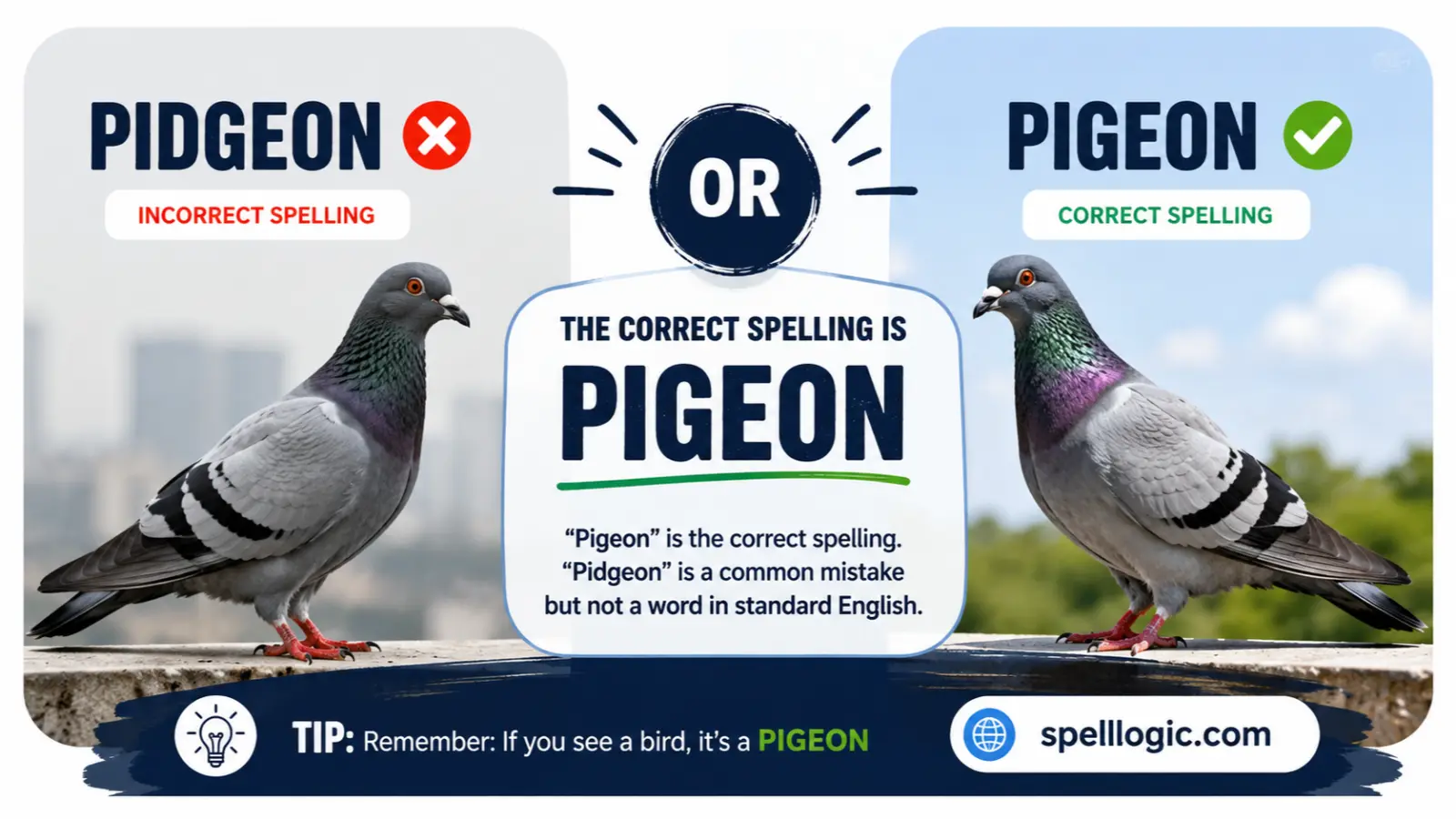
Many English learners wonder whether they should write pidgeon or pigeon. Since both words sound almost identical, it is easy to assume they are simply different spellings of the same word. However, only one spelling is accepted in standard English.
Knowing the correct spelling helps you avoid common writing mistakes in school, exams, emails, and everyday communication. In this guide, you’ll learn the difference between pidgeon and pigeon, discover why people confuse them, and find easy memory tricks to help you remember the correct form forever.
Why “Pidgeon” and “Pigeon” Are Confusing
Many people mistakenly write pidgeon instead of pigeon because the pronunciation does not clearly reveal the correct spelling.
Similar Pronunciation
Both pidgeon and pigeon are pronounced almost exactly the same:
/ˈpɪdʒən/
Since English spelling is not always phonetic, learners often spell the word the way it sounds.
Similar Spelling
The two spellings differ by only one letter arrangement:
- Pidgeon ❌
- Pigeon ✅
This tiny difference causes frequent typing and spelling mistakes.
Context Confusion
Because people often see incorrect spellings online or in informal writing, they may believe both versions are acceptable.
Common Learner Mistakes
Learners often:
- Add the extra d after pi
- Spell the word according to pronunciation
- Assume pidgeon is a British spelling
- Think both spellings are interchangeable
In reality, only “pigeon” is correct in both American and British English.
Pidgeon vs Pigeon Explained Simply
The difference is very simple.
Pidgeon is a misspelling of the word.
Pigeon is the correct English spelling for the familiar bird.
One-line Distinction
Pidgeon is an incorrect spelling, while pigeon is the correct spelling of the bird’s name.
Example Sentences
- Pidgeon is not a correct English spelling.
- A pigeon landed on the window ledge.
Another example:
- Many students accidentally write pidgeon.
- The pigeon flew back to its nest.
Understanding Homophones in English
Although pidgeon and pigeon sound alike, this is actually a case of a misspelling, not two separate homophones.
What Are Homophones?
Homophones are words that have the same pronunciation but different meanings and spellings.
Example:
- Sea
- See
These words sound identical but have different meanings.
Why Homophones Cause Confusion
English contains many words that sound alike.
For example:
- Their
- There
- They’re
Since pronunciation alone doesn’t reveal spelling, learners often confuse words.
In the case of pidgeon and pigeon, the confusion comes from spelling rather than two valid words.
What Does “Pidgeon” Mean?
Definition and Core Meaning
Pidgeon has no accepted meaning in standard English dictionaries.
It is simply an incorrect spelling of pigeon.
Origin and Historical Use
The spelling appears mainly because people write the word as they hear it.
It has never become the accepted standard spelling in English.
Occasionally, Pidgeon may appear as a surname, but that is different from the bird’s name.
Modern Usage and Synonyms
Since pidgeon is not a proper English word, it has no true synonyms.
Key Points
- Incorrect spelling
- Common typing mistake
- Not accepted in formal writing
- Not used in dictionaries as the bird’s name
Example Sentences
Incorrect:
- I saw a pidgeon in the park.
Correct:
- I saw a pigeon in the park.
What Does “Pigeon” Mean?
Definition and Core Meaning
A pigeon is a medium-sized bird belonging to the dove family.
Pigeons are found almost everywhere in the world and are well known for living in cities as well as rural areas.
Origin and Historical Context
The English word pigeon comes through Middle English from Old French, ultimately tracing back to Latin roots related to young birds.
People have kept pigeons for thousands of years for communication, racing, and companionship.
Modern Usage and Synonyms
Depending on context, similar words include:
- Dove (a related bird)
- Rock pigeon
- City pigeon
- Homing pigeon
Key Points
- Correct spelling
- Name of a common bird
- Used worldwide
- Accepted in all forms of English
Example Sentences
- A pigeon was eating seeds near the bench.
- The pigeon flew across the square.
- Homing pigeons can travel long distances.
- We watched a flock of pigeons in the city park.
Pidgeon vs Pigeon: Key Differences at a Glance
| Word | Part of Speech | Meaning | Example Context |
|---|---|---|---|
| Pidgeon | None (misspelling) | Incorrect spelling of pigeon | ❌ I saw a pidgeon. |
| Pigeon | Noun | A common bird in the dove family | ✅ A pigeon landed on the roof. |
How to Remember the Difference Between Pidgeon and Pigeon
Here are a few easy tricks.
Easy Memory Tricks
- Remember that pigeon has “ge”, not “dge.”
- Think of the word region. Both region and pigeon contain “ge.”
Association Technique
Picture a pigeon sitting in a city square.
Now imagine a dictionary beside it showing only PIGEON.
There is no dictionary entry for pidgeon.
Memorable Example
The pigeon is correct because dictionaries always spell the bird as P-I-G-E-O-N.
Common Mistakes and Confusions
Mistake 1
❌ I fed a pidgeon.
✅ I fed a pigeon.
Explanation: Pidgeon is misspelled.
Mistake 2
❌ Pidgeon is the British spelling.
✅ Pigeon is correct in both British and American English.
Explanation: There is no regional spelling difference.
Mistake 3
❌ There were many pidgeons.
✅ There were many pigeons.
Explanation: The plural follows the correct spelling.
Examples Section: Correct and Incorrect Usage
Example 1
✔ Correct: The pigeon built its nest on the balcony.
✘ Incorrect: The pidgeon built its nest on the balcony.
Example 2
✔ Correct: We watched several pigeons flying overhead.
✘ Incorrect: We watched several pidgeons flying overhead.
Example 3
✔ Correct: A pigeon landed near my feet.
✘ Incorrect: A pidgeon landed near my feet.
Example 4
✔ Correct: Children enjoyed feeding the pigeons.
✘ Incorrect: Children enjoyed feeding the pidgeons.
Self Assessment: Test Your Knowledge
Fill in the blanks.
- I saw a ______ sitting on the fence.
- ______ is not the accepted English spelling.
- A homing ______ can travel long distances.
- The correct spelling of the bird is ______.
Self Assessment Answers
- pigeon
- Pidgeon
- pigeon
- pigeon
FAQs
1. Is “pidgeon” a real English word?
No. It is a spelling mistake.
2. Which spelling is correct: pidgeon or pigeon?
Pigeon is the only correct spelling.
3. Is “pidgeon” used in British English?
No. British English also uses pigeon.
4. Why do people spell pigeon as pidgeon?
Because English pronunciation makes many people assume there should be a d after pi.
5. Can I use “pidgeon” in formal writing?
No. Always use pigeon.
6. Is pigeon a noun?
Yes. It is a common noun referring to a type of bird.
7. How can I remember the correct spelling?
Remember the pattern:
P-I-G-E-O-N
There is no “d” after pi.
Final Conclusion: Using “Pidgeon” and “Pigeon” Correctly
Understanding the difference between pidgeon and pigeon is much easier once you know that only one of them is a valid English word. Pigeon is the correct spelling and refers to the familiar bird found in cities, parks, and many natural environments around the world. Pidgeon, on the other hand, is simply a common misspelling that often appears because people write the word exactly as it sounds. This mistake is understandable, especially for English learners, since English spelling does not always match pronunciation.
However, using the correct spelling is important in school assignments, professional writing, emails, and everyday communication. A simple way to remember the difference is to think of the correct letter pattern: P-I-G-E-O-N—there is no d after pi. Reading, writing, and practicing the correct form regularly will help make it second nature. The next time you see this bird in a park or on a rooftop, you’ll know exactly how to spell its name with confidence. Every spelling mistake you correct strengthens your English skills, so keep practicing, stay curious, and enjoy building your vocabulary one word at a time.