Many English learners struggle with the phrases fill out and fill up because both contain the verb fill and seem to describe completing or adding something. However, these phrasal verbs have different meanings depending on the situation.
Using the wrong one can make your English sound unnatural or even change the meaning of your sentence. Fortunately, the difference is easy to understand once you know when each phrase is appropriate. In this guide, you’ll learn the meanings, origins, examples, memory tricks, and common mistakes so you can confidently use fill out and fill up in everyday English.
Why “Fill Out” and “Fill Up” Are Confusing
Many people confuse fill out and fill up because they are both common English phrasal verbs built around the same base verb, fill.
Similar Pronunciation
The phrases sound very similar when spoken quickly, especially because only the final word changes.
Similar Spelling
Both expressions begin with fill, making them look almost identical in writing.
Context Confusion
Both phrases involve making something “full,” but they apply to different situations.
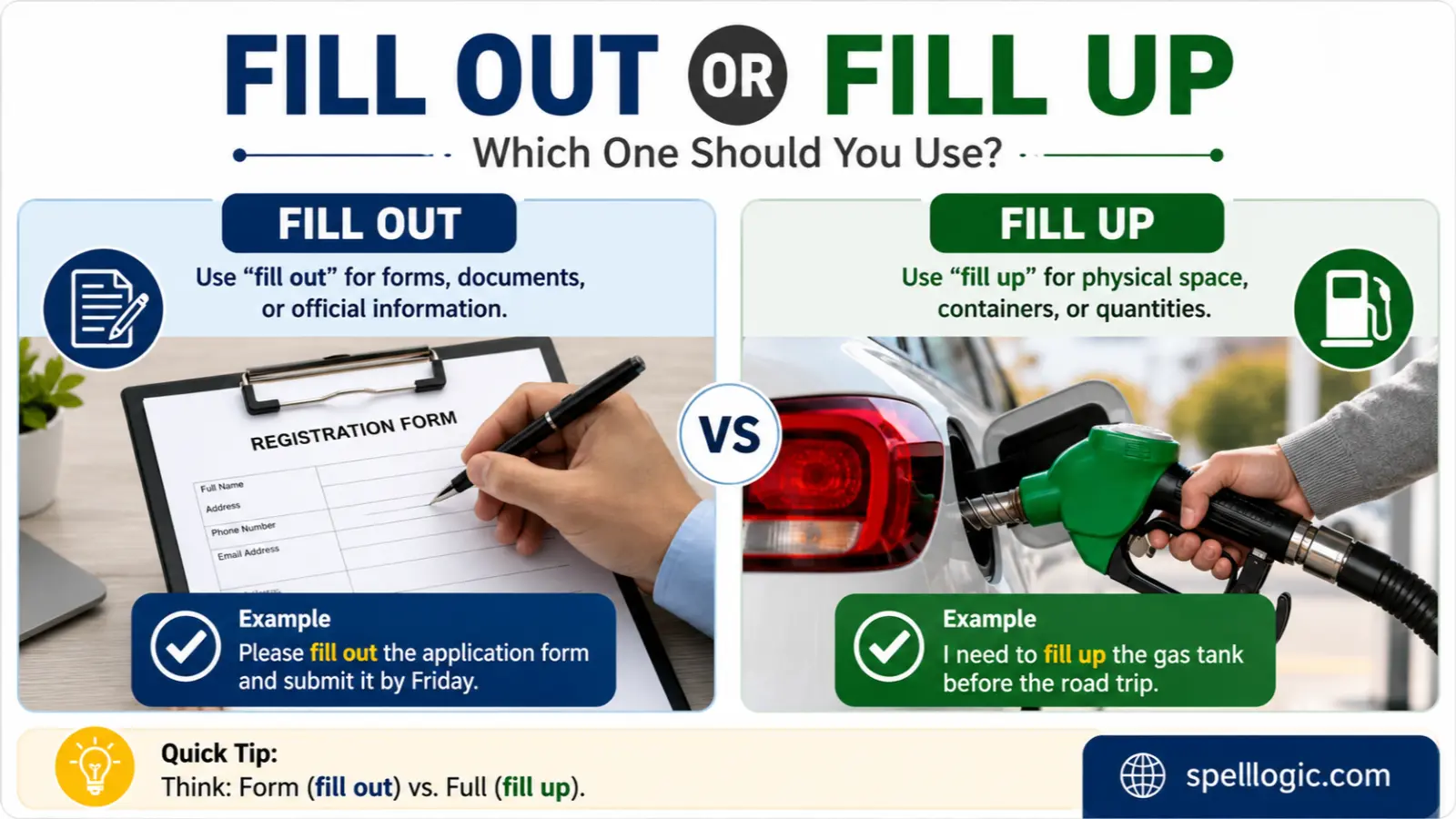
- Fill out usually means to complete a form or document.
- Fill up usually means to make a container completely full.
Common Learner Mistakes
English learners often say:
- “Please fill up this application.”
- “I need to fill out my water bottle.”
Although native speakers may understand these sentences, they sound unnatural because the wrong phrasal verb is used.
One-Line Distinction
Fill out is for paperwork, while fill up is for containers.
Example Sentences
- Please fill out this registration form before entering.
- I need to fill up my car with gasoline before the trip.
Another example:
- She filled out the online survey.
- He filled up the coffee mug.
Understanding Homophones in English
Although fill out and fill up are not homophones, learners often confuse them because they are similar-sounding phrasal verbs.
What Are Homophones?
Homophones are words that sound the same but have different meanings and spellings.
Example:
- Sea
- See
These two words sound identical but have different meanings.
Why Homophones Cause Confusion
When words sound alike, learners may choose the wrong one while speaking or writing.
Example:
- They’re going to school.
- They’re going too school. ❌
Similarly, learners may incorrectly replace fill out with fill up, even though they have different meanings.
What Does “Fill Out” Mean?
Definition and Core Meaning
Fill out means to complete a document by writing the required information.
It can also mean to become larger or more rounded, especially when talking about a person’s body or clothing, although this meaning is less common.
Origin and Historical Use
The expression has been used since the early 1900s and became popular as official forms, applications, and paperwork became more common in schools, businesses, and government offices.
Modern Usage and Synonyms
Common uses include:
- Completing forms
- Completing applications
- Completing surveys
- Completing questionnaires
Synonyms
- Complete
- Finish
- Enter information
- Write in
Example Sentences
- Please fill out the job application.
- She filled out the medical history form.
- Everyone must fill out the attendance sheet.
- I filled out the customs declaration before landing.
What Does “Fill Up” Mean?
Definition and Core Meaning
Fill up means to make something completely full.
It often refers to adding:
- Water
- Gasoline
- Fuel
- Food
- Air
- Coffee
Origin and Historical Context
The phrase has existed for centuries as a natural extension of the verb fill, meaning to make something full. As automobiles became common, fill up also became closely associated with refueling vehicles.
Modern Usage and Synonyms
Common situations include:
- Filling a gas tank
- Filling a bottle
- Filling a bucket
- Filling a cup
- Filling a balloon
Synonyms
- Refill
- Top up
- Fill completely
- Load
Example Sentences
- Please fill up the water bottle.
- We stopped to fill up the car.
- She filled up the swimming pool.
Fill Out vs Fill Up: Key Differences at a Glance
| Word | Part of Speech | Meaning | Example Context |
|---|---|---|---|
| Fill out | Phrasal verb | Complete a form or document | Fill out the application form |
| Fill up | Phrasal verb | Make something completely full | Fill up the fuel tank |
How to Remember the Difference Between Fill Out and Fill Up
Here are a few easy memory tricks.
Easy Memory Tricks
- Out = Outside writing
- You write information out onto a form.
- Up = Up to the top
- You fill something up until it is full.
Association Techniques
Imagine these pictures:
- A student writing on paperwork → Fill out
- A driver adding gasoline to a car → Fill up
Memorable Example
You fill out papers.
You fill up bottles.
This simple sentence helps most learners remember the difference.
Common Mistakes and Confusions
Wrong
❌ Please fill up this application.
Correct
✔ Please fill out this application.
Explanation: Applications are documents, not containers.
Wrong
❌ Fill out your coffee cup.
Correct
✔ Fill up your coffee cup.
Explanation: Cups are containers.
Wrong
❌ I filled up the online survey.
Correct
✔ I filled out the online survey.
Explanation: Surveys require written answers.
Wrong
❌ We filled out the gas tank.
Correct
✔ We filled up the gas tank.
Explanation: Tanks are filled with fuel.
Examples Section: Correct and Incorrect Usage
Example 1
✔ Correct: Please fill out the registration form.
✘ Incorrect: Please fill up the registration form.
Example 2
✔ Correct: I filled up the water bottle.
✘ Incorrect: I filled out the water bottle.
Example 3
✔ Correct: She filled out the visa application online.
✘ Incorrect: She filled up the visa application online.
Example 4
✔ Correct: They stopped to fill up the fuel tank.
✘ Incorrect: They stopped to fill out the fuel tank.
Self Assessment: Test Your Knowledge
Fill in the blanks with fill out or fill up.
- Please ________ this application before your interview.
- We need to ________ the car before leaving.
- Can you ________ this customer feedback form?
- She went to the kitchen to ________ her water bottle.
Self Assessment Answers
- fill out
- fill up
- fill out
- fill up
FAQs
1. Is it correct to say “fill up a form”?
No. Native English speakers normally say fill out a form.
2. Can “fill up” mean complete paperwork?
Generally, no. Fill up refers to making something physically full.
3. Is “fill in” the same as “fill out”?
Often, yes. Both can mean completing a form. In many situations, they are interchangeable, although fill out is especially common in American English.
4. Can I say “fill up the application”?
It is understandable, but fill out the application is the standard and more natural expression.
5. When do I use “fill up”?
Use fill up when talking about containers, vehicles, bottles, cups, tanks, or anything that becomes completely full.
6. Which phrase is more common in business English?
Fill out is much more common because business communication often involves forms, applications, contracts, and questionnaires.
7. Are both expressions correct English?
Yes. Both are correct, but they are used in different contexts and should not be confused.
Final Conclusion: Using “Fill Out” and “Fill Up” Correctly
Understanding the difference between fill out and fill up will make your English sound more natural and accurate. Although both phrases share the verb fill, they describe different actions. Fill out is used when you complete written documents such as forms, surveys, applications, or questionnaires by entering information. Fill up, on the other hand, is used when you make a container completely full, whether it is a water bottle, coffee cup, gas tank, bucket, or another object that can hold something.
A simple memory trick can help: you fill out paperwork, but you fill up containers. Keeping this distinction in mind will help you avoid one of the most common mistakes English learners make. As you read, listen, and practice more English, you’ll notice these phrases appear frequently in everyday conversations, workplaces, schools, and travel situations. Try creating your own example sentences and pay attention to how native speakers use each expression. With regular practice, choosing between fill out and fill up will become automatic. Every small improvement strengthens your communication skills, so keep learning, stay curious, and enjoy building your confidence in English one phrase at a time.