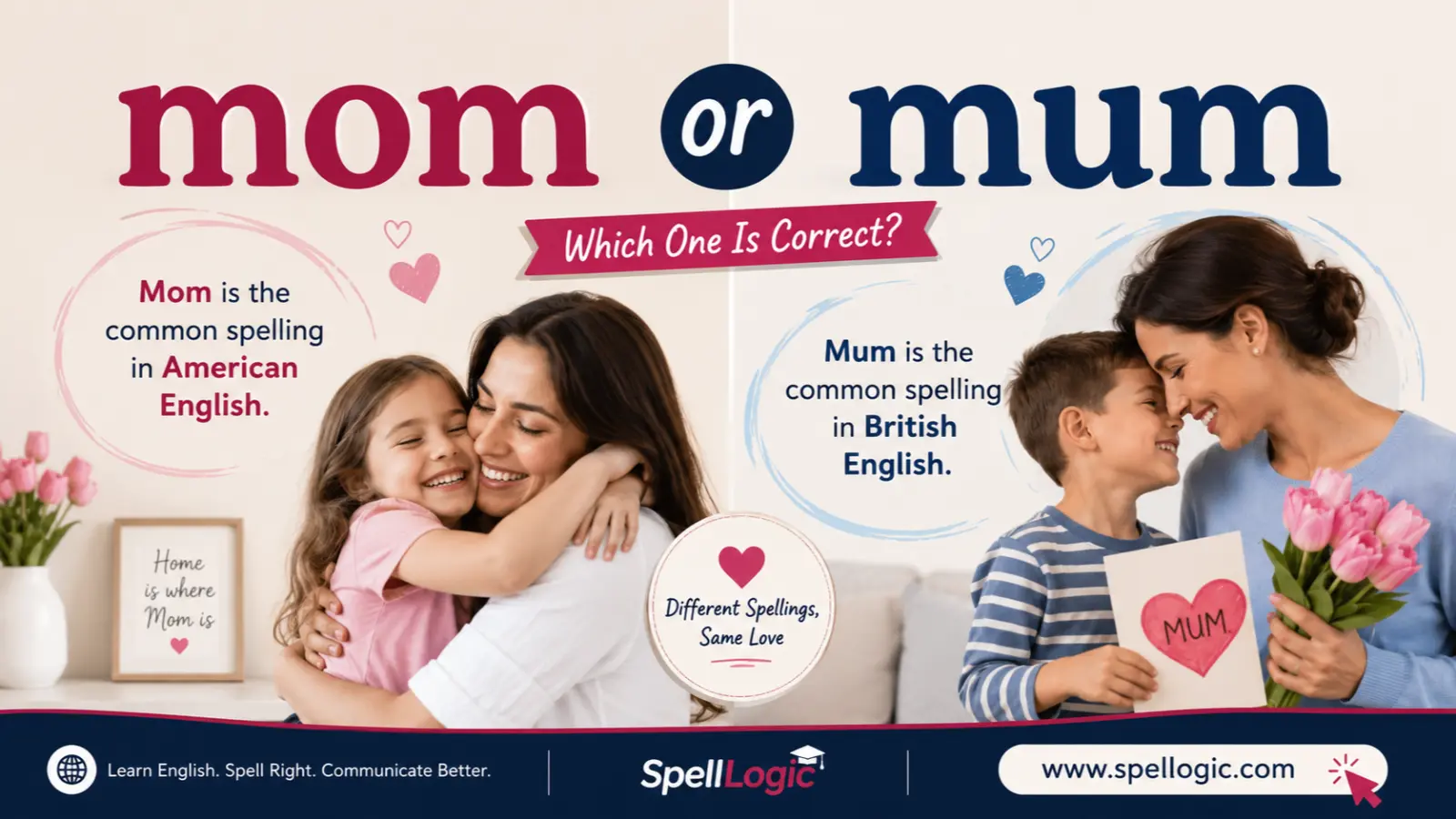
Many English learners wonder whether they should write mom or mum when talking about their mother. The confusion exists because both words have the same meaning, but they are used in different varieties of English. If you learn English from American movies, you will often hear mom, while British books and TV shows usually use mum.
Understanding the difference helps you communicate naturally and choose the right word for your audience. In this guide, you’ll learn when to use mom and mum, their origins, key differences, examples, memory tips, and common mistakes in simple, easy-to-understand English.
Table of Contents
- Introduction
- Why “Mom” and “Mum” Are Confusing
- Mom vs Mum Explained Simply
- Understanding Homophones in English
- What Does “Mom” Mean?
- What Does “Mum” Mean?
- Mom vs Mum: Key Differences at a Glance
- How to Remember the Difference Between Mom and Mum
- Common Mistakes and Confusions
- Examples Section: Correct and Incorrect Usage
- Self Assessment: Test Your Knowledge
- Self Assessment Answers
- FAQs About “Mom” and “Mum”
- Final Conclusion: Using “Mom” and “Mum” Correctly
Why “Mom” and “Mum” Are Confusing
Many people mix up mom and mum because they both refer to a person’s mother.
Similar Pronunciation
- Both words sound very similar.
- The pronunciation changes slightly depending on the speaker’s accent.
Similar Spelling
- They differ by only one letter: o in mom and u in mum.
- This small spelling difference makes them easy to confuse.
Context Confusion
Both words mean exactly the same thing, but their usage depends on the country or type of English.
- Mom is mainly used in American English.
- Mum is mainly used in British, Australian, New Zealand, and many Commonwealth varieties of English.
Common Learner Mistakes
Learners often:
- Use mum in American English writing.
- Use mom in British English exams.
- Think one word is more correct than the other.
In reality, both are correct—the best choice depends on your audience.
Mom vs Mum Explained Simply
The easiest way to understand these words is by remembering where they are commonly used.
Mom means “mother” in American English, while mum means “mother” in British English and many other English-speaking countries.
One-Line Distinction
Mom = American English.
Mum = British English.
Example Sentences
- My mom makes delicious pancakes every Sunday.
- My mum always reminds me to carry an umbrella.
Although the wording changes, the meaning stays exactly the same.
Understanding Homophones in English
What Are Homophones?
Homophones are words that sound the same or almost the same but have different spellings or meanings.
Example:
- Flower
- Flour
These two words sound alike but have different meanings.
Why Homophones Cause Confusion
English learners often rely on pronunciation when learning new words. Since pronunciation can vary by accent, similar-sounding words may seem interchangeable.
For example:
- Mom
- Mum
These words have the same meaning but different regional spellings.
What Does “Mom” Mean?
Definition and Core Meaning
Mom is an informal noun that means mother.
It is the everyday word children and adults commonly use in American English.
Origin and Historical Use
- Derived from mamma or momma.
- Became widely popular in the United States during the 19th century.
- Today it is the standard informal word for “mother” in American English.
Modern Usage and Synonyms
Common uses:
- Family conversations
- Text messages
- School writing in American English
- Everyday speech
Synonyms
- Mother
- Momma
- Mama
- Ma
Example Sentences
- My mom picked me up from school.
- I called my mom after work.
- My mom loves gardening.
- Please tell your mom I’ll be there soon.
What Does “Mum” Mean?
Definition and Core Meaning
Mum is an informal noun meaning mother in British English and several other English-speaking countries.
It expresses the same relationship as mom.
Origin and Historical Context
- Developed from mamma, just like mom.
- Became the preferred spelling in Britain.
- Today it is widely used throughout the UK, Australia, New Zealand, South Africa, and many Commonwealth countries.
Modern Usage and Synonyms
Common uses include:
- Daily conversations
- British schools
- Family letters
- Informal speech
Synonyms
- Mother
- Mama
- Mummy
- Ma
Example Sentences
- My mum makes excellent tea.
- I bought flowers for my mum.
- My mum helped me study.
- I phoned my mum yesterday.
Mom vs Mum: Key Differences at a Glance
| Word | Part of Speech | Meaning | Example Context |
|---|---|---|---|
| Mom | Noun | Mother (American English) | My mom is cooking dinner. |
| Mum | Noun | Mother (British English) | My mum is making tea. |
How to Remember the Difference Between Mom and Mum
Here are a few simple tricks.
Easy Memory Tricks
- O = USA. Think of the O in Mom as reminding you of American English.
- U = UK. Think of the U in Mum as reminding you of the United Kingdom.
Association Techniques
Imagine two postcards:
- One from New York saying Hi Mom!
- One from London saying Hi Mum!
The spelling changes, but the family relationship stays the same.
One Memorable Example
Americans usually say “Mom.” Britons usually say “Mum.”
Remembering the country helps you choose the correct spelling.
Common Mistakes and Confusions
Wrong Example
❌ My mum lives in Texas.
Correct Version
✔ My mom lives in Texas.
Explanation: American English usually prefers mom.
Wrong Example
❌ My mom is waiting outside. (In a British school essay.)
Correct Version
✔ My mum is waiting outside.
Explanation: British English normally uses mum.
Wrong Example
❌ Mom is the only correct spelling.
Correct Version
✔ Both mom and mum are correct.
Explanation: The correct choice depends on regional English.
Examples Section: Correct and Incorrect Usage
Example 1
✔ Correct: My mom drove me to school.
✘ Incorrect: My mum drove me to school. (In American English.)
Example 2
✔ Correct: My mum baked a birthday cake.
✘ Incorrect: My mom baked a birthday cake. (In British English.)
Example 3
✔ Correct: I gave my mom a Mother’s Day card.
✘ Incorrect: I gave my mum a Mother’s Day card. (If writing in American English.)
Example 4
✔ Correct: My mum enjoys gardening.
✘ Incorrect: My mom enjoys gardening. (If writing in British English.)
Self Assessment: Test Your Knowledge
Fill in the blanks.
- In American English, children usually say ______.
- In British English, the common informal word is ______.
- Both mom and mum mean a person’s ______.
- If you’re writing for a British audience, you should usually choose ______.
Self Assessment Answers
- mom
- mum
- mother
- mum
FAQs
1. Is “mom” or “mum” more correct?
Neither is more correct. Both are correct in their respective varieties of English.
2. Why do Americans say “mom”?
American English adopted mom as the standard informal word for mother, and it remains the most common choice in the United States.
3. Why do British people say “mum”?
British English traditionally uses mum, and it is the accepted everyday term across the UK.
4. Can I use “mom” in the UK?
People will understand you, but mum sounds more natural in British English.
5. Can I use “mum” in America?
Yes. Americans will usually understand it, but mom is the preferred spelling in the United States.
6. Are “mom” and “mum” formal words?
No. Both are informal terms. In formal writing, mother is usually preferred.
7. Should I switch between “mom” and “mum” in one article?
No. Stay consistent and use the spelling that matches your chosen variety of English.
Final Conclusion: Using “Mom” and “Mum” Correctly
The difference between mom and mum is simple once you understand regional English. Both words refer to your mother, and neither is more correct than the other. The key is choosing the spelling that matches the variety of English you are using. If you are writing for an American audience, mom is the natural choice. If you are communicating with readers in the United Kingdom, Australia, New Zealand, or many other Commonwealth countries, mum is the preferred spelling. In formal situations, the word mother is appropriate regardless of the country.
A helpful memory trick is to connect Mom with American English and Mum with the United Kingdom and British English. Keeping your spelling consistent throughout a piece of writing also makes your communication look more professional and natural. As you continue learning English, you’ll notice many similar regional differences, and understanding them will improve both your writing and speaking skills.
Remember that language changes across countries, but clear communication is always the goal. By practicing with real examples, reading different kinds of English, and paying attention to your audience, you’ll become more confident in choosing the right word every time. Keep learning, keep practicing, and soon using mom or mum correctly will feel completely natural.