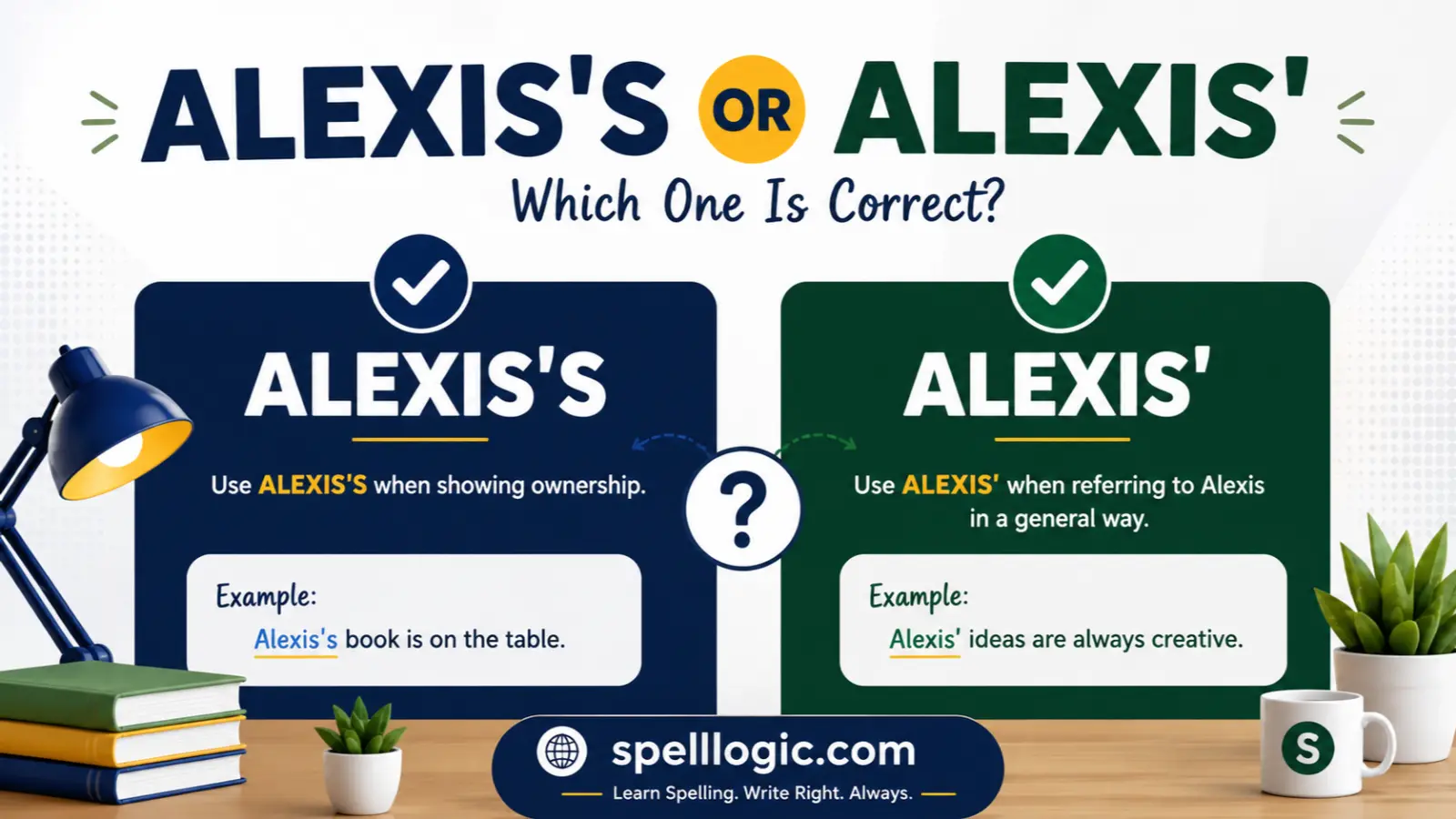
Many English learners struggle with Alexis’s and Alexis’ because both forms appear in books, newspapers, websites, and style guides. At first glance, they seem to mean exactly the same thing, yet writers often wonder which one is grammatically correct. The confusion becomes even greater because different style guides recommend different forms for possessive nouns ending in -s. Learning the difference will help you write more confidently in essays, emails, business documents, and everyday English. In this guide, you’ll discover when to use Alexis’s and Alexis’, why both can be correct, and which form is more common in modern English.
Why “Alexis’s” and “Alexis'” Are Confusing
Many people mix up Alexis’s and Alexis’ because both express possession.
Similar Pronunciation
- Most speakers pronounce both forms as “uh-LEX-iss-iz.”
- In everyday speech, there is usually little or no difference.
Similar Spelling
- Both begin with the same name: Alexis.
- The only visible difference is the extra s after the apostrophe.
Context Confusion
Different writing styles have different rules:
- Some style guides recommend Alexis’s.
- Others allow Alexis’, especially for names ending in -s.
Common Learner Mistakes
Learners often:
- Think only one form is always correct.
- Forget the apostrophe.
- Write Alexiss or Alexises by mistake.
- Mix style guides within the same document.
Alexis’s vs Alexis’ Explained Simply
Both Alexis’s and Alexis’ show that something belongs to someone named Alexis.
The main difference is writing style, not meaning.
One-line distinction:
Alexis’s is the preferred possessive form in most modern style guides, while Alexis’ is accepted by some style guides that omit the extra s after names ending in -s.
Example Sentences
- Alexis’s backpack is on the chair.
- Alexis’ backpack is on the chair.
Both sentences mean exactly the same thing.
Understanding Homophones in English
What Are Homophones?
Homophones are words that sound the same but have different meanings or spellings.
Example:
- Sea and see
Although Alexis’s and Alexis’ are not separate words with different meanings, they are pronounced the same and can look confusing to learners.
Why Homophones Cause Confusion
English contains many words that sound alike but follow different spelling rules.
For example:
- Their
- There
- They’re
Because pronunciation often stays the same while spelling changes, learners may become unsure which written form is correct.
What Does “Alexis’s” Mean?
Definition and Core Meaning
Alexis’s is the possessive form of the name Alexis.
It means that something belongs to Alexis.
Examples include:
- Alexis’s phone
- Alexis’s notebook
- Alexis’s opinion
Origin and Historical Use
Traditional English grammar generally forms possessives by adding:
‘s
This rule applies to most singular nouns, including names ending in -s.
Many modern style guides—including those commonly used in education and publishing—recommend this form.
Modern Usage and Synonyms
Although possessive forms do not have true synonyms, similar expressions include:
- belonging to Alexis
- owned by Alexis
- Alexis has
- the property of Alexis
Key Points
- Singular possessive noun
- Preferred in modern English
- Recommended by many grammar experts
- Common in academic and professional writing
Example Sentences
- Alexis’s computer needs an update.
- I borrowed Alexis’s dictionary.
- Alexis’s presentation impressed everyone.
- We admired Alexis’s artwork.
What Does “Alexis'” Mean?
Definition and Core Meaning
Alexis’ is another possessive spelling of the name Alexis.
It also means something belongs to Alexis.
The meaning is exactly the same as Alexis’s.
Origin and Historical Context
Some publishers and newspapers follow style guides that omit the extra s after singular names ending in -s.
As a result, they write:
- Alexis’
- James’
- Charles’
instead of adding ‘s.
Modern Usage and Synonyms
Equivalent expressions include:
- belonging to Alexis
- owned by Alexis
- the property of Alexis
Key Points
- Singular possessive noun
- Accepted in some style guides
- Less common in general English
- Often chosen for stylistic consistency
Example Sentences
- Alexis’ report was submitted early.
- Everyone admired Alexis’ creativity.
- Alexis’ jacket was left in the office.
- We discussed Alexis’ proposal yesterday.
Alexis’s vs Alexis’: Key Differences at a Glance
| Word | Part of Speech | Meaning | Example Context |
|---|---|---|---|
| Alexis’s | Singular possessive noun | Something belongs to Alexis | Alexis’s notebook is new. |
| Alexis’ | Singular possessive noun | Something belongs to Alexis | Alexis’ notebook is new. |
Quick Summary
- Meaning: Same
- Pronunciation: Usually the same
- Difference: Writing style
- Most modern grammar guides: Prefer Alexis’s
How to Remember the Difference Between Alexis’s and Alexis’
Easy Memory Tricks
- Think of the standard possessive rule: singular noun + ‘s.
- Since Alexis is one person, adding ‘s is usually safest.
Association Techniques
Remember this sentence:
One Alexis, one ‘s.
This reminds you that singular names usually take ‘s.
One Memorable Example
Imagine Alexis owns a bicycle.
The easiest way to write it is:
Alexis’s bicycle
This follows the standard possessive rule taught in many English classes.
Common Mistakes and Confusions
Wrong
❌ Alexis bike is outside.
Correct
✔ Alexis’s bike is outside.
Explanation: The possessive apostrophe is missing.
Wrong
❌ Alexiss notebook is missing.
Correct
✔ Alexis’s notebook is missing.
Explanation: Never add an extra s before the apostrophe.
Wrong
❌ Alexis’s notebook… and later Alexis’ bag… in the same paper.
Correct
✔ Choose one style and stay consistent.
Explanation: Mixing styles can confuse readers.
Wrong
❌ Alexis are books.
Correct
✔ Alexis’s books are on the shelf.
Explanation: Use the possessive form to show ownership
Examples Section: Correct and Incorrect Usage
Example 1
✔ Correct: Alexis’s keys are on the table.
✘ Incorrect: Alexis keys are on the table.
Example 2
✔ Correct: Alexis’ project won first place. (Acceptable in some style guides.)
✘ Incorrect: Alexiss project won first place.
Example 3
✔ Correct: Everyone liked Alexis’s speech.
✘ Incorrect: Everyone liked Alexis speech.
Example 4
✔ Correct: Alexis’ schedule changed yesterday. (Acceptable in certain styles.)
✘ Incorrect: Alexis’s’ schedule changed yesterday.
Self Assessment: Test Your Knowledge
Fill in the blanks.
1. ________ backpack is in the classroom.
2. Most modern grammar books prefer ________ over Alexis’.
3. Both Alexis’s and Alexis’ express ________.
4. Choose one writing style and remain ________ throughout your document.
Self Assessment Answers
1. Alexis’s (or Alexis’, depending on the style guide used)
2. Alexis’s
3. possession
4. consistent
FAQs
1. Is Alexis’s grammatically correct?
Yes. It is the preferred form in many modern grammar guides and educational settings.
2. Is Alexis’ also correct?
Yes. Some style guides accept Alexis’ as the possessive form of a singular name ending in -s.
3. Which form should students use?
Unless your teacher or organization follows a different style guide, Alexis’s is generally the safest choice.
4. Do both forms have the same meaning?
Yes. They both show that something belongs to Alexis.
5. Why do newspapers sometimes use Alexis’?
Some news organizations follow style guides that omit the extra s after singular names ending in -s.
6. Should I mix Alexis’s and Alexis’ in one article?
No. Choose one style and use it consistently throughout your writing.
7. Is the pronunciation different?
Usually not. Most speakers pronounce both forms the same way.
Final Conclusion: Using “Alexis’s” and “Alexis'” Correctly
Understanding the difference between Alexis’s and Alexis’ is easier once you know that the two forms usually have the same meaning. Both indicate that something belongs to a person named Alexis. The main distinction lies in style preferences, not grammar or meaning. Most modern English grammar books and educational resources recommend Alexis’s because it follows the standard rule of adding ‘s to singular nouns, even when they already end in -s. However, Alexis’ remains acceptable in certain publishing and journalistic style guides, making it a valid alternative in specific contexts.
The best approach is to choose the style required by your teacher, employer, publisher, or organization and use it consistently. If no style guide is provided, Alexis’s is usually the safest and most widely accepted option. A simple memory tip is to remember, “One person, add ‘s.” This rule works for most singular names and helps you avoid uncertainty when writing. As you continue learning English, you’ll notice that many grammar questions involve style as well as rules. With regular reading, practice, and attention to consistency, you’ll become more confident in using possessive forms correctly. Every small grammar improvement strengthens your writing, making it clearer, more professional, and easier for others to understand.