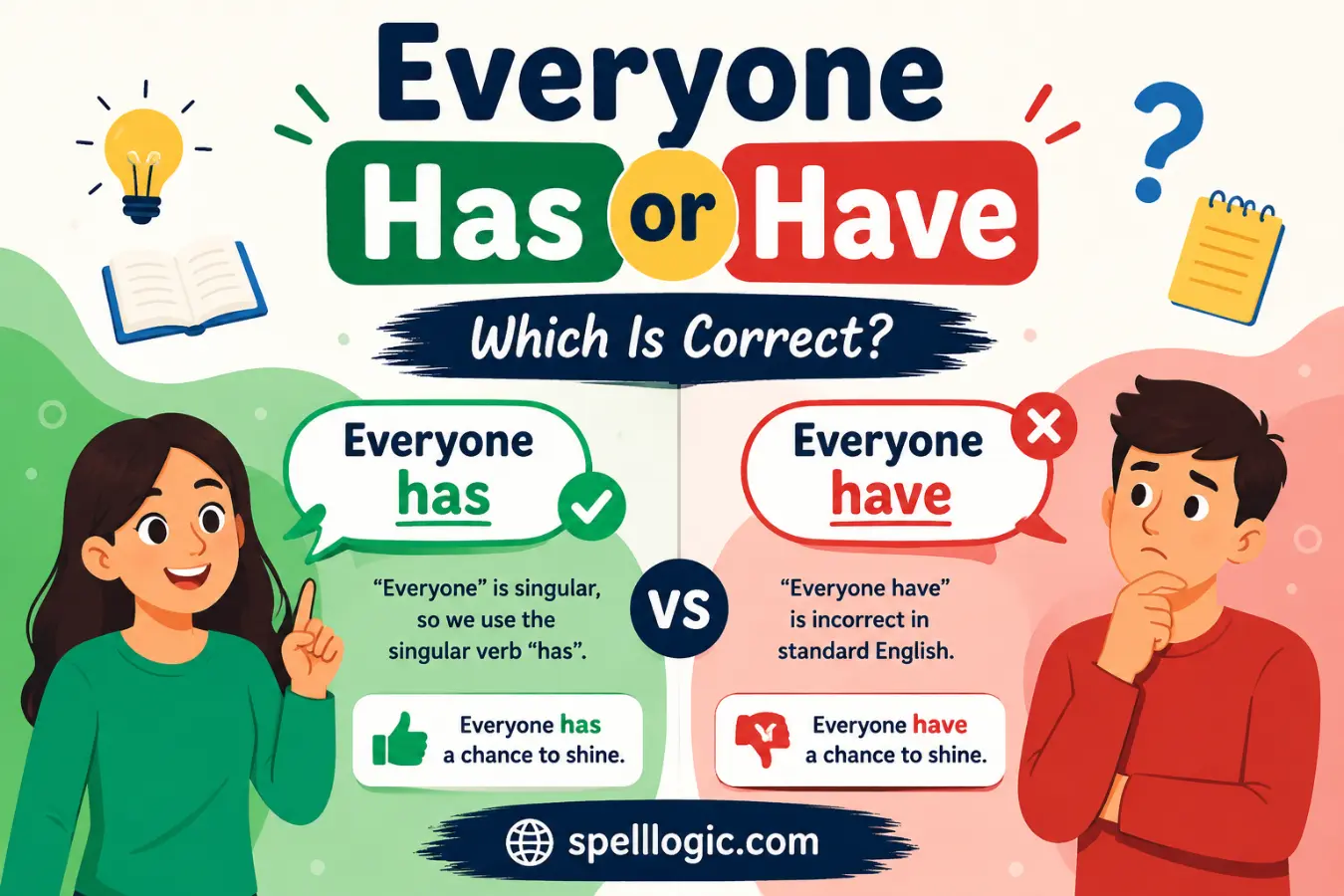
Many English learners wonder whether they should say “everyone has” or “everyone have.” At first glance, both phrases may seem possible because everyone refers to many people. However, English grammar follows a specific rule that determines which verb form is correct. Understanding this difference can help you write and speak more naturally, if you are preparing for an exam, writing an email, or having a conversation.
In this guide, we will explain the difference between everyone has and everyone have in simple language, provide examples, discuss common mistakes, and give you easy tricks to remember the correct usage.
Table of Contents
- Introduction
- Why “Everyone Has” and “Everyone Have” Are Confusing
- Everyone Has vs Everyone Have Explained Simply
- Understanding Homophones in English
- What Are Homophones?
- Why Homophones Cause Confusion
- What Does “Everyone Has” Mean?
- What Does “Everyone Have” Mean?
- Everyone Has vs Everyone Have: Key Differences at a Glance
- How to Remember the Difference Between Everyone Has and Everyone Have
- Common Mistakes and Confusions
- Examples Section: Correct and Incorrect Usage
- Self Assessment: Test Your Knowledge
- Self Assessment Answers
- FAQs About “Everyone Has and Everyone Have”
- Final Conclusion: Using “Everyone Has” and “Everyone Have” Correctly
Why “Everyone Has” and “Everyone Have” Are Confusing
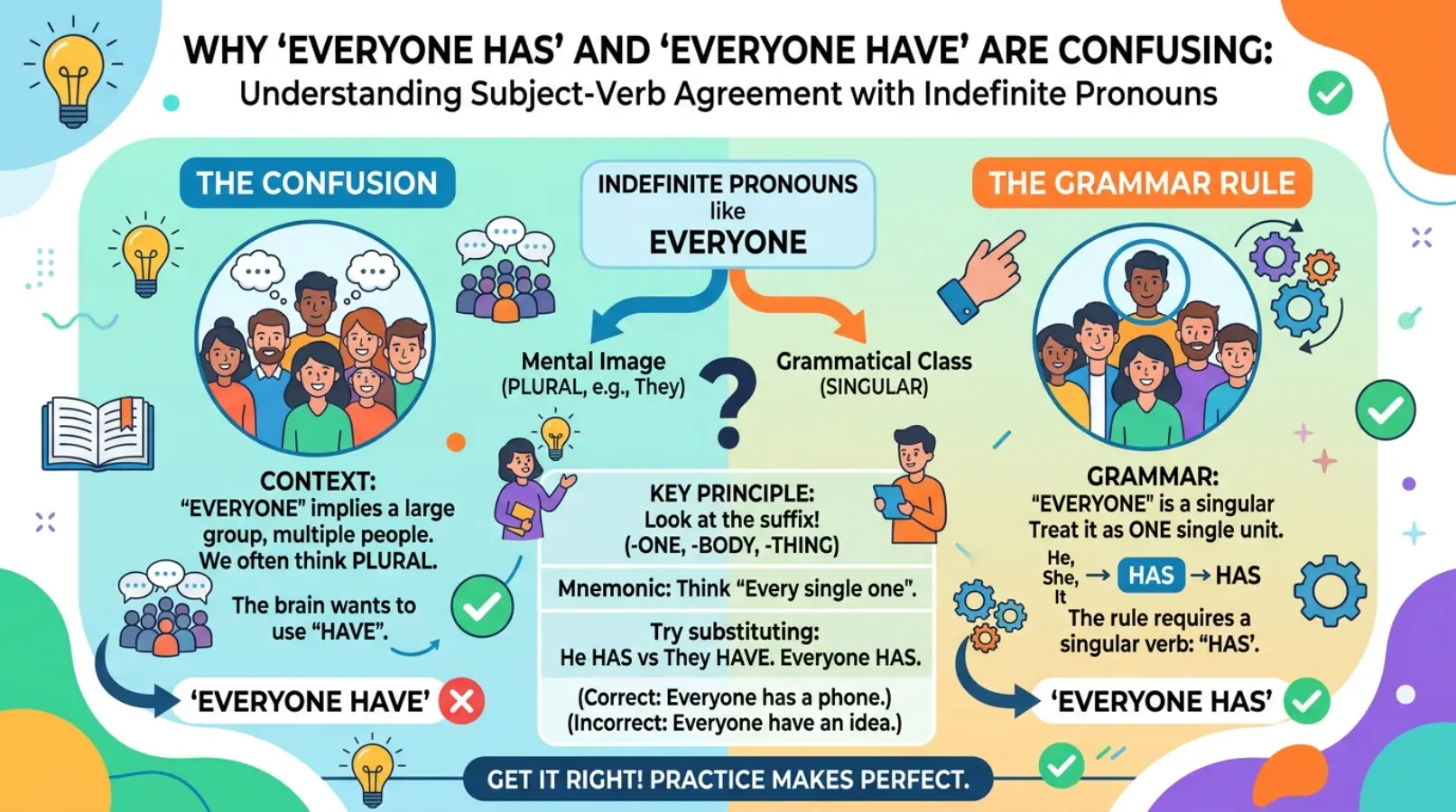
Many learners mix up everyone has and everyone have because the word everyone refers to a group of people. Since a group contains multiple individuals, it feels natural to use the plural verb have.
Here are the main reasons for the confusion:
Similar Pronunciation
In fast speech, the difference between has and have can sound subtle, especially for non-native speakers.
Similar Spelling
The words has and have share the same root verb, making them look closely related.
Context Confusion
Because everyone means all people in a group, learners often assume it requires a plural verb.
Common Learner Mistakes
Many people incorrectly say:
- Everyone have a ticket.
- Everyone have their own opinion.
- Everyone have completed the task.
The correct form in standard English is:
- Everyone has a ticket.
- Everyone has their own opinion.
- Everyone has completed the task.
Everyone Has vs Every body Have Explained Simply
Everyone has is the correct grammatical form in standard English because people
is treated as a singular pronoun.
One-Line Distinction
“Everyone has” is correct because “everyone” is singular, while “everyone have” is grammatically incorrect in standard usage.
Example Sentences
- Everyone has a chance to succeed.
- Everyone has their own favorite movie.
Incorrect examples:
- Everyone have a chance to succeed.
- Everyone have their own favorite movie.
Understanding Homophones in English
Although has and have are not homophones, learners often confuse similar-sounding words in English. Understanding these patterns can improve grammar skills.
What Are Homophones?
Homophones are words that sound the same but have different meanings or spellings.
Example:
- Their – belonging to them
- There – a place
Why Homophones Cause Confusion
When words sound alike, learners may choose the wrong spelling or meaning.
For example:
- “I left my bag over there.”
- “Their bag is on the table.”
Because the words sound similar, mistakes are common.
What Does “Everyone Has” Mean?
Definition and Core Meaning
Everyone has means that each person in a group possesses, owns, experiences, or receives something.
The phrase combines:
- Everyone = every person
- Has = singular form of the verb to have
Origin and Historical Use
The word everyone developed from combining every and one. Since one is singular, English grammar has traditionally treated everyone as singular.
As a result, singular verbs such as has, is, and does follow everyone.
Modern Usage and Synonyms
Common alternatives include:
- Every person has
- Each person has
- Everybody has
Key Points
- Grammatically correct
- Used in formal and informal English
- Follows singular verb agreement
- Common in speaking and writing
Example Sentences
- Everyone has a responsibility to follow the rules.
- Everyone has their own dreams.
- Everyone has received the email.
- Everyone has enough time to finish.
What Does “Everyone Have” Mean?
Definition and Core Meaning
Everyone have is generally an incorrect phrase in standard English grammar.
The issue occurs because have is typically used with plural subjects or with pronouns such as:
- I have
- You have
- We have
- They have
Since everyone is singular, have does not match the subject.
Origin and Historical Context
This mistake often comes from logical thinking rather than grammar rules. Learners see everyone as referring to many people and therefore choose the plural verb have.
However, English grammar focuses on the grammatical form of the subject, not the number of people involved.
Modern Usage and Synonyms
There are no standard situations where everyone have is preferred in formal English.
Instead, use:
- Everyone has
- Everybody has
- Each person has
Key Points
- Usually incorrect in standard grammar
- Common learner error
- Results from misunderstanding subject-verb agreement
- Should be replaced with everyone has
Example Sentences
Incorrect:
- Everyone have a seat.
- Everyone have completed the assignment.
Corrected:
- Everyone has a seat.
- Everyone has completed the assignment.
Everyone Has vs Everyone Have: Key Differences at a Glance
| Word/Phrase | Part of Speech | Meaning | Example Context |
|---|---|---|---|
| Everyone has | Pronoun + Verb | Each person possesses or experiences something | Everyone has a ticket. |
| Everyone have | Pronoun + Verb | Grammatically incorrect in standard English | Everyone have a ticket. ✘ |
How to Remember the Difference Between Everyone Has and Everyone Have
Learning a simple memory trick can make this rule easy to remember.
Easy Memory Tricks
Think about the word one inside everyone.
- Every + one = everyone
- One is singular
- Singular subjects take singular verbs
Therefore:
- Everyone has ✔
- Everyone have ✘
Association Techniques
Replace everyone with each person.
Example:
- Each person has a ticket.
- Everyone has a ticket.
Since each person is singular, the same rule applies.
One Memorable Example
Imagine a classroom.
Each student has a book.
Since everyone means each student, you would also say:
Everyone has a book.
Common Mistakes and Confusions
Below are some frequent errors.
Wrong Example
Everyone have a phone.
Correct Version
Everyone has a phone.
Explanation
The subject everyone is singular, so the singular verb has is required.
Wrong Example
Everyone have arrived.
Correct Version
Everyone has arrived.
Explanation
The present perfect tense requires has with singular subjects.
Wrong Example
Everyone have their own ideas.
Correct Version
Everyone has their own ideas.
Explanation
Even though their refers to people generally, the subject remains singular.
Examples Section: Correct and Incorrect Usage
Example 1
✔ Correct: Everyone has a seat at the table.
✘ Incorrect: Everyone have a seat at the table.
Example 2
✔ Correct: Everyone has finished the test.
✘ Incorrect: Everyone have finished the test.
Example 3
✔ Correct: Everyone has a different opinion.
✘ Incorrect: Everyone have a different opinion.
Example 4
✔ Correct: Everyone has received the invitation.
✘ Incorrect: Everyone have received the invitation.
Example 5
✔ Correct: Everyone has their own learning style.
✘ Incorrect: Everyone have their own learning style.
Example 6
✔ Correct: Everyone has enough information.
✘ Incorrect: Everyone have enough information.
Self Assessment: Test Your Knowledge
Fill in the blanks with has or have.
1.
Everyone _____ a chance to participate.
2.
Everyone _____ completed the project successfully.
3.
Everyone _____ their own perspective on the issue.
4.
Everyone _____ received the meeting schedule.
Self Assessment Answers
1.
Everyone has a chance to participate.
2.
Everyone has completed the project successfully.
3.
Everyone has their own perspective on the issue.
4.
Everyone has received the meeting schedule.
FAQs
1. Is “everyone has” grammatically correct?
Yes. Everyone has is the correct form because everyone is grammatically singular.
2. Is “everyone have” ever correct?
In standard English grammar, everyone have is considered incorrect.
3. Why is everyone singular if it refers to many people?
The word contains one, and English treats it as a singular indefinite pronoun.
4. Should I say “everyone has” or “everybody has”?
Both are correct and commonly used.
5. Do all singular indefinite pronouns take singular verbs?
Generally, yes. Words like everyone, everybody, someone, and anyone usually take singular verbs.
6. Can I use “their” after “everyone”?
Yes. Modern English commonly uses singular they/their after everyone.
Example:
- Everyone has their own opinion.
7. What is the easiest way to remember the rule?
Think of everyone = every one person. Since one person is singular, use has.
Final Conclusion: Using “Everyone Has” and “Everyone Have” Correctly
Understanding the difference between everyone has and everyone have is an important step toward mastering English grammar. Although everyone refers to a group of people, it is grammatically treated as a singular indefinite pronoun. Because of this rule, the correct verb form is always has, not have. This principle applies in everyday conversations, academic writing, business communication, and professional documents.
A helpful way to remember the rule is to focus on the word one hidden inside everyone. Since one is singular, the verb that follows should also be singular. For example, “Everyone has a ticket,” “Everyone has completed the assignment,” and “Everyone has their own opinion” are all correct examples. In contrast, phrases like “Everyone have a ticket” or “Everyone have finished” should be avoided in standard English.
The more you practice subject-verb agreement, the more natural these choices will become. Reading English books, listening to native speakers, and paying attention to common sentence patterns can strengthen your understanding. Whenever you feel unsure, replace everyone with each person. If each person has sounds correct, then everyone has is correct too.
Keep practicing, stay curious, and remember that every grammar rule you learn brings you one step closer to confident and fluent English communication.