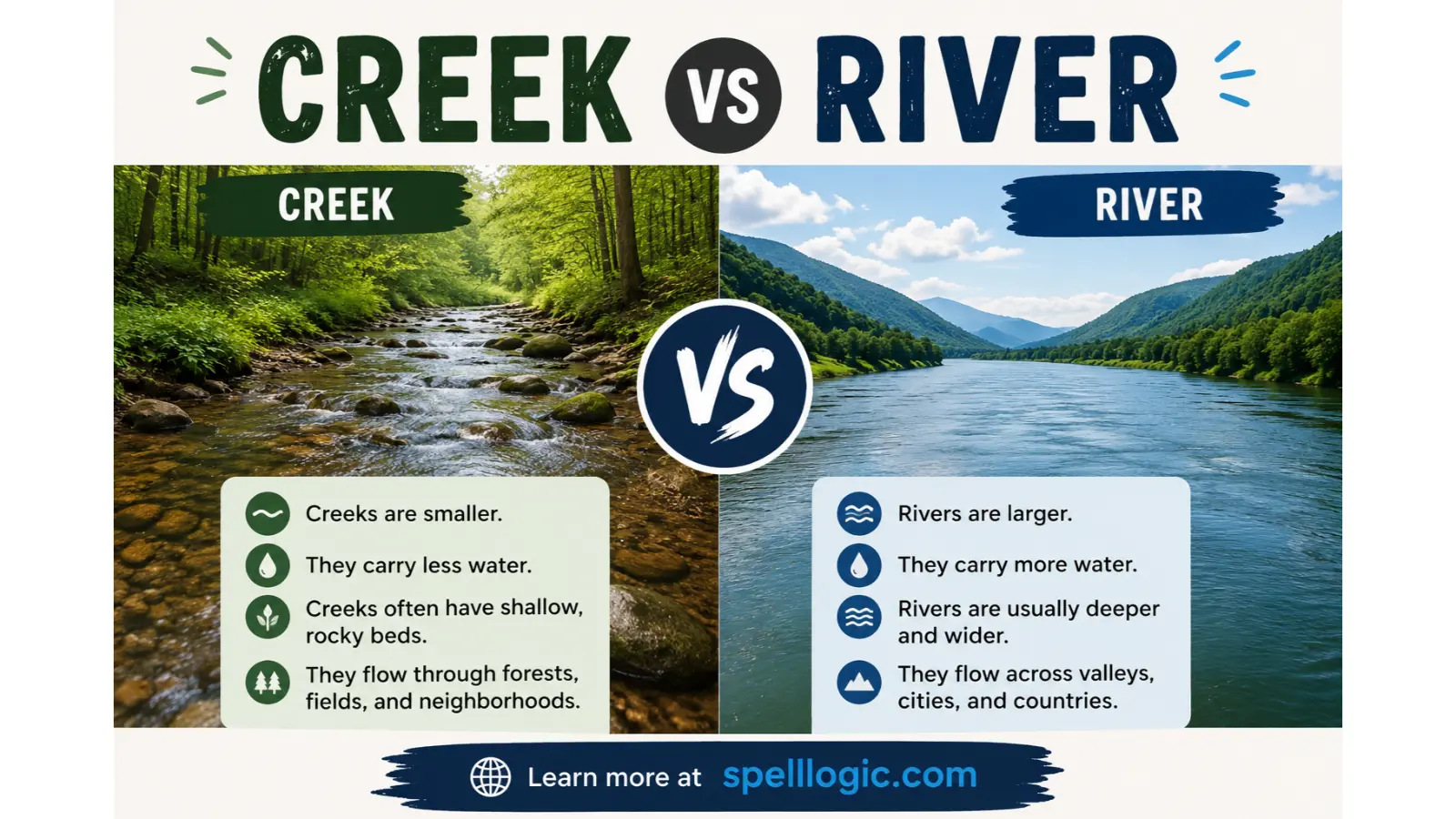
Creek vs River many English learners become confused when they hear the words creek and river. Both words describe flowing bodies of water, and in everyday conversation people sometimes use them interchangeably. However, they are not exactly the same. Understanding the difference between a creek and a river can improve your vocabulary, help you describe natural landscapes accurately, and make your English sound more natural.
if you are reading a geography book, traveling, or simply expanding your English knowledge, learning when to use creek and river correctly is useful. This guide explains the differences in a simple and easy-to-understand way.
Table of Contents
- Introduction
- Why “Creek” and “River” Are Confusing
- Creek vs River Explained Simply
- Understanding Homophones in English
- What Are Homophones?
- Why Homophones Cause Confusion
- What Does “Creek” Mean?
- What Does “River” Mean?
- Creek vs River: Key Differences at a Glance
- How to Remember the Difference Between Creek and River
- Common Mistakes and Confusions
- Examples Section: Correct and Incorrect Usage
- Self Assessment: Test Your Knowledge
- Self Assessment Answers
- FAQs About “Creek and River”
- Final Conclusion: Using “Creek” and “River” Correctly
Why “Creek” and “River” Are Confusing
Many people mix up creek and river because both refer to natural waterways.
Similar Pronunciation
The words do not sound identical, but both are common water-related terms that often appear in similar discussions.
Similar Spelling
The spellings are different, yet learners may confuse them because they belong to the same category of geographical features.
Context Confusion
A creek and a river both contain flowing water. In some regions, the distinction is based on size, while in others local traditions determine the name. This can make the terms seem interchangeable.
Common Learner Mistakes
Learners often:
- Call every flowing waterway a river.
- Use creek and river as exact synonyms.
- Assume the difference is always clearly defined.
- Ignore regional naming traditions.
Creek vs River Explained Simply
Creek means a small, narrow stream of flowing water, while river means a larger natural watercourse that carries water across a wider area.
One-Line Distinction
A creek is usually smaller and shallower, while a river is generally larger and deeper.
Example Sentences
Creek
- We crossed a small creek during our hike.
- Fish were swimming in the clear creek.
River
- The river flows through the center of the city.
- Boats travel along the river every day.
Understanding Homophones in English
What Are Homophones?
Homophones are words that sound the same or nearly the same but have different meanings and spellings.
Example:
- Sea
- See
These words sound alike but have different meanings.
Why Homophones Cause Confusion
English learners often focus on pronunciation before spelling and meaning. As a result, similar-sounding words can be mixed up.
For example:
- Their
- There
- They’re
Although creek and river are not true homophones, they create confusion because they are closely related in meaning and often appear in similar contexts.
What Does “Creek” Mean?
Definition and Core Meaning
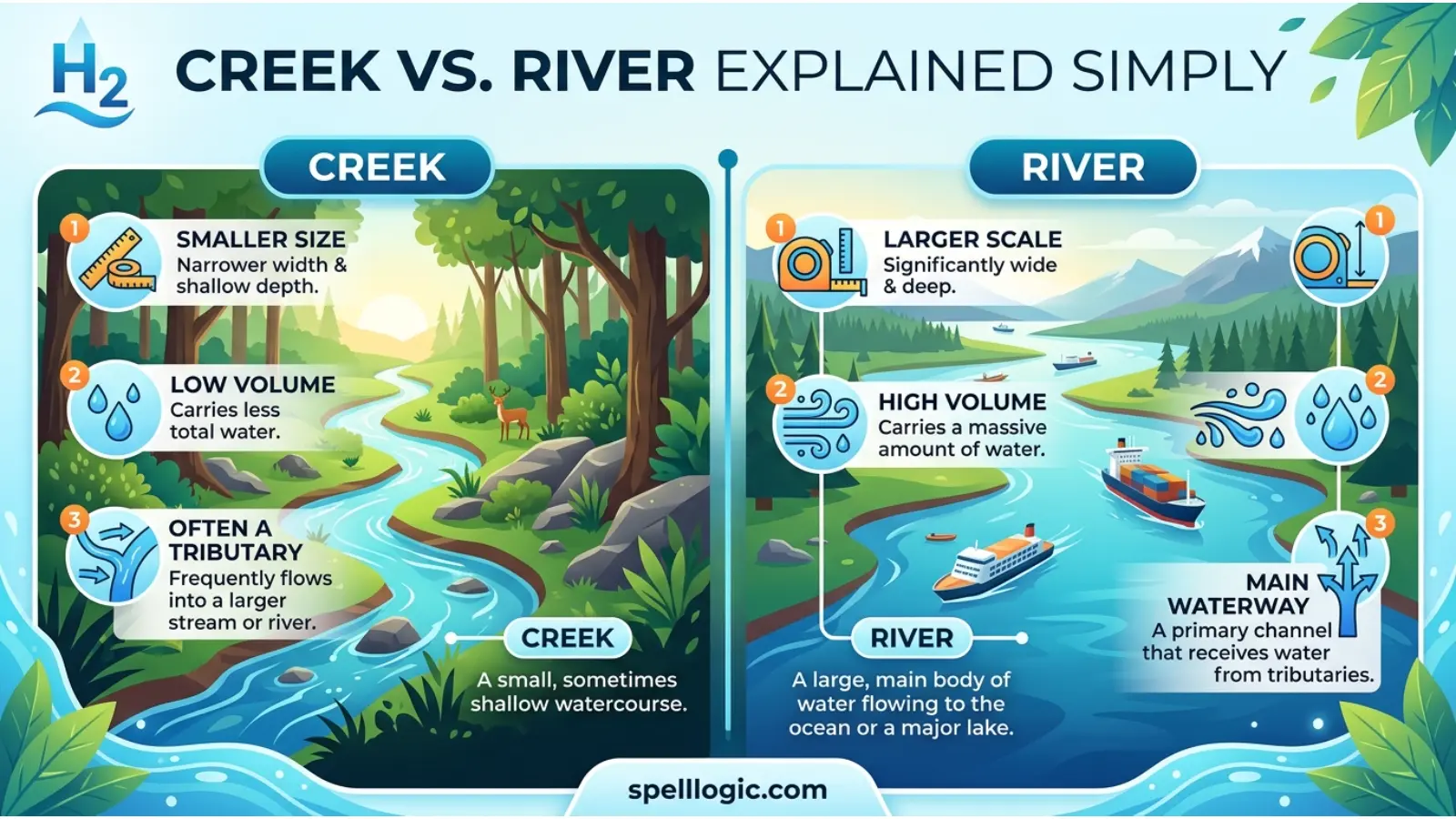
A creek is a small stream or minor waterway that flows naturally across the land. It is usually narrower and shallower than a river.
Origin and Historical Use
The word creek comes from an Old Norse word related to a corner or inlet. Over time, English speakers began using it to describe small streams and waterways.
Historically, settlers in North America frequently used the word for small flowing bodies of water.
Modern Usage and Synonyms
Today, creek commonly refers to a small freshwater stream.
Synonyms include:
- Stream
- Brook
- Rivulet
- Watercourse
Key Characteristics
- Smaller than a river
- Often shallow
- May flow into a river
- Common in rural and natural areas
Example Sentences
- Children played near the creek behind the school.
- The creek dried up during the hot summer.
- Deer often gather near the creek to drink water.
- We followed the creek through the forest.
What Does “River” Mean?
Definition and Core Meaning
A river is a large natural stream of water that flows across land toward a lake, sea, ocean, or another river.
Origin and Historical Context
The word river comes from the Latin word riparia, which relates to riverbanks and flowing water.
Throughout history, rivers have been important for transportation, agriculture, trade, and the development of civilizations.
Modern Usage and Synonyms
Today, river describes major waterways around the world.
Synonyms include:
- Waterway
- Stream (in some contexts)
- Watercourse
- Channel
Key Characteristics
- Larger than a creek
- Usually deeper and wider
- Supports transportation in many areas
- Often receives water from smaller streams and creeks
Example Sentences
- The river supplies water to nearby towns.
- A bridge crosses the river.
- Many animals live along the riverbanks.
- The river eventually empties into the ocean.
Creek vs River: Key Differences at a Glance
| Word | Part of Speech | Meaning | Example Context |
|---|---|---|---|
| Creek | Noun | A small natural stream of flowing water | We walked beside a creek in the woods. |
| River | Noun | A large natural watercourse flowing toward a larger body of water | Ships travel along the river. |
How to Remember the Difference Between Creek and River
Easy Memory Tricks
Think of a creek as a small path of water and a river as a major highway of water.
Association Techniques
- Creek = Compact
- River = Robust
Both words begin with different letters that can help you remember their sizes.
One Memorable Example
Imagine hiking in a forest.
- A small stream you can jump across is probably a creek.
- A large body of flowing water requiring a bridge is probably a river.
Common Mistakes and Confusions
Mistake 1
❌ We sailed a large boat down the creek.
✔ We sailed a large boat down the river.
Explanation: Large boats usually travel on rivers, not small creeks.
Mistake 2
❌ The tiny creek was hundreds of meters wide.
✔ The river was hundreds of meters wide.
Explanation: A creek is typically much smaller.
Mistake 3
❌ The creek carries commercial shipping traffic.
✔ The river carries commercial shipping traffic.
Explanation: Commercial shipping usually takes place on rivers.
Mistake 4
❌ We easily stepped over the river.
✔ We easily stepped over the creek.
Explanation: Small creeks can often be crossed on foot.
Examples Section: Correct and Incorrect Usage
Example 1
✔ Correct: The creek flows through the forest.
✘ Incorrect: The river flows through the forest and is only one meter wide.
Example 2
✔ Correct: Several bridges cross the river.
✘ Incorrect: Several large cargo ships travel along the creek.
Example 3
✔ Correct: The children searched for frogs in the creek.
✘ Incorrect: The children searched for frogs in the massive river they could barely see across.
Example 4
✔ Correct: The river eventually reaches the sea.
✘ Incorrect: The small creek supports international shipping.
Self Assessment: Test Your Knowledge
Fill in the blanks with creek or river.
1.
The small ______ runs behind our house.
2.
The ______ is wide enough for large boats.
3.
We crossed the shallow ______ while hiking.
4.
The longest ______ in the country flows into the ocean.
Self Assessment Answers
1.
Creek
2.
River
3.
Creek
4.
River
FAQs
1. Is a creek smaller than a river?
Yes. A creek is generally smaller, narrower, and shallower than a river.
2. Can a creek become a river?
In some cases, multiple creeks and streams join together to form larger waterways that become rivers.
3. Are creek and river synonyms?
Not exactly. Both describe flowing water, but they usually differ in size and scale.
4. Can fish live in both creeks and rivers?
Yes. Many species of fish live in both types of waterways.
5. Why are some small waterways called rivers?
Local history and regional naming traditions sometimes influence the name more than the actual size.
6. Is a creek the same as a stream?
Often, yes. A creek and a stream are very similar, though usage varies by region.
7. Which word is more common in geography?
Both are common, but river is typically used for larger and more significant waterways.
Final Conclusion: Using “Creek” and “River” Correctly
Understanding the difference between creek and river is easier once you focus on size and usage. A creek is usually a small, narrow, and shallow stream of flowing water. A river, on the other hand, is a much larger natural watercourse that often carries significant amounts of water and may flow into a sea, lake, or another river. Although both terms describe moving water, they are not interchangeable in every situation.
In everyday English, choosing the correct word helps make your descriptions more accurate. If you are talking about a small stream in a forest, creek is generally the right choice. If you are describing a large waterway that supports boats, transportation, or major ecosystems, river is usually the better word. Remember the simple memory trick: creek equals compact, river equals robust. This association can help you quickly select the correct term.
As you continue learning English, pay attention to how these words are used in books, maps, documentaries, and conversations. The more examples you encounter, the more natural the distinction will become. Keep practicing, stay curious, and remember that every new word you master brings you one step closer to confident and fluent English communication.