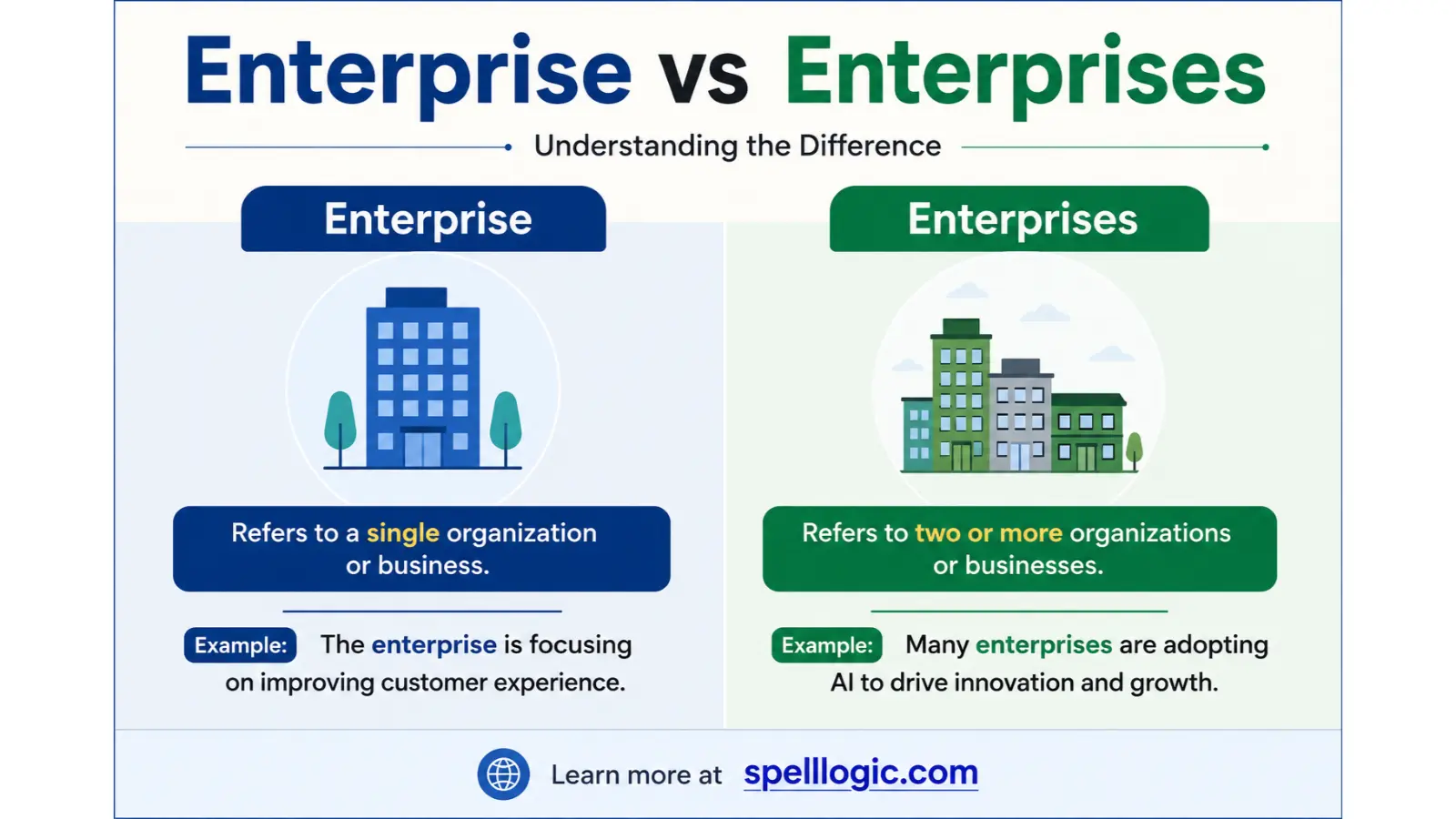
Many English learners become confused when they see enterprise and enterprises in books, business articles, and everyday conversations. At first glance, these words look almost identical, which makes it easy to assume they have different meanings. In reality, the difference is much simpler: one is singular, and the other is plural.
However, because both words are commonly used in business, economics, and professional writing, learners often struggle to know which form is correct in a sentence. Understanding the distinction between enterprise and enterprises will help you write more accurately, speak more confidently, and avoid common grammar mistakes.
Table of Contents
- Introduction
- Why “Enterprise” and “Enterprises” Are Confusing
- Enterprise vs Enterprises Explained Simply
- Understanding Homophones in English
- What Are Homophones?
- Why Homophones Cause Confusion
- What Does “Enterprise” Mean?
- What Does “Enterprises” Mean?
- Enterprise vs Enterprises: Key Differences at a Glance
- How to Remember the Difference Between Enterprise and Enterprises
- Common Mistakes and Confusions
- Examples Section: Correct and Incorrect Usage
- Self Assessment: Test Your Knowledge
- Self Assessment Answers
- FAQs About “Enterprise and Enterprises”
- Final Conclusion: Using “Enterprise” and “Enterprises” Correctly
Why “Enterprise” and “Enterprises” Are Confusing
Many learners mix up enterprise and enterprises for several reasons.
Similar Pronunciation
The words sound nearly the same when spoken. The only noticeable difference is the extra -s sound at the end of enterprises.
Similar Spelling
The spelling difference is minimal. Since only one letter changes, readers can easily overlook it.
Context Confusion
Both words often appear in business-related contexts. For example:
- Enterprise software
- Business enterprise
- Small enterprises
- Global enterprises
Because the topic remains the same, learners may not immediately recognize whether the noun is singular or plural.
Common Learner Mistakes
Many people mistakenly use:
- This enterprises is growing rapidly.
- Several enterprise are expanding overseas.
These sentences contain number agreement errors that can confuse readers.
Enterprise vs Enterprises Explained Simply
Enterprise means a business, company, project, or organization, while enterprises means more than one business, company, project, or organization.
One-Line Distinction
- Enterprise = One business or venture
- Enterprises = Multiple businesses or ventures
Example Sentences
Enterprise
- The enterprise employs over 500 workers.
- She started a successful enterprise from her home.
Enterprises
- Many enterprises are adopting digital technologies.
- Small enterprises contribute significantly to the economy.
Understanding Homophones in English
What Are Homophones?
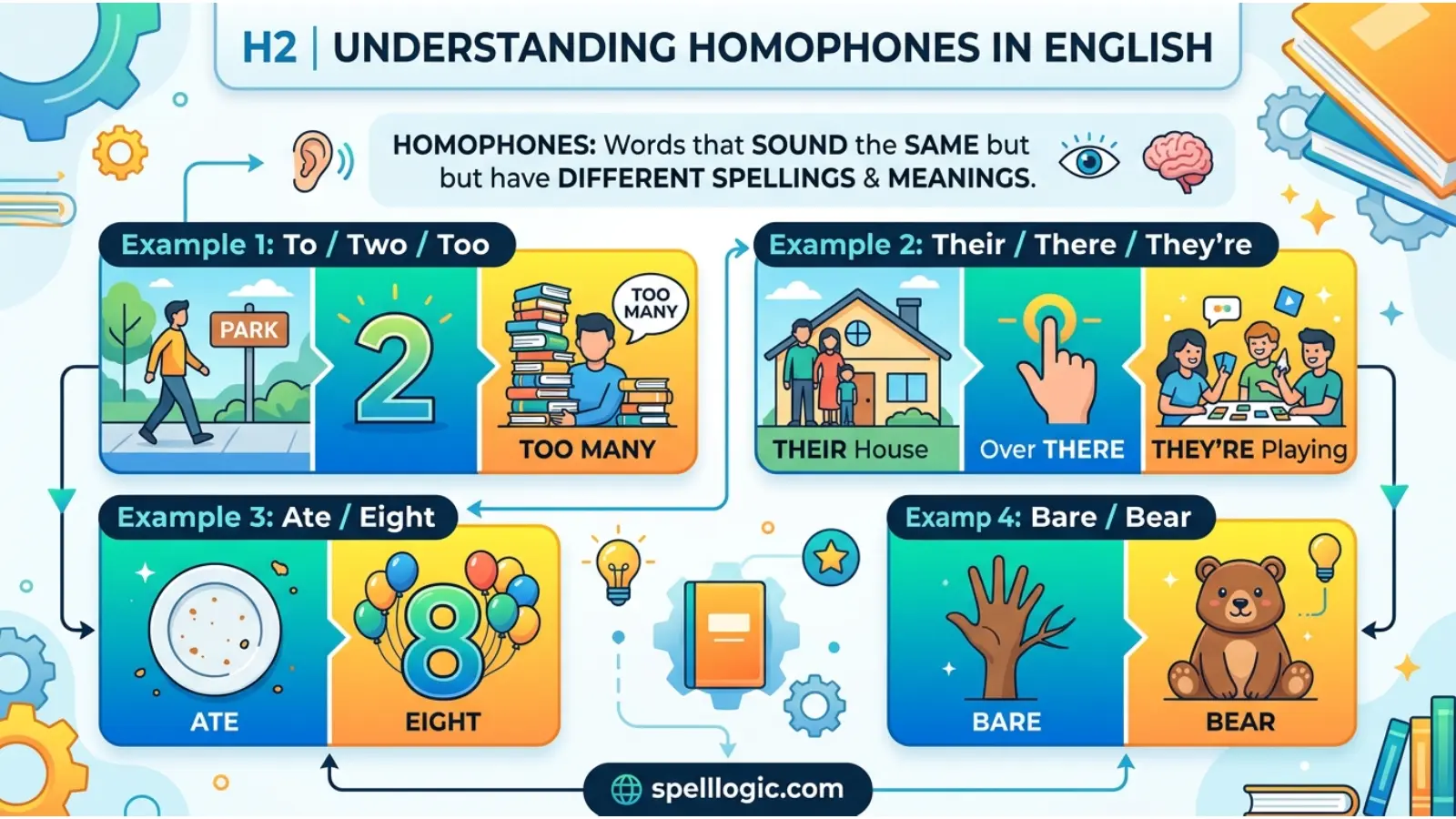
Homophones are words that sound the same or very similar but have different meanings or spellings.
Example:
- Their
- There
These words sound alike but serve different purposes in English.
Why Homophones Cause Confusion
When learners hear a word, they may not know which spelling to use. For example:
- Their house is large.
- The book is over there.
Although enterprise and enterprises are not true homophones, their similar pronunciation can still create confusion, especially in spoken English.
What Does “Enterprise” Mean?
Definition and Core Meaning
The word enterprise is a singular noun that refers to:
- A business or company
- A commercial venture
- An ambitious project
- Initiative and willingness to undertake challenges
Origin and Historical Use
The term comes from Old French and later entered English during the Middle Ages. Historically, it described a bold undertaking or venture requiring effort and initiative.
Over time, it became strongly associated with business and commercial activities.
Modern Usage and Synonyms
Today, enterprise is frequently used in business, technology, and economics.
Common Synonyms
- Business
- Company
- Venture
- Organization
- Firm
- Undertaking
Example Sentences
- The enterprise expanded into international markets.
- Running a successful enterprise requires dedication.
- The government supports private enterprise.
- Her new enterprise focuses on sustainable products.
Key Points
- Singular noun
- Refers to one business or venture
- Common in business and economic contexts
- Can also mean initiative or ambition
What Does “Enterprises” Mean?
Definition and Core Meaning
Enterprises is the plural form of enterprise.
It refers to:
- Multiple businesses
- Several companies
- Numerous ventures or projects
Origin and Historical Context
Since enterprises is simply the plural version of enterprise, it shares the same historical roots and development.
The plural form became increasingly common as discussions about industries, economies, and groups of businesses grew more widespread.
Modern Usage and Synonyms
Today, enterprises appears frequently in economic reports, business news, and academic writing.
Common Synonyms
- Businesses
- Companies
- Organizations
- Firms
- Ventures
Example Sentences
- Small enterprises often face financial challenges.
- Many enterprises have adopted cloud computing.
- Local enterprises create employment opportunities.
- Technology enterprises continue to innovate rapidly.
Key Points
- Plural noun
- Refers to two or more businesses or ventures
- Common in economic and corporate discussions
- Requires plural verbs
Enterprise vs Enterprises: Key Differences at a Glance
| Word | Part of Speech | Meaning | Example Context |
|---|---|---|---|
| Enterprise | Noun (Singular) | One business, venture, or organization | The enterprise launched a new product. |
| Enterprises | Noun (Plural) | Multiple businesses, ventures, or organizations | Several enterprises entered the market. |
How to Remember the Difference Between Enterprise and Enterprises
Learning a simple memory trick can make these words much easier to use correctly.
Easy Memory Tricks
- Enterprise = One
- Enterprises = Many
Association Technique
Think of the S at the end of enterprises as standing for several.
- No S = one business
- With S = several businesses
Memorable Example
Imagine one store:
- One store = one enterprise
Imagine ten stores:
- Ten stores = many enterprises
This visual association helps reinforce the difference.
Common Mistakes and Confusions
Mistake 1
❌ The enterprises is growing rapidly.
✔ The enterprise is growing rapidly.
Explanation: A singular noun requires a singular verb.
Mistake 2
❌ Several enterprise are expanding overseas.
✔ Several enterprises are expanding overseas.
Explanation: Multiple businesses require the plural form.
Mistake 3
❌ This enterprises provides software solutions.
✔ This enterprise provides software solutions.
Explanation: The singular determiner this requires a singular noun.
Mistake 4
❌ Each enterprises has different goals.
✔ Each enterprise has different goals.
Explanation: The word each takes a singular noun.
Examples Section: Correct and Incorrect Usage
Example 1
✔ Correct: The enterprise invested heavily in research.
✘ Incorrect: The enterprises invested heavily in research. (when referring to only one company)
Example 2
✔ Correct: Several enterprises joined the trade association.
✘ Incorrect: Several enterprise joined the trade association.
Example 3
✔ Correct: This enterprise operates in Europe and Asia.
✘ Incorrect: This enterprises operates in Europe and Asia.
Example 4
✔ Correct: Modern enterprises rely on digital technology.
✘ Incorrect: Modern enterprise rely on digital technology.
Example 5
✔ Correct: The enterprise has achieved impressive growth.
✘ Incorrect: The enterprises has achieved impressive growth.
Self Assessment: Test Your Knowledge
Fill in the blanks with enterprise or enterprises.
1.
The software _________ serves customers worldwide.
2.
Many small _________ contribute to economic growth.
3.
This _________ specializes in renewable energy.
4.
Several technology _________ announced new products this year.
Self Assessment Answers
1.
The software enterprise serves customers worldwide.
2.
Many small enterprises contribute to economic growth.
3.
This enterprise specializes in renewable energy.
4.
Several technology enterprises announced new products this year.
FAQs
1. Is enterprise singular or plural?
Enterprise is singular and refers to one business, venture, or organization.
2. What is the plural form of enterprise?
The plural form is enterprises.
3. Can enterprise mean more than a business?
Yes. It can also refer to initiative, ambition, or a challenging project.
4. Is it correct to say “small enterprises”?
Yes. This phrase refers to multiple small businesses.
5. Which is more common in business writing?
Both are common. The choice depends on whether you are discussing one company or several companies.
6. Can enterprise be used as an adjective?
Yes. In business and technology, it often acts as a modifier, such as enterprise software or enterprise solutions.
7. How can I quickly choose the correct word?
Ask yourself whether you’re referring to one business or more than one business. Use enterprise for one and enterprises for many.
Final Conclusion: Using “Enterprise” and “Enterprises” Correctly
Understanding the difference between enterprise and enterprises is much easier than many English learners initially think. The key distinction is simply number. Enterprise refers to a single business, venture, organization, or undertaking, while enterprises refers to multiple businesses or ventures. Although the words look and sound very similar, choosing the correct form becomes straightforward once you identify whether the noun is singular or plural.
In real-world communication, these terms appear frequently in business reports, economic discussions, technology articles, and professional writing. Using the correct form helps your sentences sound natural and grammatically accurate. Remember the simple memory trick: no “s” means one business, while “s” means several businesses. This small detail can prevent many common mistakes.
As you continue improving your English, pay attention to noun number and subject-verb agreement. Reading business articles and practicing with example sentences will help reinforce the difference. Language learning is a gradual process, and every small grammar rule you master brings you closer to fluent and confident communication. Keep practicing, stay curious, and you’ll find that distinctions like enterprise vs enterprises become second nature over time.