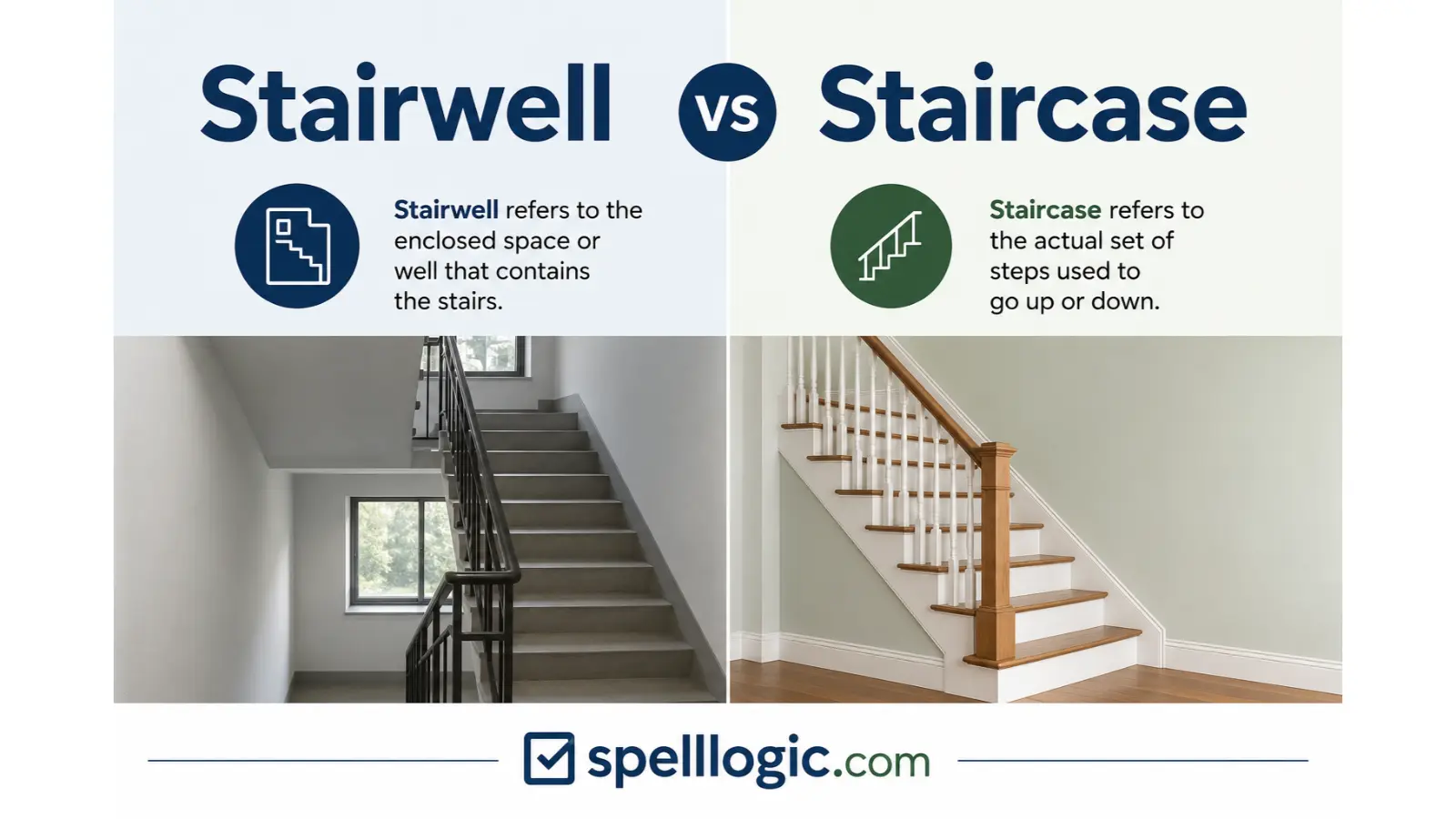
Stairwell vs Staircase confuses many English learners because both terms refer to stairs inside a building, but each word has a different meaning and use. In everyday conversations, people sometimes use them interchangeably, which makes the difference even harder to understand. However, these terms do not mean exactly the same thing.
Knowing when to use stairwell and when to use staircase can help you speak and write English more accurately, especially when describing buildings, homes, offices, and public spaces. In this guide, you’ll learn the meanings, differences, examples, and simple memory tricks that make these commonly confused words easy to understand.
Why “Stairwell” and “Staircase” Are Confusing
Several factors cause learners to mix up these words.
Similar Pronunciation
“Both words begin with ‘stair,’ so people often associate them with each other and hear them in similar situations.”
Similar Spelling
The words share the same first part, making them look alike when written.
Context Confusion
Both words are used when talking about buildings, floors, and stairs. Because they often appear in the same contexts, learners may assume they have identical meanings.
Common Learner Mistakes
Many learners use stairwell when referring to the actual stairs and use staircase when talking about the entire vertical space around the stairs. In reality, these meanings are different.
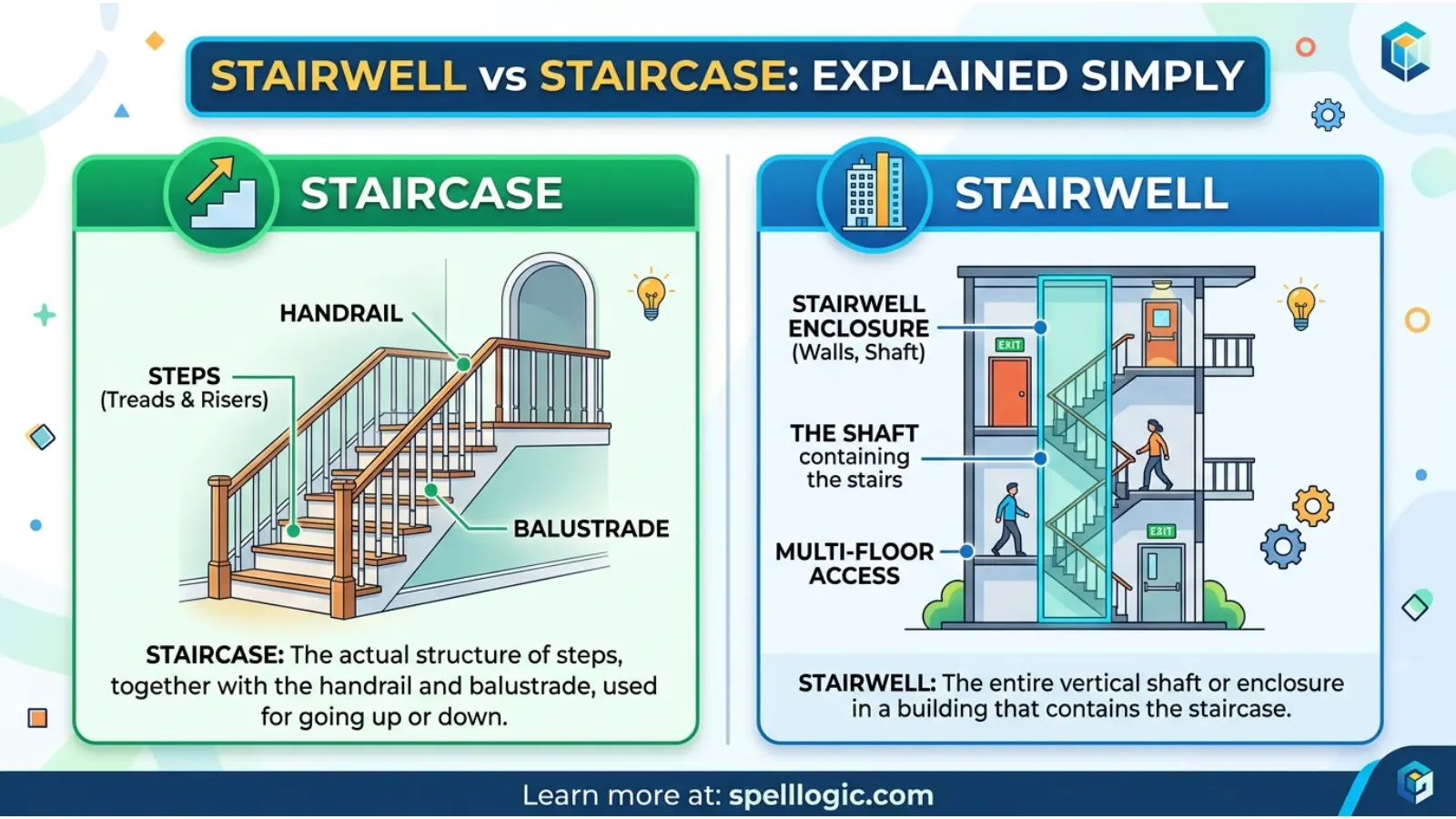
Stairwell vs Staircase Explained Simply
Stairwell means the vertical shaft or space that contains a staircase, while staircase means the actual set of stairs connecting different levels.
One-Line Distinction
A staircase is the stairs themselves; a stairwell is the space surrounding those stairs.
Example Sentences
- The firefighters ran down the stairwell during the emergency.
- The wooden staircase was beautifully designed.
- The apartment building has a narrow stairwell.
- They replaced the old staircase with a modern one.
Understanding Homophones in English
What Are Homophones?
Homophones are words that sound the same or nearly the same but have different meanings and sometimes different spellings.
Example:
- Flower
- Flour
These words sound alike but mean different things.
Why Homophones Cause Confusion
When learners hear words that sound similar, they may choose the wrong word in writing or speech.
Example:
- Their
- There
Although they sound alike, they have different meanings and grammatical functions.
People often confuse stairwell and staircase because both terms relate to the same subject and appear frequently in similar situations, even though they are not true homophones.
What Does “Stairwell” Mean?
Definition and Core Meaning
A stairwell is the vertical opening, shaft, or enclosed space in a building where a staircase is located.
It refers to the area surrounding the stairs rather than the stairs themselves.
Origin and Historical Use
The word stairwell combines:
- Stair
- Well
In architecture, a “well” can refer to an open vertical space extending through multiple floors. Over time, stairwell became the standard term for the space that houses stairs.
Modern Usage and Synonyms
Today, stairwell is commonly used in:
- Apartment buildings
- Hotels
- Office buildings
- Schools
- Emergency exits
Synonyms
- Stair shaft
- Stair enclosure
- Stair tower (in some contexts)
- Vertical stair space
Example Sentences
- The echo came from the stairwell.
- Smoke quickly filled the stairwell during the fire.
- The maintenance team cleaned the stairwell.
- Emergency lights were installed in the stairwell.
Key Points
- Refers to the space around stairs
- Common in architecture and building design
- Often associated with emergency exits
- Not the actual stairs themselves
What Does “Staircase” Mean?
Definition and Core Meaning
A staircase is a structure consisting of steps that allows people to move between floors or levels.
This is the actual set of stairs that people walk on.
Origin and Historical Context
The word staircase comes from combining:
- Stair
- Case
Historically, the term developed to describe an entire arrangement of steps and supporting structures connecting different levels.
Modern Usage and Synonyms
Today, staircase is used in homes, offices, castles, museums, and many other buildings.
Synonyms
- Stairs
- Flight of stairs
- Stairway
- Steps
Example Sentences
- The marble staircase impressed visitors.
- She walked down the staircase slowly.
- The old mansion featured a curved staircase.
- Workers repaired the damaged staircase.
Key Points
- Refers to the actual stairs
- Can be decorative or functional
- Used in both residential and commercial buildings
- Includes steps, railings, and supporting structures
Stairwell vs Staircase: Key Differences at a Glance
| Word | Part of Speech | Meaning | Example Context |
|---|---|---|---|
| Stairwell | Noun | The vertical space or shaft containing stairs | “The noise echoed through the stairwell.” |
| Staircase | Noun | The actual structure of stairs connecting floors | “The staircase leads to the second floor.” |
How to Remember the Difference Between Stairwell and Staircase
Easy Memory Tricks
Stairwell = Well = Space
Think of a well as a deep vertical opening. A stairwell is also a vertical space inside a building.
Staircase = Case of Stairs
Imagine a staircase as the physical structure made up of steps.
Association Techniques
- Stairwell = Surrounding area
- Staircase = Steps you climb
One Memorable Example
Imagine standing in a building.
- The staircase is under your feet.
- The stairwell is the space around you.
This simple image can help you remember the difference forever.
Common Mistakes and Confusions
Mistake 1
❌ The marble stairwell was beautifully carved.
✔ The marble staircase was beautifully carved.
Explanation: The carving is on the stairs, not on the surrounding space.
Mistake 2
❌ The smoke spread through the staircase.
✔ The smoke spread through the stairwell.
Explanation: Smoke typically fills the enclosed space around the stairs.
Mistake 3
❌ They replaced the old stairwell with a new one.
✔ They replaced the old staircase with a new one.
Explanation: You replace stairs, not the entire stairwell space.
Mistake 4
❌ The sound echoed off the staircase walls.
✔ The sound echoed through the stairwell.
Explanation: Echoes are usually associated with the enclosed vertical space.
Examples Section: Correct and Incorrect Usage
Example 1
✔ Correct: The firefighters checked the stairwell for trapped residents.
✘ Incorrect: The firefighters checked the staircase for trapped residents. (Possible, but less accurate when referring to the enclosed area.)
Example 2
✔ Correct: The spiral staircase became the centerpiece of the house.
✘ Incorrect: The spiral stairwell became the centerpiece of the house.
Example 3
✔ Correct: The building’s stairwell was brightly lit.
✘ Incorrect: The building’s staircase was brightly lit to improve emergency visibility throughout the enclosed space.
Example 4
✔ Correct: The staircase connects the first and second floors.
✘ Incorrect: The stairwell connects the first and second floors.
Example 5
✔ Correct: The echo traveled through the stairwell.
✘ Incorrect: The echo traveled through the staircase.
Self Assessment: Test Your Knowledge
Fill in the blanks with stairwell or staircase.
1.
The grand _________ was made of polished oak.
2.
Emergency signs were installed in the _________.
3.
The architect designed a curved _________ for the lobby.
4.
Voices echoed throughout the _________.
Self Assessment Answers
1.
The grand staircase was made of polished oak.
2.
Emergency signs were installed in the stairwell.
3.
The architect designed a curved staircase for the lobby.
4.
Voices echoed throughout the stairwell.
FAQs
1. Are stairwell and staircase the same thing?
No. A staircase is the actual stairs, while a stairwell is the space that contains those stairs.
2. Which word is more common in everyday English?
Staircase is generally more common because people frequently talk about the stairs themselves.
3. Can a stairwell contain more than one staircase?
Yes. Large buildings may have multiple staircases within a stairwell area.
4. Is stairwell an architectural term?
Yes. It is commonly used in architecture, construction, and building safety discussions.
5. Can I say “stairs” instead of “staircase”?
Yes. In everyday conversation, “stairs” is often used as a simpler alternative.
6. Is a spiral staircase still a staircase?
Yes. A spiral staircase is a type of staircase with steps arranged around a central column.
7. Why is the stairwell important in emergencies?
Stairwells often serve as evacuation routes and are designed to provide safe movement between floors.
Final Conclusion: Using “Stairwell” and “Staircase” Correctly
Understanding the difference between stairwell and staircase can make your English more precise and natural. Although these words are closely related, they refer to different parts of a building. A staircase is the physical structure made up of steps, railings, and supporting elements that people use to move between floors. A stairwell, on the other hand, is the vertical space or enclosure that contains the staircase. This distinction is especially important when discussing architecture, building design, safety procedures, and emergency exits.
A simple way to remember the difference is to think of the staircase as the thing you walk on and the stairwell as the space around it. If you picture yourself standing on stairs inside a building, your feet are on the staircase, while the surrounding shaft or enclosure is the stairwell. This mental image makes the meanings much easier to recall.
In real-world English, both words are used regularly, but in different contexts. When talking about decorative stairs, renovations, or movement between floors, use staircase. When referring to building layouts, echoes, smoke, or emergency routes, use stairwell. The more examples you read and practice, the more naturally you’ll use these terms. Keep learning, stay curious, and remember that every new word distinction helps you become a more confident English speaker and writer.