English learners often struggle with words that look and sound similar. One common example is scraped and scrapped. At first glance, these words seem almost identical. They differ by only one letter, and their pronunciation is very close. Because of this, many people accidentally use the wrong word in writing and conversation.
However, scraped and scrapped have completely different meanings. Using the wrong one can change the meaning of a sentence and create confusion. Whether you’re writing emails, articles, assignments, or social media posts, understanding the difference between these two words will help you communicate more clearly and confidently.
Table of Contents
- Introduction
- Why “Scraped” and “Scrapped” Are Confusing
- Scraped vs Scrapped Explained Simply
- Understanding Homophones in English
- What Are Homophones?
- Why Homophones Cause Confusion
- What Does “Scraped” Mean?
- What Does “Scrapped” Mean?
- Scraped vs Scrapped: Key Differences at a Glance
- How to Remember the Difference Between Scraped and Scrapped
- Common Mistakes and Confusions
- Examples Section: Correct and Incorrect Usage
- Self Assessment: Test Your Knowledge
- Self Assessment Answers
- FAQs About “Scraped and Scrapped”
- Final Conclusion: Using “Scraped” and “Scrapped” Correctly
Why “Scraped” and “Scrapped” Are Confusing
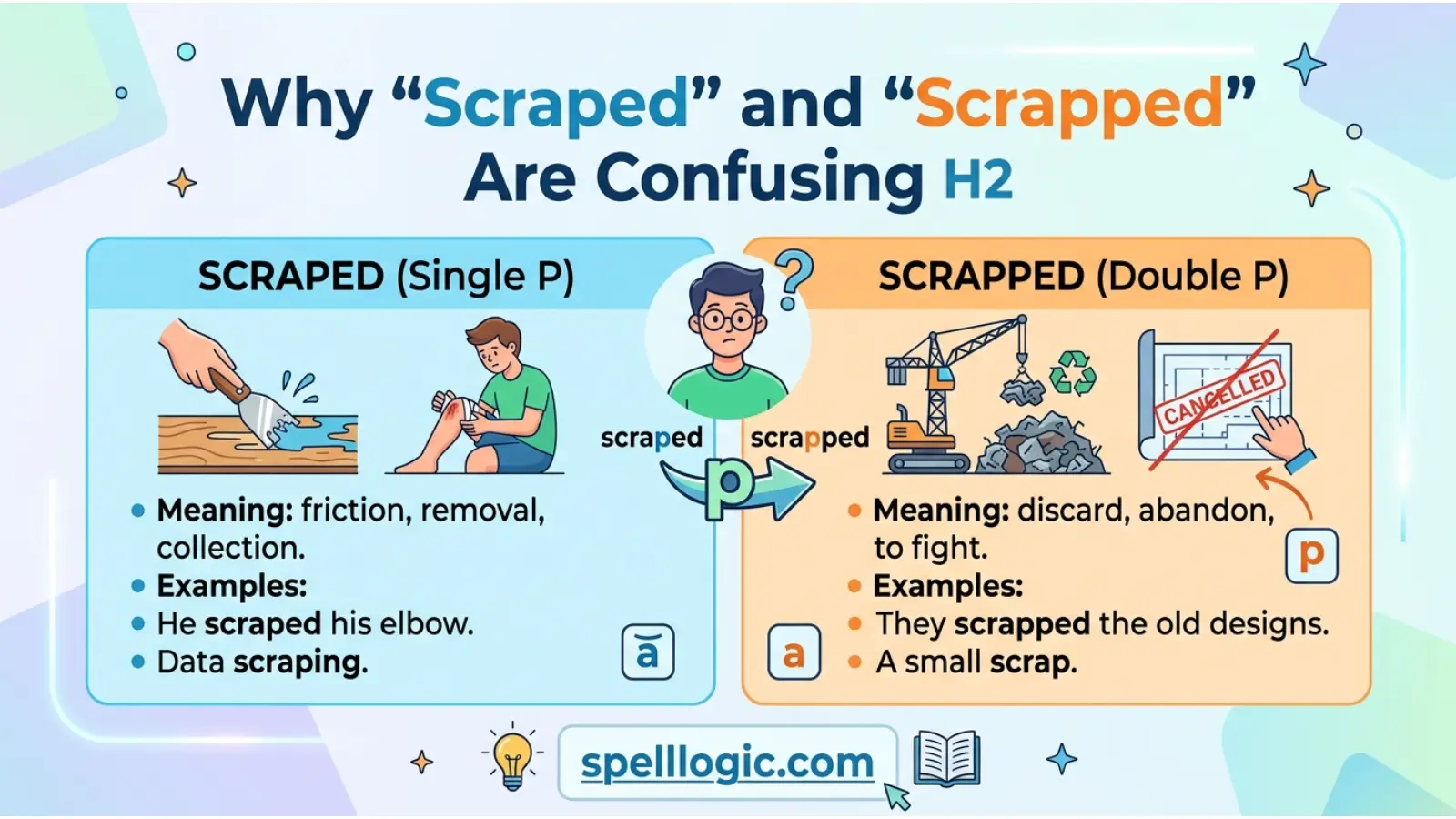
Many English learners mix up scraped and scrapped because the two words share several similarities.
Similar Pronunciation
The words sound very similar when spoken quickly. In casual conversation, the difference between the single p in scraped and the double pp in scrapped is often difficult to hear.
Similar Spelling
Both words begin with scrap-, making them visually similar. The only noticeable difference is the extra p in scrapped.
Context Confusion
Some situations involve removing or getting rid of something, which can make learners think the words are interchangeable. They are not.
Common Learner Mistakes
Learners often write:
- “The company scraped the project.” ❌
- “I scrapped my knee on the pavement.” ❌
These sentences use the wrong word because each verb has a specific meaning.
Scraped vs Scrapped Explained Simply
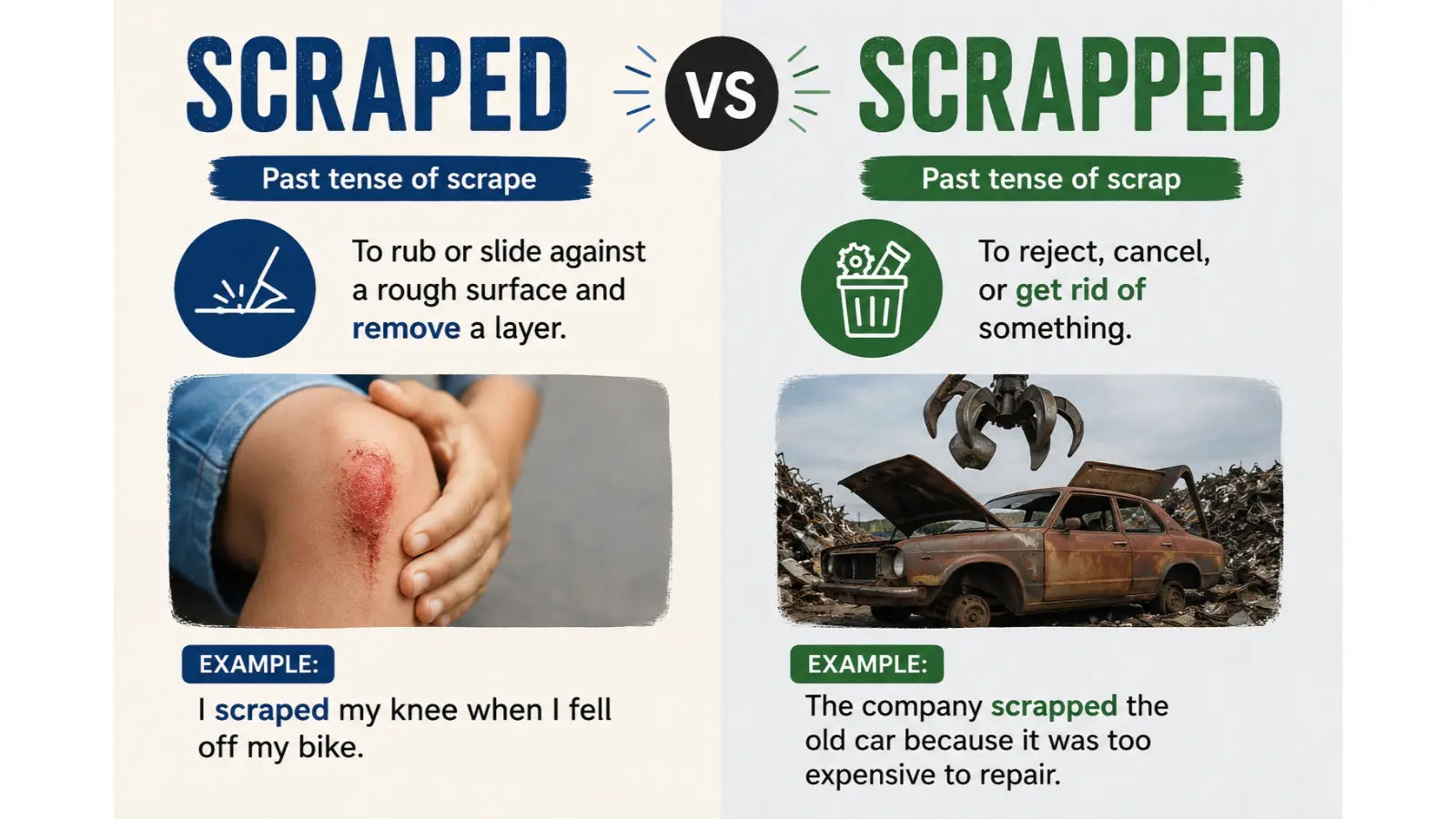
Scraped means to rub, remove, or gather something by dragging a sharp or rough object across a surface.
Scrapped means to discard, cancel, abandon, or throw something away.
One-Line Distinction
Scraped means removed by rubbing, while scrapped means thrown away or canceled.
Example Sentences
Scraped
- She scraped the paint off the wall.
- I scraped my knee while riding my bicycle.
Scrapped
- The company scrapped its expansion plan.
- They scrapped the old machine and bought a new one.
Understanding Homophones in English
What Are Homophones?
Homophones are words that sound the same or nearly the same but have different meanings and spellings.
Example:
- Sea
- See
These words sound alike but have different meanings.
Why Homophones Cause Confusion
When people hear words rather than see them written, they may choose the wrong spelling.
For example:
- “Their house is beautiful.”
- “There house is beautiful.” ❌
The words their and there sound similar, but only one is correct in the sentence.
Similarly, scraped and scrapped can confuse learners because of their similar pronunciation.
What Does “Scraped” Mean?
Definition and Core Meaning
Scraped is the past tense of scrape.
It means:
- To rub against a rough surface
- To remove something by rubbing
- To gather or collect something with effort
- To barely succeed in doing something
Origin and Historical Use
The word scrape comes from Old Norse and Germanic language roots related to scratching or rubbing surfaces.
Historically, it referred to physically removing material from a surface using a sharp tool.
Modern Usage and Synonyms
Today, scraped is used in both literal and figurative contexts.
Common synonyms:
- Scratch
- Rub
- Shave
- Remove
- Skim
- Gather
Common Uses
- Scraped paint from a wall
- Scraped mud off shoes
- Scraped ice from a windshield
- Scraped together enough money
- Scraped through an exam
Example Sentences
- He scraped the mud off his boots.
- The chef scraped the bowl clean.
- We scraped together enough money for the trip.
- She scraped her elbow during the game.
- The student scraped through the final exam.
What Does “Scrapped” Mean?
Definition and Core Meaning
Scrapped is the past tense of scrap.
It means:
- To discard something
- To cancel a plan
- To abandon an idea
- To dispose of something no longer useful
Origin and Historical Context
The noun scrap originally referred to small leftover pieces of material.
Over time, the verb scrap developed the meaning of throwing away or abandoning something because it was no longer needed.
Modern Usage and Synonyms
Today, scrapped is frequently used in business, technology, politics, and everyday conversations.
Common synonyms:
- Cancelled
- Abandoned
- Discarded
- Eliminated
- Removed
- Rejected
Common Uses
- Scrapped a project
- Scrapped a proposal
- Scrapped an old vehicle
- Scrapped construction plans
- Scrapped a policy
Example Sentences
- The government scrapped the proposal.
- We scrapped our travel plans due to bad weather.
- The factory scrapped outdated equipment.
- The company scrapped the project after reviewing costs.
- They scrapped the old software system.
Scraped vs Scrapped: Key Differences at a Glance
| Word | Part of Speech | Meaning | Example Context |
|---|---|---|---|
| Scraped | Verb (past tense of scrape) | Rubbed, scratched, removed, or gathered something | She scraped paint off the door. |
| Scrapped | Verb (past tense of scrap) | Discarded, canceled, or abandoned something | The company scrapped the project. |
How to Remember the Difference Between Scraped and Scrapped
Learning memory tricks can make confusing words easier to remember.
Easy Memory Tricks
Scraped = Surface
Both words contain the letter e.
- Scraped
- Surface
If something touches or rubs a surface, use scraped.
Association Technique
Scrapped = Stopped
Both words contain a double consonant sound feeling.
- Scrapped
- Stopped
If something is canceled or abandoned, use scrapped.
One Memorable Example
- I scraped my knee on the road.
- I scrapped my plan to go running.
The first involves physical contact.
The second involves abandoning an idea.
Common Mistakes and Confusions
Mistake 1
❌ The company scraped the marketing campaign.
✔ The company scrapped the marketing campaign.
Explanation: Campaigns are canceled, not rubbed or scratched.
Mistake 2
❌ She scrapped her arm against the fence.
✔ She scraped her arm against the fence.
Explanation: Physical rubbing requires scraped.
Mistake 3
❌ They scraped the old proposal.
✔ They scrapped the old proposal.
Explanation: Proposals can be abandoned or discarded.
Mistake 4
❌ He scrapped the mud from his shoes.
✔ He scraped the mud from his shoes.
Explanation: Mud is physically removed by scraping.
Examples Section: Correct and Incorrect Usage
Example 1
✔ Correct: I scraped the ice off the car window.
✘ Incorrect: I scrapped the ice off the car window.
Example 2
✔ Correct: The company scrapped its original business plan.
✘ Incorrect: The company scraped its original business plan.
Example 3
✔ Correct: She scraped her knee while playing soccer.
✘ Incorrect: She scrapped her knee while playing soccer.
Example 4
✔ Correct: The city scrapped the construction project.
✘ Incorrect: The city scraped the construction project.
Example 5
✔ Correct: He scraped the burnt food from the pan.
✘ Incorrect: He scrapped the burnt food from the pan.
Example 6
✔ Correct: The organization scrapped the outdated policy.
✘ Incorrect: The organization scraped the outdated policy.
Self Assessment: Test Your Knowledge
Fill in the blanks with scraped or scrapped.
1.
The company _______ its plans for a new office.
2.
She _______ paint off the old wooden chair.
3.
We _______ the project because it was too expensive.
4.
He _______ his elbow when he fell off the skateboard.
Self Assessment Answers
1.
The company scrapped its plans for a new office.
2.
She scraped paint off the old wooden chair.
3.
We scrapped the project because it was too expensive.
4.
He scraped his elbow when he fell off the skateboard.
FAQs
1. Is it scraped or scrapped a project?
The correct phrase is scrapped a project because a project is canceled or abandoned.
2. What does scraped mean in simple English?
It means rubbed, scratched, or removed from a surface.
3. What does scrapped mean in business?
It means canceled, discontinued, or abandoned.
4. Can you scrape your knee?
Yes. If your knee rubs against a rough surface and gets injured, you scrape your knee.
5. Can a plan be scraped?
Usually no. Plans are typically scrapped, not scraped.
6. Why do people confuse scraped and scrapped?
They look similar, sound similar, and differ by only one letter.
7. Which word is used in technology?
Both can be used:
- Scraped often refers to collecting data from websites.
- Scrapped refers to abandoning software, projects, or systems.
Final Conclusion: Using “Scraped” and “Scrapped” Correctly
Understanding the difference between scraped and scrapped is an important step toward mastering English vocabulary. Although these words look and sound very similar, their meanings are completely different. Scraped refers to rubbing, scratching, removing material from a surface, or barely achieving something. In contrast, scrapped means throwing away, canceling, abandoning, or discontinuing something that is no longer needed or useful.
A simple way to remember the difference is to think about action versus abandonment. If something is being physically rubbed, scratched, or removed, the correct word is scraped. If an idea, project, plan, machine, or policy is being discarded or canceled, the correct word is scrapped. This memory trick can help you choose the right word quickly when speaking or writing.
In everyday life, you might scrape paint from a wall, scrape ice from a windshield, or scrape your knee during a fall. Meanwhile, businesses frequently scrap projects, governments scrap policies, and individuals scrap plans that no longer make sense.
The more examples you read and practice, the easier these words become to remember. Keep learning, pay attention to context, and don’t be afraid to make mistakes. Every new word you master brings you one step closer to speaking and writing English with confidence.