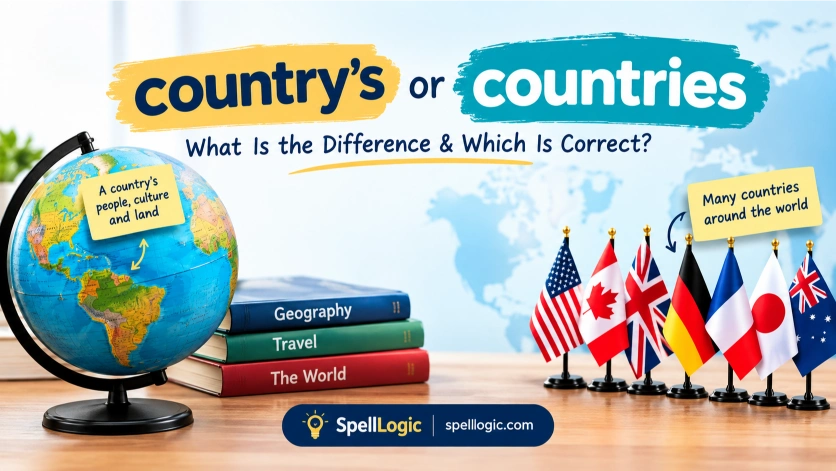
English learners often become confused when they see apostrophes in words such as country’s and countries. Although these forms look similar, they have different meanings and grammatical functions. Understanding country’s or countries is important because one small spelling change can completely change the meaning of a sentence.
The word country’s usually shows possession or describes something belonging to one country, while countries is the plural form of country. In this guide, we will explain country’s or countries in simple English, with clear examples, useful memory tricks, common mistakes, and practice questions so you can use both forms confidently.
Why “country’s” and “countries” Are Confusing
The confusion between country’s or countries usually comes from the apostrophe and the unusual plural spelling. Learners may think that adding 's or changing y to ies are simply two ways to make the same word.
Here are the main reasons for the confusion:
- Similar pronunciation: In fast speech, the possessive form country’s and the plural countries can sound quite similar.
- Similar spelling: Both forms begin with country, so they are easy to mix up when writing.
- Context confusion: A sentence about one country can require either a possessive form or a plural form depending on the intended meaning.
- Common learner mistakes: Learners often use an apostrophe to create a plural, writing country’s when they actually mean countries.
A useful rule is simple: an apostrophe does not normally make a noun plural. It often shows possession.
country’s vs countries Explained Simply
The easiest way to understand country’s or countries is to identify whether you are talking about one country owning or having something or more than one country.
country’s means “belonging to one country” or “related to one country.”
countries means “more than one country.”
One-line distinction
country’s shows possession or association with one country, while countries is the plural form of country.
Example sentences
- The country’s economy is growing quickly.
Here, country’s means the economy belonging to or associated with one country. - Many countries have different cultures.
Here, countries refers to more than one country.
When deciding between country’s or countries, first ask: “Am I talking about one country’s something, or am I talking about several countries?”
Understanding Homophones in English
Although country’s or countries can be confused in speech, they are not true homophones in standard English. Homophones are words that have the same pronunciation but different meanings or spellings.
What Are Homophones?
Homophones are words that sound alike but have different meanings and often different spellings.
For example, two, to, and too are commonly pronounced alike but have different meanings.
Why Homophones Cause Confusion
When two words sound alike, learners cannot always use pronunciation to identify the correct spelling. They must understand the sentence and the grammatical role of the word.
For example, in writing, you must know whether to is a preposition or too means “also” or “excessively.”
In the case of country’s or countries, meaning and grammar are especially important because the spelling itself tells you whether you have a possessive form or a plural noun.
What Does “country’s” Mean?
Definition and Core Meaning
country’s is the possessive form of the singular noun country. It can also be used as a contraction of country is or, less commonly, country has, depending on context.
Most commonly, it means that something belongs to, comes from, or is connected with one country.
Examples include:
- The country’s capital is beautiful.
- The country’s population is increasing.
- The country’s history is fascinating.
- The country’s borders were changed.
In these sentences, the apostrophe shows a relationship between one country and another noun.
Origin and Historical Use
The noun country comes from Old French contre, related to the idea of a region or area. Over time, English developed country as a word for a particular territory, nation, or rural area.
English uses apostrophe-s as a common way to mark possession. Therefore, the possessive form of singular country is country’s.
The spelling pattern is:
country + ‘s = country’s
Modern Usage and Synonyms
Today, country’s or countries may appear frequently in news reports, academic writing, government documents, geography articles, and everyday conversation.
Depending on the context, words such as national, domestic, territorial, or state’s may sometimes express a related idea, although they are not always exact substitutes.
Useful points to remember:
- country’s refers to one country.
- It normally shows possession or association.
- The apostrophe comes before s.
- It can describe a country’s government, people, economy, history, culture, or laws.
- It should not normally be used simply to make the noun plural.
Example Sentences
- The country’s education system needs improvement.
- The country’s president addressed the nation.
- We studied the country’s geography in class.
- The country’s main industry is agriculture.
- The country’s climate varies across different regions.
These examples demonstrate why choosing country’s or countries correctly depends on the intended meaning.
What Does “countries” Mean?
Definition and Core Meaning
countries is the plural form of the noun country. It means two or more countries.
The spelling changes because country ends in a consonant followed by y. To form the plural, the y changes to ies:
country → countries
For example:
- Several countries signed the agreement.
- People from different countries attended the conference.
- These countries share a border.
Origin and Historical Context
The word country developed in English to describe a region, territory, or land. As English developed its regular plural system, nouns ending in consonant + y generally formed their plurals by changing y to ies.
This is why English uses countries, rather than countrys, as the standard plural.
Modern Usage and Synonyms
Countries is used whenever a writer or speaker refers to multiple nations or territories.
Depending on context, related terms can include nations, states, lands, or territories. However, these words do not always have exactly the same meaning.
Important points include:
- countries means more than one country.
- It is a plural noun.
- It does not use an apostrophe.
- The spelling changes from y to ies.
- It can be used after numbers and plural expressions.
Example Sentences
- Five countries participated in the competition.
- Many countries are investing in renewable energy.
- The organization operates in several countries.
- These countries have different languages.
- Students from various countries joined the program.
The key to country’s or countries is recognizing that countries describes a quantity of nations rather than possession.
country’s vs countries: Key Differences at a Glance
The following table makes country’s or countries easier to compare:
| Word | Part of Speech | Meaning | Example Context |
|---|---|---|---|
| country’s | Possessive singular noun | Belonging to or associated with one country | The country’s economy is growing. |
| countries | Plural noun | More than one country | Several countries joined the meeting. |
A quick comparison can also help:
- The country’s flag = the flag of one country.
- The countries’ flags = the flags of multiple countries.
- Countries = plural.
- Country’s = singular possessive.
Notice an important third form: countries’. This means something belongs to multiple countries. For example, the countries’ leaders means the leaders of several countries.
How to Remember the Difference Between country’s and countries
Learning country’s or countries becomes easier when you connect each spelling with its function.
Easy memory tricks
1. Apostrophe = ownership
Think of the apostrophe in country’s as a small sign pointing to something that belongs to one country.
The country’s flag = the flag belongs to one country.
2. “IES” = several
Remember that countries ends in -ies, just like other plural nouns such as cities, families, and libraries.
3. Ask a question
Before choosing the word, ask:
- “Does something belong to one country?” → country’s
- “Am I talking about more than one country?” → countries
Association techniques
Connect country’s with words such as economy, government, capital, and history. These often follow a possessive form.
Connect countries with words such as many, several, different, various, and five. These words commonly introduce plural nouns.
One memorable example
The country’s leader met leaders from several countries.
The first word describes something connected with one country. The second refers to multiple nations.
Common Mistakes and Confusions
One of the biggest problems with country’s or countries is using an apostrophe simply because the writer wants to show more than one.
Wrong example
✘ There are many country’s in Europe.
This is incorrect because many requires a plural noun. The apostrophe is unnecessary.
Correct version
✔ There are many countries in Europe.
Here, countries means more than one country.
Another common mistake
✘ The countries economy is growing.
This sentence needs a possessive apostrophe because the economy is associated with one country.
✔ The country’s economy is growing.
Multiple countries
If something belongs to several countries, use the plural possessive:
✔ The countries’ leaders met yesterday.
The apostrophe comes after s because countries is already plural.
This distinction is essential when studying country’s or countries because there are actually three useful forms:
- country = one country
- country’s = belonging to one country
- countries = more than one country
- countries’ = belonging to multiple countries
Examples Section: Correct and Incorrect Usage
Example 1
✔ Correct: The country’s population is growing.
✘ Incorrect: The countries population is growing.
Explanation: The sentence refers to the population of one country, so the singular possessive form is required.
Example 2
✔ Correct: Several countries joined the agreement.
✘ Incorrect: Several country’s joined the agreement.
Explanation: Several means more than one, so use the plural noun countries without an apostrophe.
Example 3
✔ Correct: The country’s culture is unique.
✘ Incorrect: The countries culture is unique.
Explanation: The culture is associated with one country, so use the singular possessive form.
Example 4
✔ Correct: Different countries have different traditions.
✘ Incorrect: Different country’s have different traditions.
Explanation: Different refers to multiple countries in this sentence. Therefore, use countries.
Example 5
✔ Correct: The countries’ governments worked together.
✘ Incorrect: The country’s governments worked together.
Explanation: If governments from multiple countries are being discussed, the plural possessive countries’ is appropriate. If you mean the governments of multiple countries, the apostrophe follows the plural s.
Self Assessment: Test Your Knowledge
Fill in each blank with country’s, countries, or countries’.
- The ______ economy depends heavily on tourism.
- Many ______ are participating in the event.
- The ______ leaders signed a joint statement.
- The ______ capital is located near the coast.
Self Assessment Answers
- country’s — The economy belongs to or is associated with one country.
- countries — The sentence refers to more than one country.
- countries’ — The leaders belong to multiple countries.
- country’s — The capital is associated with one country.
These answers reinforce the central distinction in country’s or countries: possession and number determine the correct spelling.
FAQs
1. What is the difference between country’s or countries?
Country’s is the singular possessive form, while countries is the plural form of country. One shows a relationship with one country; the other refers to multiple countries.
2. Is “country’s” plural?
No. Country’s is normally singular possessive. For example, the country’s capital refers to the capital of one country.
3. Is “countries” the plural of “country”?
Yes. Countries is the standard plural form of country. The final y changes to ies.
4. When should I use country’s?
Use country’s when something belongs to, comes from, or is associated with one country. For example, the country’s economy.
5. When should I use countries?
Use countries when you mean two or more countries. For example, many countries have different laws.
6. What is the plural possessive form?
The plural possessive form is countries’. It means something belongs to multiple countries, as in the countries’ representatives.
7. Does an apostrophe make a noun plural?
Usually, no. An apostrophe commonly shows possession or contraction. The plural of country is countries, not country’s.
Final Conclusion: Using “country’s” and “countries” Correctly
Understanding country’s or countries is much easier once you focus on two ideas: number and possession. Use country’s when you are talking about something connected with or belonging to one country, such as the country’s economy or the country’s history. Use countries when you mean more than one nation, such as many countries or several countries. If something belongs to multiple countries, remember the third form, countries’, as in the countries’ leaders.
The most useful memory trick is to associate the apostrophe in country’s with possession and the -ies ending in countries with plurality. Also remember that apostrophes do not normally create plurals. When you see a sentence containing many, several, various, or a number greater than one, countries will usually be the correct choice. With regular practice and attention to context, choosing between these forms will become natural. Keep reading, writing, and checking your examples, and you will soon use these forms accurately and confidently in everyday English.