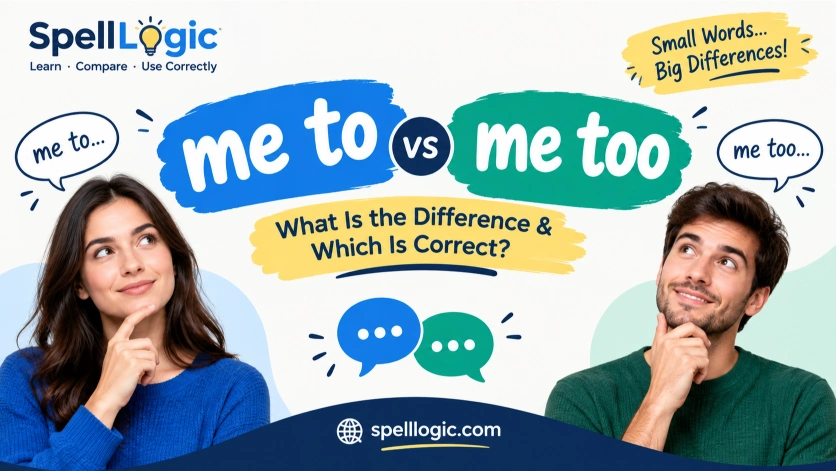
English learners often wonder whether “me to or me too” is the correct way to write a common expression. The confusion happens because “to” and “too” sound very similar, especially in fast, natural speech. However, they have different meanings and grammatical functions. Choosing the wrong word can change the meaning of your sentence or make your writing look incorrect.
The good news is that the difference is simple once you understand what each word does. In this guide, we will explain “me to or me too” in easy English, provide practical examples, and give you memory tricks to help you choose the right form confidently.
Why “Me To” and “Me Too” Are Confusing
The phrase “me to or me too” creates confusion because the words to and too have almost identical pronunciation in many everyday sentences. When people hear an expression rather than see it written, it can be difficult to know which spelling is correct.
Similar pronunciation
To and too are commonly pronounced alike in normal speech. For example, the final word in “I want to go” and the word “too” in “I want to go too” may sound very similar.
However, pronunciation alone does not tell you which spelling to use.
Similar spelling
The words contain the same basic letters, with too simply having an additional o. That small spelling difference represents an important difference in meaning.
Context confusion
The correct choice depends on the role of the word in the sentence. To is generally a preposition or part of an infinitive, while too is usually an adverb meaning “also” or “excessively.”
Common learner mistakes
A frequent mistake is writing “me to” when the intended meaning is “I also agree” or “the same is true for me.” Another mistake is adding an unnecessary too when to belongs to a verb phrase.
Understanding the sentence’s meaning is therefore more useful than relying on pronunciation.
“Me To” vs “Me Too” Explained Simply
The easiest way to understand “me to or me too” is to look at the meaning of each expression.
“Me to” is not normally a complete expression meaning “I also.” It can appear naturally when to connects me with another part of a sentence.
“Me too” is a common expression used to mean “I also,” “the same is true for me,” or “I agree.”
One-line distinction
Me to uses to as part of a larger grammatical structure, while me too means “I also” or “the same applies to me.”
Examples
- “Please send the information to me.”
- “I love reading.” — “Me too!”
So, when someone says something about themselves and you want to say that you feel or do the same thing, “me too” is normally the correct choice.
The key to “me to or me too” is to ask yourself whether you mean “also.” If you do, choose too.
Understanding Homophones in English
English contains many words that sound alike but have different spellings and meanings. These words can be especially difficult for learners because listening does not always reveal the correct spelling.
What Are Homophones?
Homophones are words that have the same or very similar pronunciation but different meanings and spellings.
For example:
- right — correct or opposite of left
- write — to form words with a pen or keyboard
The words sound alike but perform different jobs.
Why Homophones Cause Confusion
Pronunciation can make to and too seem interchangeable. However, spelling must follow meaning and grammar.
For example:
- “I want to learn English.”
- “I want to learn English too.”
The first to introduces the verb learn, while too means also.
This distinction explains why “me to or me too” cannot be solved simply by listening to the phrase.
What Does “Me To” Mean?
Definition and Core Meaning
Me to is not generally a fixed phrase meaning “I also.” Instead, me is the object pronoun, and to is usually a preposition that connects it to another word or idea.
For example:
- “Give the package to me.”
- “She spoke to me.”
- “He sent the message to me.”
Notice that the natural structure is usually to me, not me to, although me to can occur when other sentence elements come before it.
For example:
- “She asked me to wait.”
- “They want me to stay.”
- “He told me to call later.”
In these sentences, me receives the action of the first verb, while to begins an infinitive phrase such as to wait, to stay, or to call.
Origin and Historical Use
The word to is an old English function word with roots in earlier forms of English and Germanic languages. It has long been used to express direction, relationship, purpose, and other grammatical relationships.
Over time, English developed several important constructions with to, including the infinitive form:
- to eat
- to read
- to work
- to learn
Modern Usage and Synonyms
Because to performs grammatical functions rather than expressing one simple idea, it does not always have a direct synonym.
Common uses include:
- showing direction: “Go to school.”
- showing a recipient: “Give it to Sarah.”
- introducing an infinitive: “I want to learn.”
- showing a relationship: “Listen to me.”
Example Sentences
- “My teacher asked me to finish the exercise.”
- “My parents want me to study harder.”
- “Please give the book to me.”
- “She came to me for advice.”
- “He told me to wait outside.”
These examples show why context matters when considering “me to or me too.”
What Does “Me Too” Mean?
Definition and Core Meaning
Me too is an expression meaning “I also,” “I feel the same,” “I do the same,” or “the same applies to me.”
It is extremely common in everyday English.
For example:
“I enjoy watching movies.”
“Me too!”
The second speaker is saying, “I also enjoy watching movies.”
Origin and Historical Context
The word too developed from an older English word meaning “also” or “in addition.” Modern English continues to use too in this sense.
It can also have another meaning: excessively.
For example:
- “This coffee is too hot.”
- “The bag is too heavy.”
When too means “also,” it can appear at the end of a sentence or phrase:
- “I want to go too.”
- “She likes tea too.”
- “Me too.”
Modern Usage and Synonyms
When too means “also,” useful alternatives include:
- also
- as well
- likewise
- in addition
For the short expression me too, however, these alternatives may require a complete sentence.
For example:
- “I like football too.”
- “I also like football.”
- “I like football as well.”
- “Me too.”
Example Sentences
- “I am tired.” — “Me too.”
- “I love chocolate.” — “Me too!”
- “I want to visit London.” — “Me too.”
- “I was surprised by the news too.”
- “She wants to join us too.”
If your intended meaning is “I also,” the answer to “me to or me too” is “me too.”
“Me To” vs “Me Too”: Key Differences at a Glance
| Word | Part of Speech | Meaning | Example Context |
|---|---|---|---|
| to | Preposition / infinitive marker | Direction, relationship, or infinitive marker | “She asked me to wait.” |
| too | Adverb | Also; excessively | “I want to go too.” |
The biggest difference is grammatical. To usually connects words or introduces an infinitive, while too adds the meaning “also” or “excessively.”
When deciding “me to or me too,” focus on what you want the sentence to mean rather than how the words sound.
How to Remember the Difference Between Me To and Me Too
A few simple memory tricks can make this distinction much easier.
Memory Trick 1: Two Os = Also
Think of too as having an extra o because it adds something extra.
Too = also.
For example:
“I like pizza.”
“Me too.”
The second speaker is adding themselves to the statement.
Memory Trick 2: To + Verb
When to comes before a base-form verb, it often creates an infinitive:
- to eat
- to sleep
- to study
- to work
So remember:
To + verb = action.
Memory Trick 3: Ask “Do I Mean Also?”
When you are unsure about “me to or me too,” ask:
Do I mean “also”?
If the answer is yes, use too.
One Memorable Example
“I want to learn English.”
“Me too!”
Here, too means “I also want to learn English.”
Common Mistakes and Confusions
Learners often make mistakes because to and too sound alike.
Mistake 1
✘ “I love this song. Me to.”
✔ “I love this song. Me too.”
Why? The speaker means “I also love this song,” so too is required.
Mistake 2
✘ “She asked me too finish the work.”
✔ “She asked me to finish the work.”
Why? Here, to introduces the infinitive finish. The meaning is not “also.”
Mistake 3
✘ “I want me too go with you.”
✔ “I want to go with you too.”
Why? The first to introduces the verb go, while the final too means “also.”
Mistake 4
✘ “Please give the letter too me.”
✔ “Please give the letter to me.”
Why? The sentence needs the preposition to before the recipient.
These examples show that the answer to “me to or me too” depends entirely on meaning and sentence structure.
Examples Section: Correct and Incorrect Usage
Example 1
✔ Correct: “I am hungry.” — “Me too.”
✘ Incorrect: “I am hungry.” — “Me to.”
The response means “I am hungry also,” so too is correct.
Example 2
✔ Correct: “My manager asked me to call you.”
✘ Incorrect: “My manager asked me too call you.”
Here, to introduces the verb call.
Example 3
✔ Correct: “I want to attend the meeting too.”
✘ Incorrect: “I want too attend the meeting.”
The first to belongs before attend, while too can be used at the end to mean “also.”
Example 4
✔ Correct: “She sent the document to me.”
✘ Incorrect: “She sent the document too me.”
The word to shows the recipient.
Example 5
✔ Correct: “I enjoy learning new words. Me too!”
✘ Incorrect: “I enjoy learning new words. Me to!”
Again, too means “also.”
Example 6
✔ Correct: “He wants me to join the team.”
✘ Incorrect: “He wants me too join the team.”
The construction is me + to + verb, so to is required.
Self Assessment: Test Your Knowledge
Fill in each blank with to or too.
- “I really like this restaurant.” — “Me ____.”
- “She asked me ____ help her.”
- “I want ____ learn English ____.”
- “Please send the invitation ____ me.”
Try to answer all four before checking the solutions.
Self Assessment Answers
- too — “Me too” means “I also.”
- to — “asked me to help” uses to before the infinitive.
- to, too — “want to learn” uses to, while the final too means “also.”
- to — “to me” identifies the recipient.
A useful test is to replace too with also. If the sentence still makes sense, too may be the correct choice.
FAQs
1. Is “me too” correct English?
Yes. Me too is a standard and very common informal expression meaning “I also” or “the same is true for me.”
2. Is “me to” ever correct?
Yes, but usually as part of a larger grammatical construction. For example, “She asked me to wait” is correct. Here, to introduces the verb wait.
3. Should I say “me too” when I agree with someone?
Yes. If someone says, “I love this book,” you can naturally reply, “Me too,” meaning that you also love the book.
4. What is the difference between “to” and “too”?
To commonly expresses direction, relationship, or an infinitive, while too commonly means “also” or “excessively.”
5. Is “me too” formal?
It is grammatically correct but conversational. In formal writing, a complete sentence such as “I feel the same way” or “I agree” may be more appropriate.
6. Can “too” mean something other than “also”?
Yes. Too can mean “excessively,” as in “The water is too cold” or “The box is too heavy.”
7. What is the easiest way to remember the correct spelling?
Remember: too = also. If you can replace the word with also, use too. If to introduces a verb or shows direction or a recipient, use to.
Final Conclusion: Using “Me To” and “Me Too” Correctly
Understanding “me to or me too” becomes easy once you focus on meaning instead of pronunciation. To and too may sound alike in everyday English, but they perform different grammatical jobs. To commonly shows direction, identifies a relationship or recipient, or introduces an infinitive verb. For example, we say “She asked me to wait” and “Give the book to me.” In contrast, too commonly means “also.” That is why the natural response to “I love this movie” is “Me too.” A simple memory trick is to connect the two o’s in too with the idea of “something extra” or “also.”
Whenever you are unsure, ask whether you mean “also.” If you do, choose too. With regular reading, writing, and practice, this small distinction will quickly become automatic. Do not worry if you make mistakes at first. Learning confusing English words takes practice, and every correction helps you become a clearer and more confident English writer.