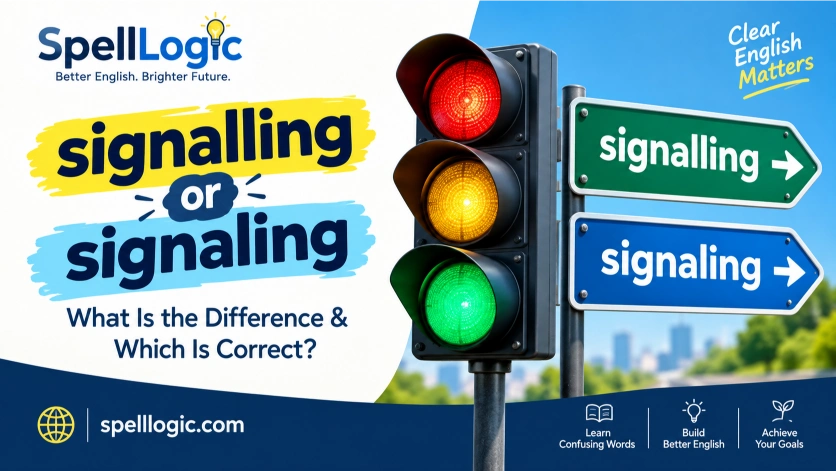
English spelling can change depending on where the language is used, and signalling or signaling is a good example. Both forms are correct, but they belong to different spelling traditions. British English and many other varieties usually prefer the double l, while American English normally uses a single l.
This difference can confuse learners because the pronunciation and meaning stay the same. Knowing which form to use helps you write naturally for your intended audience and avoid unnecessary spelling corrections. Once you understand the regional pattern, choosing between these two forms becomes simple.
Why “signalling” and “signaling” Are Confusing
The main reason signalling or signaling causes confusion is that English has more than one accepted spelling system. The two forms look almost identical, sound the same, and carry the same grammatical function. The difference is mainly regional.
- Similar pronunciation: Both forms are pronounced the same way in normal English speech.
- Similar spelling: The only visible difference is the extra l in the British-style form.
- Context confusion: Learners may see one spelling in textbooks and the other on websites, news pages, or software documentation.
- Common learner mistakes: Some writers assume one version is always wrong, or they switch between British and American spelling in the same piece of writing.
For anyone checking signalling or signaling, the verb signal means to communicate information, give a sign, or indicate something. When the verb takes the -ing ending, spelling conventions determine whether the final consonant is doubled.
signalling vs signaling Explained Simply
When learners compare signalling or signaling, they should first know that both forms have exactly the same basic meaning. The choice depends on the variety of English you are using.
The simplest distinction is: “signalling” is the usual British spelling, while “signaling” is the usual American spelling.
Examples:
- The driver was signalling before turning left.
- The driver was signaling before turning left.
These sentences show that signalling or signaling does not change the meaning. The first follows British English spelling, while the second follows American English spelling. Canadian, Australian, and other English varieties may follow their own conventions, so checking the style used by your audience is useful.
Understanding Homophones in English
Homophones are words that sound alike but have different spellings and meanings. They are a frequent source of difficulty for English learners.
What Are Homophones?
Homophones are words with the same or very similar pronunciation but different meanings or spellings. For example, to, too, and two sound alike but have different uses.
Why Homophones Cause Confusion
When learners depend only on pronunciation, it can be difficult to know which written form is correct. For example, someone may hear “two” and need context to decide whether the speaker means the number, the adverb too, or the preposition to.
When studying signalling or signaling, remember that these forms are not homophones in the usual sense because they are simply regional spellings of the same word. They are pronounced alike and have the same meaning.
What Does “signalling” Mean?
Definition and Core Meaning
When learning signalling or signaling, start with the core meaning. Signalling is the British English spelling of the present participle or gerund of signal. It describes the act of giving information, showing an indication, or communicating a message through words, movements, sounds, lights, or other signs.
For example, a driver may be signalling a turn, a device may be signalling an error, or a person may be signalling that they need help.
Origin and Historical Use
The word signal entered English through French and ultimately traces back to Latin roots connected with a sign or mark. Over time, it developed into a noun and verb referring to something that communicates information.
In signalling or signaling, British spelling conventions commonly double the final consonant when a one-syllable verb such as signal receives an ending beginning with a vowel. This produces signalling. The same pattern appears in words such as travelling and cancelled in British English.
Modern Usage and Synonyms
For learners asking about signalling or signaling, it is helpful to know that signalling is common in British English and in contexts influenced by British spelling. It appears in everyday writing as well as technical subjects such as railway signalling, telecommunications, biology, and communication studies.
Related words and synonyms include:
- indicating
- communicating
- showing
- alerting
- notifying
- expressing
- signifying
Example Sentences
- The cyclist was signalling before moving into the next lane.
- The warning light was signalling a problem with the engine.
- Her silence was signalling that she did not agree.
- The railway system uses electronic signalling to manage trains safely.
What Does “signaling” Mean?
Definition and Core Meaning
For signalling or signaling, the meaning stays the same across varieties. Signaling is the American English spelling of the same present participle or gerund. It has the same meaning as the British form: giving information, communicating an intention, or indicating that something is happening.
Thus, the meaning does not change when the spelling changes. Only the regional spelling convention is different.
Origin and Historical Context
American English gradually developed spelling preferences that differ from British English in several areas. Words ending in -l are one example. American usage often avoids doubling the final l when adding certain suffixes, leading to forms such as signaling, traveling, and canceled.
The spelling choice in signalling or signaling became established through American dictionaries, publishing practices, education, and general usage.
Modern Usage and Synonyms
In discussions of signalling or signaling, signaling is especially common in American newspapers, academic writing, business communication, technology, and online content written for a U.S. audience.
In signalling or signaling, common related words include:
- indicating
- communicating
- showing
- alerting
- notifying
- expressing
- pointing to
Example Sentences
- The driver was signaling before making a right turn.
- The software is signaling that an update is available.
- The study found that the results were signaling a major change.
- The athlete was signaling to the coach from across the field.
signalling vs signaling: Key Differences at a Glance
| Word | Part of Speech | Meaning | Example Context |
|---|---|---|---|
| signalling | Verb form / gerund | Giving a sign or communicating information | British English: “She is signalling a turn.” |
| signaling | Verb form / gerund | Giving a sign or communicating information | American English: “She is signaling a turn.” |
The table shows why signalling or signaling is not really a question of right versus wrong. Both are standard forms. The important point is regional consistency.
How to Remember the Difference Between signalling and signaling
A simple memory trick can make signalling or signaling much easier.
Memory trick 1: Think British = extra L.
When writing British English, remember that many words keep a doubled l in forms such as signalling, travelling, and modelling.
Memory trick 2: Think American = one L.
American English commonly uses signaling, traveling, and modeling.
Association technique: Imagine the extra l as a small “British spelling marker.” It does not change the pronunciation or meaning; it simply reminds you which spelling tradition you are following.
Memorable example:
“Britain is signalling with two Ls; America is signaling with one L.”
This trick is useful because the same regional pattern appears in several related spelling choices.
Common Mistakes and Confusions
A common mistake when learning signalling or signaling is treating one spelling as universally correct.
Wrong assumption: “Signaling is a spelling mistake because British English uses signalling.”
Correct explanation: Signaling is standard American English, so it is correct when American spelling is being used.
Another mistake with signalling or signaling is mixing spelling systems within the same document. For example, a writer might use signalling in one paragraph and traveling in another. Although readers will understand both, the mixture can make the writing look inconsistent.
Common incorrect and corrected patterns
- ✘ “Signaling is always wrong.”
✔ “Signaling is standard in American English.” - ✘ “Signalling is the only correct spelling.”
✔ “Signalling is standard in British English and some other varieties.” - ✘ “The two forms have different meanings.”
✔ “The two forms have the same meaning but different regional spelling conventions.” - ✘ “You must change signalling to signaling in every document.”
✔ “Choose the spelling that matches your target variety and keep it consistent.”
Examples Section: Correct and Incorrect Usage
Example 1
✔ Correct: The driver was signalling before turning.
This is appropriate in British English.
✘ Incorrect: The driver was signalling before turning.
This is not actually incorrect if the document uses British spelling. The example illustrates why context matters.
Example 2
✔ Correct: The driver was signaling before turning.
This is appropriate in American English.
✘ Incorrect: The driver was signaling before turning.
Again, this is not grammatically incorrect. It would only be a problem if the surrounding document specifically requires British spelling.
Example 3
✔ Correct: The warning system is signalling an error.
This follows British spelling.
✘ Incorrect: The warning system is signalling an error.
It is not wrong in British English; calling it incorrect without considering the regional style would be misleading.
Example 4
✔ Correct: The warning system is signaling an error.
This follows American spelling.
✘ Incorrect: The warning system is signaling an error.
It would be unsuitable only in a context that specifically requires British spelling.
The key lesson from signalling or signaling is that spelling accuracy sometimes depends on the English variety, not simply on a universal right-or-wrong rule.
Self Assessment: Test Your Knowledge
To review signalling or signaling, fill in each blank with the form that best matches the stated variety.
- In British English: “The driver was ______ before turning.”
- In American English: “The driver was ______ before turning.”
- British English often writes “travelled” and “______” with a doubled l.
- American English often writes “traveled” and “______” with one l.
Self Assessment Answers
- signalling — British English uses the doubled l form.
- signaling — American English uses the single l form.
- signalling — the British spelling pattern is used.
- signaling — the American spelling pattern is used.
FAQs
Is signalling or signaling correct?
Both are correct. Signalling is generally preferred in British English, while signaling is generally preferred in American English.
Is signalling British or American English?
Signalling is primarily the British English spelling. It is also used in other varieties and contexts that follow British spelling conventions.
Is signaling American English?
Yes. Signaling is the standard American English spelling of the word.
Do signalling and signaling have different meanings?
No. The meaning is the same. For signalling or signaling, the difference is the spelling convention used by different English varieties.
Should I use signalling or signaling in academic writing?
When deciding between signalling or signaling, use the form required by your institution, publisher, style guide, or target audience. Consistency is more important than choosing one form as universally superior.
Why does British English use two Ls?
British spelling conventions commonly double the final l in certain words when suffixes are added. This produces forms such as signalling.
How can I avoid switching between the two spellings?
Choose your target variety before writing. If you are using British English, use the British pattern consistently; if you are using American English, use the American pattern consistently.
Final Conclusion: Using signalling and signaling Correctly
Understanding signalling or signaling is a useful step toward more accurate English writing because it teaches an important lesson: not every spelling difference means that one form is wrong. Signalling is the common British English form, while signaling is the common American English form. Both refer to the same action of giving information, showing an intention, or communicating through a sign. The pronunciation and core meaning do not change.
In real-world writing, your best choice depends on your audience. A British newspaper, school assignment, or website may expect signalling, while an American publication or U.S.-focused website will normally prefer signaling. Other English-speaking regions may follow British or American conventions depending on their local style.
For signalling or signaling, the easiest memory tip is to connect the extra l with British spelling and the single l with American spelling. More importantly, try to keep your spelling consistent throughout a document. Once you recognize this regional pattern, signalling or signaling becomes much easier to choose correctly.
English has many spelling variations, and learning them gradually will make your writing more confident and natural. Keep practicing, pay attention to your audience, and remember that understanding the rule is more valuable than memorizing isolated spellings.