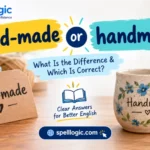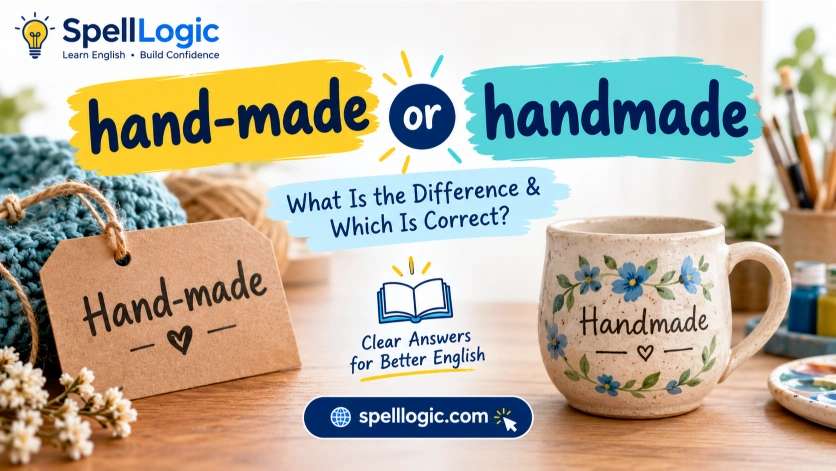
English learners often wonder whether the correct form is hand-made or handmade. Both forms have appeared in English writing, which can make the choice confusing. The issue becomes even more noticeable when writing product descriptions, advertisements, blogs, labels, or online store listings. Understanding hand-made-or-handmade helps you choose the spelling that looks natural and follows modern English usage.
In most cases, handmade is now the preferred spelling when the word works as an adjective or noun. The hyphenated form can still appear in some contexts, especially when writers want to make the compound structure especially clear. Learning the difference will make your writing more accurate and professional.
Why hand-made and handmade Are Confusing
The words hand-made and handmade refer to the same basic idea: something produced by hand rather than entirely by a machine. The main difference is usually the spelling and modern style preference.
Similar Pronunciation
There is normally no meaningful pronunciation difference between the two forms. Whether a writer uses the hyphen or leaves it out, the word is generally spoken in the same way.
Because the pronunciation is the same, learners cannot use sound to decide which written form is appropriate.
Similar Spelling
The two forms contain exactly the same basic words. The only visible difference is the hyphen.
This makes hand-made-or-handmade a spelling and usage question rather than a pronunciation question.
Context Confusion
You may see the word on product packaging, websites, menus, craft-store signs, advertisements, and social media. Some sources may use the older or stylistic hyphenated spelling, while others use the modern closed form.
For example, a website may describe a product as “handmade pottery,” while an older text may use “hand-made pottery.”
Common Learner Mistakes
Common mistakes include:
- Assuming both forms are always equally preferred.
- Using the hyphenated form in every situation.
- Writing hand made as two separate words when an established compound adjective is intended.
- Changing the spelling randomly within the same article.
- Assuming the hyphen changes the meaning.
For modern general English, handmade is usually the safest choice.
hand-made vs handmade Explained Simply
The easiest way to understand hand-made-or-handmade is to remember that both forms communicate the idea of something made by hand.
One-line distinction: Handmade is the standard modern spelling, while hand-made is a less common hyphenated variant.
In other words, hand-made means “made by hand,” while handmade means the same thing and is generally preferred in contemporary English.
Examples
- The shop sells handmade candles.
- She bought a beautiful handmade wooden bowl.
If you encounter hand-made in a book, advertisement, or older publication, it is not necessarily a spelling error. The form has been used traditionally, but current usage generally favors the closed spelling.
Understanding Homophones in English
The distinction in hand-made-or-handmade is not a homophone issue. It is primarily a matter of compound-word spelling.
What Are Homophones?
Homophones are words that sound the same but have different meanings or spellings.
For example, flower and flour are homophones. They sound alike, but a flower is a plant, while flour is used in cooking.
Why Homophones Cause Confusion
Learners cannot always identify the correct spelling simply by listening. If two words sound identical, they must understand the meaning and context to choose the right written form.
However, hand-made and handmade do not represent two different homophones. They are spelling variants of the same expression.
What Does hand-made Mean?
Definition and Core Meaning
Hand-made describes something created, prepared, or produced by hand rather than being made entirely through automated machinery.
The word can describe many products, including:
- hand-made furniture
- hand-made jewelry
- hand-made clothing
- hand-made decorations
- hand-made pottery
- hand-made gifts
The hyphen connects “hand” and “made” into a compound expression.
Origin and Historical Use
The idea behind the word is straightforward: hand refers to human manual work, and made refers to something produced or created.
English has traditionally used hyphens to connect words that function together as a compound modifier. As English spelling has developed, many compounds have gradually changed from open forms to hyphenated forms and, eventually, closed forms.
This historical development helps explain why you may still find hand-made in older books or publications.
Modern Usage and Synonyms
Although hand-made remains understandable and can be acceptable in some editorial styles, modern English strongly favors handmade as one word.
Related words and phrases include:
- artisan-made
- handcrafted
- crafted by hand
- manually produced
- traditionally made
Example Sentences
- The museum displayed several hand-made baskets.
- They specialize in hand-made leather goods.
- The artist creates hand-made decorations for weddings.
- The market sells traditional hand-made crafts.
These examples demonstrate that the hyphenated spelling can still be encountered, particularly when a writer or publication follows a particular style.
What Does handmade Mean?
Definition and Core Meaning
Handmade is an adjective or noun describing something made by hand, usually with a significant amount of human skill or manual work.
For example, a handmade necklace is produced through human craftsmanship instead of being mass-produced entirely by automated processes.
The word is especially common when discussing crafts, gifts, furniture, clothing, food, art, and other products associated with personal craftsmanship.
Origin and Historical Context
The meaning comes from the combination of hand and made. Over time, compound expressions in English often become more established as single words.
As the closed spelling became more common, handmade emerged as the preferred modern form in many dictionaries, publishing environments, commercial descriptions, and everyday writing.
Modern Usage and Synonyms
Today, handmade is widely used in both British and American English.
It commonly appears in:
- online product descriptions
- craft businesses
- fashion writing
- marketing materials
- gift guides
- packaging
- lifestyle articles
- marketplace listings
Useful synonyms and related expressions include:
- handcrafted
- artisan
- hand-crafted
- made by hand
- individually made
- traditionally crafted
Example Sentences
- She sells handmade soap online.
- I received a handmade card from my friend.
- The restaurant serves handmade pasta.
- This handmade table was made from local wood.
For most modern writing, handmade should be your first choice.
hand-made vs handmade: Key Differences at a Glance
When comparing hand-made-or-handmade, the important point is that the two forms usually have the same meaning. The major distinction concerns spelling preference and style.
| Word | Part of Speech | Meaning | Example Context |
|---|---|---|---|
| hand-made | Adjective | Made by hand; created manually | hand-made furniture |
| handmade | Adjective / Noun | Made by hand; created through human craftsmanship | handmade jewelry |
The closed form is generally more natural in contemporary English.
If you are writing an article, product description, school assignment, business page, or social media post, choosing handmade will usually give your writing a modern and polished appearance.
How to Remember the Difference Between hand-made and handmade
A simple way to remember hand-made-or-handmade is:
Handmade = one established modern word.
Easy Memory Trick
Think of handmade as a finished product. The two parts have become so closely connected that they normally appear together as one word.
Association Technique
Imagine a craftsperson making a product with their hands. When you think of the finished product, remember:
Hand + made = handmade
The two ideas are now joined into one common English word.
One Memorable Example
Think about a handmade gift. If your friend creates a wooden toy by hand, you would normally write:
“My friend gave me a handmade wooden toy.”
This example makes the modern spelling easy to remember.
Common Mistakes and Confusions
The most common problem is not misunderstanding the meaning but choosing a less preferred spelling.
Mistake 1
✘ Incorrect for modern standard usage: She sells hand made candles.
✔ Correct: She sells handmade candles.
The closed form is preferred when the word functions as the established adjective.
Mistake 2
✘ Less preferred: I bought a hand-made necklace.
✔ Preferred in modern writing: I bought a handmade necklace.
The hyphenated version is understandable, but the closed spelling is more common today.
Mistake 3
✘ Inconsistent: The company sells handmade bags and hand-made shoes.
✔ Better: The company sells handmade bags and handmade shoes.
Consistency improves readability and gives professional writing a cleaner appearance.
Mistake 4
✘ Incorrect assumption: “Hand-made and handmade always have different meanings.”
✔ Better understanding: They generally express the same basic meaning; the difference is mainly spelling and editorial style.
Examples Section: Correct and Incorrect Usage
Here are practical examples to help you understand hand-made-or-handmade in real sentences.
Example 1
✔ Correct: The artist creates handmade pottery.
✘ Incorrect: The artist creates hand made pottery.
Explanation: The closed form is preferred when the compound adjective is used in modern standard writing.
Example 2
✔ Correct: We bought a handmade wooden chair.
✘ Incorrect: We bought a hand made wooden chair.
Explanation: Handmade is normally written as one word.
Example 3
✔ Correct: This website sells handmade gifts.
✘ Incorrect: This website sells hand-made gifts.
Explanation: The hyphenated version is understandable, but the closed spelling is generally preferred today.
Example 4
✔ Correct: She gave me a handmade scarf.
✘ Incorrect: She gave me a hand made scarf.
Explanation: The standard modern compound form is one word.
Example 5
✔ Correct: The store specializes in handmade jewelry.
✘ Incorrect: The store specializes in hand made jewelry.
Explanation: Use the established closed form for a polished contemporary style.
Example 6
✔ Correct: The catalog describes the products as handmade.
✘ Incorrect: The catalog describes the products as hand made.
Explanation: The single-word spelling is the normal modern choice.
Self Assessment: Test Your Knowledge
Complete each sentence with the preferred form.
- My sister bought a __________ handbag from the local craft shop.
- The company produces __________ furniture.
- We gave our teacher a __________ card.
- This store specializes in __________ candles and soaps.
Try answering all four before checking the solutions below.
Self Assessment Answers
- handmade — My sister bought a handmade handbag from the local craft shop.
- handmade — The company produces handmade furniture.
- handmade — We gave our teacher a handmade card.
- handmade — This store specializes in handmade candles and soaps.
The easiest rule is to use handmade as the standard modern spelling unless a particular publication or style guide requires the hyphenated form.
FAQs
1. Is handmade one word?
Yes. Handmade is normally written as one word in modern English and is the preferred form in most everyday and professional contexts.
2. Is hand-made grammatically correct?
Hand-made can be found in English and is understandable. However, it is less common than handmade in contemporary general usage.
3. What is the difference between hand-made and handmade?
The basic meaning is the same. The main difference is spelling. Handmade is the modern closed form, while hand-made is the hyphenated variant.
4. Should I write handmade in a product description?
Yes. Handmade is usually the best choice for product descriptions, online stores, advertisements, and marketing content.
5. Is handmade an adjective?
Yes. Handmade commonly functions as an adjective, as in “a handmade necklace” or “handmade furniture.” It can also be used as a noun in some contexts.
6. Is hand-made a homophone of handmade?
No. They are not separate homophones. They are different written forms of the same compound expression and are generally pronounced alike.
7. Which spelling should English learners use?
For most modern writing, learners should choose handmade. It is simple, widely recognized, and commonly preferred in contemporary English.
Final Conclusion: Using hand-made and handmade Correctly
Understanding hand-made-or-handmade is mainly a matter of recognizing how English compound words develop over time. Both forms communicate the idea of something created by hand, but handmade is the preferred modern spelling in most situations. You will commonly see it in product descriptions, craft businesses, advertisements, blogs, packaging, online stores, and everyday writing. The hyphenated form hand-made is still understandable and may appear in older texts or according to particular editorial styles, but it is generally less common today.
For English learners, the simplest rule is to remember handmade as one established word. When you want to describe a product created through human craftsmanship, use phrases such as “handmade jewelry,” “handmade furniture,” “handmade gifts,” or “handmade clothing.” Also remember that this pair is not a homophone problem; the pronunciation is essentially the same, while the written form differs. If you consistently use the modern closed spelling, your writing will look natural and professional. Keep practicing compound words in real sentences, and choosing the correct form will soon become automatic.