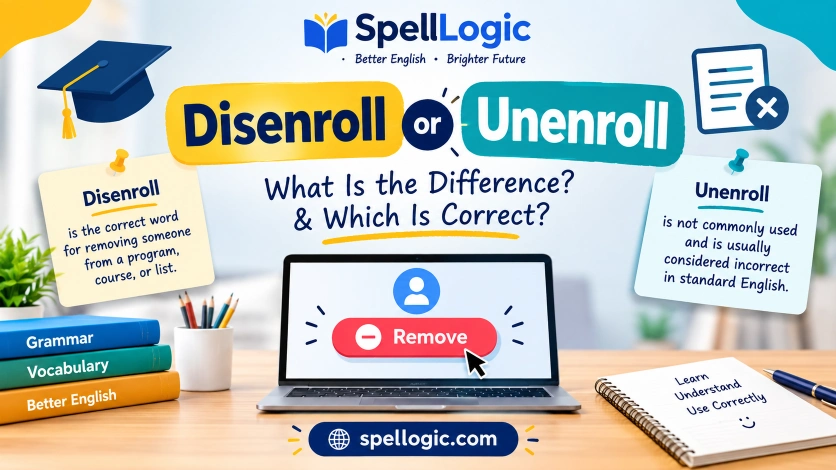
English learners often come across both disenroll and unenroll when reading about schools, courses, memberships, programs, subscriptions, or online services. Because the two verbs have almost the same spelling and meaning, it can be difficult to know which one is correct. In many situations, both forms can describe removing someone from a course, program, or enrollment.
However, usage can vary by organization, region, and context. Understanding disenroll or unenroll helps you choose natural wording and avoid unnecessary confusion in formal writing. This guide explains the meanings, differences, examples, common mistakes, and practical usage of both terms in simple English.
Why “disenroll or unenroll” Are Confusing
The expressions disenroll or unenroll are confusing because they are extremely close in both form and meaning. A learner may see one form on a school website and the other on an online learning platform and wonder whether one is grammatically wrong.
Similar Pronunciation
The two verbs sound very similar because they share the same base word, enroll. The prefixes dis- and un- are attached to the same basic idea of enrollment.
They are not homophones, however. Homophones have the same pronunciation but different meanings or spellings. These two words have different prefixes and can be distinguished when spoken carefully.
Similar Spelling
Both words contain enroll, which makes their written forms look almost identical:
- disenroll
- unenroll
This visual similarity often causes learners to treat them as completely interchangeable without considering context.
Context Confusion
Both forms can refer to ending or removing an enrollment. For example, a student might leave a course, or an administrator might remove a student from a program.
Different institutions may also have different preferred terminology. One university may use disenroll, while an online platform may use unenroll.
Common Learner Mistakes
A common mistake is assuming that one word is always correct and the other is always incorrect. That is not generally true.
Another mistake is using the words without checking the context. When writing about a specific school, course, membership, or website, it is often best to follow that organization’s terminology.
Disenroll or Unenroll Explained Simply
At a basic level, disenroll or unenroll can both describe ending an enrollment or removing someone from an enrolled status.
One-line distinction: Disenroll often emphasizes removing someone from enrollment, while unenroll commonly emphasizes reversing or ending an enrollment.
The difference is usually subtle rather than absolute.
Examples:
- The school may disenroll a student who does not meet the program requirements.
- You can unenroll from the online course at any time.
The first form is frequently associated with an official action taken by an institution. The second is especially common when a person actively removes themselves from a course or service. Still, actual usage varies, so context matters more than a strict grammatical rule.
Understanding Homophones in English
Understanding homophones can help learners recognize why similar-sounding words sometimes create confusion. However, these particular verbs are not homophones.
What Are Homophones?
Homophones are words that sound the same but have different spellings or meanings.
For example:
- right — correct or opposite of left
- write — to form words using letters
They sound alike but have different meanings and spellings.
Why Homophones Cause Confusion
When two words sound identical, learners cannot depend on pronunciation alone to identify the correct spelling.
For example, someone may hear write and right in conversation and need the surrounding context to understand which word is intended. The situation is different with disenroll or unenroll, because the two forms do not have identical pronunciation.
What Does “Disenroll” Mean?
The word disenroll is a verb meaning to remove someone from an enrollment or to end a person’s enrollment in a program, course, organization, or service.
Definition and Core Meaning
The central idea is removal from an enrolled status.
For example:
The university may disenroll a student who fails to complete the required registration process.
Here, the university is taking an action that ends the student’s enrollment.
Origin and Historical Use
The word is formed from the prefix dis- and the verb enroll. The prefix dis- can express separation, reversal, or removal. As a result, the word developed naturally as a way to describe removing someone from an enrolled group or status.
Its use became especially practical in institutional contexts such as education, healthcare plans, memberships, and government programs.
Modern Usage and Synonyms
Today, this verb is used in several settings, including:
- schools and universities
- training programs
- health plans
- membership programs
- government services
- subscription systems
- professional organizations
Depending on the context, possible alternatives include:
- remove from enrollment
- withdraw
- cancel enrollment
- terminate enrollment
- remove from a program
Example Sentences
- The college can disenroll students who do not pay their fees.
- The administrator decided to disenroll the participant from the training program.
- Students may be disenrolled if they fail to meet the attendance requirements.
- The organization sent a notice before taking the enrollment action.
In formal institutional writing, this verb can sound more administrative or official than everyday alternatives such as leave or withdraw.
What Does “Unenroll” Mean?
The word unenroll is also a verb. It generally means to remove yourself or someone else from a course, program, service, list, or enrollment.
Definition and Core Meaning
The central idea is ending or reversing an enrollment.
For example:
I decided to unenroll from the course because I no longer had enough time to study.
Here, the person is actively ending their participation.
Origin and Historical Context
The word combines un- with enroll. The prefix un- commonly indicates reversal or removal of an existing condition. Therefore, unenroll developed as a straightforward way of expressing the action of reversing enrollment.
It is particularly familiar in modern digital environments where users can enroll in and later remove themselves from online courses, mailing lists, programs, and platforms.
Modern Usage and Synonyms
Common alternatives include:
- withdraw from a course
- leave a program
- cancel enrollment
- remove enrollment
- drop a course
- opt out
The exact alternative depends on the context.
For example, universities often prefer withdraw or drop for courses, while a website may use unenroll as the label on a button.
Example Sentences
- I need to unenroll from this online class.
- She unenrolled from the training program yesterday.
- Click the button if you want to unenroll from the course.
- The platform allows users to unenroll whenever they choose.
The term is especially natural when discussing an individual’s action in a digital or educational environment.
Disenroll or Unenroll: Key Differences at a Glance
The difference between disenroll or unenroll is mainly related to emphasis, context, and preferred institutional usage rather than a completely different meaning.
| Word | Part of Speech | Meaning | Example Context |
|---|---|---|---|
| Disenroll | Verb | Remove someone from enrollment or end their enrolled status | An institution removes a student |
| Unenroll | Verb | Reverse or end an enrollment | A learner leaves an online course |
Both words can overlap. For instance, an administrator could use either term when describing the removal of a participant, depending on the organization’s preferred vocabulary.
The safest choice is therefore to consider who is performing the action, what type of enrollment is involved, and which terminology the organization officially uses.
How to Remember the Difference Between Disenroll and Unenroll
Remembering disenroll or unenroll becomes easier when you focus on the prefixes.
Easy Memory Tricks
Think of dis- as suggesting separation or removal.
Think of un- as suggesting reversal or undoing.
Therefore:
- disenroll → remove from enrollment
- unenroll → undo or end enrollment
This is a helpful memory aid, but it should not be treated as an absolute grammar rule because real-world usage overlaps.
Association Techniques
Associate disenroll with an administrator:
The school disenrolls a student.
Associate unenroll with an individual user:
I unenroll from the course.
This distinction is particularly useful for remembering common patterns.
One Memorable Example
Imagine an online course. You click a button to leave the course yourself: unenroll. Later, an administrator removes a student because of an eligibility problem: disenroll.
The two situations can overlap, but the example helps you remember their typical emphasis.
Common Mistakes and Confusions
One of the biggest problems with disenroll or unenroll is assuming that one must always be wrong.
Wrong Example
✘ I disenrolled myself from the online course.
This sentence is not necessarily grammatically wrong. However, if the platform specifically uses unenroll for a learner’s voluntary action, unenrolled may sound more natural in that context.
Correct Version
✔ I unenrolled from the online course.
This clearly describes a learner choosing to leave.
Another Example
✘ The university unenrolled the student for failing to meet the requirements.
This may be understandable, but an institution may more naturally use:
✔ The university disenrolled the student for failing to meet the requirements.
The important point is that disenroll can strongly suggest an official removal, while unenroll often describes ending an enrollment.
Important Usage Tip
Do not automatically correct one form to the other. First check the context, the intended meaning, and the terminology used by the organization involved.
Examples Section: Correct and Incorrect Usage
Example 1
✔ Correct: I unenrolled from the online course after the first week.
This is natural when the learner chooses to leave.
✘ Incorrect: I unenrolled from the online course after the first week because the word is never used for personal action.
That explanation is incorrect. The verb can be used for personal action.
Example 2
✔ Correct: The university disenrolled the student after reviewing the eligibility requirements.
This works well for an institutional removal.
✘ Incorrect: The university disenrolled the student, so the sentence is grammatically impossible.
The sentence is not grammatically impossible. The verb can describe institutional action.
Example 3
✔ Correct: Students should check the course website before choosing to unenroll.
This is appropriate when referring to leaving a course.
✘ Incorrect: Students should always use disenroll when they leave a course themselves.
There is no universal rule requiring that choice.
Example 4
✔ Correct: The administrator notified the participant before disenrolling them from the program.
This clearly presents the action as an administrative decision.
✘ Incorrect: The two words can never have overlapping meanings.
They can overlap considerably in real-world English.
Self Assessment: Test Your Knowledge
Fill in each blank with disenroll or unenroll in the most suitable form.
- I decided to ______ from the online course because I was too busy.
- The school may ______ students who do not complete the required paperwork.
- You can ______ from the training program through your account settings.
- The administrator had to ______ the participant after the eligibility review.
Self Assessment Answers
- unenroll — The learner is choosing to leave the course.
- disenroll — The school is taking an official action.
- unenroll — The individual is reversing their enrollment.
- disenroll — The administrator is removing the participant.
Remember that context can allow either term in some situations. These answers represent the most natural choices for the particular situations described.
FAQs
1. Are disenroll and unenroll the same?
They have very similar meanings and can both describe ending enrollment. However, disenroll often emphasizes official removal, while unenroll frequently describes reversing or ending enrollment.
2. Is disenroll a correct English word?
Yes. Disenroll is an established English verb used in educational, administrative, membership, and program-related contexts.
3. Is unenroll a correct English word?
Yes. Unenroll is also an established verb and is especially common in online learning, digital platforms, courses, and other situations where users can remove themselves from an enrollment.
4. Should I use disenroll or unenroll for an online course?
Either may be possible, but unenroll is often a natural choice when a learner voluntarily leaves an online course. Always follow the terminology used by the platform.
5. Which word is more formal?
Neither word is automatically formal in every situation. Disenroll can sound more administrative because it is often used for official removal, while unenroll is common in user-facing digital instructions.
6. Can I say “unenrolled”?
Yes. Unenrolled is the past tense and past participle of unenroll. For example: “She unenrolled from the class yesterday.”
7. Can I use “disenrolled” in a sentence?
Yes. Disenrolled is the past tense and past participle of disenroll. For example: “The student was disenrolled from the program.”
Final Conclusion: Using Disenroll and Unenroll Correctly
Understanding disenroll or unenroll is easier when you focus on the basic idea of enrollment and the context in which the action happens. Both verbs can describe ending or removing an enrollment, so neither should automatically be labeled incorrect. However, disenroll often carries an administrative sense in which an institution, organization, or administrator removes someone from an enrolled status. Unenroll, on the other hand, is especially common when a person reverses their own enrollment, such as leaving an online course or training program.
A useful memory trick is to associate dis- with separation or removal and un- with undoing an existing action. For example, a school might disenroll a student, while a learner might unenroll from an online course. Even so, these are helpful patterns rather than strict rules. Real-world organizations may choose one term as their official wording and use it consistently.
When you are unsure, check the context and look at the terminology used by the relevant school, platform, company, or organization. Most importantly, do not worry if you encounter both forms. Recognizing their overlap will help you read English more confidently and choose natural wording in your own writing. With regular practice, these small vocabulary differences become much easier to understand and remember.