Many English learners wonder whether the correct spelling is soulmate or soul mate. Both forms appear in books, websites, messages, and everyday conversations, so it is easy to think they have different meanings. In reality, the two forms refer to the same idea: a person who is believed to have a deep emotional or spiritual connection with another person. The main difference is spelling and style, not meaning.
Understanding how these forms are used can help you write naturally and choose the form that best fits your audience or style guide. Once you learn the basic pattern, this spelling question becomes much easier to handle.
Why “soulmate or soul mate” Are Confusing
These forms are confusing because they look almost identical and are pronounced in exactly the same way. The only visible difference is the space between the two words. That small difference can make learners wonder whether one spelling is correct and the other is wrong.
Similar Pronunciation
Both forms are normally pronounced the same way. When people hear the expression in conversation, they cannot tell whether the writer would spell it as one word or two.
Similar Spelling
The spelling is almost identical. The phrase soulmate or soul mate is almost identical in both forms. “Soul mate” contains the same two elements as “soulmate”; they are simply written separately. This makes the distinction easy to miss when reading quickly.
Context Confusion
The phrase soulmate or soul mate can describe a romantic partner, a very close friend, or someone who seems deeply compatible with another person. Different dictionaries, publishers, and style guides may prefer one form, which adds to the uncertainty.
Common Learner Mistakes
With soulmate or soul mate, a common mistake is assuming that one form has a different definition. Another is believing that the two-word form is always wrong. In modern English, both spellings can be found, although the closed form is increasingly common.
Soulmate vs soul mate Explained Simply
For soulmate or soul mate, the simplest answer is that both spellings describe a person with whom someone feels an unusually deep connection. They are spelling variants rather than two different concepts.
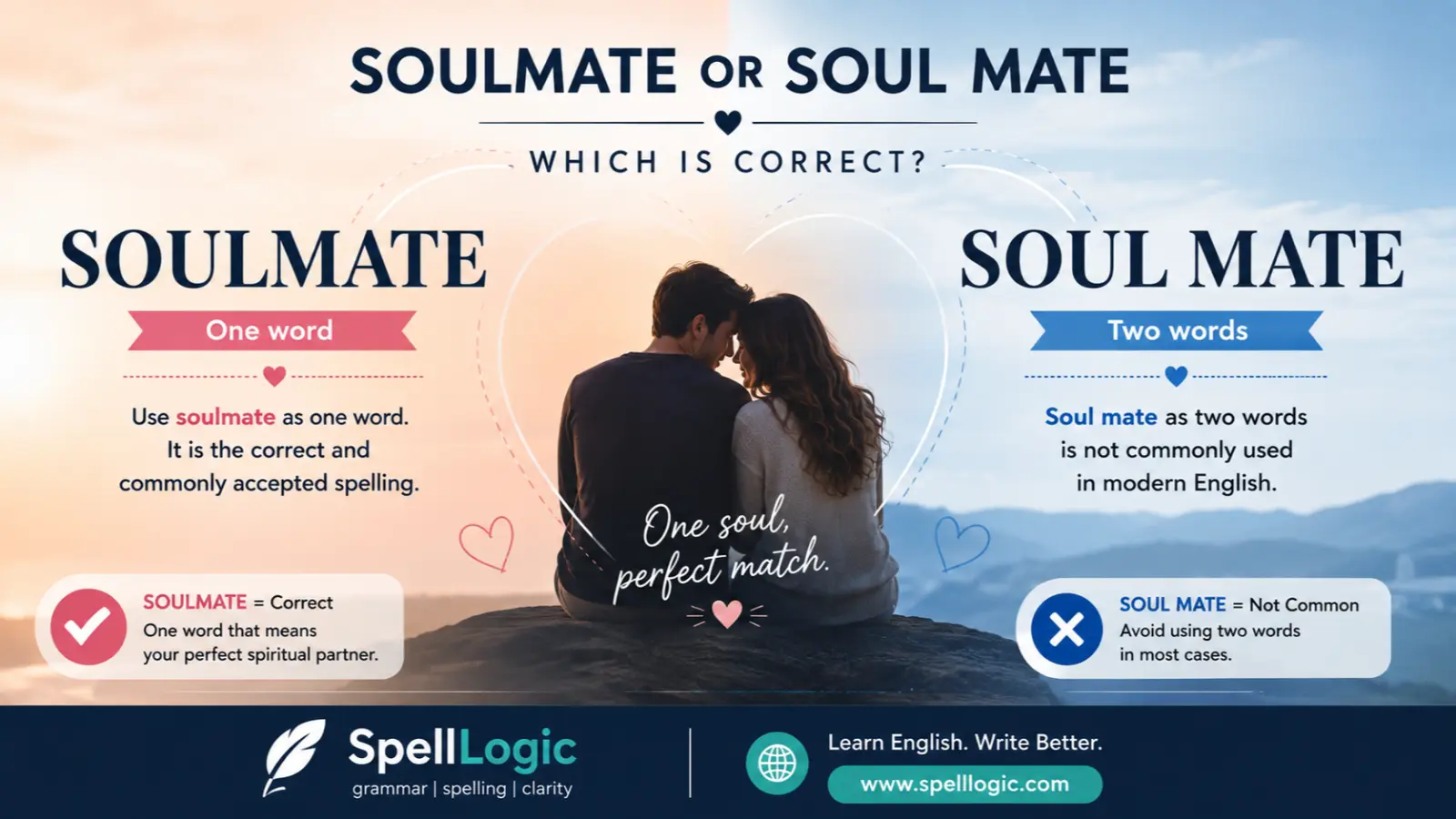
One-line distinction: “Soulmate” and “soul mate” have the same basic meaning; “soulmate” is the closed form, while “soul mate” is the open form.
Example Sentences
- Maya believes she has finally met her soulmate.
- Daniel described his best friend as his soul mate.
In short, soulmate or soul mate means a person thought to be deeply and naturally compatible with you, while the expression can be written as either one word or two.
When choosing between soulmate or soul mate, which form should you choose? In contemporary general writing, “soulmate” is a safe and widely recognized choice. However, “soul mate” is still understandable and remains established in English. If you are following a particular dictionary, publisher, or house style, use the spelling it recommends.
Understanding Homophones in English
The spelling issue in soulmate or soul mate is not actually a homophone problem. The two forms sound the same because they contain the same words, but they are spelling variants rather than separate words with different pronunciations.
What Are Homophones?
Homophones are words that sound alike but have different meanings or spellings. For example, “pair” and “pear” sound the same but refer to different things.
Why Homophones Cause Confusion
Homophones can confuse learners because listening alone does not reveal the spelling or meaning. For example, someone hearing “I bought a pair” needs context to know which spelling is intended. With soulmate and soul mate, however, the meaning stays essentially the same, so the issue is mainly one of written style.
What Does “soulmate” Mean?
Definition and Core Meaning
A soulmate is a person whom someone feels deeply connected to, often emotionally, romantically, or spiritually. The word can suggest a sense of unusual compatibility, understanding, or closeness.
The concept behind soulmate or soul mate does not have to be limited to romantic relationships. Some people use the term for a lifelong friend, creative partner, or another person who seems to understand them exceptionally well.
Origin and Historical Use
The idea behind the word is much older than its modern spelling. Ancient philosophical traditions included ideas about people being naturally connected or incomplete without a special counterpart. In English, the expression “soul mate” appeared before the closed spelling became widespread.
For soulmate or soul mate, over time, frequent use helped the expression develop into a familiar compound noun. As with many English compounds, a phrase that begins as separate words can gradually become hyphenated or closed.
Modern Usage and Synonyms
Today, soulmate or soul mate is common in informal conversation, popular culture, relationship writing, and personal storytelling. Depending on the context, related expressions include “life partner,” “kindred spirit,” “ideal partner,” “companion,” and “perfect match.” These are not exact synonyms in every situation, because each expression carries a slightly different emotional meaning.
Common uses include:
- describing a romantic partner
- talking about an exceptionally close friend
- expressing a strong feeling of compatibility
- describing a person who seems uniquely understanding
- discussing love, relationships, or emotional connection
Example Sentences
- She says her husband is her soulmate.
- I met a friend who feels like a soulmate in every way.
- They believe they were meant to become soulmates.
- He does not believe everyone has only one soulmate.
Notice that soulmate or soul mate often expresses a belief or feeling rather than a scientifically proven fact. Writers may use it seriously, humorously, or figuratively.
What Does “soul mate” Mean?
Definition and Core Meaning
A soul mate is a person believed to share a profound emotional, spiritual, or personal connection with another person. The meaning is essentially the same as the closed spelling.
Origin and Historical Context
The two-word expression has a longer visible history in English than the closed compound. English often changes compound expressions over time. Words may begin as separate units and later become hyphenated or written together when speakers use them frequently.
This pattern can be seen with soulmate or soul mate. Language users gradually develop preferred spellings, and dictionaries eventually record common usage. As a result, older texts may contain “soul mate” while newer texts often use “soulmate.”
Modern Usage and Synonyms
The open form of soulmate or soul mate is still clear and acceptable to many readers, particularly in literary, traditional, or style-conscious writing. It can also appear when a writer wants the phrase to retain a stronger sense of the individual words “soul” and “mate.”
Related expressions include:
- kindred spirit
- life partner
- romantic partner
- close companion
- ideal match
- trusted companion
Example Sentences
- She considers her sister her soul mate.
- He wrote a poem about finding his soul mate.
- They felt like soul mates from the moment they met.
- A soul mate does not necessarily have to be a romantic partner.
The key point about soulmate or soul mate is that the open spelling does not create a new definition. It simply represents another established way of writing the same expression.
Soulmate vs Soul mate: Key Differences at a Glance
The soulmate or soul mate table shows why learners should not treat these as two separate vocabulary items. Their grammatical role and basic meaning are the same.
| Word | Part of Speech | Meaning | Example Context |
|---|---|---|---|
| soulmate | Noun | A person believed to share a deep connection with someone | “She thinks he is her soulmate.” |
| soul mate | Noun | A person believed to share a deep connection with someone | “He found his soul mate.” |
The table shows why learners should not treat these as two separate vocabulary items. Their grammatical role and basic meaning are the same. The main difference is whether the compound is written as one word or two.
The closed spelling is often the more convenient choice in current general English. Nevertheless, the open spelling is not automatically an error. When consistency matters, follow the dictionary or style guide used by your school, employer, publisher, or website.
How to Remember the Difference Between soulmate and soul mate
Easy Memory Tricks
For soulmate or soul mate, think of the expression as a compound. A compound noun is made from two words that work together as one idea. If you want the modern closed spelling, remember that the two parts have “joined” together:
soul + mate = soulmate
Association Techniques
you can also connect the spelling with the idea of closeness. A soulmate is someone who feels very close to you, so imagine “soul” and “mate” standing close together with no space.
If you prefer the traditional open form of soulmate or soul mate, remember that it is simply “soul + mate” written separately. The meaning does not change.
One Memorable Example
“After years of friendship, Lina realized that her best friend was her soulmate.”
The important lesson about soulmate or soul mate is simple: do not search for a difference in meaning that is not there. Focus on spelling preference and context.
Common Mistakes and Confusions
Learners often make mistakes with soulmate or soul mate because they assume that the open and closed forms must have different meanings. They do not.
Wrong Examples
- “My soulmate and soul mate are two different kinds of people.”
- “You can use soul mate only for romantic relationships.”
- “Soul mate is always incorrect because it has two words.”
Correct Versions
- “My soulmate and soul mate refer to the same basic idea.”
- “A soul mate can be a romantic partner or, depending on context, another deeply connected person.”
- “Soul mate is an established spelling, although soulmate is very common in modern usage.”
Another mistake is changing the spelling in the same article without a reason. Consistency makes your writing look more polished. If you choose the closed form at the beginning, continue using it unless your source or style guide requires another form.
Examples Section: Correct and Incorrect Usage
✔ Correct:
“She believes her husband is her soulmate.”
The closed form works naturally as a noun.
✔ Correct:
“He called his longtime friend his soul mate.”
The open form is also understandable and established.
✘ Incorrect:
“She thinks her soulmate and soul mate have completely different meanings.”
The two forms do not normally represent different concepts.
✔ Correct:
“Finding a soulmate is a common theme in romantic fiction.”
The compound noun can be used naturally in general writing.
✘ Incorrect:
“Every soul mate must be a romantic partner.”
The expression can be used more broadly, depending on the writer and context.
✔ Correct:
“Check your preferred dictionary before choosing between soulmate and soul mate.”
This is useful when a formal publication requires a specific style.
Self Assessment: Test Your Knowledge
- Which form is commonly used as a closed compound in modern English: ______?
- Do soulmate and soul mate normally have different meanings: ______?
- Which spelling has a space between the two words: ______?
- If a style guide specifies one spelling, should you follow it: ______?
Self Assessment Answers
- soulmate
- No. They normally have the same basic meaning.
- soul mate
- Yes. Consistency with the required style guide is the best choice.
FAQs About “soulmate and soul mate”
1. Is soulmate or soul mate correct?
Both forms are established, but soulmate is widely used as the closed compound in contemporary English.
2. Is soul mate one word or two words?
Both spellings appear in English. “Soulmate” is one word, while “soul mate” is two words.
3. Does soulmate mean true love?
Not necessarily. It usually describes a person believed to have a very deep connection with someone, but the idea can be romantic, emotional, or spiritual.
4. Can a soulmate be a friend?
Yes. Many people use the term for a friend who shares an unusually strong emotional or personal connection.
5. Is soul mate outdated?
Not necessarily. It remains recognizable and established, although many modern writers prefer the closed form.
6. Should I use soulmate in formal writing?
It is generally understandable and acceptable, but formal writing should follow the relevant dictionary or style guide if one specifies a preferred spelling.
7. Why do English compounds change spelling?
Frequent expressions can develop from separate words into hyphenated or closed compounds. Usage patterns, dictionaries, and publishing styles all influence this process.
Final Conclusion: Using “soulmate” and “soul mate” Correctly
The main difference between soulmate or soul mate is not meaning but spelling. Both forms describe a person who is believed to share an unusually deep emotional, personal, or spiritual connection with another person. The closed form, soulmate, is especially common in contemporary English, while soul mate remains an established open form. Therefore, English learners should not worry that choosing one spelling will automatically change the meaning of a sentence.
For everyday writing, title is a simple and widely recognized expression. However, if you are writing for a school, company, publisher, or website with a particular style guide, follow its preferred spelling. The most useful memory trick is to think of the two parts as a single concept: soul + mate can become soulmate. At the same time, remember that the open form can still be found in English.
When you encounter books, articles, or online content, remember that context usually makes the meaning clear. The spelling difference should not distract you from the message. Most importantly, pay attention to consistency and context rather than treating the two spellings as different vocabulary words. English spelling becomes easier when you notice patterns like these. Keep practicing with real examples, check reliable references when necessary, and you will become more confident in choosing the natural form.