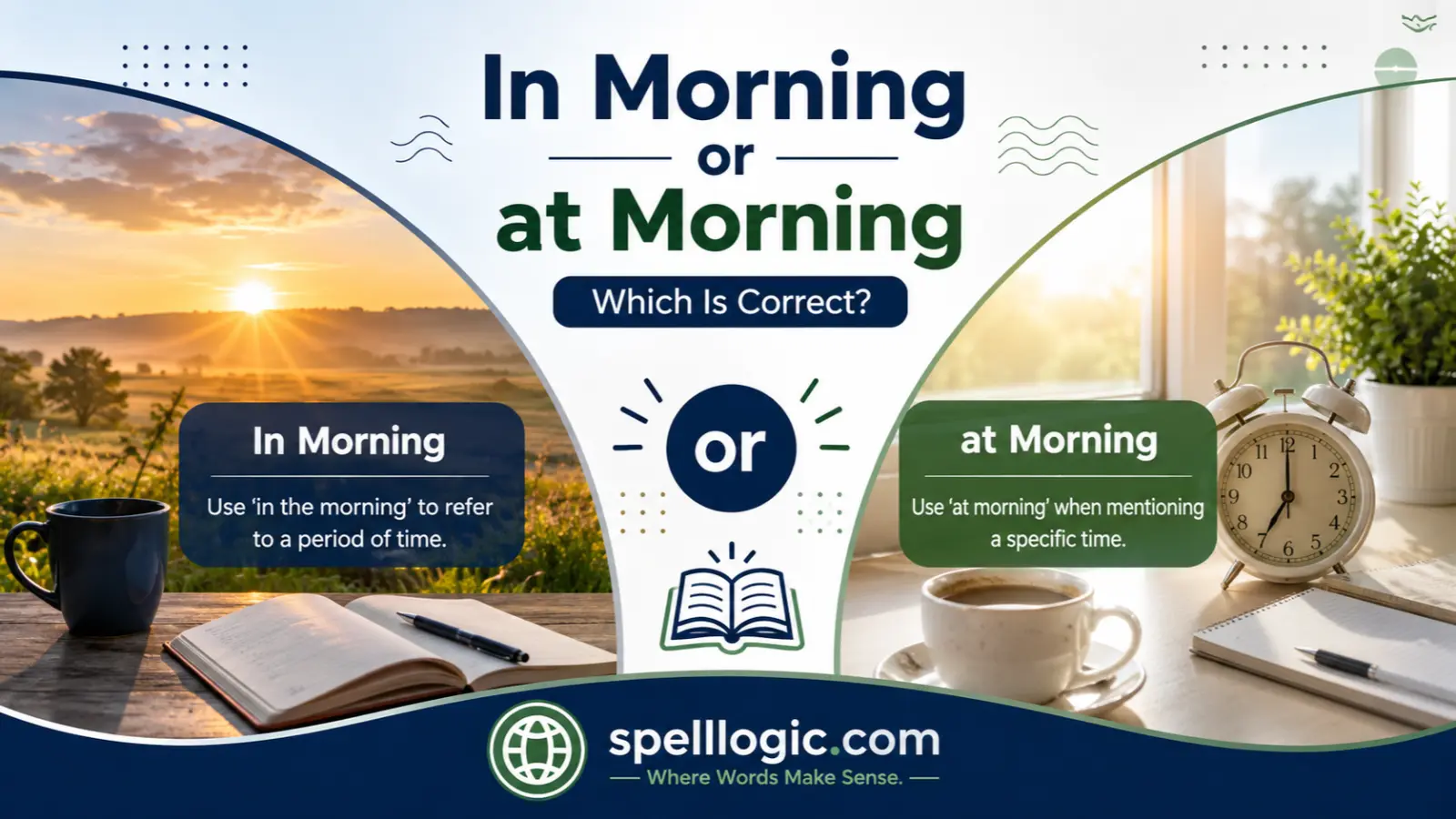
English learners often wonder whether in morning or at morning is the correct way to describe something that happens during the early part of the day. The confusion usually comes from the fact that English uses several prepositions for time, including in, at, and on. Although these small words seem simple, choosing the wrong one can make a sentence sound unnatural.
The good news is that there is a clear rule to follow. In standard English, in the morning is the natural and grammatically correct expression when talking generally about the morning. Understanding this difference will help you write clearer sentences, speak more naturally, and avoid a common mistake made by English learners.
Why “in morning or at morning” Are Confusing
At first glance, both may seem logical. However, English time expressions follow established patterns, and these patterns are not always predictable from other languages.
Similar Pronunciation
The phrases can sound similar when spoken quickly, especially for learners who are still developing their listening skills. The words in and at are both short function words, so they can be difficult to notice in natural conversation.
Similar Spelling
There is no major spelling similarity between in and at. The confusion comes mainly from their grammatical function. Both words can introduce expressions of time, but they are used with different types of time references.
Context Confusion
English commonly uses in with longer periods and at with specific points in time. For example, we say in July but at noon. Because morning refers to a period, learners may incorrectly transfer the rule for exact times and choose at.
Common Learner Mistakes
A frequent mistake is saying I wake up at morning. A natural standard-English version is I wake up in the morning. Another common error is leaving out the article the and saying I study in morning. In ordinary standard English, in the morning is preferred.
“in morning or at morning” Explained Simply
The easiest rule is this: use in the morning when you mean the morning period in general.
The expression at morning is not normally used in modern standard English for ordinary daily situations. In special literary, poetic, historical, or unusual contexts, at morning can sometimes appear, but it is not the normal choice for everyday communication.
One-line distinction: Use in the morning for the general morning period; do not normally use at morning in everyday English.
For example:
- I go for a walk in the morning.
- She usually drinks coffee in the morning.
So, when choosing between in morning or at morning, remember that the standard everyday form is in the morning.
Understanding Homophones in English
The issue here is not actually a homophone problem. Instead, it is a preposition and time-expression problem. Still, understanding homophones is useful because English learners often encounter similar-looking or similar-sounding word pairs.
What Are Homophones?
Homophones are words that sound the same, or nearly the same, but have different meanings, spellings, or both.
For example:
- right = correct or opposite of left
- write = to form words with a pen, pencil, or keyboard
These words sound alike but have different meanings and spellings.
Why Homophones Cause Confusion
Homophones can cause confusion because listeners cannot always identify the correct word from sound alone. Context provides the meaning.
For example, write and right sound alike, but Please write your name clearly requires the verb write. The present topic is different because in and at are not homophones. The main challenge is choosing the correct preposition.
What Does “in morning” Mean?
Definition and Core Meaning
The expression in morning or at morning raises an important grammatical point: morning is normally treated as a period of time, so the standard expression uses in.
In standard English, however, the natural complete phrase is in the morning, rather than simply in morning. It refers to the part of the day between night and afternoon.
For example:
- I exercise in the morning.
- We usually have breakfast in the morning.
- He reads the newspaper in the morning.
- The children leave for school in the morning.
The word in is commonly used with periods such as:
- in the morning
- in the afternoon
- in the evening
- in July
- in winter
- in 2026
Origin and Historical Use
The word morning comes from Old English morgen, related to words for the early part of the day. Over centuries, English developed established patterns for describing parts of the day. The expression in the morning became the normal grammatical form.
English prepositions have developed through long-term usage rather than through one simple universal rule. Therefore, learners often need to memorize common combinations.
Modern Usage and Synonyms
In modern English, in the morning is extremely common in conversation, writing, education, business communication, and everyday instructions.
Related expressions include:
- early in the morning — during the early hours
- tomorrow morning — the morning of the next day
- this morning — the morning of today
- every morning — each morning
- one morning — on one particular morning
Notice that these expressions do not always require in because English uses different structures depending on the sentence.
Example Sentences
- I usually check my emails in the morning.
- The train leaves in the morning.
- We met in the morning before work.
- She feels more energetic in the morning.
- Please call me in the morning.
What Does “at morning” Mean?
Definition and Core Meaning
The phrase at morning is not the normal expression for describing ordinary activities during the morning. Modern standard English generally uses in the morning instead.
Therefore, when learners ask about in morning or at morning, the important distinction is between a standard everyday construction and an uncommon construction.
You may occasionally see at morning in literary, poetic, archaic, or deliberately stylized writing. In such contexts, it can suggest the arrival or beginning of morning. However, this usage should not be copied into ordinary English unless the context specifically calls for it.
Origin and Historical Context
Older forms of English allowed greater variation in time expressions than modern everyday English. Literary works may therefore contain structures that sound unusual today. Expressions involving at and parts of the day can sometimes be found in older or poetic language.
Modern learners should focus on contemporary standard usage rather than trying to imitate every historical construction.
Modern Usage and Synonyms
For ordinary communication, replace at morning with one of these natural alternatives:
- in the morning
- early in the morning
- tomorrow morning
- this morning
- at dawn
- at sunrise
The last two are especially useful when referring to a specific moment or event connected with the beginning of daylight.
Example Sentences
Instead of saying I exercise at morning, say:
- I exercise in the morning.
- I exercise early in the morning.
Instead of The birds sing at morning, ordinary English would normally use:
- The birds sing in the morning.
For a more specific time, you could say:
- The birds start singing at dawn.
“In morning or at morning”: Key Differences at a Glance
| Word | Part of Speech | Meaning | Example Context |
|---|---|---|---|
| in | Preposition | Used with a period of time | I study in the morning. |
| at | Preposition | Often used with a specific point in time | I wake up at 7 a.m. |
| in the morning | Time expression | During the morning period | We walk in the morning. |
| at morning | Uncommon time expression | Mainly literary or unusual | May occur in poetic writing. |
The central rule is simple: morning is normally treated as a period, so use “in the morning.” By contrast, at is commonly used for precise clock times, such as at 6 a.m., at noon, or at midnight.
How to Remember the Difference Between in morning or at morning
Easy Memory Tricks
A useful memory trick is:
IN = inside a period. AT = a point.
Think of the morning as a container of time. If an activity happens somewhere inside that period, use in.
- in the morning
- in the afternoon
- in the evening
When you identify a precise point, at is often appropriate:
- at 6 a.m.
- at noon
- at midnight
- at sunrise
Association Techniques
Imagine a timeline. The whole morning is a wide section of that timeline, so you are in it. A particular clock time is a single point, so you are at it.
For example:
- I study in the morning.
- I start studying at 8 a.m.
Both sentences can describe the same routine, but the first gives a general period while the second gives a precise time.
One Memorable Example
Remember this pair:
I exercise in the morning, but I exercise at 7 a.m.
This sentence shows the difference clearly. The morning is a period; 7 a.m. is a specific point.
Common Mistakes and Confusions
Mistake 1
✘ I wake up at morning.
✔ I wake up in the morning.
Explanation: Morning is normally expressed as a period of time, so in is the natural preposition.
Mistake 2
✘ I study in morning.
✔ I study in the morning.
Explanation: In ordinary standard English, the article the is normally included in this expression.
Mistake 3
✘ We meet at morning every day.
✔ We meet in the morning every day.
Explanation: The sentence refers generally to the morning period, not to one exact point.
Mistake 4
✘ I leave home in 7 a.m.
✔ I leave home at 7 a.m.
Explanation: A specific clock time takes at.
Mistake 5
✘ She arrives at the morning.
✔ She arrives in the morning.
Explanation: At the morning is not the normal expression for everyday English.
Examples Section: Correct and Incorrect Usage
Example 1
✔ Correct: I usually read in the morning.
✘ Incorrect: I usually read at morning.
The first sentence uses the standard expression for a general morning routine.
Example 2
✔ Correct: We will travel in the morning.
✘ Incorrect: We will travel at morning.
The activity happens during the morning period, so in is appropriate.
Example 3
✔ Correct: The meeting begins at 9 a.m.
✘ Incorrect: The meeting begins in 9 a.m.
A clock time is a specific point, so at is used.
Example 4
✔ Correct: She goes running early in the morning.
✘ Incorrect: She goes running early at morning.
The natural phrase is early in the morning.
Example 5
✔ Correct: I received your message this morning.
✘ Incorrect: I received your message at this morning.
With this morning, no preposition is needed.
Example 6
✔ Correct: We arrived at dawn.
✘ Incorrect: We arrived in dawn.
Dawn can refer to a specific point or moment, so at dawn is standard.
Self Assessment: Test Your Knowledge
Fill in each blank with the correct preposition or expression.
- I usually drink tea ___ the morning.
- The bus leaves ___ 7:30 a.m.
- She likes to exercise early ___ the morning.
- We arrived ___ dawn.
Self Assessment Answers
- in — I usually drink tea in the morning.
- at — The bus leaves at 7:30 a.m.
- in — She likes to exercise early in the morning.
- at — We arrived at dawn.
These answers follow the basic distinction between periods of time and specific points in time.
FAQs About “in morning or at morning”
Is “in the morning” correct?
Yes. In the morning is the standard and natural expression in modern English when referring generally to the morning period.
Is “at morning” grammatically correct?
At morning is not normally used in everyday modern English. It may appear in poetic, literary, or archaic contexts, but learners should generally use in the morning.
Should I say “in morning” or “in the morning”?
Use in the morning in standard everyday English. The article the normally appears in this expression.
Why do we use “in” with morning?
Morning is generally understood as a period of time. English commonly uses in with periods, as in in the morning, in the afternoon, and in the evening.
When should I use “at” with time?
Use at with many specific points in time, such as at 7 a.m., at noon, at midnight, and at dawn.
Can I say “this morning” without “in”?
Yes. This morning already functions as a complete time expression, so you normally do not need in. For example: I saw him this morning.
Is “at the morning” correct?
No, not for normal everyday English. The natural expression is in the morning. If you mean a specific moment near the start of daylight, at dawn or at sunrise may be more appropriate.
Final Conclusion: Using “in morning or at morning” Correctly
The question of in morning or at morning becomes much easier once you understand how English treats periods and points of time. In normal modern English, the correct everyday expression is in the morning. We use it when talking about activities or events that happen during the morning period. For example, I work in the morning and She exercises in the morning are both natural sentences. By contrast, at morning is uncommon in ordinary English and may sound unnatural to a native speaker. It can occasionally appear in poetic, literary, or historical language, but it is not the form English learners should normally choose.
A helpful memory rule is “IN for a period, AT for a point.” Thus, we say in the morning but at 8 a.m. We also say in the afternoon and in the evening, while expressions such as at noon, at midnight, and at dawn refer to specific points or moments. Also remember that the standard phrase includes the: in the morning, not usually in morning. With regular practice, these small preposition choices will become automatic. Keep noticing time expressions in everyday English, and you will gradually develop a natural sense of which preposition fits each situation.