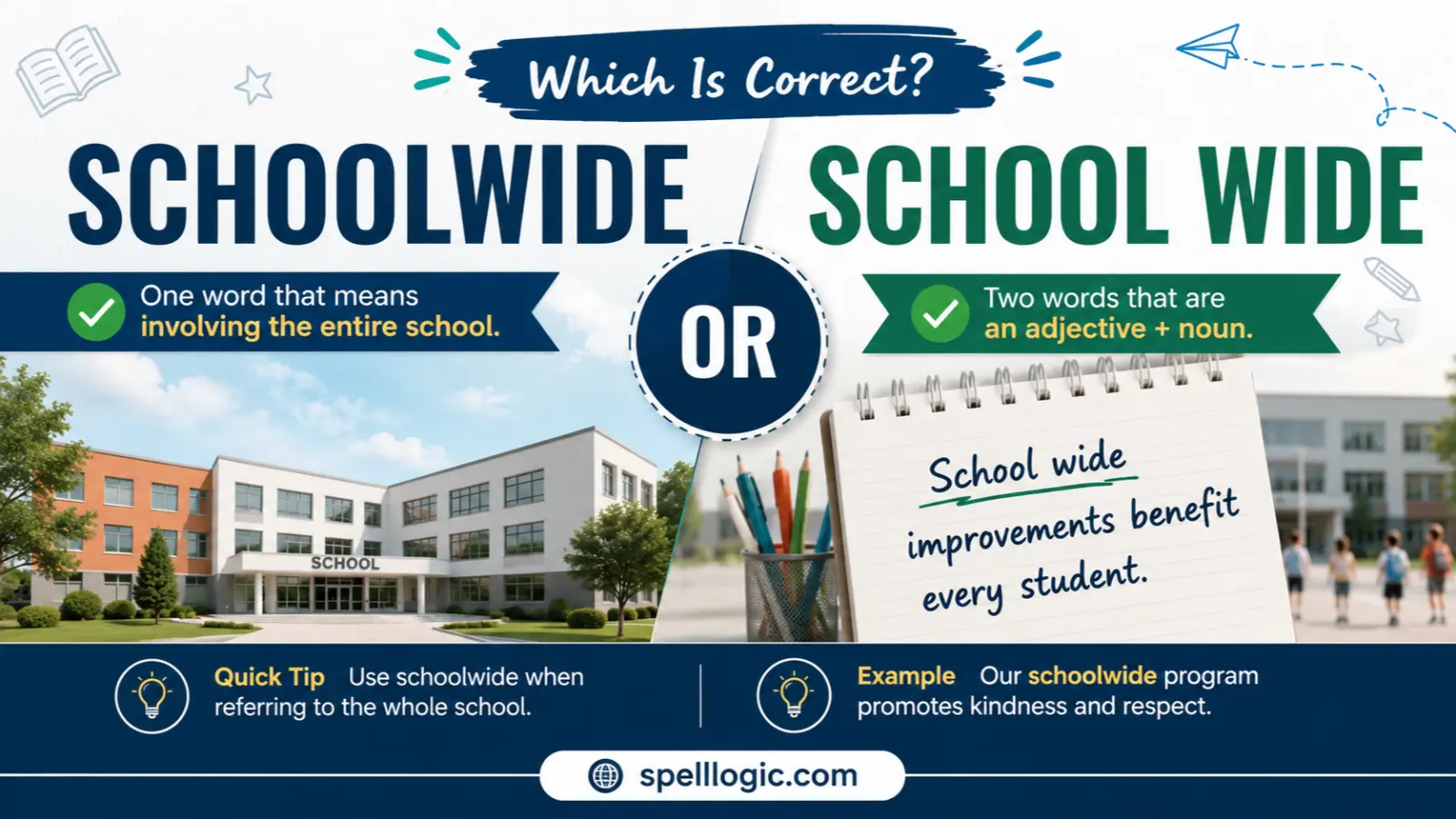
Schoolwide or school-wide is a common spelling question for English learners because both forms appear in books, school documents, websites, and everyday writing. At first glance, the two forms seem to have exactly the same meaning, and in most contexts, they do. The main difference is usually a matter of spelling style and editorial preference rather than meaning.
Understanding when to use the closed form and when to use the hyphenated form can make your writing look clearer and more professional. This guide explains the meaning, usage, history, common mistakes, and practical examples so you can confidently choose the right form in different situations.
Why “schoolwide or school-wide” Are Confusing
The question of schoolwide or school-wide often arises because the two forms look almost identical and normally communicate the same idea. English learners may wonder whether one is grammatically correct and the other is a spelling error.
Similar pronunciation
Both forms are pronounced in essentially the same way. The hyphen does not normally change how the word sounds. Therefore, listening to someone use the word will not help you decide which spelling they prefer.
Similar spelling
The two forms contain the same words: school and wide. The only visible difference is the hyphen. English frequently combines words over time, so compounds may appear first as separate words, then as hyphenated compounds, and eventually as closed compounds.
Context confusion
Schools often use the term in official announcements, policies, newsletters, and reports. Because different style guides and institutions may prefer different spellings, learners can encounter both forms in authentic English.
Common learner mistakes
A frequent mistake is assuming that one form is always wrong. Another is treating the hyphen as a change in meaning. In most ordinary contexts, neither assumption is correct. Writers should instead consider consistency, dictionary guidance, and the style used by their organization.
Schoolwide or School-Wide Explained Simply
The simplest way to understand schoolwide or school-wide is to recognize that both forms generally describe something involving an entire school rather than only one class, department, or group.
One-line distinction: Schoolwide is the closed form, while school-wide is the hyphenated form; both generally mean “involving the whole school.”
For example:
- The principal announced a schoolwide reading competition.
- The school introduced a school-wide recycling program.
The two sentences communicate essentially the same idea. In contemporary American English, the closed spelling schoolwide is widely used, while the hyphenated spelling remains acceptable in many contexts and may be preferred by particular publications or institutions.
Understanding Homophones in English
This spelling issue is sometimes grouped with other confusing word questions, but it is important to note that these forms are not homophones. They are two spellings of the same compound expression, with the same basic pronunciation and meaning.
What Are Homophones?
Homophones are words that sound the same but have different meanings and usually different spellings.
For example:
- flower refers to the blooming part of a plant.
- flour is used in cooking and baking.
These words sound alike, but their meanings and spellings differ.
Why Homophones Cause Confusion
Homophones can be confusing because spoken English does not reveal which spelling a speaker means. For example, when someone says “flour,” you need context to understand whether they mean flour or flower.
The present spelling question is different. The two forms here do not represent different words with different meanings. Instead, the main issue is whether the compound is written with or without a hyphen.
What Does “Schoolwide” Mean?
Definition and Core Meaning
Schoolwide is an adjective or adverb meaning “involving, affecting, or applying to the entire school.” It combines school with wide to describe something that extends across the whole school community.
For example, a schoolwide policy applies to students, teachers, or staff throughout the school rather than to only one classroom.
The word can describe:
- schoolwide activities
- schoolwide policies
- schoolwide programs
- schoolwide events
- schoolwide changes
- schoolwide rules
- schoolwide campaigns
Origin and Historical Use
The compound developed from the productive English pattern in which -wide means “throughout” or “extending across.” Similar formations include nationwide, worldwide, citywide, and statewide.
English gradually creates closed compounds when combinations become familiar. As a result, forms that were once written separately or with a hyphen can eventually appear as single words in modern dictionaries and publications.
Modern Usage and Synonyms
Today, schoolwide is common in American English, particularly in education-related writing. It is especially useful when describing an initiative or policy that affects an entire educational institution.
Depending on the sentence, possible alternatives include:
- whole-school
- across the school
- throughout the school
- school-wide
- involving the entire school
The best alternative depends on the tone and grammatical structure of the sentence.
Example Sentences
- The teachers agreed on a schoolwide behavior policy.
- A schoolwide assembly will take place on Friday.
- The principal launched a schoolwide attendance campaign.
- Students participated in a schoolwide science competition.
- The new rule became a schoolwide requirement.
In each example, the word tells readers that the action or policy extends beyond one class.
What Does “School-Wide” Mean?
Definition and Core Meaning
School-wide has the same basic meaning as schoolwide. It describes something that extends throughout or affects the entire school.
The hyphen joins school and wide into a compound modifier. Some writers use this form because the relationship between the two elements is immediately visible.
For example:
The principal introduced a school-wide safety campaign.
Here, the campaign applies to the entire school.
Origin and Historical Context
Hyphenated compounds are common in English because writers often use a hyphen to show that two words work together as one descriptive unit. Over time, however, frequently used compounds may become closed forms.
This explains why readers may encounter both spellings in educational materials. A publication that follows one editorial style may choose school-wide, while another may choose schoolwide.
Modern Usage and Synonyms
The hyphenated form remains understandable and widely encountered, especially in formal documents and varieties of English that favor hyphenation in compound modifiers.
Useful alternatives include:
- whole-school
- across the school
- throughout the school
- schoolwide
- institution-wide, when referring to a broader institution
Example Sentences
- The school organized a school-wide charity event.
- Teachers supported a school-wide literacy project.
- The principal announced a school-wide meeting.
- The new procedure is part of a school-wide initiative.
- Parents received information about the school-wide program.
The meaning remains focused on the entire school.
Schoolwide or School-Wide: Key Differences at a Glance
| Word | Part of Speech | Meaning | Example Context |
|---|---|---|---|
| Schoolwide | Adjective/Adverb | Affecting or involving the entire school | A schoolwide policy |
| School-wide | Adjective/Adverb | Affecting or involving the entire school | A school-wide policy |
The most important point is that the difference is primarily orthographic, meaning it concerns how the expression is written. The basic meaning does not normally change.
If your school, workplace, publisher, or style guide consistently uses one form, follow that preference. Consistency is often more important than choosing one spelling in isolation.
How to Remember the Difference Between Schoolwide and School-Wide
Remembering the difference between schoolwide or school-wide becomes easier when you focus on the word wide. It means that something extends across an entire area or group.
Easy memory tricks
Think:
school + wide = across the whole school
The closed form looks compact:
schoolwide
The hyphenated form visibly connects the two parts:
school-wide
Association techniques
You can compare the word with other familiar compounds:
- nationwide = throughout a nation
- worldwide = throughout the world
- citywide = throughout a city
- statewide = throughout a state
- schoolwide = throughout a school
This pattern helps you remember why schoolwide is a natural English formation.
One memorable example
Imagine the principal announces:
“The reading challenge is for every student.”
You can think, “It is schoolwide because the whole school is involved.”
If you prefer the hyphenated style, you can write:
“The reading challenge is school-wide because the whole school is involved.”
The meaning stays the same.
Common Mistakes and Confusions
One common mistake is believing that the hyphenated version has a different meaning. Usually, it does not.
Wrong example
✘ The principal said the school-wide policy applies only to Grade 5.
Better version
✔ The principal said the school-wide policy applies to the entire school.
The problem in the first sentence is not the hyphen. The problem is the meaning: a policy described as school-wide should normally apply across the school, not only to one grade.
Another mistake is switching between forms randomly in the same document.
Better practice
If you begin a school newsletter using schoolwide, continue using that form unless there is a specific reason to change it. Consistent spelling gives professional writing a cleaner appearance.
Writers should also avoid unnecessary hyphenation when their chosen style treats the compound as a closed word.
Examples Section: Correct and Incorrect Usage
Example 1
✔ Correct: The principal announced a schoolwide reading program.
This means the reading program involves the entire school.
✘ Incorrect: The principal announced a school wide reading program.
The open form is generally less suitable when the expression functions as an established compound.
Example 2
✔ Correct: The teachers planned a school-wide sports event.
This is acceptable when the writer or style guide prefers the hyphenated form.
✘ Incorrect: The teachers planned a schoolwide sports event for only one classroom.
The spelling is not the problem. The context conflicts with the meaning of the word because a schoolwide event should normally extend across the school.
Example 3
✔ Correct: A schoolwide policy was introduced to improve attendance.
The policy applies throughout the school.
✘ Incorrect: A school wide policy was introduced to improve attendance.
The separated form is usually not the preferred modern compound spelling.
Example 4
✔ Correct: The school held a school-wide environmental campaign.
The hyphenated form clearly joins the two elements into one modifier.
✘ Incorrect: The campaign was described as school-wide, but only three students were allowed to participate.
Again, the issue is not the spelling. The description does not match the intended scope.
Self Assessment: Test Your Knowledge
Fill in each blank with the form that best fits the sentence.
- The principal introduced a ______ reading challenge for all students.
- The teachers organized a ______ meeting for staff members.
- Our school launched a ______ campaign to reduce plastic waste.
- The new attendance rule became a ______ policy.
Self Assessment Answers
- schoolwide — The reading challenge involves the entire school.
- school-wide — This hyphenated form is acceptable when following a style that prefers it.
- schoolwide — The campaign extends throughout the school.
- school-wide — The hyphenated compound correctly describes a policy applying across the school.
Both accepted spellings can communicate the same basic idea. The important principle is to follow the preferred style of your school, publisher, organization, or chosen dictionary.
FAQs
Is schoolwide or school-wide correct?
Both forms can be correct. Schoolwide is a common closed spelling, while school-wide is a recognized hyphenated form. Follow the style preferred by your publication or organization.
Is schoolwide one word?
Yes. Schoolwide is commonly written as one word, particularly in modern American English.
Should school-wide have a hyphen?
It can. The hyphenated spelling is widely understood and may be preferred by certain style guides or institutions.
Does schoolwide mean the whole school?
Yes. It generally means something that affects, involves, or applies to the entire school.
Is schoolwide an adjective?
Yes. It commonly functions as an adjective, as in “a schoolwide policy.” It can also be used adverbially in some contexts.
Can I use schoolwide in formal writing?
Yes. Schoolwide is suitable for formal writing when it matches the spelling conventions of your chosen style guide or organization.
Which spelling should English learners use?
A practical choice is schoolwide when your dictionary or style guide supports it. However, consistency matters most. If your school or publication uses school-wide, follow that convention throughout the document.
Final Conclusion: Using Schoolwide and School-Wide Correctly
Understanding schoolwide or school-wide is easier once you recognize that the two forms generally express the same idea: something that involves, affects, or applies to the entire school. The main difference is the spelling style. Schoolwide appears as a closed compound, while school-wide uses a hyphen to connect the two elements. Neither form normally creates a different meaning. When writing for a school, website, business, or publication, check its preferred style and use that spelling consistently.
You should also remember that this is not a true homophone problem because the two forms represent the same expression rather than two unrelated words. A useful memory trick is to connect wide with the idea of “throughout”: schoolwide means “throughout the school.” Once you understand this pattern, similar compounds such as citywide and nationwide become easier to recognize. Most importantly, do not let small spelling differences discourage you. Learning how English compounds develop will help you write with greater accuracy, confidence, and clarity.