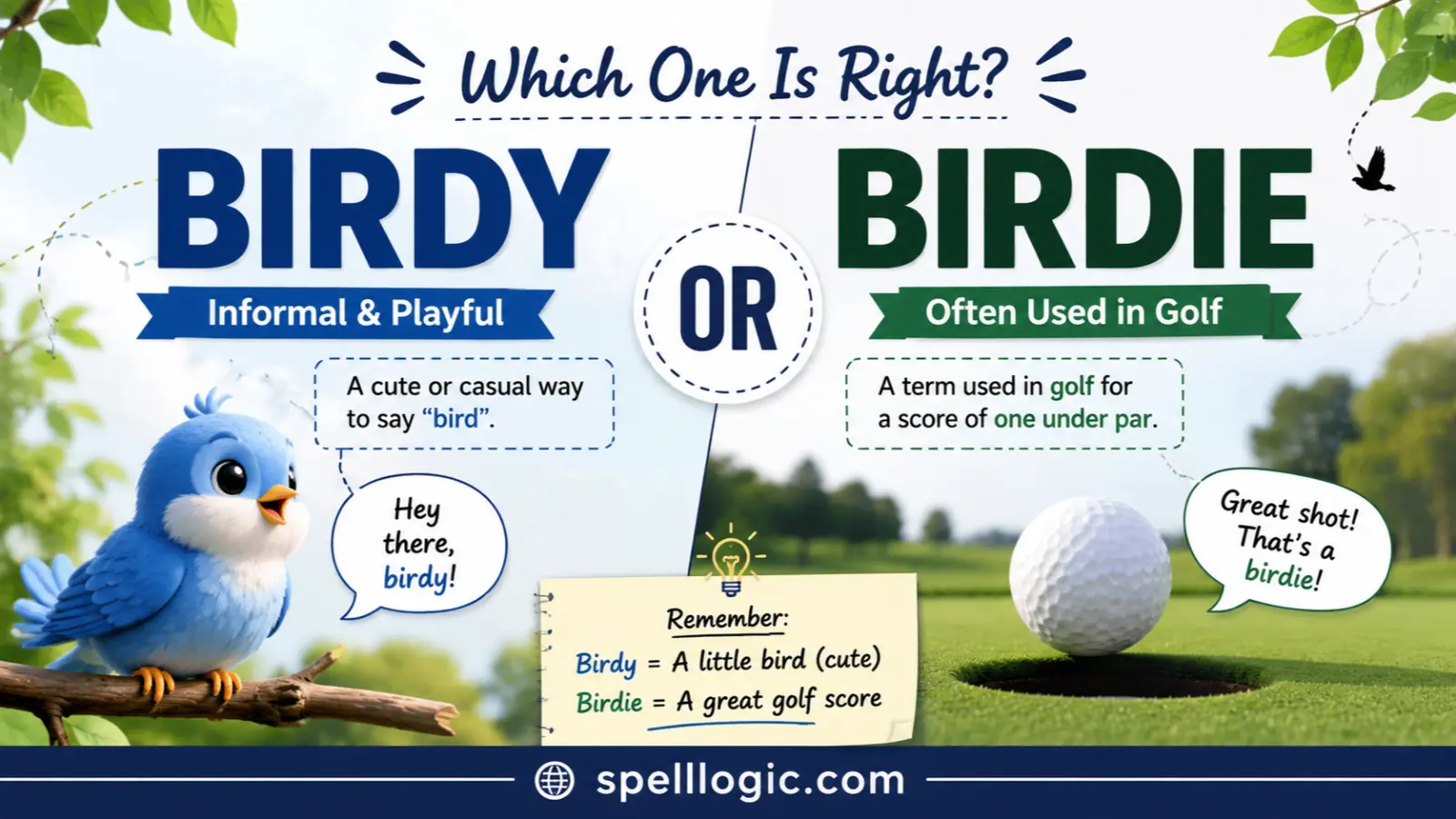
English learners often wonder whether birdy or birdie is the correct spelling when they want to describe a small bird, use a cute nickname, or talk about the golf score of one stroke under par. The confusion is understandable because both forms can look and sound almost identical.
However, they do not have exactly the same standard usage. In most everyday English, birdie is the preferred spelling when referring to a small bird or using the word as a noun. Birdy can appear as a less common spelling, a name, or an informal adjective. Understanding the difference helps learners choose the right word in writing, conversation, and formal communication.
Why “Birdy” and “Birdie” Are Confusing
The words birdy or birdie are easy to mix up because they have nearly identical pronunciation and very similar spelling. For many English learners, the only obvious difference is the final letter: y in one form and ie in the other.
Similar Pronunciation
In many contexts, birdy and birdie are pronounced the same or almost the same. This makes the difference difficult to notice in conversation.
For example, if someone says, “Look at that little birdie,” you hear the sound rather than the spelling. When you later write the sentence, you may wonder which spelling to use.
Similar Spelling
Both forms begin with bird, so their visual appearance is very similar. The ending changes from -y to -ie, which is a common spelling variation in English.
English contains many words with similar endings. For example, informal forms such as doggy, doggie, kitty, and kittie can create similar spelling questions.
Context Confusion
The correct choice can also depend on context. Birdie is the standard spelling for a small bird and is also a common term in golf. Birdy may be used informally as an adjective, a name, or an alternative spelling in particular contexts.
Therefore, learners should not assume that the two spellings are always interchangeable.
Common Learner Mistakes
A common mistake is using birdy whenever the intended meaning is a small bird. In standard English writing, birdie is normally the safer choice.
Another mistake is assuming that every word ending in -y can be changed to -ie without affecting usage. English spelling does not always work that way.
Birdy vs Birdie Explained Simply
The easiest way to understand birdy or birdie is to focus on standard modern usage.
Birdy can occur as an informal spelling, an adjective meaning bird-like, or a proper name. However, it is much less common as the standard noun for a small bird.
Birdie is the standard and widely recognized noun for a small bird. It is also a familiar or affectionate term for a bird and has a separate meaning in golf.
One-Line Distinction
Birdy is mainly an informal or alternative form, while birdie is the standard noun for a small bird and a standard golf term.
Example Sentences
- The little birdie sat quietly on the windowsill.
- The garden looked especially birdy after the trees attracted several species.
In simple terms, birdy or birdie does not have a perfectly equal relationship: birdie is the standard choice for the noun “a small bird.”
Understanding Homophones in English
What Are Homophones?
Homophones are words that have the same pronunciation but different spellings and meanings.
For example, flower and flour sound the same but have completely different meanings. One refers to a plant’s bloom, while the other is a baking ingredient.
The relationship between birdy or birdie is slightly different because birdy is not simply a separate standard dictionary noun with an unrelated meaning. The forms can sound alike, but their spelling and usage differ.
Why Homophones Cause Confusion
Sound-based communication does not show spelling. Therefore, learners may know a word from conversation without knowing which written form is standard.
For example, someone might hear “birdie” many times before seeing it written. When they eventually write the word, they may choose birdy because the ending sounds like the letter y.
This is why learning vocabulary through both pronunciation and spelling is important.
What Does “Birdy” Mean?
Definition and Core Meaning
Birdy is a less common form that can be used informally to describe something related to birds or having qualities associated with a bird. It may also occur as a personal or artistic name.
Unlike birdie, it is not normally the preferred standard noun for “a small bird” in ordinary English.
The meaning of birdy depends strongly on context.
Origin and Historical Use
The form birdy follows a familiar English pattern in which -y is added to a noun to create an adjective. For example, cloudy means full of clouds, while fishy can mean related to fish or suspicious.
In informal speech, speakers may also use birdy affectionately or creatively. However, the spelling has not replaced birdie as the standard noun for a small bird.
Modern Usage and Synonyms
Today, birdy can appear in:
- Informal descriptions
- Creative writing
- Child-directed speech
- Nicknames
- Names and titles
- Descriptions meaning “bird-like”
- Informal online communication
Depending on the intended meaning, possible related words include:
- Bird-like
- Avian
- Birdish
- Feathered
- Ornithological
These alternatives are not exact synonyms in every context.
Example Sentences
- The room had a cheerful, birdy feeling because of its feather decorations.
- The character has a birdy appearance, with a small face and bright eyes.
- Birdy is also used as a name or nickname in some contexts.
When the intended meaning is simply “a small bird,” however, birdie is normally the better choice.
What Does “Birdie” Mean?
Definition and Core Meaning
Birdie is a standard English noun with several meanings. Most commonly, it refers to a small bird, especially when the speaker is being affectionate or informal.
It can also refer to a score of one stroke under par on a golf hole.
For example:
- A child may call a small bird a birdie.
- A golfer may say, “I made a birdie on the ninth hole.”
Origin and Historical Context
The word birdie developed as a diminutive form of bird. The ending -ie is often used in English to create affectionate, familiar, or smaller forms of words.
This pattern can be seen in words such as doggie, kitty, and horsie. Over time, birdie became an established word in English rather than merely a temporary nickname.
The golf meaning developed separately from the everyday meaning and became a standard part of golf vocabulary.
Modern Usage and Synonyms
In modern English, birdie is widely understood and accepted.
It can refer to:
- A small bird
- An affectionate name for a bird
- A child’s word for a bird
- A golf score of one under par
- A nickname for a person in some contexts
Possible synonyms for the small-bird meaning include:
- Little bird
- Small bird
- Songbird, when appropriate
- Chick, in some contexts
However, these words do not always have exactly the same meaning.
Example Sentences
- A tiny birdie landed on my hand.
- The children watched the birdie through the window.
- She scored a birdie on the final hole.
- The photographer asked everyone to look at the birdie.
The intended meaning is usually clear from the surrounding context.
Birdy vs Birdie: Key Differences at a Glance
The main difference between birdy or birdie is standard usage rather than pronunciation.
| Word | Part of Speech | Meaning | Example Context |
|---|---|---|---|
| Birdy | Adjective/noun in informal or specialized use | Bird-like, related to birds, or an informal/name form | “The costume looked very birdy.” |
| Birdie | Noun | A small bird, affectionate term for a bird, or one under par in golf | “A birdie landed on the fence.” |
For learners, the most useful rule is simple: choose birdie when you mean “a small bird.”
How to Remember the Difference Between Birdy and Birdie
Remembering birdy or birdie becomes easier when you connect each spelling with its most common function.
Easy Memory Tricks
1. Think “little bird” → birdie
The -ie ending often creates an affectionate or diminutive form. A birdie can be thought of as a “little bird.”
2. Think “bird-like” → birdy
The -y ending commonly helps form adjectives. Therefore, something described as birdy may have qualities associated with birds.
3. Remember the golf meaning
Golf uses birdie, not birdy, for a score of one stroke under par.
Association Techniques
Connect birdie with the phrase “little birdie.” This is a common expression and makes the spelling easier to remember.
Connect birdy with adjectives such as fishy, cloudy, and sunny. The -y ending can remind you that birdy may describe something with bird-like qualities.
One Memorable Example
Think of this sentence:
“The little birdie looks birdy because it has bright feathers.”
Here, birdie is the small bird, while birdy describes something that has bird-like qualities.
Common Mistakes and Confusions
Many learners make mistakes with birdy or birdie because they rely on pronunciation instead of standard spelling.
Wrong Example 1
✘ I saw a small birdy in the garden.
Correct Version
✔ I saw a small birdie in the garden.
Explanation: When birdie means a small or little bird, it is the standard spelling.
Wrong Example 2
✘ He made a birdy on the seventh hole.
Correct Version
✔ He made a birdie on the seventh hole.
Explanation: The golf term is spelled birdie.
Wrong Example 3
✘ The decoration has a birdie design.
This sentence is not necessarily wrong. It depends on the intended meaning. If the speaker means that the decoration features a small bird, birdie can work in an informal context. If the intended meaning is “bird-like,” birdy may be more suitable.
Important Point
Not every appearance of birdy is automatically incorrect. Context matters. However, English learners should generally use birdie when they mean the established noun for a small bird.
Examples Section: Correct and Incorrect Usage
Example 1
✔ Correct: The little birdie flew away before I could take a picture.
✘ Incorrect: The little birdy flew away before I could take a picture.
Explanation: Birdie is the standard noun for a small bird.
Example 2
✔ Correct: Sarah made a birdie on the tenth hole.
✘ Incorrect: Sarah made a birdy on the tenth hole.
Explanation: In golf, the established term is birdie.
Example 3
✔ Correct: The costume looked very birdy because of its wings and feathers.
✘ Incorrect: The costume looked very birdie because of its wings and feathers.
Explanation: Here, birdy functions as an informal adjective meaning bird-like.
Example 4
✔ Correct: The children were excited to see the little birdie.
✘ Incorrect: The children were excited to see the little birdy.
Explanation: Birdie is the conventional spelling for the affectionate noun.
Example 5
✔ Correct: The character has a birdy face and a sharp nose.
✘ Incorrect: The character has a birdie face and a sharp nose.
Explanation: In this context, birdy describes a bird-like appearance.
Self Assessment: Test Your Knowledge
Fill in each blank with birdy or birdie.
- The tiny ______ landed on the branch.
- The golfer made a ______ on the fifth hole.
- The costume looked rather ______ because it had feathers and wings.
- The child smiled when she saw the little ______ outside the window.
Self Assessment Answers
- birdie — It refers to a small bird.
- birdie — It is the standard golf term for one under par.
- birdy — It describes something as bird-like.
- birdie — It is an affectionate term for a small bird.
FAQs
Is birdy or birdie correct?
For the noun meaning a small bird, birdie is the standard and preferred spelling. Birdy can appear in informal, descriptive, or name-related contexts.
Is birdie a real English word?
Yes. Birdie is an established English word. It can mean a small bird or, in golf, a score of one stroke under par.
Is birdy a word in English?
Yes, birdy can be found in English usage, but it is less common and more context-dependent. It may describe something bird-like or appear as an informal or proper-name spelling.
Do birdy and birdie sound the same?
They can be pronounced the same or very similarly. This similarity is one reason learners confuse the spellings.
Which spelling should English learners use?
English learners should generally choose birdie when referring to a small bird or the golf score. Use birdy when the context specifically calls for an informal or descriptive adjective.
What does birdie mean in golf?
In golf, a birdie means completing a hole one stroke under par. For example, if a par-four hole is completed in three strokes, the golfer has made a birdie.
Can birdie be used as a nickname?
Yes. Birdie can be used as a nickname or affectionate name for a person or animal. Its use depends on the individual and the context.
Final Conclusion: Using “Birdy” and “Birdie” Correctly
Understanding birdy or birdie is easier once you focus on meaning and standard usage rather than pronunciation alone. Birdie is the standard and most widely accepted spelling when you mean a small bird, an affectionate term for a bird, or the golf score of one stroke under par. Birdy, on the other hand, is less common and is often used informally to describe something bird-like. It can also appear as a name, nickname, creative spelling, or other specialized usage.
A useful memory trick is to connect birdie with “little bird” and golf, while connecting birdy with the adjective ending -y. When you are writing for school, work, or formal communication, birdie is usually the safer choice when referring to the noun. With regular practice and attention to context, you can quickly recognize which spelling fits your sentence. Keep learning these small spelling differences—they can make your English clearer, more natural, and more confident.