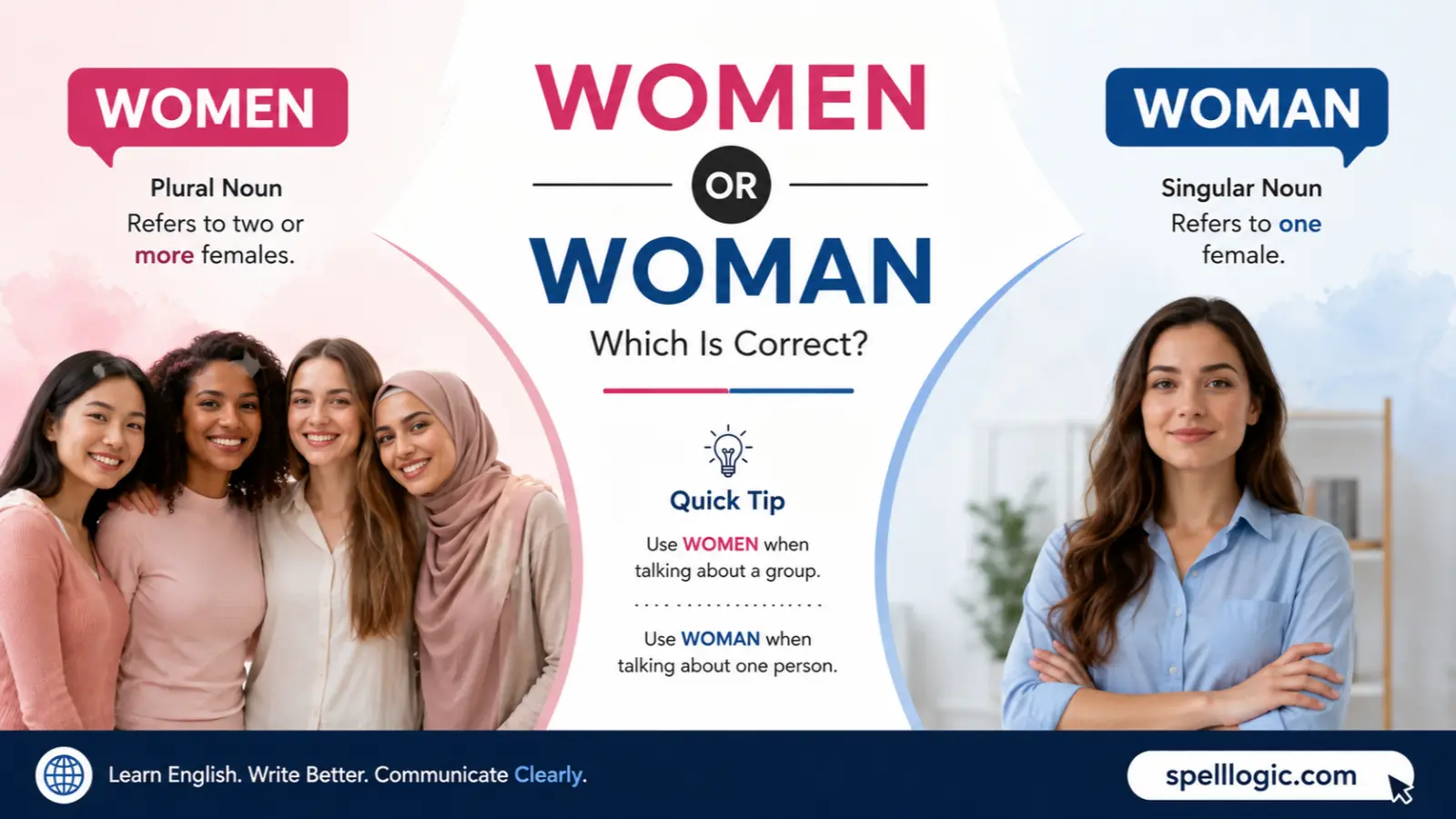
Women or woman is a common English question for learners who are unsure whether they should use a singular or plural noun. The confusion usually comes from the fact that woman changes to women in the plural, and the spelling and pronunciation are different in ways that are easy to overlook.
Understanding this difference is important because choosing the wrong form can make an otherwise clear sentence grammatically incorrect. Whether you are writing an email, speaking in conversation, or studying English grammar, knowing when to use each form will help you communicate more accurately. Once you learn the simple rule, the distinction becomes easy to remember and use.
Why “Women or Woman” Are Confusing
Many English learners mix up these two forms because they refer to the same type of person but express different numbers. The key issue is singular versus plural: one person is a woman, while more than one person is women.
Similar pronunciation
The two words do not sound the same. Woman is generally pronounced like “wuh-muhn,” while women is generally pronounced like “wim-in.” Because learners may first encounter these words in writing, they can remember the spelling without being fully confident about the pronunciation.
Similar spelling
The spelling looks closely related because both words come from the same noun. However, the vowel pattern changes from woman to women. This makes the plural form an important irregular noun to learn rather than a word that simply takes -s.
Context confusion
The surrounding words usually tell you which form is needed. If you are talking about one person, use the singular form. If you are talking about two or more people, use the plural form.
For example:
- “That woman is a doctor.” → one person
- “Those women are doctors.” → more than one person
Common learner mistakes
A frequent error is adding -s to the singular noun and writing “womans.” That form is incorrect in standard English. Another mistake is using the plural form with a singular verb, such as “One women is waiting.” The correct sentence is “One woman is waiting.”
Women or Woman Explained Simply
The easiest way to understand the difference is to focus on number. When learners search for women or woman, this singular-versus-plural rule is the main point to check.
Woman is the singular noun used for one adult female person. Women is the irregular plural noun used for two or more adult female people.
One-line distinction: Use woman for one person and women for more than one person.
Example sentences:
- “A woman is waiting outside the office.”
- “Several women are waiting outside the office.”
In short, women means more than one adult female person, while woman means one adult female person. This simple singular-versus-plural rule solves most usage questions about women or woman.
Understanding Homophones in English
These words are sometimes discussed alongside pronunciation difficulties, but they are not homophones. They have related meanings and spellings, yet their pronunciations are different.
What Are Homophones?
Homophones are words that sound the same but have different meanings, spellings, or both. For example, right and write are homophones because they have the same pronunciation but different meanings and spellings.
Why Homophones Cause Confusion
Pronunciation can create confusion when learners depend only on sound to identify a word. However, the pair discussed here requires a different lesson: learners need to recognize both number and pronunciation.
For instance, if someone says “women,” the listener should understand that the speaker is referring to multiple people. If someone says “woman,” the speaker means one person.
What Does “Women” Mean?
Definition and Core Meaning
When studying women or woman, remember that women is the plural form of woman. It refers to two or more adult female people. It is an irregular plural because it does not follow the common pattern of adding -s or -es.
For example:
- “The women are discussing the project.”
- “Three women work in that department.”
- “Many women enjoy reading.”
- “The organization supports women in business.”
Origin and Historical Use
The noun has Old English roots. The modern singular form developed from the Old English word wīfmann, while the plural developed through historical changes in pronunciation and spelling. Over centuries, English gradually moved toward the modern forms used today.
This history explains why the plural is not formed by simply adding a regular ending. For learners comparing women or woman, that irregular pattern is worth memorizing.
Like other irregular English forms, it needs to be learned as a complete word.
Modern Usage and Synonyms
For learners asking about modern English uses the plural form in everyday conversation, formal writing, journalism, education, and professional communication.
Depending on context, related words may include:
- females — a formal or biological term in specific contexts
- ladies — a polite term in some social situations
- adults — broader and not limited to female people
- female people — a descriptive phrase, though usually less natural than the noun
The best choice depends on context. When deciding between women or woman, look at the number of people first. In most ordinary situations, the standard plural noun is the clearest option.
Example Sentences
- “The women in the class completed their assignments.”
- “Several women attended the conference.”
- “Those women are my neighbors.”
- “Many women have contributed to science and the arts.”
- “The two women spoke with the manager.”
When checking women or woman, notice that plural subjects normally take plural verbs:
- “The women are ready.”
- “The women were invited.”
- “The women have arrived.”
Using a singular verb after a plural subject is another common grammar mistake.
What Does “Woman” Mean?
Definition and Core Meaning
For the women or woman question, woman is a singular noun that refers to one adult female person. It can be used when speaking generally about one individual or when referring to a particular person.
For example:
- “She is a talented woman.”
- “A woman called earlier.”
- “That woman is my teacher.”
- “Every woman deserves respect.”
Origin and Historical Context
The word has a long history in English and developed from Old English. Its earlier form referred broadly to a female human being and was connected to the older word for a person or human being. Over time, its meaning and spelling changed into the modern noun used today.
Although its history is interesting, learners mainly need to remember its grammatical role when studying women or woman: it is the singular form.
Modern Usage and Synonyms
Today, the noun is common in everyday and formal English. Related expressions include:
- lady — often used as a polite or social term
- female — an adjective in many contexts and a noun in some formal or biological contexts
- adult female — a precise descriptive phrase
However, these words are not always interchangeable. The women or woman choice should match the number and meaning of the sentence.
Example Sentences
- “A woman is speaking to the receptionist.”
- “That woman lives next door.”
- “She is a successful businesswoman.”
- “Every woman in the group received a certificate.”
- “The woman who called you left a message.”
A useful grammar point in the women or woman comparison is that a singular subject usually takes a singular verb:
- “The woman is here.”
- “The woman was invited.”
- “The woman has arrived.”
Women or Woman: Key Differences at a Glance
| Word | Part of Speech | Meaning | Example Context |
|---|---|---|---|
| Woman | Noun | One adult female person | “A woman is waiting.” |
| Women | Noun | Two or more adult female people | “The women are waiting.” |
The biggest difference in women or woman is grammatical number. The singular form identifies one person, while the plural form identifies multiple people.
Another important point in the women or woman comparison is verb agreement. A singular noun normally takes a singular verb, while a plural noun normally takes a plural verb:
- “The woman is ready.”
- “The women are ready.”
This pattern is especially useful in writing because it helps you check a women or woman sentence quickly.
How to Remember the Difference Between Women and Woman
Remembering the women or woman distinction does not require a complicated grammar rule. A few simple techniques can make it automatic.
1. Think “one” versus “many”
For women or woman, use a quick number test:
- One → woman
- Two or more → women
If you can replace the noun with “one person,” choose the singular form. If you can replace it with “several people,” choose the plural form.
2. Connect the verb to the noun
Another useful women or woman check is to connect the verb to the noun:
- “The woman is…”
- “The women are…”
When you see is, the singular noun is usually appropriate. When you see are, the plural noun is usually appropriate.
3. Remember the irregular plural
The women or woman pair is an irregular plural, so do not try to form the plural by adding -s. English has many irregular plurals, such as:
- man → men
- woman → women
- child → children
- person → people
Learning these pairs together can strengthen your memory.
One Memorable Example
Think of a group photo. If there is one woman in the photo, use the singular form. If there are five women in the photo, use the plural form.
That visual connection makes the difference easier to remember.
Common Mistakes and Confusions
Mistake 1: Adding “-s” to make the plural
Wrong: “Three womans joined the meeting.”
Correct: “Three women joined the meeting.”
Explanation: The plural is irregular. You cannot make it by adding -s.
Mistake 2: Using the plural form for one person
Wrong: “One women is waiting outside.”
Correct: “One woman is waiting outside.”
Explanation: The word “one” clearly signals a singular noun.
Mistake 3: Using the singular noun for a group
Wrong: “The woman are talking.”
Correct: “The women are talking.”
Explanation: “The” can be used with either number, so the noun and verb must show whether you mean one person or multiple people.
Mistake 4: Choosing the wrong verb
Wrong: “The women is ready.”
Correct: “The women are ready.”
Explanation: A plural subject normally takes a plural verb.
Mistake 5: Forgetting the pronunciation difference
Learners sometimes assume the two words are pronounced almost identically because their spelling is related. Practicing them aloud can help:
- woman → commonly /ˈwʊmən/
- women → commonly /ˈwɪmɪn/
Accent and regional pronunciation can vary, but the distinction remains important.
Examples Section: Correct and Incorrect Usage
Example 1
✔ Correct: “A woman is waiting at the bus stop.”
✘ Incorrect: “A women is waiting at the bus stop.”
The sentence refers to one person, so the singular noun is required. This is the central rule behind women or woman.
Example 2
✔ Correct: “The women are attending a workshop.”
✘ Incorrect: “The woman are attending a workshop.”
The sentence refers to multiple people, so the plural noun and plural verb are needed.
Example 3
✔ Correct: “Two women work in my office.”
✘ Incorrect: “Two womans work in my office.”
The word “two” requires a plural noun, and the correct irregular plural is women.
Example 4
✔ Correct: “That woman has a new job.”
✘ Incorrect: “That women has a new job.”
The demonstrative “that” points to one person, so the singular form is correct. It therefore answers the women or woman question clearly.
Example 5
✔ Correct: “Many women have joined the program.”
✘ Incorrect: “Many woman have joined the program.”
“Many” is used with plural countable nouns, so the plural form is required.
Self Assessment: Test Your Knowledge
Fill in each blank with the correct form.
- One ______ is waiting near the entrance.
- Several ______ attended the meeting.
- That ______ is my English teacher.
- Many ______ work in this organization.
Self Assessment Answers
- woman — “One” refers to a single person.
- women — “Several” refers to more than one person.
- woman — “That” refers to one person in this sentence.
- women — “Many” requires a plural countable noun.
A useful way to check your answers to women or woman exercises is to identify the number first. Look for words such as one, a, that, several, many, two, or three. These words often make the correct noun form obvious.
FAQs
1. Is “woman” singular or plural?
Woman is singular. It refers to one adult female person.
2. Is “women” singular or plural?
Women is plural. It refers to two or more adult female people.
3. Is “women” a regular plural?
No. It is an irregular plural. The plural does not simply add -s to the singular form.
4. Why are woman and women pronounced differently?
Their pronunciations developed through historical changes in English. Modern standard pronunciation distinguishes the two forms clearly.
5. Should I say “a woman” or “a women”?
Say “a woman.” The article a is used with a singular countable noun.
6. Should I say “many woman” or “many women”?
Say “many women.” The word many requires a plural countable noun.
7. Are woman and women homophones?
No. They have related meanings and spellings, but they are pronounced differently. They are singular and plural forms of the same noun.
Final Conclusion: Using Women and Woman Correctly
The difference between these two forms is simple once you focus on grammatical number. Woman refers to one adult female person, while women refers to two or more adult female people. The plural form is irregular, so you should not write “womans.” Instead, memorize the pair as you would other irregular forms such as man and men or child and children.
In everyday English, context gives you useful clues. Words such as “a,” “one,” and “that” often point to the singular form, while “two,” “several,” and “many” usually require the plural form. Verb agreement can also help: “The woman is here,” but “The women are here.” In addition, remember that the two forms have different pronunciations, so practicing them aloud can improve both speaking and listening skills.
For women or woman, the best memory trick is short: one woman, two or more women. Use that rule when writing emails, completing grammar exercises, speaking with others, or checking your work. With regular practice, this common English distinction will quickly become natural. Keep learning one small grammar difference at a time, and your English will become clearer, more accurate, and more confident.