English learners often wonder whether to use has or have after all. The confusion happens because all can refer to several people or things, or to one complete amount of something. As a result, the verb changes according to the noun or pronoun that all represents.
Understanding this small grammar rule can make your English more accurate and natural. In this guide, we will explain all has or have in simple language, show you the difference with clear examples, and cover common mistakes. By the end, you will know how to choose the correct form confidently in both writing and everyday conversation.
Why “all has” and “all have” Are Confusing
The main reason learners search for all has or have is that all does not always take the same verb. Its verb depends on the noun or pronoun it represents.
Similar pronunciation
Has and have are both forms of the verb to have. Learners sometimes focus on the meaning of all and forget to check the subject that follows it.
Similar spelling
Although has and have look different, they belong to the same verb. This can make beginners think that either form can follow all.
Context confusion
Compare these sentences:
- All the students have finished their work.
- All the information has been checked.
The first sentence talks about several students, while the second refers to one complete amount of information. This difference explains much of the confusion surrounding all has or have.
Common learner mistakes
A common mistake is to assume that all is automatically plural. Another is to choose has because the speaker is thinking about the whole group as one unit. In standard English, the noun represented by all normally determines the verb.
The easiest way to solve all has or have questions is to identify that noun first.
“all has” vs “all have” Explained Simply
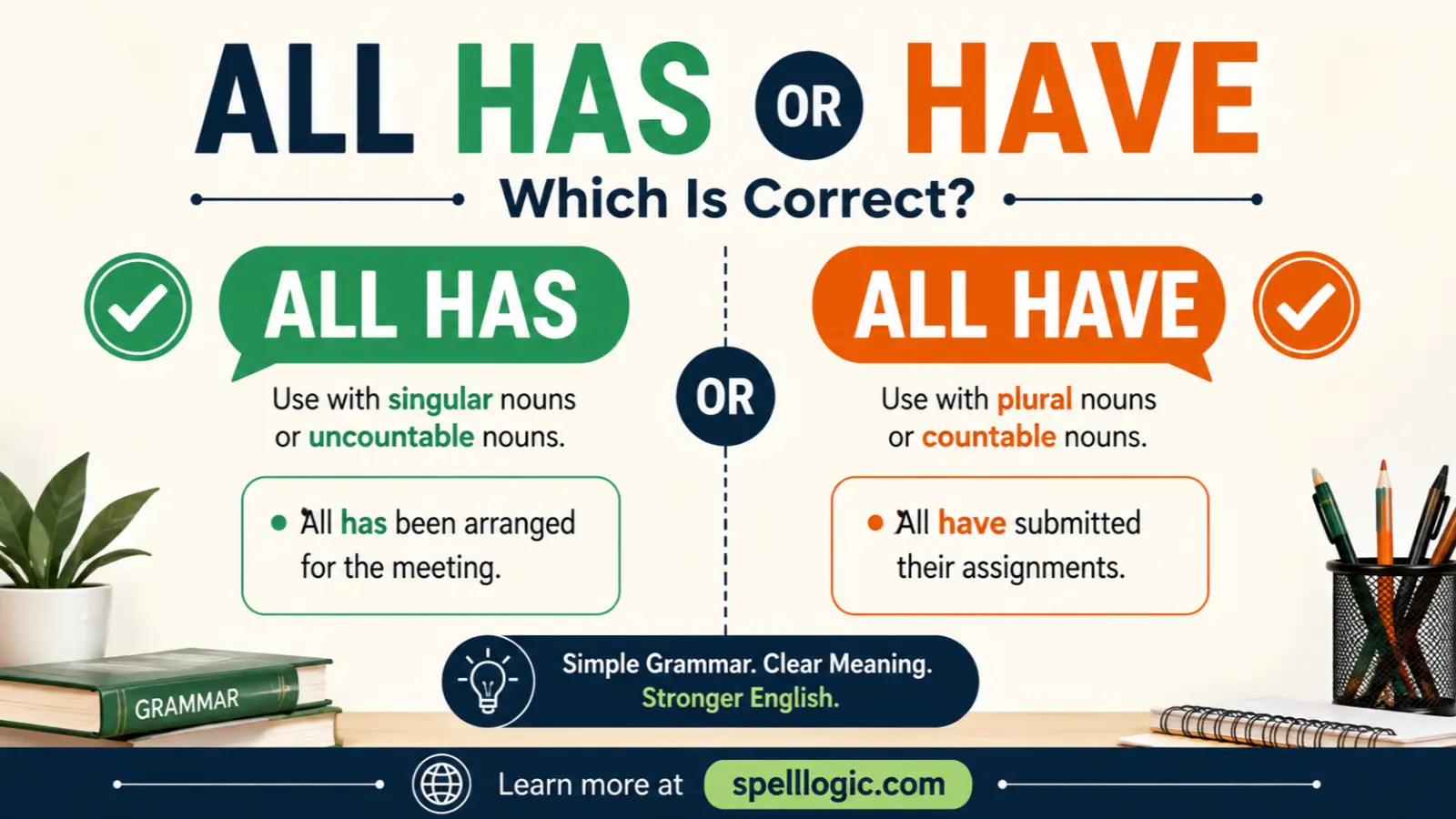
The basic rule behind all has or have is simple: has goes with a singular or uncountable subject, while have goes with a plural subject.
One-line distinction: Use has when all refers to an uncountable amount or singular idea; use have when it refers to plural people, things, or pronouns.
For example:
- All the information has been updated.
- All the employees have received the message.
So, when deciding all has or have, do not look at all alone. Look at the noun or pronoun that follows it.
Useful patterns include:
- all + plural countable noun → have
- all + uncountable noun → has
- all of them → have
- all of us → have
- all of you → have
For English learners, this subject-verb agreement rule is the most important point to remember about all has or have.
Understanding Homophones in English
Before going further, it is important to clarify one point. Has and have are not homophones. They are different grammatical forms of the same verb.
What Are Homophones?
Homophones are words that sound the same but have different meanings, spellings, or both.
For example:
- sea = a large body of salt water
- see = to notice something with your eyes
They sound alike but have different meanings.
Why Homophones Cause Confusion
Homophones can confuse learners because sound alone does not always reveal which word is intended.
For example, in “I can see the sea,” context tells us which meaning belongs to each word.
The confusion with all has or have is different because the choice is based on grammar and subject-verb agreement, not on identical pronunciation.
What Does “all has” Mean?
Definition and Core Meaning
The expression all has is used when all refers to an uncountable noun or, in some contexts, a singular idea. The verb has is the third-person singular present form of have.
Examples include:
- All the information has been saved.
- All the furniture has arrived.
- All the money has been spent.
- All the work has been completed.
These examples show why all has or have cannot be decided by the word all alone. The noun following it controls the verb.
Origin and Historical Use
The verb have comes from Old English habban, meaning to possess, hold, or have. Over centuries, English developed the forms have and has for different subjects.
The word all has also existed in English for centuries and has continued to express the idea of completeness or the whole amount.
Modern Usage and Synonyms
Today, all has commonly appears with uncountable nouns such as:
- information
- advice
- equipment
- furniture
- money
- evidence
- work
- traffic
For learners studying all has or have, these nouns are especially useful because they usually require a singular verb.
Example Sentences
- All the evidence has been reviewed.
- All the advice has been useful.
- All the equipment has been tested.
- All the furniture has been delivered.
- All the money has disappeared.
- All the information has been updated.
A useful test is to replace all with the entire amount. If that meaning works, has is often the correct choice.
What Does “all have” Mean?
Definition and Core Meaning
The expression all have is used when all refers to plural people or things. The verb have agrees with a plural subject.
For example:
- All the students have arrived.
- All the cars have been washed.
- All the children have finished eating.
- All the books have been returned.
These examples demonstrate the plural side of all has or have.
Origin and Historical Context
The form have also developed from the Old English verb habban. Modern English uses have with plural subjects and with I, you, we, and they.
The word all can function as a determiner, pronoun, or adverb. When it represents several separate people or things, it commonly takes a plural verb.
Modern Usage and Synonyms
Common structures include:
- all the students have
- all the workers have
- all the books have
- all the houses have
- all of them have
- all of us have
- all of you have
When learning all has or have, remember that plural countable nouns normally require have.
Example Sentences
- All the players have practiced today.
- All the guests have arrived.
- All the documents have been signed.
- All of them have agreed.
- All of us have seen the results.
- All the computers have been repaired.
Notice that all of you have is also correct because you refers to a group in this expression.
“all has” vs “all have”: Key Differences at a Glance
The following table makes all has or have easier to understand:
| Word | Part of Speech | Meaning | Example Context |
|---|---|---|---|
| all has | Phrase: determiner/pronoun + verb | Refers to an uncountable amount or singular idea | All the information has been updated. |
| all have | Phrase: determiner/pronoun + verb | Refers to plural people or things | All the students have finished. |
The central difference is subject-verb agreement. Has agrees with a singular or uncountable subject, while have agrees with a plural subject.
Therefore, the best way to understand all has or have is to identify what all represents.
How to Remember the Difference Between “all has” and “all have”
Easy Memory Tricks
1. Check the noun after “all.”
- All the books have…
- All the water has…
Books are separate countable objects, while water is uncountable.
2. Think “many” or “one amount.”
If all represents many separate items, think have.
If it represents one complete amount, think has.
3. Check a pronoun.
If the structure is all of them, all of us, or all of you, use have.
Association Techniques
Connect have with many:
Many students have questions.
Connect has with one amount:
One amount of information has been saved.
This is a helpful shortcut when answering all has or have questions.
One Memorable Example
Remember this pair:
All the apples have been eaten.
All the juice has been drunk.
Apples are separate countable items, but juice is one uncountable substance. This simple contrast can help you remember all has or have.
Common Mistakes and Confusions
Mistake 1: Assuming “all” is always plural
✘ All the information have been saved.
✔ All the information has been saved.
Explanation: Information is uncountable, so it takes has.
Mistake 2: Using “has” with a plural noun
✘ All the students has arrived.
✔ All the students have arrived.
Explanation: Students is plural, so it takes have.
Mistake 3: Forgetting the pronoun
✘ All of them has finished.
✔ All of them have finished.
Explanation: Them is plural, so have is required.
Mistake 4: Treating uncountable nouns as plural
Words such as advice, information, furniture, equipment, and money are normally uncountable in standard English. They generally take has when used with all.
Mistake 5: Choosing by sound
Do not decide all has or have only by what sounds natural. First identify the grammatical subject and then match the verb to it.
Examples Section: Correct and Incorrect Usage
Example 1
✔ Correct: All the students have completed the assignment.
✘ Incorrect: All the students has completed the assignment.
Students is plural, so have is correct.
Example 2
✔ Correct: All the information has been verified.
✘ Incorrect: All the information have been verified.
Information is uncountable, so has is correct.
Example 3
✔ Correct: All of them have agreed to the plan.
✘ Incorrect: All of them has agreed to the plan.
Them is a plural pronoun, so have is required.
Example 4
✔ Correct: All the equipment has arrived.
✘ Incorrect: All the equipment have arrived.
Equipment is normally uncountable in English, so has is correct.
Example 5
✔ Correct: All the documents have been signed.
✘ Incorrect: All the documents has been signed.
Documents is plural, so have agrees with it.
Example 6
✔ Correct: All the money has been spent.
✘ Incorrect: All the money have been spent.
Money is uncountable, so has is correct.
These examples reinforce the central rule behind all has or have: identify the subject before choosing the verb.
Self Assessment: Test Your Knowledge
Fill in each blank with has or have.
- All the employees ______ received the new instructions.
- All the information ______ been checked carefully.
- All of them ______ agreed with the decision.
- All the furniture ______ arrived at the new office.
Before checking the answers, identify the noun or pronoun represented by all. This is the quickest way to solve an all has or have exercise.
Self Assessment Answers
- have — Employees is a plural countable noun.
- has — Information is an uncountable noun.
- have — Them is a plural pronoun.
- has — Furniture is an uncountable noun.
The key to all has or have is always subject-verb agreement. Once you identify the subject, the answer becomes much easier.
FAQs
1. Is “all has” grammatically correct?
Yes. All has can be correct when all refers to an uncountable noun or a singular idea. For example, “All the information has been checked.”
2. Is “all have” grammatically correct?
Yes. All have is correct when all refers to plural people or things. For example, “All the students have arrived.”
3. Should I say “all the information has” or “all the information have”?
Say all the information has because information is an uncountable noun. This is one of the most common points in all has or have grammar questions.
4. Should I use “all of them has” or “all of them have”?
Use all of them have. The pronoun them is plural, so it requires have.
5. Does “all” always take “have”?
No. The correct form depends on what all represents. It can take has with an uncountable noun and have with a plural noun or pronoun.
6. Can “all” refer to one thing?
Yes, especially when it refers to an uncountable amount. For example, “All the water has evaporated.” Here, all means the entire amount of water.
7. What is the easiest way to choose the correct verb?
Look at the noun or pronoun that follows all. If it is plural, use have. If it is uncountable or singular in meaning, use has. This simple check solves most all has or have questions.
Final Conclusion: Using “all has” and “all have” Correctly
Understanding all has or have becomes much easier when you stop treating all as the only part that determines the verb. Instead, identify the noun or pronoun that all represents. Use has when it refers to an uncountable amount or a singular idea, as in “All the information has been checked” or “All the money has been spent.” Use have when it refers to plural people or things, as in “All the students have arrived” or “All the documents have been signed.”
The easiest memory trick for all has or have is to look at the noun after all. Separate, countable items usually require have, while one uncountable amount usually requires has. The same pattern applies to pronouns: all of them have, all of us have, and all of you have are correct.
With regular practice, choosing between these forms will become automatic. Whenever you are unsure, pause and ask yourself what all refers to. Then match the verb to that subject. Learning small grammar rules like this can make your writing clearer and your everyday English more confident. Keep practicing with real examples, and you will soon handle all has or have correctly without hesitation.