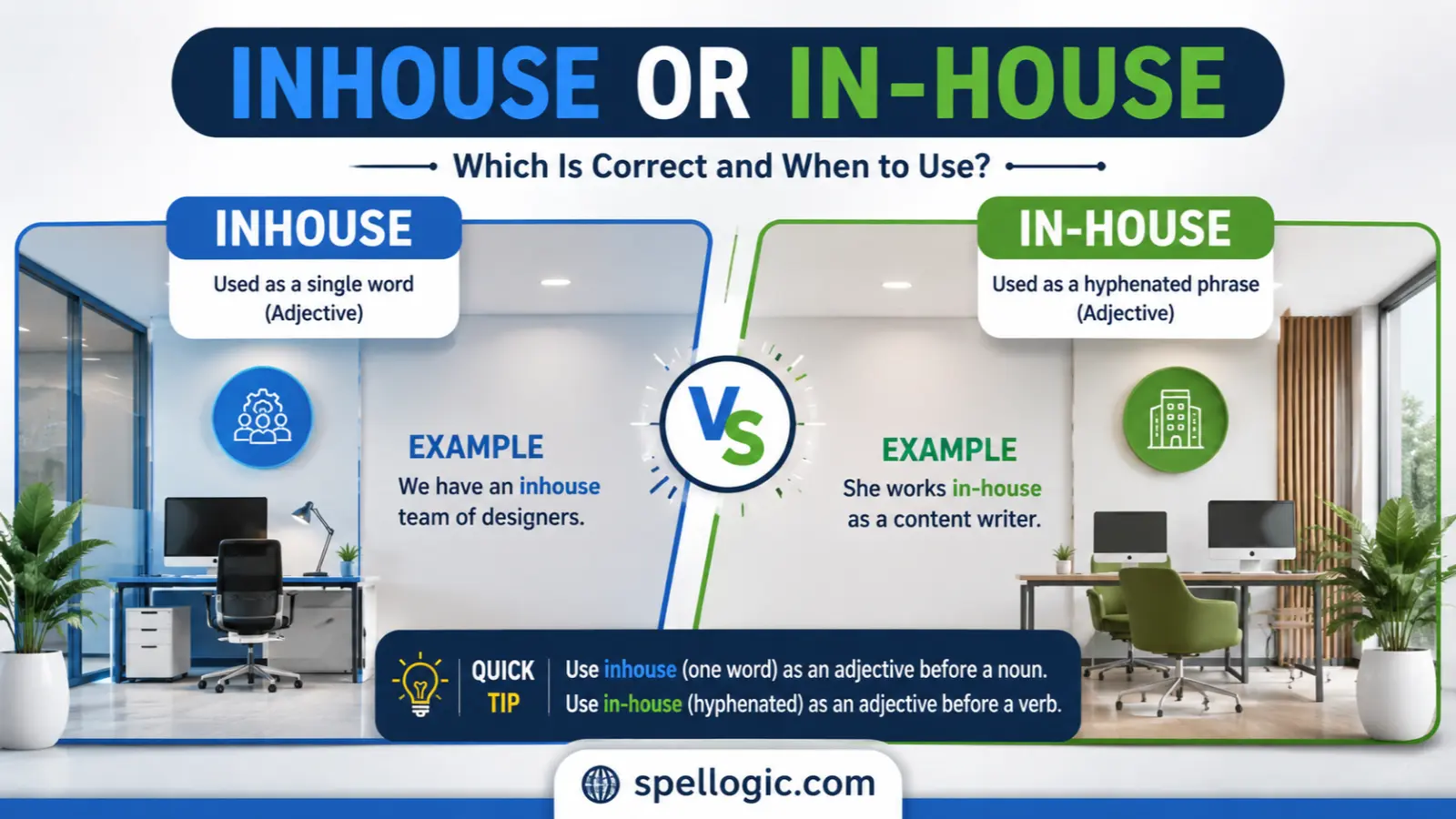
English learners often wonder whether inhouse or in house is the correct form because the two expressions look almost identical and are closely related in meaning. The confusion becomes greater when writers see in-house in business, workplace, and professional writing.
Knowing the difference helps you write clearer emails, reports, articles, and everyday messages. The key is to understand when the words describe something as part of an organization and when they simply indicate a location or situation. This small distinction can make your writing more accurate and professional.
Why “inhouse” and “in house” Are Confusing
For learners searching inhouse or in house, pronunciation alone does not provide the answer. The forms are easy to mix up because they contain exactly the same basic words.
Similar pronunciation
When spoken naturally, the forms can sound very similar. This makes it difficult to hear whether a writer should use one word, a hyphenated form, or two words.
Similar spelling
Both forms contain in and house. The spelling question inhouse or in house is therefore easy to understand. Writers may also encounter in-house, which adds another option and creates even more uncertainty.
Context confusion
This is the heart of the inhouse or in house question. The main issue is grammatical function. In-house is commonly used as an adjective or adverb to describe something handled within an organization or available internally. In house is normally a two-word phrase used when “house” refers to a place or when the phrase functions adverbially.
For example, compare “We have an in-house designer” with “The designer works in house.” The first describes the designer as an internal employee or resource. The second focuses on where or how the work is done.
Common learner mistakes
A frequent mistake is writing inhouse as a single word in formal English. Standard edited English generally prefers in-house when the expression works as a compound modifier and in house when it is a separate phrase. Therefore, writers should not automatically join the two words.
inhouse vs in house Explained Simply
The simplest way to understand the inhouse or in house question is to look at the role the expression plays in the sentence.
- In-house usually means provided, produced, or handled within a company, organization, or group.
- In house usually works as a two-word phrase, especially when referring to something being done or kept within a particular place.
- Inhouse as one unhyphenated word is generally not the preferred form in careful standard English.
One-line distinction: Use in-house for an internal service, employee, activity, or resource; use in house when the phrase functions as a separate adverbial expression.
Two examples make the distinction clearer. These examples show the practical inhouse or in house difference:
- The company has an in-house legal team.
- We decided to keep the project in house instead of outsourcing it.
Understanding Homophones in English
The question of inhouse or in house is sometimes treated like a homophone problem, but it is important to be precise. These forms are not a classic pair of homophones because they are different spellings or spacing choices for a related expression rather than two unrelated words with the same pronunciation.
What Are Homophones?
Homophones are words that sound the same but have different meanings or spellings. For example, right and write are homophones. They sound alike, but their meanings and spellings are different.
Why Homophones Cause Confusion
Sound alone cannot always tell you which spelling to choose. For instance, a learner may hear “write” and “right” and need the surrounding sentence to identify the correct word.
A similar lesson applies here: The inhouse or in house issue still requires attention to grammar and context. With this expression, however, the central issue is not true homophony but whether the expression should be written as a compound adjective/adverb or as separate words.
What Does “inhouse” Mean?
Definition and Core Meaning
“Inhouse” is sometimes seen as a single-word spelling, especially in informal business writing, online content, or specialized usage. However, it is generally not the preferred standard form in careful edited English. Most formal writing uses in-house for the adjective or adverbial compound.
When learners ask about inhouse or in house, they often mean this internal sense. The intended meaning is usually “within a company, organization, or group” rather than “outside it.”
Origin and Historical Use
The expression developed from the ordinary combination of in and house, with “house” referring to a business, institution, household, or internal organization. It became especially common in phrases such as in-house counsel, in-house training, and in-house production.
The history behind inhouse or in house helps explain why several spellings appear.
Over time, some writers began joining the words as inhouse. This spelling is common enough to appear in informal contexts, but it is not generally the safest choice for formal standard English.
Modern Usage and Synonyms
For formal inhouse or in house usage, choose the standard form that fits the sentence.
Related words and phrases include:
- internal
- company-based
- organization-based
- privately handled
- internally produced
- within the organization
- performed internally
Example sentences
- The company employs an in-house accountant.
- We provide in-house training for new employees.
- The magazine has an in-house editing team.
- The software was developed in-house.
- The business decided to handle customer support in house.
What Does “in house” Mean?
Definition and Core Meaning
“In house” is a two-word expression. It can indicate that something remains within a particular house, organization, or internal setting. In modern professional English, it often contrasts with outside, external, or outsourced work.
In the inhouse or in house discussion, this form remains a useful two-word construction.
For example, “We completed the work in house” means the organization completed the work internally rather than hiring an outside provider.
Origin and Historical Context
The phrase grew naturally from the literal meaning of “in” plus “house.” A house can refer to a physical building, a household, or, in certain contexts, an institution or business. As organizational language developed, “house” could also refer to the organization itself.
Modern Usage and Synonyms
For everyday inhouse or in house choices, context is more important than sound.
Useful alternatives include:
- internally
- within the organization
- within the company
- on the premises
- inside the organization
- without outside help
Example sentences
- We decided to keep the work in house.
- The repairs will be handled in house.
- The company produces its advertisements in house.
- The training is conducted in house.
- They prefer to manage recruitment in house.
One useful test is to replace the phrase with internally. If the sentence still makes sense, the two-word form may be appropriate.
inhouse vs in house: Key Differences at a Glance
| Word | Part of Speech | Meaning | Example Context |
|---|---|---|---|
| inhouse | Usually treated as a nonstandard or informal spelling | Intended to mean internal or within an organization | Avoid in careful formal writing |
| in-house | Adjective or adverb | Internal; provided or done within an organization | An in-house lawyer; work was done in-house |
| in house | Adverbial phrase | Within the organization or internal setting | We kept the work in house |
How to Remember the Difference Between inhouse and in house
Memory tricks can make the inhouse or in house distinction much easier.
Easy memory tricks
Think of in-house as a label attached to a noun:
- in-house team
- in-house expert
- in-house training
- in-house service
When the phrase directly describes a noun, the hyphen helps show that the two words work together as one modifier.
Think of in house as an action or location phrase:
- keep it in house
- work in house
- produce it in house
- manage it in house
Association techniques
Use this simple association:
Hyphen = joined idea.
If “in” and “house” combine to describe something as internal, the hyphenated form is often the clearest choice.
Two words = separate phrase.
If the phrase follows a verb and tells how or where something is done, separate words may be more natural.
One memorable example
Remember this pair:
We have an in-house designer, and the designer works in house.
Common Mistakes and Confusions
Many learners use inhouse because they see it online when researching inhouse or in house. However, formal English normally favors in-house and in house.
Wrong example 1
✘ The company has an inhouse lawyer.
Correct version
✔ The company has an in-house lawyer.
Explanation: The expression directly describes “lawyer,” so the hyphenated compound adjective is appropriate.
Wrong example 2
✘ We decided to keep the project in-house with no hyphen because it is always one word.
Correct version
✔ We decided to keep the project in house.
Explanation: Here the phrase follows the verb “keep” and functions adverbially.
Wrong example 3
✘ The team provides inhouse training.
Correct version
✔ The team provides in-house training.
Explanation: “In-house” directly modifies “training,” so the hyphen makes the relationship clear.
Important style point
For formal inhouse or in house writing, consistency is especially helpful. English punctuation can vary slightly among style guides, especially when an expression appears after a verb. However, inhouse as one word is not the safest choice for formal learner writing. When clarity matters, use in-house as a compound modifier and in house as a separate phrase.
Examples Section: Correct and Incorrect Usage
Here are several examples to make the inhouse or in house difference easier to recognize.
Example 1
✔ Correct: The company hired an in-house designer.
✘ Incorrect: The company hired an inhouse designer.
The compound modifier comes directly before “designer,” so the hyphenated form is preferred.
Example 2
✔ Correct: We decided to handle the project in house.
✘ Incorrect: We decided to handle the project inhouse.
Here the phrase explains how the project will be handled, so the separate form works well.
Example 3
✔ Correct: Our in-house team created the report.
✘ Incorrect: Our inhouse team created the report.
“In-house” modifies “team,” making the hyphen useful.
Example 4
✔ Correct: The company produces its training materials in house.
✘ Incorrect: The company produces its training materials inhouse.
The phrase follows the verb and means internally.
Example 5
✔ Correct: The organization offers in-house technical support.
✘ Incorrect: The organization offers inhouse technical support.
The expression modifies “technical support,” so the standard compound form is preferred.
Self Assessment: Test Your Knowledge
Fill in each blank with in-house, in house, or inhouse to test your understanding of inhouse or in house.
- The company has an ________ marketing specialist.
- We decided to keep the design work ________.
- The hospital provides ________ training for its staff.
- The software was developed ________.
Self Assessment Answers
- in-house — It directly modifies “marketing specialist.”
- in house — It follows “keep” and functions as a separate phrase.
- in-house — It modifies “training.”
- in-house — In this sentence, it functions as an adverb meaning internally; the hyphenated form is widely accepted in standard professional usage.
Notice that sentence 4 demonstrates an important point about inhouse or in house: the hyphenated form can also function adverbially as well as adjectivally. The choice between the hyphenated and separate forms can depend on style and construction.
FAQs
1. Is “inhouse” one word?
“Inhouse” is found in some informal and specialized writing, but it is generally not the preferred form in careful standard English. Use in-house or in house according to the sentence.
2. Is “in-house” correct?
Yes. In-house is the standard hyphenated form when the expression works as a compound modifier, and it is also commonly used adverbially in professional English.
3. Is “in house” correct?
Yes. In house is correct when it functions as a separate phrase, especially when it follows a verb and means “internally” or “within the organization.”
4. Should I write “in-house training”?
Yes. In-house training is a standard and common expression because “in-house” modifies “training.”
5. Should I write “work in house” or “work in-house”?
Both constructions can appear in edited English, but usage varies by style. Many modern style guides use in-house consistently as the established adverbial form, while some contexts use in house to preserve the phrase as two words.
6. What is the easiest way to choose the correct form?
First, avoid automatically writing inhouse. Then check the sentence. If the expression directly modifies a noun, in-house is usually the clearest choice. If it is a separate phrase meaning “internally,” in house can be appropriate.
7. Does the meaning change completely between the two forms?
No. The basic idea remains related to something being internal or within a particular organization or setting. The main difference is grammatical function and style.
Final Conclusion: Using “inhouse” and “in house” Correctly
Understanding inhouse or in house becomes much easier when you focus on grammar rather than pronunciation. The single-word spelling inhouse appears in some informal or specialized contexts, but it is not usually the best choice for careful standard English. In most professional and academic writing, use in-house when the expression acts as a compound adjective, such as “an in-house lawyer” or “in-house training.”
Use in house when you need a separate phrase meaning that something is done internally or within an organization, such as “We completed the work in house.” Also remember that modern style guides may use in-house as an adverb, so consistency matters within a document. A helpful memory trick is simple: a hyphen joins in and house when they work together as one descriptive unit, while two words can show a separate phrase. With regular practice, you will quickly recognize which form fits your sentence. Keep reading, writing, and checking examples, and this small English distinction will soon feel natural.