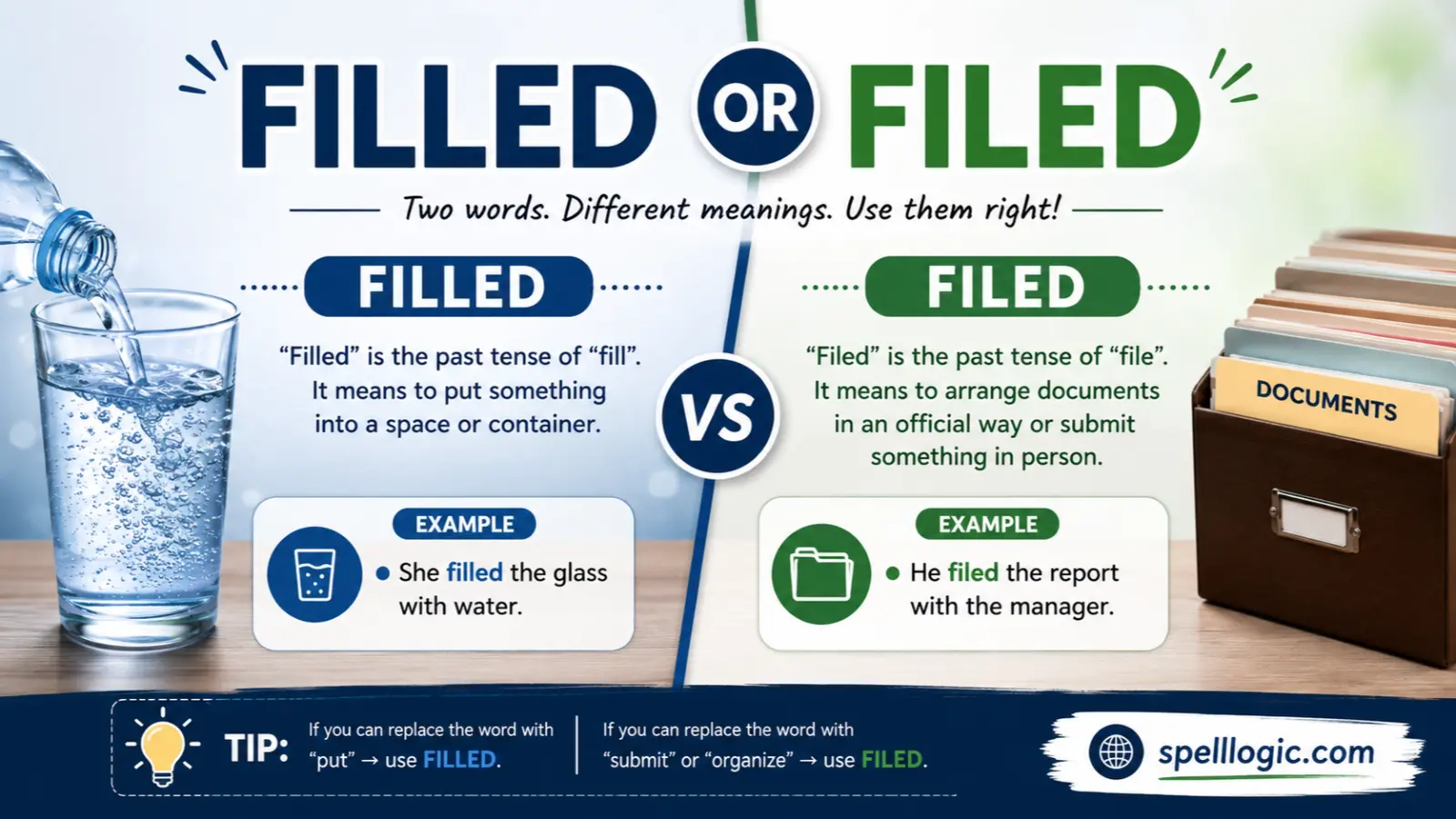
Many English learners confuse filled and filed because these words look almost identical and sound similar in everyday speech. However, they have completely different meanings and are used in different situations. Filled relates to making something full, while filed refers to organizing documents, submitting official papers, or smoothing a surface with a file.
Mixing them up can change the meaning of a sentence and create misunderstandings in writing and conversation. Learning the difference between filled and filed will help you communicate more accurately and confidently in both formal and everyday English.
Table of Contents
- Introduction
- Why “Filled” and “Filed” Are Confusing
- Filled vs Filed Explained Simply
- Understanding Homophones in English
- What Does “Filled” Mean?
- What Does “Filed” Mean?
- Filled vs Filed: Key Differences at a Glance
- How to Remember the Difference Between Filled and Filed
- Common Mistakes and Confusions
- Examples Section: Correct and Incorrect Usage
- Self Assessment: Test Your Knowledge
- Self Assessment Answers
- FAQs About Filled and Filed
- Final Conclusion: Using Filled and Filed Correctly
Why “Filled” and “Filed” Are Confusing
Many learners accidentally use filled instead of filed, or vice versa. The confusion happens for several reasons.
Similar Pronunciation
In fast speech, filled and filed sound very similar, especially for non-native speakers. The ending -ed also makes both words sound alike.
Similar Spelling
The words differ by only one letter:
- Filled
- Filed
This small spelling difference makes typing mistakes common.
Context Confusion
Both words often appear in workplaces, schools, hospitals, and government offices.
For example:
- She filled out the application.
- She filed the application.
These actions happen together but mean different things.
Common Learner Mistakes
Learners often write:
- “He filled a complaint.” ❌
- “She filed the glass with water.” ❌
The correct verbs depend on the action being described.
Filled vs Filed Explained Simply
The easiest way to remember the difference is this:
Filled means made full, while filed means submitted, organized, or smoothed.
One-Line Distinction
Filled = made something full.
Filed = submitted documents or organized papers (or used a file tool).
Example Sentences
- She filled the bottle with clean water.
- The lawyer filed the legal documents yesterday.
Another pair:
- We filled the room with balloons.
- The accountant filed the tax return before the deadline.
Understanding Homophones in English
What Are Homophones?
Homophones are words that sound the same or nearly the same but have different meanings and spellings.
For example:
- Sea and see
Although they sound alike, they mean completely different things.
Filled and filed are not perfect homophones in every accent, but they are close enough that many learners confuse them.
Why Homophones Cause Confusion
English contains many words with similar pronunciation but different meanings.
For example:
- There
- Their
- They’re
If you focus only on pronunciation, you may choose the wrong spelling. Understanding the meaning and context helps you select the correct word.
What Does “Filled” Mean?
Definition and Core Meaning
Filled is the past tense and past participle of fill.
It means:
- To make something full
- To occupy space
- To satisfy a need
- To complete a form
Origin and Historical Use
The verb fill comes from Old English fyllan, meaning “to make full.” It has been used for over a thousand years and remains one of the most common English verbs.
Modern Usage and Synonyms
Depending on the context, filled can mean:
- Made full
- Loaded
- Packed
- Occupied
- Completed
- Supplied
Common Uses
- Filled a glass
- Filled a room
- Filled an order
- Filled a prescription
- Filled a position
- Filled out a form
Example Sentences
- She filled the cup with coffee.
- The children filled the playground with laughter.
- We filled the online application yesterday.
- The doctor filled the prescription.
What Does “Filed” Mean?
Definition and Core Meaning
Filed is the past tense and past participle of file.
It usually means:
- Submitted official documents
- Organized papers
- Smoothed something using a file tool
Origin and Historical Context
The word file comes from Latin through Old French. Originally, it referred to a thread used to hold papers together. Later, it came to mean organizing documents and submitting records.
Modern Usage and Synonyms
Depending on context, filed may mean:
- Submitted
- Registered
- Recorded
- Stored
- Organized
- Smoothed
Common Uses
- Filed taxes
- Filed a complaint
- Filed a lawsuit
- Filed documents
- Filed records
- Filed nails
Example Sentences
- She filed the paperwork before leaving.
- The company filed its annual report.
- He carefully filed his nails.
- The attorney filed the case in court.
Filled vs Filed: Key Differences at a Glance
| Word | Part of Speech | Meaning | Example Context |
|---|---|---|---|
| Filled | Verb (past tense of fill) | Made something full or completed | She filled the bottle with water. |
| Filed | Verb (past tense of file) | Submitted, organized, recorded, or smoothed | He filed the tax return online. |
How to Remember the Difference Between Filled and Filed
Here are some simple memory tricks.
Easy Memory Trick 1
Filled = Full
Both words begin with F and relate to making something full.
Easy Memory Trick 2
Filed = Folder
Think of putting papers into a file folder.
Association Technique
Imagine two office workers.
One worker fills out forms.
The other worker files those forms into a cabinet.
Memorable Example
She filled out the application, then filed it with the government office.
First you complete it.
Then you submit or organize it.
Common Mistakes and Confusions
Wrong
❌ I filled a complaint against the company.
Correct
✔ I filed a complaint against the company.
Explanation: Complaints are officially submitted, not made full.
Wrong
❌ She filed the glass with milk.
Correct
✔ She filled the glass with milk.
Explanation: Milk makes the glass full.
Wrong
❌ They filled their taxes yesterday.
Correct
✔ They filed their taxes yesterday.
Explanation: Taxes are submitted.
Wrong
❌ He filed the swimming pool with water.
Correct
✔ He filled the swimming pool with water.
Explanation: Water fills a pool.
Examples Section: Correct and Incorrect Usage
Example 1
✔ Correct: She filled the bucket with sand.
✘ Incorrect: She filed the bucket with sand.
Example 2
✔ Correct: The lawyer filed the lawsuit this morning.
✘ Incorrect: The lawyer filled the lawsuit this morning.
Example 3
✔ Correct: We filled every seat in the auditorium.
✘ Incorrect: We filed every seat in the auditorium.
Example 4
✔ Correct: The company filed its financial report before the deadline.
✘ Incorrect: The company filled its financial report before the deadline.
Example 5
✔ Correct: The balloons filled the room with color.
✘ Incorrect: The balloons filed the room with color.
Example 6
✔ Correct: She filed all the customer records alphabetically.
✘ Incorrect: She filled all the customer records alphabetically.
Self Assessment: Test Your Knowledge
Fill in the blanks with filled or filed.
- The employee ________ the documents before lunch.
- She ________ the vase with fresh flowers.
- The lawyer ________ an appeal in court.
- We ________ every available seat during the concert.
Self Assessment Answers
- filed
- filled
- filed
- filled
FAQs
1. Is it “filled a complaint” or “filed a complaint”?
The correct phrase is filed a complaint because a complaint is officially submitted.
2. What is the difference between filled and filed?
Filled means made full, while filed means submitted, organized, recorded, or smoothed with a file.
3. Can I say “filled out a form”?
Yes. Filled out a form means you completed the form by writing the required information.
4. What does “filed taxes” mean?
It means you officially submitted your tax return to the appropriate tax authority.
5. Are filled and filed homophones?
They are considered near-homophones because they sound very similar in many English accents.
6. Which word is used for organizing documents?
Use filed when talking about organizing or storing documents.
7. Which word is used for making something full?
Use filled whenever something becomes full or occupied.
Final Conclusion: Using “Filled” and “Filed” Correctly
Understanding the difference between filled and filed is an important step toward improving your English vocabulary and writing skills. Although these two words look similar and may sound almost the same in everyday conversation, they describe completely different actions. Filled refers to making something full, completing a form, or occupying a space. Filed, on the other hand, means submitting official documents, organizing records, or smoothing an object with a file. Paying attention to the context is the easiest way to choose the correct word.
A simple memory trick can make the distinction even easier. Think of filled as connected to full, because both relate to adding something until there is no empty space left. Think of filed as connected to a file folder, where documents are stored or submitted. This association works well in offices, schools, legal settings, and everyday communication.
As you continue learning English, practice using both words in your own sentences. Reading books, writing short paragraphs, and completing grammar exercises will help reinforce the correct usage. Remember that even advanced English speakers occasionally make spelling mistakes, so don’t be discouraged. With regular practice and by focusing on meaning rather than pronunciation alone, you’ll quickly learn when to use filled and when to use filed, making your English clearer, more accurate, and more confident.