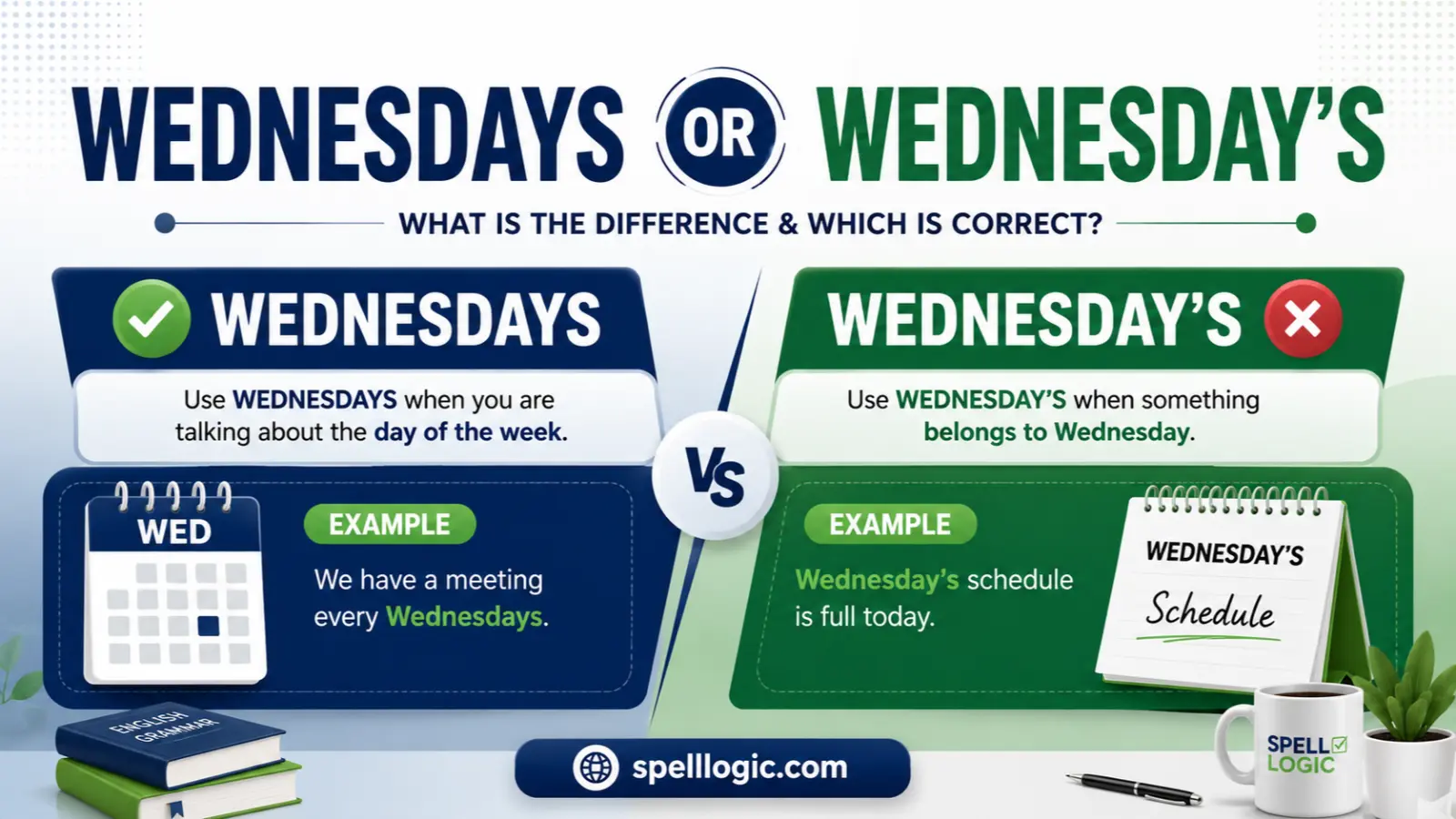
Many English learners get confused between Wednesdays and Wednesday’s because the words look almost identical. The only visible difference is the apostrophe, but that small punctuation mark completely changes the meaning. One word refers to more than one Wednesday, while the other shows ownership or possession related to Wednesday.
Using the wrong form can make your writing look incorrect, especially in emails, school assignments, or professional communication. In this guide, you’ll learn the difference between Wednesdays and Wednesday’s in simple English, see plenty of examples, avoid common mistakes, and remember the correct usage with easy tips.
Why “Wednesdays” and “Wednesday’s” Are Confusing
Many people mix up Wednesdays and Wednesday’s because they sound exactly the same when spoken.
Similar Pronunciation
Both words are pronounced /ˈwenz.deɪz/. Since the apostrophe is silent, listeners cannot hear the difference.
Similar Spelling
The only difference is the apostrophe (‘). This tiny punctuation mark changes the grammatical function of the word.
Context Confusion
Writers often wonder whether they should make the word plural or possessive.
For example:
- Our meetings are every Wednesdays.
- Wednesday’s meeting has been postponed.
The first sentence uses the plural form incorrectly after every, while the second correctly uses the possessive form because the meeting belongs to Wednesday.
Common Learner Mistakes
- Adding an apostrophe to make a plural.
- Forgetting the apostrophe when showing possession.
- Using Wednesday’s when talking about multiple Wednesdays.
- Writing Wednesdays when referring to something happening on one specific Wednesday.
Wednesdays vs Wednesday’s Explained Simply
The difference is easy once you know the grammar.
Wednesdays is the plural form of Wednesday.
Wednesday’s is the possessive form of Wednesday.
One-Line Distinction
Wednesdays means more than one Wednesday, while Wednesday’s means something belongs to or is associated with Wednesday.
Example Sentences
- We usually play football on Wednesdays.
- Wednesday’s presentation starts at 10 a.m.
- The library closes early on Wednesdays.
- Wednesday’s weather forecast predicts heavy rain.
Understanding Homophones in English
Although Wednesdays and Wednesday’s are not true homophones in grammar, they sound identical in speech, which creates confusion.
What Are Homophones?
Homophones are words that sound the same but have different meanings or spellings.
Example:
- Sea
- See
Both sound alike but have different meanings.
Why Homophones Cause Confusion
When speaking, listeners cannot hear punctuation such as apostrophes.
For example:
- Wednesday’s class
- Wednesdays are busy
Both sound almost identical, so learners must rely on grammar and context instead of pronunciation.
What Does “Wednesdays” Mean?
Definition and Core Meaning
Wednesdays is the plural noun for Wednesday.
It refers to more than one Wednesday or something that happens every Wednesday.
Origin and Historical Use
The word Wednesday comes from Old English Wōdnesdæg, meaning Woden’s Day, named after the Germanic god Woden (Odin).
The plural form developed naturally by adding -s.
Modern Usage and Synonyms
Common situations include:
- Weekly schedules
- School timetables
- Office routines
- Recurring events
There is no true synonym for Wednesdays, but related expressions include:
- Every Wednesday
- On Wednesdays
- Weekly on Wednesday
Key Points
- Plural noun
- Refers to multiple Wednesdays
- No apostrophe
- Used for repeated events
Example Sentences
- The museum offers free entry on Wednesdays.
- Our English classes are held on Wednesdays.
- I usually work late on Wednesdays.
- Wednesdays are my busiest days.
What Does “Wednesday’s” Mean?
Definition and Core Meaning
Wednesday’s is the possessive form of Wednesday.
It shows that something belongs to or is connected with a particular Wednesday.
Origin and Historical Context
English uses ‘s to show possession.
Therefore:
Wednesday + ‘s = Wednesday’s
Modern Usage and Synonyms
Common examples include:
- Wednesday’s meeting
- Wednesday’s schedule
- Wednesday’s weather
- Wednesday’s lesson
Related expressions include:
- The schedule for Wednesday
- The meeting on Wednesday
- Wednesday’s agenda
Key Points
- Possessive noun
- Shows ownership or association
- Uses an apostrophe before s
- Refers to one Wednesday
Example Sentences
- Wednesday’s lecture was fascinating.
- We changed Wednesday’s appointment.
- Wednesday’s forecast looks sunny.
- Everyone enjoyed Wednesday’s workshop.
Wednesdays vs Wednesday’s: Key Differences at a Glance
| Word | Part of Speech | Meaning | Example Context |
|---|---|---|---|
| Wednesdays | Plural noun | More than one Wednesday | We meet on Wednesdays. |
| Wednesday’s | Possessive noun | Something belonging to Wednesday | Wednesday’s meeting begins at 9. |
How to Remember the Difference Between Wednesdays and Wednesday’s
Here are some easy tricks.
Easy Memory Tricks
- No apostrophe = more than one day
- Apostrophe = belongs to that day
Association Techniques
Think of the apostrophe as meaning belongs to.
If something belongs to Wednesday, use Wednesday’s.
If you simply mean several Wednesdays, use Wednesdays.
Memorable Example
- Wednesdays are for exercise.
- Wednesday’s exercise was difficult.
The first refers to every Wednesday.
The second refers to one specific Wednesday.
Common Mistakes and Confusions
Wrong
❌ I work every Wednesday’s.
✅ I work every Wednesday.
Explanation: After every, use the singular noun.
Wrong
❌ Our meetings are on Wednesday’s.
✅ Our meetings are on Wednesdays.
Explanation: Multiple Wednesdays require the plural.
Wrong
❌ Wednesdays meeting has moved.
✅ Wednesday’s meeting has moved.
Explanation: The meeting belongs to Wednesday.
Wrong
❌ I enjoy Wednesday’s because they’re quieter.
✅ I enjoy Wednesdays because they’re quieter.
Explanation: The sentence refers to multiple Wednesdays.
Examples Section: Correct and Incorrect Usage
Example 1
✔ Correct: We always visit our grandparents on Wednesdays.
✘ Incorrect: We always visit our grandparents on Wednesday’s.
Example 2
✔ Correct: Wednesday’s homework is due tomorrow.
✘ Incorrect: Wednesdays homework is due tomorrow.
Example 3
✔ Correct: The gym is less crowded on Wednesdays.
✘ Incorrect: The gym is less crowded on Wednesday’s.
Example 4
✔ Correct: Wednesday’s football match was exciting.
✘ Incorrect: Wednesdays football match was exciting.
Self Assessment: Test Your Knowledge
Fill in the blanks.
- We have music lessons every ________.
- ________ meeting starts at 3 p.m.
- The restaurant is closed on ________.
- ________ weather was colder than expected.
Self Assessment Answers
- Wednesday (after “every”) or Wednesdays (if rewritten as “on Wednesdays”)
- Wednesday’s
- Wednesdays
- Wednesday’s
FAQs
1. Is “Wednesdays” plural?
Yes. Wednesdays is the plural form of Wednesday.
2. What does “Wednesday’s” mean?
It is the possessive form showing that something belongs to or relates to Wednesday.
3. Can I use “Wednesday’s” for recurring events?
No. For recurring weekly events, use Wednesday after every or Wednesdays after on.
4. Which is correct: “on Wednesdays” or “on Wednesday’s”?
On Wednesdays is correct when referring to repeated weekly events.
5. Why do people confuse these words?
They sound the same, and the apostrophe is not pronounced.
6. Is “Wednesday’s class” correct?
Yes. It means the class taking place on Wednesday.
7. Is “every Wednesdays” correct?
No. The correct expression is every Wednesday.
Final Conclusion: Using “Wednesdays” and “Wednesday’s” Correctly
Understanding the difference between Wednesdays and Wednesday’s is much easier once you know the role of the apostrophe. Wednesdays is simply the plural form of Wednesday and is used when talking about multiple Wednesdays or events that happen regularly on that day. For example, you can say, “We have piano lessons on Wednesdays.” In contrast, Wednesday’s is the possessive form and shows that something belongs to or is connected with a particular Wednesday, as in “Wednesday’s meeting has been rescheduled.” Although these words sound exactly the same, their meanings are different, so context is the key to choosing the correct form.
A simple way to remember the difference is this: no apostrophe means more than one Wednesday, while an apostrophe means something belongs to Wednesday. If you are describing a weekly routine, think about using Wednesday or Wednesdays. If you are referring to an event, schedule, lesson, or forecast for a specific Wednesday, Wednesday’s is usually the right choice. Reading carefully, practicing with real-life examples, and paying attention to punctuation will help you avoid common mistakes. The more you use these forms correctly, the more natural they will become, making your spoken and written English clearer, more accurate, and more confident.