English learners often see kindergarten written correctly in one place and kindergarden in another. The question kindergarten or kindergarden appears often because the two forms look almost identical. Because they sound very similar, it is easy to assume that both are accepted spellings. However, standard English recognizes only one spelling for the name of the early school stage: kindergarten.
Learning the difference is useful because spelling errors can appear in school applications, websites, emails, forms, and everyday writing. The good news is that the distinction is simple once you understand where the word came from and remember its unusual middle letters. This guide explains the meaning, history, pronunciation, usage, common mistakes, and memory tricks in clear English.
Why “kindergarten or kindergarden” Are Confusing
The spelling question kindergarten or kindergarden is especially common among learners who rely on pronunciation. People asking kindergarten or kindergarden mix up these forms mainly because they are pronounced almost the same in ordinary English speech. When a learner hears the word rather than sees it, the spelling can be difficult to remember. The ending also encourages confusion because English speakers may naturally connect the word with garden, a familiar word associated with a place where things grow.
Similar pronunciation
The two spellings do not create a meaningful difference in pronunciation. In normal English, they are usually heard as the same word. Therefore, listening alone cannot tell a learner which spelling to choose.
Similar spelling
The forms share most of their letters. Only the middle part changes: the standard form contains -garten, while the common misspelling contains -garden. That small difference is easy to overlook.
Context confusion
The word refers to an educational setting, so learners may connect it with other words for children, schools, or gardens. The familiar English word garden can make the incorrect spelling feel logical even though it is not standard.
Common learner mistakes
A frequent mistake is replacing -garten with -garden. Some learners also write the word with unnecessary spaces or capitalize it in ordinary sentences. In American English, kindergarten is normally lowercase unless it begins a sentence or appears in a proper name.
“kindergarten or kindergarden” Explained Simply
For kindergarten or kindergarden, the easiest way to understand the issue is to treat one form as the standard word and the other as a spelling error.
Kindergarten means an early educational class or school program for young children, usually before primary or elementary school.
Kindergarden is not the standard English spelling of that educational term. It is a common misspelling caused partly by the familiar word garden.
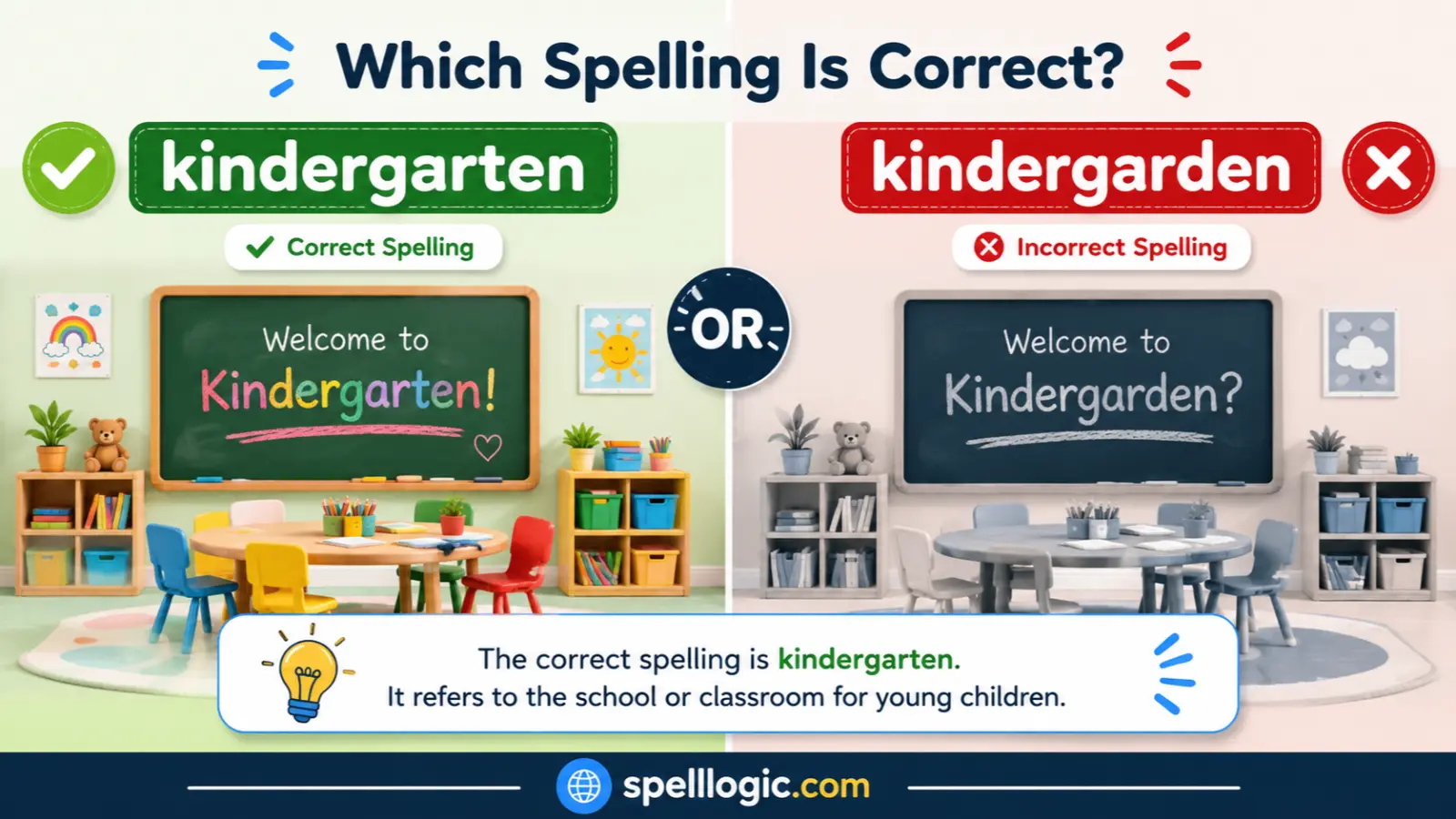
One-line distinction: Kindergarten is the correct spelling; kindergarden is a misspelling in standard English.
Examples
- My daughter starts kindergarten next month.
- The school has a new kindergarten classroom.
These examples show how the standard spelling works in everyday English.
Understanding Homophones in English: kindergarten or kindergarden
Spelling confusion does not always mean that two words are true homophones. In this case, the issue is better described as a spelling confusion involving two visually similar forms.
What Are Homophones?
Homophones are words that sound the same but have different meanings, spellings, or both. For example, flower and flour are pronounced alike but have completely different meanings.
For kindergarten or kindergarden, the forms discussed here are not best treated as two standard homophones. One is the accepted spelling, while the other is generally a misspelling.
Why Homophones Cause Confusion
When words sound alike, learners cannot depend on pronunciation to remember spelling. For example, hearing “flower” does not tell you whether the speaker means a plant or the ingredient used in baking. Similarly, hearing the school term does not reveal whether someone has written the standard spelling correctly.
What Does “kindergarten” Mean? | kindergarten or kindergarden
Definition and Core Meaning
Kindergarten is a school or class for young children, generally the year or period immediately before formal primary or elementary education, although the exact age and educational structure vary by country.
In the United States, kindergarten is commonly the school year before first grade. In other education systems, the term may refer more broadly to preschool education.
Origin and Historical Use
The word in kindergarten or kindergarden comes from German. Kindergarten literally combines Kind, meaning “child,” and Garten, meaning “garden.” The term was introduced by German educator Friedrich Fröbel in the nineteenth century. His idea was that young children should be nurtured and encouraged to develop much like plants in a garden.
The original German spelling explains why the English word contains -garten, not -garden. Understanding this history can make the spelling easier to remember.
Modern Usage and Synonyms
Today, the word is widely used in English-language education. Depending on the country and context, related terms can include:
- preschool
- pre-primary school
- nursery school
- early-years education
- reception class
These terms are not always exact synonyms because educational systems differ.
Example sentences
- The children enjoyed their first week of kindergarten.
- She teaches reading and numbers in kindergarten.
- Our local school offers a full-day kindergarten program.
- He made new friends during kindergarten.
The word can refer to the class, program, or educational stage, depending on the sentence.
What Does “kindergarden” Mean? | kindergarten or kindergarden
Definition and Core Meaning
Kindergarden does not have a separate standard English meaning in this context. It is generally a misspelling of the name of the early educational stage.
Because garden is a common English word, the incorrect form may look meaningful. However, changing -garten to -garden does not create a new standard English word for children’s education.
Origin and Historical Context
In kindergarten or kindergarden, the mistaken spelling likely develops from the visual influence of the English word garden. Learners may remember that the German word contains a part that sounds like “garden” and then spell it using the familiar English form.
The historical origin is important here. The final part comes from German Garten, not from the English noun garden. Although German and English words are related historically, the accepted English spelling preserves the German-derived form.
Modern Usage and Synonyms
You may encounter this spelling in informal writing, search queries, messages, social media posts, or other user-generated content. Its appearance does not make it an accepted alternative.
Instead, use standard terms such as:
- kindergarten
- preschool
- nursery school
- pre-primary education
- early childhood education
Example sentences
- She is enrolled in kindergarten this year.
- The kindergarten teacher welcomed the new students.
- Parents attended a meeting about the kindergarten program.
If you see the incorrect form in a draft, school document, or website, replace it with the standard spelling.
“kindergarten or kindergarden”: Key Differences at a Glance
The central spelling point in kindergarten or kindergarden is shown below.
| Word | Part of Speech | Meaning | Example Context |
|---|---|---|---|
| Kindergarten | Noun | An early educational class or school program for young children | “He attends kindergarten.” |
| Kindergarden | Noun-like misspelling | No separate standard meaning in this context | Avoid this spelling in formal English. |
The table makes the central point about kindergarten or kindergarden clear: there is no meaning-based distinction between the two forms. The issue is correctness of spelling.
How to Remember the Difference Between Kindergarten and Kindergarden
A useful way to remember kindergarten or kindergarden is to focus on the unusual middle letters. A few simple memory techniques can prevent this spelling mistake.
1. Remember the German origin of kindergarten or kindergarden
Think of Kind + Garten. Kind means “child,” and Garten means “garden” in German. The spelling therefore keeps -garten.
2. Use the “T” trick for kindergarten or kindergarden
When writing the word, pause before the final part and remember:
Kinder + GARTEN
The T is the key letter. If you write garden, you have dropped the T.
3. Connect it with the word “German” when learning kindergarten or kindergarden
The word comes from German, so you can associate the unusual spelling with its German origin. This is not a spelling rule for every German-derived English word, but it is a useful memory aid here.
4. Think of children, not plants: kindergarten or kindergarden
The educational term is about children. The word may look as if it contains the English word garden, but its historical form is different.
One memorable example
Imagine a sign that says:
“Welcome to our Kinder-GARTEN!”
Picture the children growing and learning like plants. The unusual T in Garten becomes easier to remember.
Common Mistakes and Confusions: kindergarten or kindergarden
In kindergarten or kindergarden, the most common error is writing the familiar English word garden inside the school term.
Wrong example
My son starts kindergarden in September.
Correct version
My son starts kindergarten in September.
The problem is the spelling, not the meaning. Most readers will understand the incorrect form, but it should still be corrected in formal or professional writing.
Another common mistake
Some learners think the two spellings represent different types of schools. They do not. Standard English uses one spelling for the term.
Capitalization confusion
Another issue is unnecessary capitalization:
Incorrect: My child attends Kindergarten.
Better in ordinary writing: My child attends kindergarten.
Capitalize the word when it begins a sentence or forms part of an official name, according to the style used by the institution.
Why the mistake persists
English spelling often contains words from other languages. Learners naturally adapt unfamiliar spellings to familiar patterns. Since garden is common in English, replacing garten with garden feels natural. Knowing the origin helps break that habit.
Examples Section: Correct and Incorrect Usage for kindergarten or kindergarden
Example 1
✔ Correct: The children are excited to start kindergarten.
✘ Incorrect: The children are excited to start kindergarden.
Explanation: Use the form ending in -garten.
Example 2
✔ Correct: She works as a kindergarten teacher.
✘ Incorrect: She works as a kindergarden teacher.
Explanation: The adjective form used before teacher keeps the same spelling.
Example 3
✔ Correct: Our school offers a kindergarten program.
✘ Incorrect: Our school offers a kindergarden program.
Explanation: The incorrect spelling does not become acceptable when it is used before another noun.
Example 4
✔ Correct: He learned the alphabet in kindergarten.
✘ Incorrect: He learned the alphabet in kindergarden.
Explanation: The educational stage has the standard spelling with -garten.
Example 5
✔ Correct: The kindergarten classroom is bright and welcoming.
✘ Incorrect: The kindergarden classroom is bright and welcoming.
Explanation: The same spelling applies when the word describes the classroom.
Self Assessment: Test Your Knowledge of kindergarten or kindergarden
Fill in each blank with the correct form.
- My little brother will start ______ next year.
- She is a ______ teacher with ten years of experience.
- The school has expanded its ______ program.
- The children enjoyed their first day of ______.
Self Assessment Answers for kindergarten or kindergarden
- kindergarten
- kindergarten
- kindergarten
- kindergarten
If you selected the standard spelling in every sentence, you have understood the main rule.
FAQs About “kindergarten and kindergarden”
Readers searching kindergarten or kindergarden often have the same basic spelling question.
1. Is kindergarten or kindergarden correct?
Kindergarten is the correct standard spelling in English. The other form is a common misspelling.
2. Why do people spell kindergarten incorrectly?
People often replace -garten with -garden because garden is a familiar English word and the two forms sound very similar.
3. What does kindergarten mean?
It refers to an early educational class or program for young children, usually before primary or elementary school.
4. Is kindergarten a German word?
Yes. The English word comes from German and was introduced by Friedrich Fröbel. Its literal parts relate to “child” and “garden.”
5. Is kindergarden ever acceptable?
In standard English, it should not be used as the spelling of the educational term. Treat it as a misspelling and use the standard form instead.
6. How can I remember the spelling?
Remember GARTEN and especially the T. Thinking about the word’s German origin can also help.
7. Is kindergarten the same as preschool?
Not always. The exact meaning and age range depend on the country’s education system. In some places, kindergarten is part of formal schooling, while preschool may describe an earlier stage.
Final Conclusion: Using “kindergarten” and “kindergarden” Correctly
The key lesson in kindergarten or kindergarden is straightforward. The difference between kindergarten and kindergarden is simple once you focus on spelling rather than pronunciation. Kindergarten is the standard English word for an early educational stage or class for young children. Kindergarden is generally a misspelling, not a different educational term. The confusion happens because the words look almost identical and because the familiar English word garden makes the incorrect spelling seem reasonable.
The best way to remember the correct form is to focus on its German origin: Kindergarten comes from German Kind (“child”) and Garten (“garden”). That gives you a useful visual clue: GARTEN has a T. You can also remember the image of a “garden” where children are nurtured and encouraged to grow.
In real-world writing, always choose the standard spelling for school applications, educational documents, websites, emails, assignments, and professional communication. If you are learning English, do not worry if this spelling has caused confusion before. Unusual spellings become much easier when you understand their history and practice them in context. Keep using the correct form in your writing, and your confidence will grow with every example.