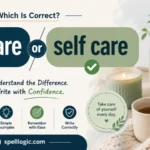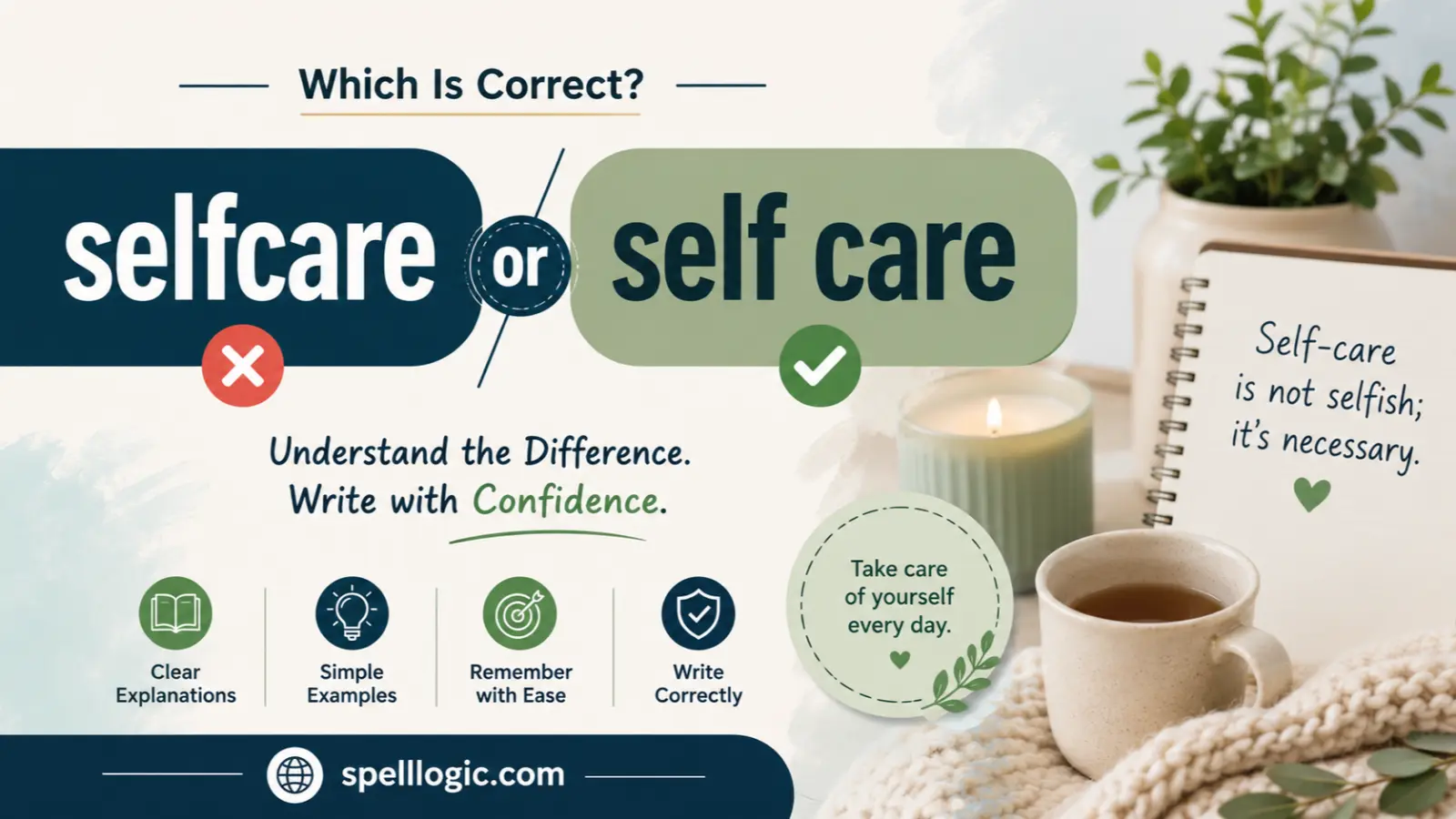
English learners often wonder whether selfcare or self care is the correct way to write the phrase. The confusion is understandable because English frequently combines words into compounds, while other expressions remain separate or become hyphenated. In this case, however, neither spelling is the best standard choice in formal English. The usual dictionary form is self-care, with a hyphen.
Understanding this small punctuation difference can make your writing clearer and more professional. It also helps you recognize related forms such as self-care routine, self-care activities, and self-care practices. Once you understand the pattern, choosing the right form becomes simple.
Why “Selfcare” and “Self Care” Are Confusing
The expressions selfcare and self care look almost identical, so it is easy to assume that they are simply two accepted spellings of the same word. In everyday online writing, both forms can appear, especially in hashtags, captions, informal posts, and advertisements.
Similar pronunciation
Both forms are pronounced in essentially the same way: self-care. Because there is no meaningful pronunciation difference, listening cannot help you decide how to spell the expression.
Similar spelling
The only visible difference between selfcare and self care is the space. However, standard English normally treats this expression as a hyphenated compound noun: self-care.
Context confusion
Modern English uses many compounds that change over time. For example, some expressions begin as two words and later become hyphenated or closed compounds. This makes learners unsure whether a particular expression should be open, closed, or hyphenated.
Common learner mistakes
A common mistake is to copy the spelling seen on social media or in search results. Another is to assume that every two-part expression can be joined into one word. In formal writing, it is safer to use the established dictionary form self-care.
For learners researching selfcare or self care, the key point is that the standard form is usually self-care.
Selfcare or Self Care Explained Simply
The simplest answer is this: self-care is the standard spelling used for the practice of taking care of your physical, emotional, and mental well-being.
“Selfcare” is generally written incorrectly as a closed compound in standard English. “Self care” may appear as an open form in informal usage, but self-care is the conventional form in edited English.
One-line distinction
Selfcare or self care refers to the same general idea, but the standard written form is self-care.
Example sentences
- Taking regular breaks from work is an important part of self-care.
- She created a simple self-care routine that includes reading and exercise.
So, when deciding between selfcare or self care, choose self-care for standard English.
Understanding Homophones in English
The question of selfcare or self care is sometimes treated like a pronunciation problem, but it is not really a homophone issue.
What Are Homophones?
Homophones are words that have the same pronunciation but different meanings or spellings. For example, flower and flour sound alike but have different meanings.
Why Homophones Cause Confusion
Homophones can confuse learners because listening does not reveal the spelling. However, selfcare and self care do not have different meanings or different pronunciations. They are simply competing written forms of the same expression.
Therefore, selfcare or self care should be understood as a spelling and style question rather than a homophone question.
What Does “Selfcare” Mean?
Definition and Core Meaning
“Selfcare” is an attempt to write the expression self-care as one closed word. It refers to activities or habits intended to support a person’s physical, mental, or emotional well-being.
In standard edited English, however, selfcare is generally not the preferred spelling.
Origin and Historical Use
The idea behind self-care is not new. People have long discussed personal care, health, rest, and well-being. The modern term developed from the combination of self and care, with the hyphen helping readers understand the compound clearly.
English compounds can change spelling over time. Some eventually become closed words, while others remain open or hyphenated. Self-care has traditionally been written with a hyphen in standard usage.
Modern Usage and Synonyms
People may encounter selfcare on websites, social media, product labels, or informal content. Its meaning is usually clear from context, but readers of formal English will generally expect self-care.
Related words and phrases include:
- personal care
- well-being
- wellness
- personal wellness
- healthy habits
- relaxation
- self-maintenance
- personal health
Example sentences
- Informal online posts sometimes use selfcare as a single word.
- In an edited article, the writer should normally replace selfcare with self-care.
- The course teaches students about healthy habits and self-care.
If you see selfcare or self care in online content, remember that appearance in search results does not automatically make a spelling standard.
What Does “Self Care” Mean?
Definition and Core Meaning
“Self care” is an open form made from the words self and care. It expresses the idea of looking after your own health, comfort, or well-being.
Although the meaning is clear, formal English normally prefers the hyphenated compound self-care.
Origin and Historical Context
The noun care has a long history in English, while self is used to identify the individual person. When they combine to describe a practice of caring for one’s own well-being, the compound form self-care makes the relationship between the words easy to recognize.
The open spelling can still appear in informal writing. English spelling conventions are not always fixed immediately, so variants may coexist for a period of time.
Modern Usage and Synonyms
“Self care” commonly appears in casual writing, especially in social media posts and personal notes. In professional, academic, and carefully edited writing, self-care is usually the better choice.
Useful related expressions include:
- taking care of yourself
- personal wellness
- health maintenance
- emotional well-being
- stress management
- personal care
- healthy lifestyle
Example sentences
- “Self care” is understandable, but self-care is more standard.
- A balanced self-care plan can include sleep, exercise, and relaxation.
- Good self-care does not have to be expensive or complicated.
When comparing selfcare or self care, remember that the open form is understandable, but the hyphenated form is the safest standard choice.
Selfcare or Self Care: Key Differences at a Glance
| Word | Part of Speech | Meaning | Example Context |
|---|---|---|---|
| selfcare | Nonstandard closed form | Care of one’s own well-being | Usually seen in informal online writing |
| self care | Open form/variant | Care of one’s own well-being | Informal writing and some variant usage |
| self-care | Standard compound noun | Deliberate care for one’s physical, mental, or emotional well-being | Formal, professional, and edited writing |
This table shows why the issue is mainly about spelling and style, not meaning. If you need the safest form for an article, essay, report, or workplace document, use self-care.
For learners comparing selfcare or self care, the hyphen is the important detail.
How to Remember the Difference Between Selfcare and Self Care
Easy memory tricks
Think of self-care as one combined idea made from two words. The hyphen acts like a small bridge connecting self and care.
A useful rule is:
Self + care = self-care.
Association techniques
Connect the word with other familiar hyphenated compounds, such as:
- self-esteem
- self-control
- self-confidence
- self-awareness
- self-discipline
These examples can help you remember that compounds beginning with self- are often written with a hyphen.
One memorable example
Imagine a note on your desk saying:
“Make time for self-care.”
The hyphen visually connects the two parts and reminds you to use the standard form.
For anyone learning selfcare or self care, this simple “self + care” bridge is an easy way to remember the spelling.
Common Mistakes and Confusions
Wrong example
✘ I need more selfcare after a stressful week.
Correct version
✔ I need more self-care after a stressful week.
The meaning is clear in the incorrect sentence, but the spelling does not follow the usual standard form.
Another wrong example
✘ She practices self care every evening.
Correct version
✔ She practices self-care every evening.
The open form is understandable, but the hyphenated form is preferred in standard edited English.
Why these mistakes happen
Learners often see different forms online and assume that all of them are equally correct. In addition, English contains many open, hyphenated, and closed compounds. As a result, spelling can be difficult to predict.
The safest approach when checking selfcare or self care is to use the established standard form rather than copying an informal variant.
Examples Section: Correct and Incorrect Usage
Example 1
✔ Correct: Regular exercise can be part of your self-care routine.
✘ Incorrect: Regular exercise can be part of your selfcare routine.
Explanation: Use the hyphenated form in standard English.
Example 2
✔ Correct: She set aside Sunday evening for self-care.
✘ Incorrect: She set aside Sunday evening for self care.
Explanation: The open spelling is understandable, but self-care is the conventional edited form.
Example 3
✔ Correct: Good self-care can help you manage everyday stress.
✘ Incorrect: Good selfcare can help you manage everyday stress.
Explanation: The closed spelling is generally not the standard form.
Example 4
✔ Correct: Reading before bed is one of my favorite self-care activities.
✘ Incorrect: Reading before bed is one of my favorite self care activities.
Explanation: The hyphen makes the compound clear and follows standard usage.
These examples make the answer to selfcare or self care straightforward: write self-care when you want the standard form.
Self Assessment: Test Your Knowledge
Fill in each blank with self-care, selfcare, or self care.
- Taking a short break is a simple form of ______.
- She created a weekly ______ routine.
- Getting enough sleep is important for ______.
- The article discusses healthy ______ practices.
Self Assessment Answers
- self-care
- self-care
- self-care
- self-care
If you answered all four correctly, you have understood the main spelling rule behind selfcare or self care.
FAQs About “Selfcare and Self Care”
Is “selfcare” one word?
No. Selfcare is generally not the standard spelling in edited English. Use self-care instead.
Is “self care” correct?
It is understandable and can appear as a variant, especially in informal writing. However, self-care is the conventional standard form.
Is “self-care” the correct spelling?
Yes. Self-care is the preferred standard spelling for the noun describing care of your own physical, mental, or emotional well-being.
Is self-care hyphenated?
Yes. The standard noun is normally written self-care with a hyphen.
Is self-care a noun or an adjective?
It is commonly used as a noun, as in “Self-care is important.” It can also appear in compound modifiers, such as “self-care routine” or “self-care activities.”
Should I use “self-care” in formal writing?
Yes. Self-care is the safest choice for essays, articles, professional documents, educational materials, and other edited writing.
Why do I see “selfcare” and “self care” online?
Online writing includes informal spellings, brand styles, hashtags, and inconsistent editing. Seeing a variant does not mean it is the preferred standard form.
Final Conclusion: Using Selfcare and Self Care Correctly
The main lesson is simple: selfcare or self care are not the preferred standard spellings when you want to write the common English term for caring for your own well-being. The conventional form is self-care, with a hyphen. It can describe healthy activities, rest, exercise, emotional support, relaxation, and other habits that help a person look after themselves. Although you may encounter the closed form selfcare or the open form self care online, especially in informal content, these variants should not be your first choice in polished English.
Remember the easy rule: self + care = self-care. The same pattern can help you recognize other compounds beginning with “self-,” such as self-control and self-confidence. Most importantly, do not worry if this distinction seemed confusing at first. English spelling has many exceptions and changing conventions. By noticing standard forms and practicing them in real sentences, you can make your writing more accurate, natural, and confident.