English learners often notice that a tiny apostrophe can completely change the meaning of a word. This is especially true when comparing johns or john’s, because the two forms look almost identical and may sound similar in casual speech. However, they do not perform the same grammatical job. One form can be a plural noun, while the other is usually a possessive form of a proper name.
Understanding this distinction helps you write names, possessives, and plural nouns accurately. It also prevents awkward mistakes in emails, essays, stories, signs, and everyday messages. Once you understand what the apostrophe does, the difference becomes much easier to remember.
Why “johns or john’s” Are Confusing
The forms in johns or john’s differ by only one punctuation mark, but that apostrophe carries important grammatical information. Learners may therefore choose the wrong form when writing quickly.
Similar pronunciation
In many contexts, the two forms can sound nearly identical. The apostrophe is a writing mark, so it does not always create a noticeable difference in pronunciation. This makes it difficult to identify the correct spelling by listening alone.
Similar spelling
Both forms contain the name John. The plural-looking form adds an s, while the possessive form adds an apostrophe before the s. Because the visual difference is so small, writers sometimes overlook it.
Context confusion
The meaning depends on the job the word performs. A plural noun tells us that there is more than one person or thing. A possessive form tells us that something belongs to, relates to, or is associated with someone named John.
Common learner mistakes
A frequent mistake is adding an apostrophe simply because an s appears at the end of a word. Apostrophes do not normally make ordinary nouns plural. They are mainly used for possession and contractions. Therefore, learners should first decide whether they mean a plural or ownership/association.
“johns or john’s” Explained Simply
The easiest way to understand johns or john’s is to look at the grammatical purpose of the final s.
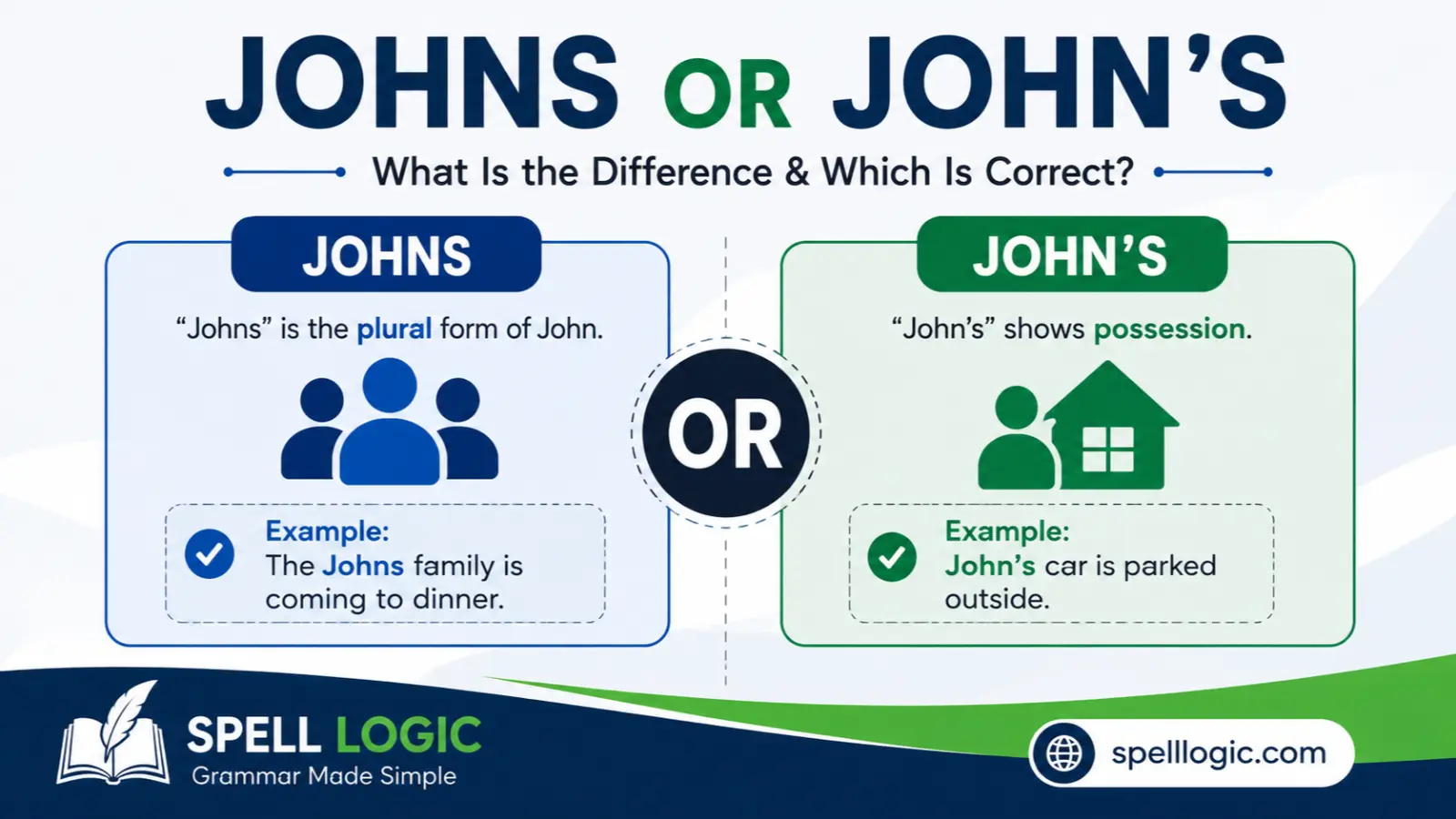
Simple explanation: Johns can be a plural form of the name John, meaning more than one person named John. John’s is normally the possessive form of the singular name John, showing that something belongs to or is connected with John.
One-line distinction: Johns refers to multiple people named John; John’s usually shows possession or association with one John.
Examples:
- There are three Johns in my class.
- John’s notebook is on the desk.
So, when choosing between johns or john’s, ask a simple question: “Am I talking about more than one John, or am I showing something connected to one John?”
Understanding Homophones in English
Words and forms that sound alike can cause spelling problems, especially when punctuation is involved. However, these two forms are better understood as different grammatical forms that may sound very similar rather than as classic homophones.
What Are Homophones?
Homophones are words that have the same pronunciation but different meanings, spellings, or both. For example, to, too, and two can sound alike but have different meanings and grammatical uses.
Why Homophones Cause Confusion
Sound alone cannot always tell you which written form to choose. For example, if someone says “John’s car,” you must use context and grammar to know that the possessive form is intended. Listening carefully is useful, but understanding sentence structure is even more important.
What Does “johns” Mean?
Definition and Core Meaning
Johns can have more than one grammatical use, depending on context. Most importantly for this comparison, it can be the plural form of the proper name John, referring to two or more people who have that name.
For example, if four students named John attend the same school, you can say, “The four Johns joined the meeting.” Here, the s indicates plurality.
The word can also appear in specialized contexts as a plural common noun in some varieties of English. For example, john can be informal slang for a toilet, and johns can refer to more than one such place. In another context, Johns may be part of a proper name, such as a family name or institutional name. Context is therefore important.
Origin and Historical Use
The name John comes through Latin and Greek forms from the Hebrew name Yohanan, commonly interpreted as meaning “Yahweh is gracious.” It became a very common personal name in English and many other languages.
As a plural, Johns follows a normal English pattern for names: when referring to several people with the same first name, writers can add s without an apostrophe.
For learners checking johns or john’s, the key is to separate the name itself from the grammatical function.
Modern Usage and Synonyms
There is no exact synonym for the plural proper name Johns, because it identifies people by name. Depending on context, you might instead say people named John, several people named John, or the men named John.
When comparing johns or john’s, remember that a plural name does not need an apostrophe.
Key points:
- Johns can mean more than one person named John.
- It does not use an apostrophe when it is simply plural.
- The plural form follows ordinary naming conventions.
- Context determines whether the word has a specialized meaning.
Example Sentences
- Two Johns work in our department.
- The teacher asked the three Johns to introduce themselves.
- Several Johns attended the reunion.
- The list contains four students named John, so there are four Johns in total.
What Does “john’s” Mean?
Definition and Core Meaning
John’s is most commonly the possessive form of the singular proper name John. It indicates that something belongs to John, is associated with John, or comes from John.
For example, in “John’s phone is ringing,” the phone is associated with John. In “John’s idea was excellent,” the idea belongs to or originated with John.
In the johns or john’s question, this possessive meaning is the main reason the apostrophe appears.
Origin and Historical Context
The apostrophe in the possessive form comes from the wider history of English possessive spelling. Modern English commonly marks singular possession by adding ‘s to a noun or name. Thus, John becomes John’s when the writer needs to show possession or close association.
This rule is separate from the history of the name itself. The name John has ancient roots, while the apostrophe is a grammatical convention that developed in English writing.
Modern Usage and Synonyms
There is no single synonym for John’s because its exact replacement depends on the sentence. You can often rewrite it using a phrase such as belonging to John, associated with John, or of John.
Key points:
- John’s usually shows singular possession.
- It can also show authorship, origin, relationship, or association.
- The apostrophe comes before the s.
- It should not be used simply to make a name plural.
Example Sentences
- John’s car is parked outside.
- I borrowed John’s dictionary.
- John’s answer was correct.
- We visited John’s office yesterday.
“johns or john’s”: Key Differences at a Glance
| Word | Part of Speech | Meaning | Example Context |
|---|---|---|---|
| Johns | Plural proper noun in the relevant context | More than one person named John | Three Johns joined the group. |
| John’s | Possessive proper noun | Something belonging or relating to one John | John’s jacket is blue. |
The spelling choice in johns or john’s becomes clearer when you focus on whether the name is plural or possessive. The table shows why the apostrophe matters. Johns answers the question “How many people named John?” John’s answers a question such as “Whose?” or “Who is this associated with?”
How to Remember the Difference Between “johns” and “john’s”
When reviewing johns or john’s, a simple memory trick is: apostrophe = possession. When you see ‘s, think “something connected to one person.” For example, John’s book means the book belongs to or is associated with John.
For a plural, leave the apostrophe out. If you mean several people with the same name, write Johns.
Easy memory tricks
- Johns = several Johns.
- John’s = something connected to John.
- Think “John’s = John has” when the sentence allows it.
- If you can ask “Whose?”, the possessive form may be correct.
Association techniques
A helpful way to remember johns or john’s is to imagine two pictures. In the first picture, three people all named John are standing together. Label them Johns. In the second picture, one John is holding a backpack. Label it John’s backpack.
One memorable example
Three Johns entered the room, but only John’s umbrella was left behind.
The first form identifies multiple people. The second shows that one umbrella is associated with one John.
Common Mistakes and Confusions
When learners practice johns or john’s, they often make one of two mistakes: using an apostrophe to create a plural or leaving the apostrophe out when showing possession.
Wrong example 1
✘ There are three John’s in my office.
This is incorrect if the writer simply means three people named John. The apostrophe is unnecessary because the name is plural.
Correct version
✔ There are three Johns in my office.
Wrong example 2
✘ Johns car is outside.
This is incorrect when the writer means that the car belongs to John. The possessive apostrophe is needed.
Correct version
✔ John’s car is outside.
Why these errors happen
English learners sometimes think every final s needs an apostrophe, but that is not true. Plural nouns generally do not use apostrophes. Possessive nouns often do. The best solution is to identify the meaning before choosing the spelling.
Examples Section: Correct and Incorrect Usage
For johns or john’s, the following examples make the contrast practical.
Example 1
✔ Correct: The two Johns are waiting downstairs.
Here, the word refers to two people with the same name, so it is plural.
✘ Incorrect: The two John’s are waiting downstairs.
The apostrophe incorrectly suggests possession.
Example 2
✔ Correct: John’s laptop is on the table.
The laptop belongs to or is associated with John, so the possessive form is required.
✘ Incorrect: Johns laptop is on the table.
Without the apostrophe, the intended possessive relationship is not marked.
Example 3
✔ Correct: We invited several Johns to the event.
The writer means several people who share the first name John.
✘ Incorrect: We invited several John’s to the event.
The apostrophe does not belong in an ordinary plural.
Example 4
✔ Correct: John’s presentation starts at nine.
The presentation is associated with John.
✘ Incorrect: Johns presentation starts at nine.
The possessive marker is missing.
Self Assessment: Test Your Knowledge
To review johns or john’s, fill in each blank with Johns or John’s.
- There are three ______ in our football club.
- ______ new bicycle is very expensive.
- The teacher spoke to two ______ after class.
- I found ______ keys on the kitchen table.
Self Assessment Answers
- Johns — The sentence refers to three people named John.
- John’s — The bicycle belongs to or is associated with John.
- Johns — The sentence refers to two people with the same name.
- John’s — The keys belong to or are associated with John.
For johns or john’s, a useful check is to ask whether the word is plural or possessive. If it means “more than one John,” choose Johns. If it means “belonging to or associated with John,” choose John’s.
FAQs
A common johns or john’s question is whether the plural form is acceptable.
Is Johns a correct word?
Yes. Johns is correct when it is the plural of the proper name John, as in “There are two Johns in the class.” It can also have other meanings in specialized contexts.
Is John’s always possessive?
Usually, John’s is the possessive form of the singular name John. It can also appear in contractions such as “John’s coming,” where John’s means “John is” or, in some contexts, “John has.” Context determines the meaning.
Should I write Johns or John’s for multiple people?
Use Johns when you mean multiple people named John. Do not add an apostrophe merely to make the name plural.
Should I write John’s for one person’s belongings?
Yes. Use John’s to show that something belongs to, comes from, or is associated with one John, such as “John’s phone.”
Can an apostrophe make a name plural?
Normally, no. Modern English uses a simple s for most plural names, so Johns is the standard plural when referring to several people named John.
Is Johns a surname too?
Yes. Johns can also be a surname. In that case, it is simply part of a person’s name and should be treated according to the context in which the surname appears.
How can I quickly choose the correct form?
Ask what you mean. If you mean several people named John, use Johns. If you mean something belonging or relating to one John, use John’s.
Final Conclusion: Using “johns” and “john’s” Correctly
Understanding johns or john’s becomes simple once you focus on the purpose of the final s and the apostrophe. Johns is used when the name is plural and refers to more than one person named John. John’s, on the other hand, is normally the possessive form of the singular name John and shows that something belongs to, comes from, or is connected with John. For example, “Two Johns joined the meeting” identifies multiple people, while “John’s notebook is missing” identifies something associated with one person.
The most useful memory rule is short: no apostrophe for a normal plural; apostrophe before s for singular possession. When you are unsure, ask yourself what the sentence means. Are you talking about several people named John? Choose Johns. Are you answering “Whose?” or describing something connected with one John? Choose John’s.
This small punctuation difference can make your writing much clearer and more accurate. With regular practice, you will recognize the correct form quickly in emails, schoolwork, professional writing, and everyday communication. Keep checking the meaning behind the spelling, and these two forms will soon become easy to use correctly.