Many English learners struggle with possessive forms, especially when a name ends with the letter s. One common question is whether to write Lucas’s or Lucas’. Both forms appear in books, newspapers, and online articles, which makes the choice even more confusing.
The good news is that both can be correct depending on the style guide you follow. Understanding when and why each form is used will help you write more confidently and avoid common grammar mistakes. In this guide, you’ll learn the difference between Lucas’s and Lucas’, their meanings, usage rules, examples, and practical memory tips.
Table of Contents
- Introduction
- Why “Lucas’s” and “Lucas'” Are Confusing
- Lucas’s vs Lucas’ Explained Simply
- Understanding Homophones in English
- What Does “Lucas’s” Mean?
- What Does “Lucas'” Mean?
- Lucas’s vs Lucas’: Key Differences at a Glance
- How to Remember the Difference
- Common Mistakes and Confusions
- Examples Section: Correct and Incorrect Usage
- Self Assessment: Test Your Knowledge
- Self Assessment Answers
- FAQs About “Lucas’s and Lucas'”
- Final Conclusion
Why “Lucas’s” and “Lucas'” Are Confusing
The forms Lucas’s and Lucas’ confuse many English learners because they both show possession, but they follow different style preferences.
Similar Pronunciation
In spoken English, both forms are usually pronounced almost the same. Most speakers say:
- Lucas’s book → LOO-kus-iz book
Because they sound alike, learners often think only one spelling is correct.
Similar Spelling
The only visible difference is the extra s after the apostrophe.
- Lucas’s
- Lucas’
This small change makes it difficult to know which one to choose.
Context Confusion
Different grammar books and style guides recommend different forms.
For example:
- Many schools teach Lucas’s.
- Some newspapers prefer Lucas’.
As a result, learners see both versions in authentic English.
Common Learner Mistakes
People often:
- Think one form is always wrong.
- Forget the apostrophe completely.
- Add an extra apostrophe.
- Mix different style guides in the same document.
Lucas’s vs Lucas’ Explained Simply
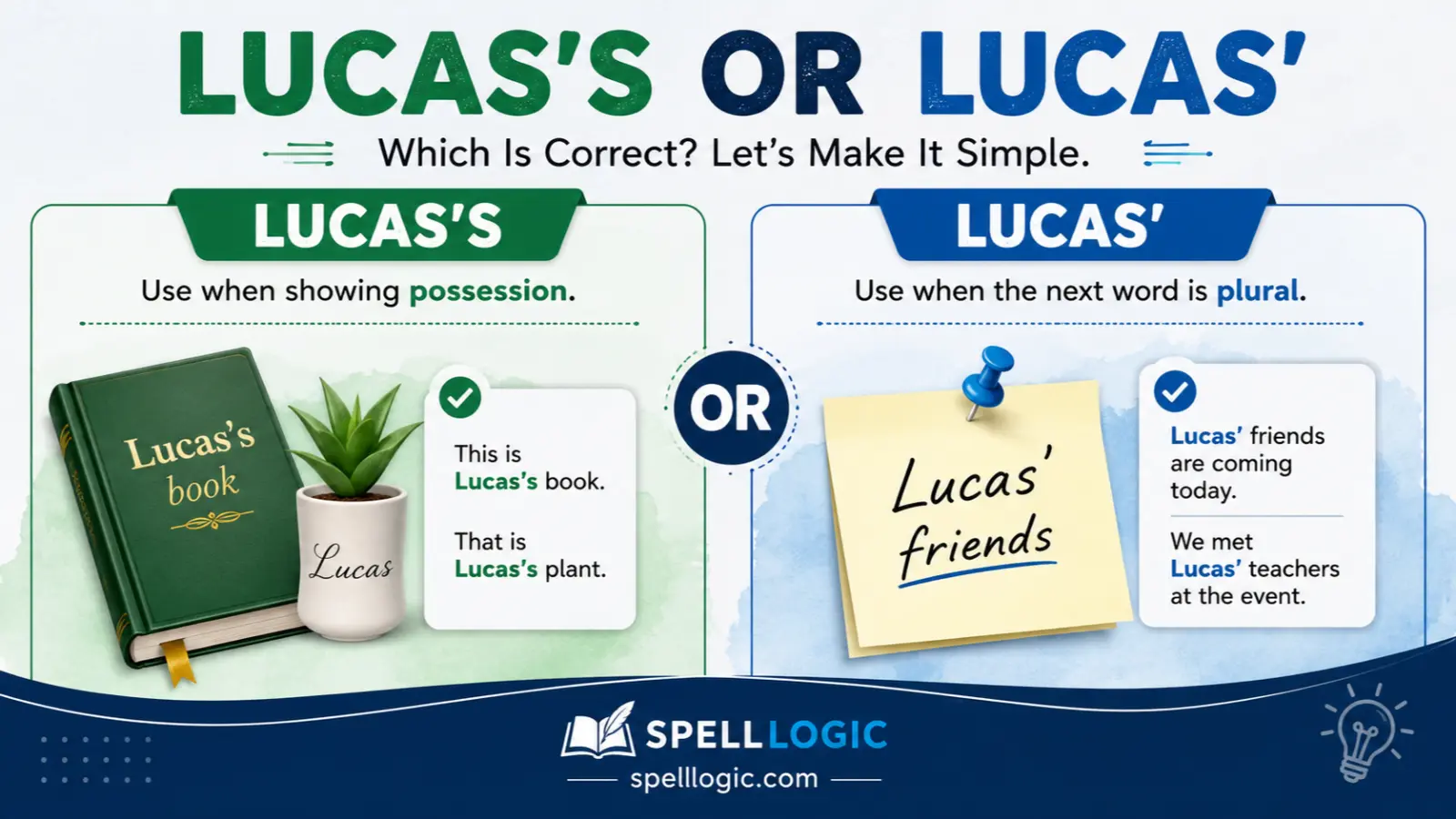
Both Lucas’s and Lucas’ are possessive forms of the proper noun Lucas.
Simple Explanation
Lucas’s follows the traditional grammar rule of adding ‘s to singular nouns, even if they end in s.
Lucas’ is an alternative possessive spelling accepted by some style guides.
One-Line Distinction
Lucas’s is the standard possessive form, while Lucas’ is an accepted alternative in certain writing styles.
Examples
- Lucas’s backpack is on the chair.
- Lucas’s teacher praised him today.
- Lucas’ backpack is on the chair.
- Lucas’ teacher praised him today.
Both sets of sentences are grammatically acceptable when used consistently.
Understanding Homophones in English
Although Lucas’s and Lucas’ are not homophones, learners often confuse them because they sound nearly identical.
What Are Homophones?
Homophones are words that sound the same but have different meanings or spellings.
Example:
- pair
- pear
These words are pronounced the same but have different meanings.
Why Homophones Cause Confusion
English pronunciation does not always match spelling.
For example:
- their
- there
- they’re
These sound alike but are used differently.
Similarly, Lucas’s and Lucas’ sound almost identical even though their spellings differ according to writing style.
What Does “Lucas’s” Mean?
Definition and Core Meaning
Lucas’s is the possessive form of the singular name Lucas.
It means:
Something belongs to Lucas.
Example:
- Lucas’s bicycle
- Lucas’s homework
- Lucas’s phone
Origin and Historical Use
Traditional English grammar has long recommended adding ‘s to singular nouns, even when they end with s.
Examples include:
- James’s
- Charles’s
- Lucas’s
This rule appears in many modern grammar books and major style guides.
Modern Usage and Synonyms
Common uses include:
- ownership
- belonging
- association
- relationship
Examples:
- Lucas’s friend
- Lucas’s opinion
- Lucas’s project
- Lucas’s family
Example Sentences
- Lucas’s computer needs updating.
- I borrowed Lucas’s notebook.
- Everyone admired Lucas’s presentation.
- Lucas’s dog loves playing outside.
What Does “Lucas'” Mean?
Definition and Core Meaning
Lucas’ also shows possession.
Its meaning is exactly the same as Lucas’s.
The difference is only the preferred writing style.
Origin and Historical Context
Some publishers and newspaper style guides simplify possessive forms by using only an apostrophe after names ending in s.
Examples include:
- Lucas’
- James’
- Charles’
Although less common in everyday writing, this form remains acceptable in several editorial styles.
Modern Usage and Synonyms
Like Lucas’s, it expresses:
- ownership
- possession
- belonging
- association
Example Sentences
- Lucas’ jacket is hanging by the door.
- Lucas’ report impressed the manager.
- Lucas’ artwork won first prize.
- Lucas’ bicycle was repaired yesterday.
Lucas’s vs Lucas’: Key Differences at a Glance
| Word | Part of Speech | Meaning | Example Context |
|---|---|---|---|
| Lucas’s | Possessive proper noun | Something belongs to Lucas | Lucas’s car is new. |
| Lucas’ | Possessive proper noun | Something belongs to Lucas | Lucas’ car is new. |
Key takeaway: The meaning is identical. The spelling depends on the style guide you follow.
How to Remember the Difference Between Lucas’s and Lucas’
Easy Memory Tricks
Remember this simple rule:
Singular name = usually add ‘s
That gives you:
Lucas → Lucas’s
This is the safest choice for school, business, and everyday writing.
Association Technique
Think:
Lucas owns something.
Add ‘s to show ownership.
Lucas → Lucas’s laptop
If you’re writing for a publication with its own style guide, follow its preference.
Memorable Example
Imagine Lucas holding a soccer ball.
Ask yourself:
Whose ball is it?
Answer:
Lucas’s ball.
This mental picture makes the standard rule easy to remember.
Common Mistakes and Confusions
Wrong
❌ Lucas book is missing.
✅ Lucas’s book is missing.
Explanation: Possession requires an apostrophe.
Wrong
❌ Lucas’s’ backpack
✅ Lucas’s backpack
Explanation: Never use two apostrophes.
Wrong
❌ Lucas books are on the desk.
✅ Lucas’s books are on the desk.
Explanation: Without the apostrophe, the sentence does not show ownership.
Wrong
❌ Lucas’s report and later Lucas’ report in the same article.
✅ Choose one style and stay consistent.
Explanation: Consistency is important in formal writing.
Examples Section: Correct and Incorrect Usage
Example 1
✔ Correct: Lucas’s bicycle needs new tires.
✘ Incorrect: Lucas bicycle needs new tires.
Example 2
✔ Correct: Lucas’ office is on the second floor.
✘ Incorrect: Lucas” office is on the second floor.
Example 3
✔ Correct: I enjoyed Lucas’s presentation.
✘ Incorrect: I enjoyed Lucas presentation.
Example 4
✔ Correct: Lucas’ painting sold quickly.
✘ Incorrect: Lucas’s’ painting sold quickly.
Example 5
✔ Correct: Lucas’s phone rang during class.
✘ Incorrect: Lucas phone rang during class.
Self Assessment: Test Your Knowledge
Fill in the blanks.
1.
I borrowed ______ notebook yesterday.
A. Lucas’s
B. Lucas
2.
The teacher praised ______ essay.
A. Lucas’
B. Lucas
3.
Which form is the standard possessive in most grammar books?
A. Lucas’s
B. Lucas
4.
Both Lucas’s and Lucas’ have the same ______.
A. meaning
B. pronunciation only
Self Assessment Answers
- Lucas’s
- Lucas’ (accepted in some style guides)
- Lucas’s
- meaning
FAQs
1. Is Lucas’s grammatically correct?
Yes. It is the standard possessive form recommended by most grammar guides.
2. Is Lucas’ also correct?
Yes. Some style guides accept it as an alternative possessive spelling.
3. Which form should students use?
Students should usually use Lucas’s unless their teacher or institution requires another style.
4. Do both forms mean the same thing?
Yes. They both indicate that something belongs to Lucas.
5. Why do newspapers sometimes write Lucas’?
Some editorial style guides prefer shorter possessive forms for names ending in s.
6. Can I use both spellings in one article?
It is better not to. Choose one style and use it consistently.
7. Which form is better for everyday English?
For most learners, Lucas’s is the safest and most widely accepted choice.
Final Conclusion: Using “Lucas’s” and “Lucas'” Correctly
Choosing between Lucas’s and Lucas’ may seem difficult at first, but the difference is simpler than many learners expect. Both forms express exactly the same idea: they show that something belongs to a person named Lucas. The main difference lies in writing style rather than meaning. Most grammar books, educational materials, and style guides recommend Lucas’s because it follows the general rule of adding ‘s to singular nouns, even when they already end in s. On the other hand, Lucas’ is accepted by some newspapers, publishers, and organizations that follow different editorial conventions.
When writing for school, exams, business communication, or everyday English, Lucas’s is usually the safest and clearest choice. If you are writing for a publication or employer with a specific style guide, simply follow that guide consistently throughout your document. A helpful memory trick is to think, “One person named Lucas owns something, so add ‘s.” This simple rule will work in most situations and help you avoid common punctuation mistakes. As you continue learning English, remember that understanding grammar rules—and the style choices behind them—will make your writing more accurate, natural, and professional. With regular practice and careful proofreading, using Lucas’s and Lucas’ correctly will soon become second nature.