Many English learners become confused when writing ordinal numbers, especially numbers like 21st, 22nd, 23rd, and 24th. One of the most common mistakes is writing 21th instead of 21st because people assume every number ending with “1” should follow the same pattern as “20th” or “30th.” However, English ordinal numbers have specific spelling rules.
Understanding the difference between 21th and 21st will help you write dates, rankings, birthdays, anniversaries, and lists correctly. In this guide, you’ll learn which form is correct, why the mistake happens, and how to remember the right spelling with simple explanations and practical examples.
Why “21th” and “21st” Are Confusing
Many learners accidentally write 21th because English ordinal numbers do not always follow one simple pattern.
Here are the main reasons for the confusion.
Similar Pronunciation
When spoken quickly, 21st may sound similar to what some learners imagine as 21th, especially if English is not their first language.
Similar Spelling
Both words begin with 21, but the endings -st and -th are different. Many people incorrectly assume all ordinal numbers use -th.
Context Confusion
Ordinal numbers are used in:
- Dates
- Birthdays
- Rankings
- Floors
- Anniversaries
- Chapters
Because many numbers end in -th, learners often overuse this ending.
Common Learner Mistakes
- Writing 21th birthday instead of 21st birthday
- Writing 21th century instead of 21st century
- Assuming every ordinal number ends in th
- Forgetting the special endings st, nd, and rd
21th vs 21st Explained Simply
The difference is very simple.
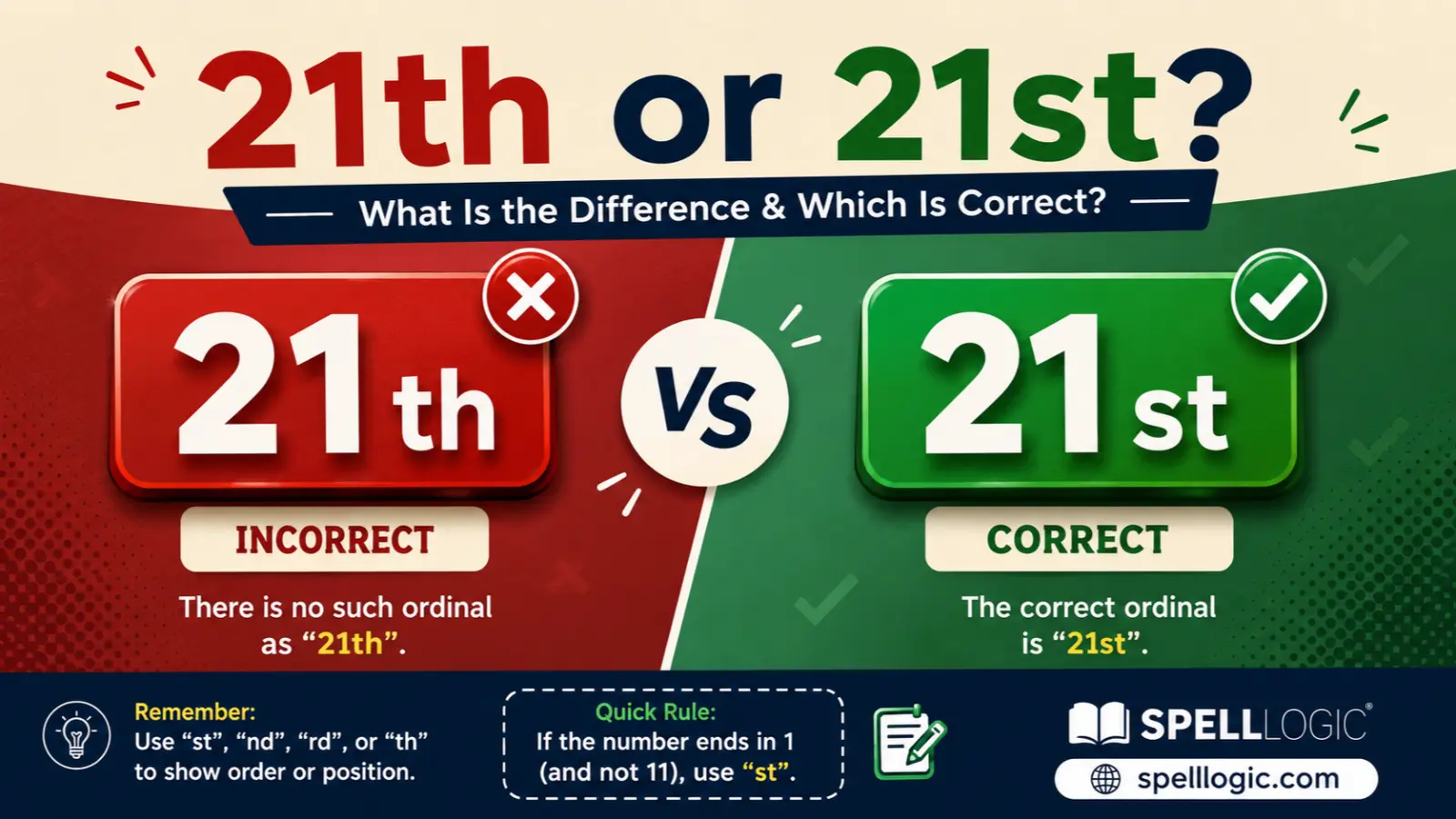
- 21th is incorrect in standard English.
- 21st is the correct ordinal form of the number 21.
One-Line Distinction
21th is a spelling mistake, while 21st is the correct way to write the ordinal number twenty-first.
Example Sentences
- She celebrated her 21st birthday yesterday.
- The meeting will take place on the 21st of August.
Simple explanation:
21th has no accepted meaning in standard English, while 21st means twenty-first, referring to position, order, or sequence.
Understanding Homophones in English
Although 21th and 21st are not homophones, learners often confuse them because they represent similar-looking ordinal numbers.
What Are Homophones?
Homophones are words that sound the same but have different meanings and spellings.
Example:
- Sea
- See
These two words sound identical but have different meanings.
Why Homophones Cause Confusion
People often spell words based on how they hear them rather than the spelling rules.
Example:
Someone might confuse:
- there
- their
- they’re
Similarly, learners may incorrectly write 21th because they overgeneralize the -th ending instead of following ordinal number rules.
What Does “21th” Mean?
Definition and Core Meaning
21th is not a correct English word.
It has no official definition in dictionaries.
It is simply a spelling mistake.
Origin and Historical Use
The incorrect form appears because learners apply the -th suffix to every number.
English grammar, however, uses special endings for numbers ending in:
- 1 → st
- 2 → nd
- 3 → rd
Exceptions include:
- 11th
- 12th
- 13th
Modern Usage and Synonyms
There are no synonyms because 21th is incorrect.
Instead, always use:
- 21st
- Twenty-first
Example Sentences
Incorrect:
- I finished in 21th place.
- Today is my 21th birthday.
Correct:
- I finished in 21st place.
- Today is my 21st birthday.
What Does “21st” Mean?
Definition and Core Meaning
21st is the correct ordinal number for twenty-one.
It shows:
- Position
- Rank
- Sequence
- Order
Origin and Historical Context
English ordinal numbers developed from Old English.
The suffix -st is traditionally used for numbers ending in 1, except for 11th.
Examples include:
- 1st
- 21st
- 31st
- 41st
Modern Usage and Synonyms
Common written forms include:
- 21st
- Twenty-first
These are used in:
- Dates
- Birthdays
- Competitions
- Floors
- Chapters
- Centuries
Example Sentences
- She lives on the 21st floor.
- Today is the 21st of September.
- The 21st century has brought major technological advances.
- He finished in 21st place.
21th vs 21st: Key Differences at a Glance
| Word | Part of Speech | Meaning | Example Context |
|---|---|---|---|
| 21th | Incorrect form | No accepted meaning | ✘ My 21th birthday |
| 21st | Ordinal number | Twenty-first; indicates position or order | ✔ My 21st birthday |
How to Remember the Difference Between 21th and 21st
Here are some easy memory tricks.
Easy Memory Tricks
- Numbers ending in 1 usually use st.
- Read 21st aloud as twenty-first.
- Never write 21th.
Association Techniques
Remember this pattern:
- 1 → st
- 21 → st
- 31 → st
- 41 → st
Only these exceptions use th:
- 11th
- 12th
- 13th
One Memorable Example
Think:
My 21st birthday.
Nearly everyone writes this phrase correctly, making it an easy reminder that 21st is the correct spelling.
Common Mistakes and Confusions
Wrong
❌ Today is my 21th birthday.
Correct
✅ Today is my 21st birthday.
Explanation:
Numbers ending in 1 (except 11) take st.
Wrong
❌ The 21th century is full of innovation.
Correct
✅ The 21st century is full of innovation.
Explanation:
21st century is the correct expression.
Wrong
❌ She came 21th in the race.
Correct
✅ She came 21st in the race.
Explanation:
Ordinal rankings use the correct suffix.
Wrong
❌ The event is on 21th June.
Correct
✅ The event is on 21st June.
Explanation:
Dates also use the correct ordinal ending.
Examples Section: Correct and Incorrect Usage
Example 1
✔ Correct:
The meeting is scheduled for the 21st of May.
✘ Incorrect:
The meeting is scheduled for the 21th of May.
Example 2
✔ Correct:
She celebrated her 21st birthday with friends.
✘ Incorrect:
She celebrated her 21th birthday with friends.
Example 3
✔ Correct:
He finished 21st in the competition.
✘ Incorrect:
He finished 21th in the competition.
Example 4
✔ Correct:
The 21st century has changed communication dramatically.
✘ Incorrect:
The 21th century has changed communication dramatically.
Self Assessment: Test Your Knowledge
Fill in the blanks.
- Today is my ______ birthday.
- The meeting is on the ______ of July.
- We live in the ______ century.
- She finished ______ in the marathon.
Self Assessment Answers
- 21st
- 21st
- 21st
- 21st
FAQs
Is 21th correct in English?
No. 21th is incorrect. The correct spelling is 21st.
Why is 21st correct instead of 21th?
Because numbers ending in 1 normally take the -st suffix, except for 11th.
How do you write twenty-first?
You can write it as:
- 21st
- Twenty-first
Both are correct.
Is 21st used in dates?
Yes.
Example:
- 21st January
- January 21st
Is 21st used for birthdays?
Yes.
Example:
- Her 21st birthday was unforgettable.
What is the rule for ordinal numbers ending in 1?
Use -st for numbers ending in 1, except 11th.
Examples:
- 1st
- 21st
- 31st
- 41st
What are the correct ordinal suffixes?
The main suffixes are:
- st
- nd
- rd
- th
Their use depends on the last digit, with special exceptions for 11th, 12th, and 13th.
Final Conclusion: Using “21th” and “21st” Correctly
Understanding the difference between 21th and 21st is easier once you know the basic rules for English ordinal numbers. The key point to remember is that 21th is not a correct English form, while 21st is the proper way to write twenty-first. Whether you are talking about a birthday, a date, a competition ranking, a floor in a building, or the 21st century, you should always use 21st. This small spelling difference can make your writing look much more accurate and professional.
A helpful memory trick is to remember that most numbers ending in 1 use the -st suffix, such as 1st, 21st, 31st, and 41st. The only common exceptions are 11th, 12th, and 13th, which all take -th. Keeping this simple pattern in mind will help you avoid one of the most common mistakes made by English learners.
As you continue improving your English, pay attention to ordinal numbers whenever you write dates, birthdays, rankings, or lists. Practicing these forms regularly will make them feel natural over time. The more you read and write correct examples like 21st birthday, 21st century, and 21st place, the easier it becomes to remember the correct form. Every small improvement strengthens your English skills, so keep practicing and enjoy the learning process.