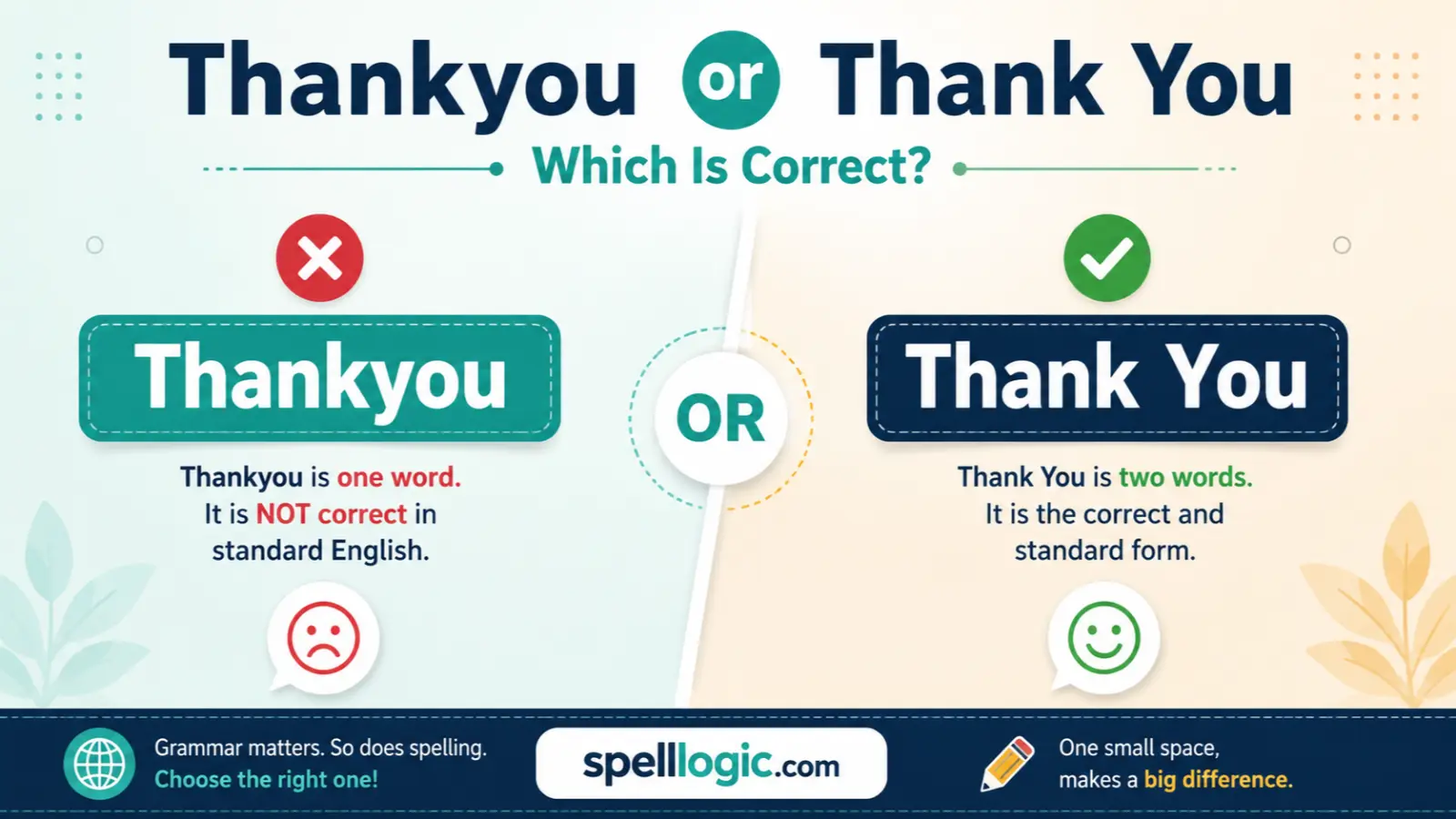
Many English learners wonder whether they should write thankyou or thank you. Since both forms look almost the same and sound identical when spoken, it’s easy to assume they are interchangeable. However, standard English follows a clear rule. Knowing the correct spelling helps you write more naturally in emails, messages, letters, school assignments, and professional communication.
In this guide, you’ll learn the difference between thankyou and thank you, discover when each form is appropriate, explore their history and usage, and practice with examples so you can use the correct expression with confidence every time.
Why “Thankyou” and “Thank You” Are Confusing
Many people accidentally write thankyou because it sounds exactly like thank you in conversation. Fast typing, texting, and informal writing also contribute to the confusion.
Here are the main reasons learners mix them up:
Similar Pronunciation
- Both are pronounced the same.
- There is no difference in spoken English.
Similar Spelling
- The only visible difference is the space between the words.
- This small change makes many people think both spellings are acceptable.
Context Confusion
- Social media, text messages, and handmade signs sometimes use thankyou as a decorative style.
- In standard English writing, thank you is the accepted form.
Common Learner Mistakes
- Writing thankyou in emails.
- Using thankyou in academic assignments.
- Assuming one-word spellings are always correct because other expressions like goodbye became one word over time.
Thankyou vs Thank You Explained Simply
The difference is straightforward.
- Thank you is the correct spelling in standard English.
- Thankyou is generally considered a misspelling, although it occasionally appears as a brand name, artistic design, or informal styling.
One-Line Distinction
Thankyou is usually an incorrect spelling, while thank you is the correct English expression used to show gratitude.
Simple Explanation
Thankyou means an incorrectly combined spelling of the expression in standard English, while thank you means an expression of gratitude or appreciation.
Example Sentences
- Thank you for helping me finish the project.
- Thank you very much for your kindness.
Understanding Homophones in English
What Are Homophones?
Homophones are words that sound the same but have different spellings or meanings.
Example:
- Flower – a blooming plant.
- Flour – powder used for baking.
Although thankyou and thank you sound identical, they are not true homophones because one is simply the standard spelling and the other is generally regarded as an incorrect spelling rather than a separate word.
Why Homophones Cause Confusion
English contains many words that sound alike. Learners often rely on pronunciation instead of spelling, which leads to writing mistakes.
Example:
- They’re coming tomorrow.
- Their house is beautiful.
Since thankyou and thank you are pronounced the same, writers often omit the space without realizing it.
What Does “Thankyou” Mean?
Definition and Core Meaning
In standard English dictionaries, thankyou is not accepted as the correct spelling of the expression used to express gratitude.
However, you may occasionally see it:
- As part of a company or brand name.
- In graphic designs.
- On greeting cards.
- In hashtags or social media posts.
Origin and Historical Use
The phrase thank you has existed in English for centuries.
Unlike words such as goodbye, it has not officially become one word in modern standard English.
Modern Usage and Synonyms
Although thankyou appears online, professional writers avoid it.
Related expressions include:
- Thanks
- Many thanks
- Thanks a lot
- Much appreciated
- I appreciate it
Example Sentences
- ❌ Thankyou for your email.
- ❌ Thankyou very much.
These examples are considered incorrect in formal English.
What Does “Thank You” Mean?
Definition and Core Meaning
Thank you is a polite expression used to show gratitude, appreciation, or acknowledgment.
It is one of the most common expressions in English.
Origin and Historical Context
The phrase comes from the verb thank, which has been part of English for hundreds of years.
Over time, thank you became the standard polite response used around the world.
Modern Usage and Synonyms
Today, thank you appears in:
- Emails
- Business communication
- Academic writing
- Casual conversations
- Customer service
- Speeches
- Cards and letters
Common synonyms include:
- Thanks
- Many thanks
- Much appreciated
- I appreciate it
- Thanks so much
Example Sentences
- Thank you for your support.
- Thank you for attending today’s meeting.
- Thank you for your patience.
- Thank you very much.
Thankyou vs Thank You: Key Differences at a Glance
| Word | Part of Speech | Meaning | Example Context |
|---|---|---|---|
| Thankyou | Not considered standard English | Usually an incorrect spelling of “thank you” | ❌ Thankyou for your help. |
| Thank You | Interjection / expression of gratitude | A polite way to express appreciation | ✔ Thank you for your help. |
How to Remember the Difference Between Thankyou and Thank You
Learning this difference is easy once you know one simple rule.
Easy Memory Tricks
- Think of thank as the action.
- Think of you as the person receiving your gratitude.
- Since they are separate words, keep a space between them.
Association Technique
Imagine saying:
“I thank you.”
If you can separate the two words while speaking, write them separately.
Memorable Example
I thank you for your kindness.
Because thank and you are separate words in the sentence, the expression should also be written as thank you.
Common Mistakes and Confusions
Here are mistakes learners often make.
Wrong
❌ Thankyou for coming.
Correct
✔ Thank you for coming.
Explanation: The expression is written as two separate words.
Wrong
❌ Thankyou so much.
Correct
✔ Thank you so much.
Explanation: Standard English requires a space.
Wrong
❌ Please accept my thankyou.
Correct
✔ Please accept my thanks.
Explanation: The noun is thanks, not thankyou.
Wrong
❌ Thankyou everyone!
Correct
✔ Thank you, everyone!
Explanation: Use the correct spelling and punctuation.
Examples Section: Correct and Incorrect Usage
Example 1
✔ Correct: Thank you for your valuable advice.
✘ Incorrect: Thankyou for your valuable advice.
Example 2
✔ Correct: Thank you very much.
✘ Incorrect: Thankyou very much.
Example 3
✔ Correct: Thank you for your quick response.
✘ Incorrect: Thankyou for your quick response.
Example 4
✔ Correct: Thank you for visiting our website.
✘ Incorrect: Thankyou for visiting our website.
Example 5
✔ Correct: Thank you, everyone, for your support.
✘ Incorrect: Thankyou everyone for your support.
Example 6
✔ Correct: She smiled and said, “Thank you.”
✘ Incorrect: She smiled and said, “Thankyou.”
Self Assessment: Test Your Knowledge
Fill in the blanks with thankyou or thank you.
- ________ for helping me yesterday.
- She said, “________ very much.”
- The correct spelling in formal writing is ________.
- We sent an email saying, “________ for your cooperation.”
Self Assessment Answers
- Thank you
- Thank you
- Thank you
- Thank you
FAQs
Is “thankyou” one word?
No. In standard English, thank you is written as two separate words.
Which spelling is grammatically correct?
Thank you is the correct spelling for formal and informal writing.
Why do I sometimes see “thankyou” online?
It is often used as a design choice, hashtag, brand name, or informal styling, but it is not considered standard English.
Can I use “thankyou” in business emails?
No. Always use thank you in professional communication.
Is “thanks” the same as “thank you”?
Yes. Both express gratitude, but thanks is generally more informal.
Is “thank you” formal or informal?
It works in both formal and informal situations, making it one of the most versatile expressions in English.
How can I remember the correct spelling?
Think of the sentence “I thank you.” Since the words are separate there, they remain separate in the expression thank you.
Final Conclusion: Using “Thankyou” and “Thank You” Correctly
Understanding the difference between thankyou and thank you is easier than it first appears. Although both forms sound exactly the same, only thank you is accepted as the standard spelling in modern English. It is the polite expression you should use in emails, conversations, academic writing, business communication, letters, and everyday messages. On the other hand, thankyou is generally viewed as a misspelling, even though you may occasionally encounter it in logos, artwork, greeting cards, social media hashtags, or brand names. When in doubt, choose thank you to ensure your writing is clear, professional, and grammatically correct.
A simple way to remember the rule is to think of the sentence “I thank you.” Because thank and you are separate words, they should stay separate whenever you use the expression. Practicing with real-life examples, checking your writing before sending it, and reading well-edited English content will help make the correct spelling feel natural. Over time, this small detail will become a habit, improving both your written and spoken confidence. Every correctly written thank you demonstrates good language skills and respectful communication. Keep learning, keep practicing, and remember that mastering small differences like this is an important step toward becoming a more fluent and confident English user.