Many English learners wonder whether they should write eventhough or even though. Since both forms look and sound almost the same, it’s easy to think they are interchangeable. However, only one of them is considered correct in standard English.
Knowing the difference is important because using the wrong form can make your writing look unprofessional or lead to grammar mistakes. In this guide, you’ll learn the correct spelling, meaning, usage, and memory tricks for eventhough and even though. By the end, you’ll know exactly which form to use and why.
Table of Contents
- Introduction
- Why “Eventhough” and “Even Though” Are Confusing
- Eventhough vs Even Though Explained Simply
- Understanding Homophones in English
- What Does “Eventhough” Mean?
- What Does “Even Though” Mean?
- Eventhough vs Even Though: Key Differences at a Glance
- How to Remember the Difference Between Eventhough and Even Though
- Common Mistakes and Confusions
- Examples Section: Correct and Incorrect Usage
- Self Assessment: Test Your Knowledge
- Self Assessment Answers
- FAQs About “Eventhough” and “Even Though”
- Final Conclusion: Using “Eventhough” and “Even Though” Correctly
Why “Eventhough” and “Even Though” Are Confusing
Many learners accidentally write eventhough as one word because they often hear even though spoken quickly in conversation.
Here are the main reasons for the confusion:
Similar Pronunciation
When native speakers say even though, the words blend together. This makes it sound like a single word.
Similar Spelling
The only visible difference is the space between even and though. Many people overlook this small detail.
Context Confusion
Both forms appear to express contrast, so learners assume both spellings are acceptable.
Common Learner Mistakes
- Writing eventhough in essays and emails.
- Assuming spell check will always correct the mistake.
- Treating even though as one compound word.
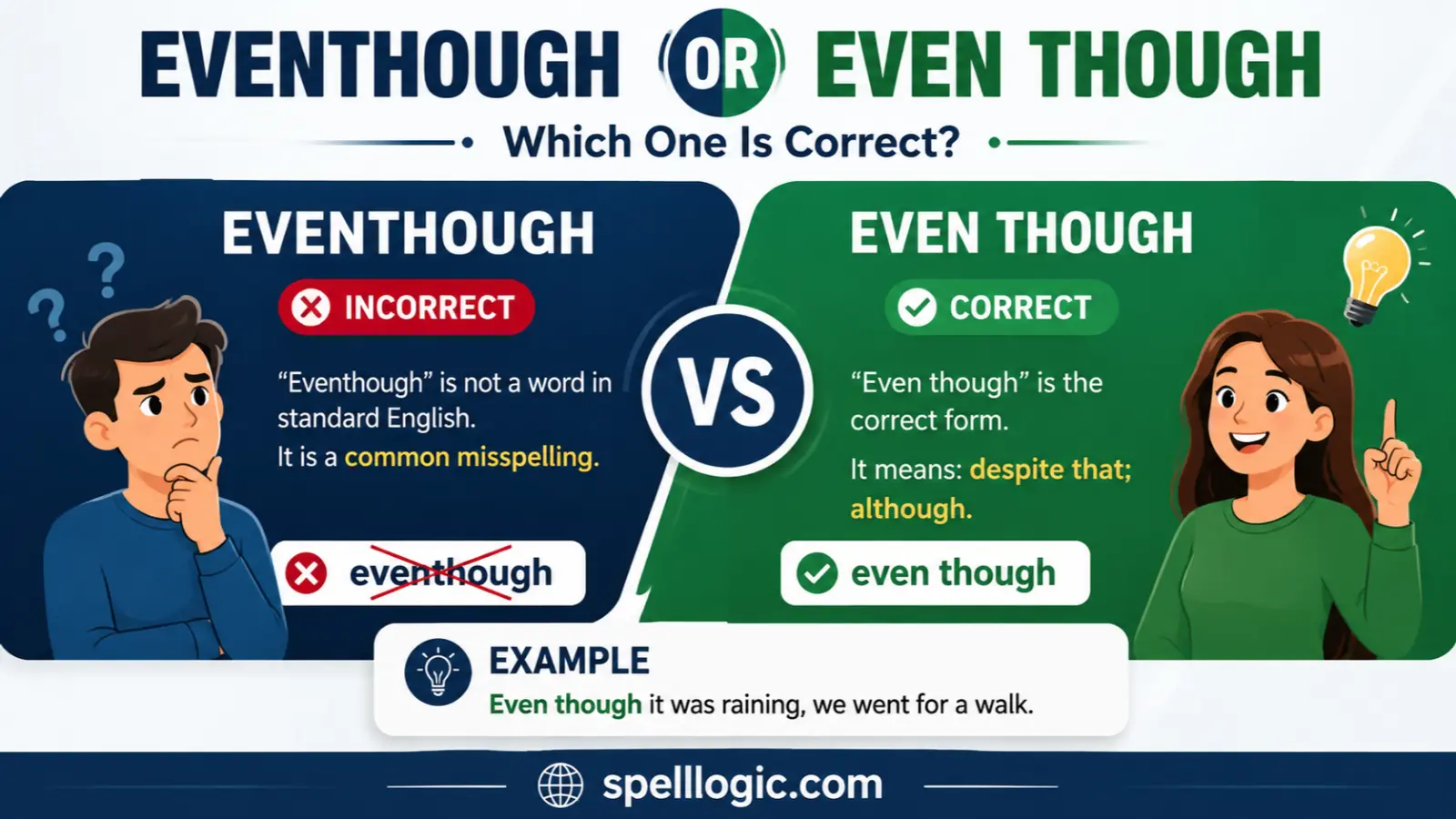
Remember: In modern standard English, eventhough is considered a spelling mistake. The correct form is even though.
Eventhough vs Even Though Explained Simply
The difference is actually very simple.
- Eventhough is not a correct English word.
- Even though is a correct conjunction used to introduce contrast.
One-Line Distinction
Eventhough is an incorrect spelling, while even though is the correct expression used to show contrast between two ideas.
Example Sentences
- Eventhough is incorrect and should not be used in formal or informal writing.
- Even though it was raining, we went for a walk.
Another example:
- Even though she was tired, she finished her homework.
- Even though the road was busy, they arrived safely.
Understanding Homophones in English
What Are Homophones?
Homophones are words that sound the same but have different meanings or spellings.
For example:
- Sea and see
- Right and write
Although eventhough and even though are not true homophones, they create similar confusion because they sound almost identical when spoken.
Why Homophones Cause Confusion
English contains many words and phrases with similar pronunciation.
For example:
- “They’re going home.”
- “Their house is nearby.”
Because these words sound alike, learners sometimes choose the wrong spelling.
Likewise, many people mistakenly combine even though into one word.
What Does “Eventhough” Mean?
Definition and Core Meaning
Strictly speaking, eventhough has no accepted meaning in standard English because it is not recognized as a correct word.
It is simply a misspelling of even though.
Origin and Historical Use
There is no historical record of eventhough being accepted in formal English.
Instead, it developed as a common typing or spelling error because people naturally join frequently used phrases together.
Modern Usage and Synonyms
Since eventhough is incorrect, it has no official synonyms.
Whenever you see it, replace it with:
- even though
- although
- though
- despite the fact that
Example Sentences
❌ Eventhough I was late, I caught the train.
✔ Even though I was late, I caught the train.
What Does “Even Though” Mean?
Definition and Core Meaning
Even though is a subordinating conjunction that introduces a surprising contrast between two ideas.
It means:
- despite the fact that
- although
- although it is true that
It connects two clauses where one fact does not prevent another from happening.
Origin and Historical Context
The phrase combines:
- even, meaning “to emphasize,”
- though, meaning “although.”
Together, they strengthen the contrast more than though alone.
Writers have used even though for centuries in both spoken and written English.
Modern Usage and Synonyms
Common synonyms include:
- although
- though
- despite the fact that
- notwithstanding (formal)
Example Sentences
- Even though it was cold, they played outside.
- Even though she apologized, he remained upset.
- Even though the exam was difficult, everyone tried their best.
- Even though the shop was closed, people kept arriving.
Eventhough vs Even Though: Key Differences at a Glance
| Word | Part of Speech | Meaning | Example Context |
|---|---|---|---|
| Eventhough | Not a valid English word | Incorrect spelling | ❌ Eventhough it rained… |
| Even though | Subordinating conjunction | Despite the fact that | ✔ Even though it rained, we continued. |
How to Remember the Difference Between Eventhough and Even Though
Here are some simple tricks.
Easy Memory Tricks
- Remember that even and though are always two separate words.
- If you can replace it with although, you need even though.
Association Techniques
Think of the phrase as two friends walking together:
Even + Though
They stay together but never merge into one word.
One Memorable Example
Imagine a sign saying:
Even though it’s raining, the park is open.
You would never write:
Eventhough it’s raining…
The missing space is your clue.
Common Mistakes and Confusions
Wrong Example
❌ Eventhough she studied hard, she failed.
Correct Version
✔ Even though she studied hard, she failed.
Explanation
The conjunction must always be written as two separate words.
Wrong Example
❌ Eventhough I like coffee, I prefer tea.
Correct Version
✔ Even though I like coffee, I prefer tea.
Explanation
Never combine even and though into a single word.
Wrong Example
❌ Eventhough they were busy, they helped us.
Correct Version
✔ Even though they were busy, they helped us.
Explanation
The space between the two words is essential.
Examples Section: Correct and Incorrect Usage
Example 1
✔ Correct: Even though it was snowing, the match continued.
✘ Incorrect: Eventhough it was snowing, the match continued.
Example 2
✔ Correct: Even though she disagreed, she respected his opinion.
✘ Incorrect: Eventhough she disagreed, she respected his opinion.
Example 3
✔ Correct: Even though the book was long, it was interesting.
✘ Incorrect: Eventhough the book was long, it was interesting.
Example 4
✔ Correct: Even though he missed the bus, he arrived on time.
✘ Incorrect: Eventhough he missed the bus, he arrived on time.
Self Assessment: Test Your Knowledge
Fill in the blanks with eventhough or even though.
- ________ it was late, they continued working.
- ________ is not accepted in standard English.
- We enjoyed the picnic ________ it started to rain.
- ________ she felt nervous, she gave an excellent speech.
Self Assessment Answers
- Even though
- Eventhough
- Even though
- Even though
FAQs
Is “eventhough” one word?
No. Eventhough is not a correct English word.
Which spelling is correct?
Even though is always the correct spelling.
Can I use “eventhough” in formal writing?
No. It should never be used in academic, professional, or formal writing.
Is “even though” the same as “although”?
Almost. Both express contrast, but even though often adds stronger emphasis.
Why do people write “eventhough”?
Because even though is often pronounced quickly in speech, making it sound like one word.
Is “even though” a conjunction?
Yes. It is a subordinating conjunction that connects two clauses showing contrast.
What can I use instead of “even though”?
You can often use:
- although
- though
- despite the fact that
Final Conclusion: Using “Eventhough” and “Even Though” Correctly
Understanding the difference between eventhough and even though is easier than it first appears. The key point to remember is that eventhough is not a correct English word, while even though is the standard and widely accepted conjunction used to introduce a contrast between two ideas. Whether you’re writing an essay, sending an email, creating business documents, or having everyday conversations, using even though correctly will make your English look more polished and professional.
A simple memory trick is to think of even and though as two separate words that always work together but never combine into one. If you can replace the phrase with although, then even though is almost certainly the correct choice. Reading English books, articles, and news stories can also help reinforce the correct spelling through repeated exposure.
As you continue improving your English, pay attention to common spelling errors like this one. Small details such as spacing can make a big difference in clear communication. Practice writing your own sentences with even though, review the examples in this guide, and test yourself regularly. With consistent practice, choosing the correct form will soon become second nature, helping you write and speak English with greater confidence and accuracy.